
A custom sheet metal chassis manufacturer produces metal structures that support, position, and protect internal components inside equipment, enclosures, and cabinets. A sheet metal chassis is far more than a simple metal box. It functions as the structural base of a machine, the internal support frame of an electronic device, the mounting platform for electrical hardware, or the foundation of an industrial assembly.
If you require small, custom-formed metal boxes for individual modules, see our profile as a fabricated metal box manufacturer for electronics.
When looking for the bottom foundation plates of large machine frames, read about our capabilities as a custom sheet metal base plate manufacturer.
To build the external body and cosmetic panels around your support chassis, refer to our page as a metal equipment housing manufacturer.
To seal maintenance ports and cable access areas, check out our options as a sheet metal cover plate fabrication supplier.
To seal and protect electronic sub-assemblies, check out our work as a specialized custom sheet metal panel manufacturer.
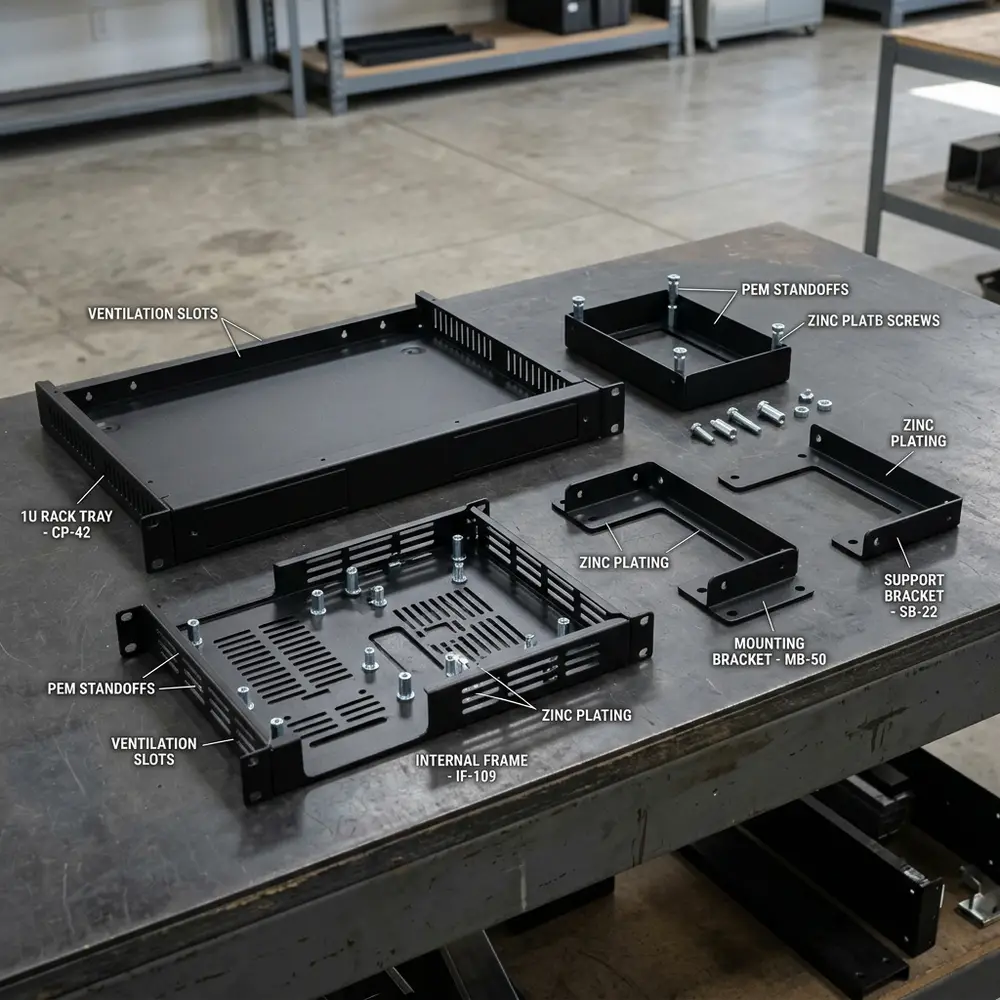
If the chassis is inaccurate, your final product will not assemble correctly. If the installer has to reach for a drill, a grinder, or emotional support to make things fit, the part was not manufactured correctly. A chassis with incorrect hole sizes or alignment is not a chassis—it is just an expensive drilling template.
MSTFAB manufactures custom sheet metal chassis according to customer STEP/STP files, PDF drawings, and DXF/DWG files. We support custom chassis bases, equipment chassis frames, rack-mounted enclosures, control unit trays, and welded sub-structures.
To hold components inside your assemblies securely, we also operate as an experienced metal mounting bracket fabrication manufacturer.
Chassis vs. Enclosures: The Manufacturing Difference
While a sheet metal enclosure primarily protects external components, a chassis acts as the internal carrier that defines where every board, power supply, and cable is mounted. A cover only needs to fit over the outside, but a chassis dictates whether assembly is possible in the first place. That is why chassis fabrication requires more attention to flatness, hole tolerances, grounding points, and structural rigidity.
Material Selection for Sheet Metal Chassis
The choice of material affects weight, rigidity, rust protection, electrical grounding, and overall production cost. Different environments demand different material selections:
| Material Grade | Common Applications | Benefits | Trade-offs |
|---|---|---|---|
| Cold Rolled Steel (SPCC/DC01) | Indoor control cabinets, rack servers, consumer electronics, internal support frames. | Excellent strength, flat sheet profile, easy to weld, low base material cost. | Prone to rust; must be powder coated or plated to protect the surface. |
| Galvanized Steel (SGCC/SECC) | Power distribution frames, internal brackets, telecom trays, HVAC equipment bases. | Built-in zinc-coated corrosion resistance. Cut edges remain protected. | Not ideal for cosmetic outer surfaces; zinc coating makes welding more difficult. |
| Stainless Steel (SS304/SS316) | Medical equipment frames, food machinery, chemical cabinets, coastal telecom enclosures. | Outstanding rust resistance, clean appearance, no painting required. | Higher material cost; heavier weight; requires specialized tooling. |
| Aluminum (5052/6061) | Aerospace brackets, automotive electronics, battery chassis, handheld devices. | Lightweight (one-third the weight of steel), good corrosion resistance. | Lower tensile strength; bending radius must be larger to avoid cracking. |
Laser Cutting Chassis Blanks
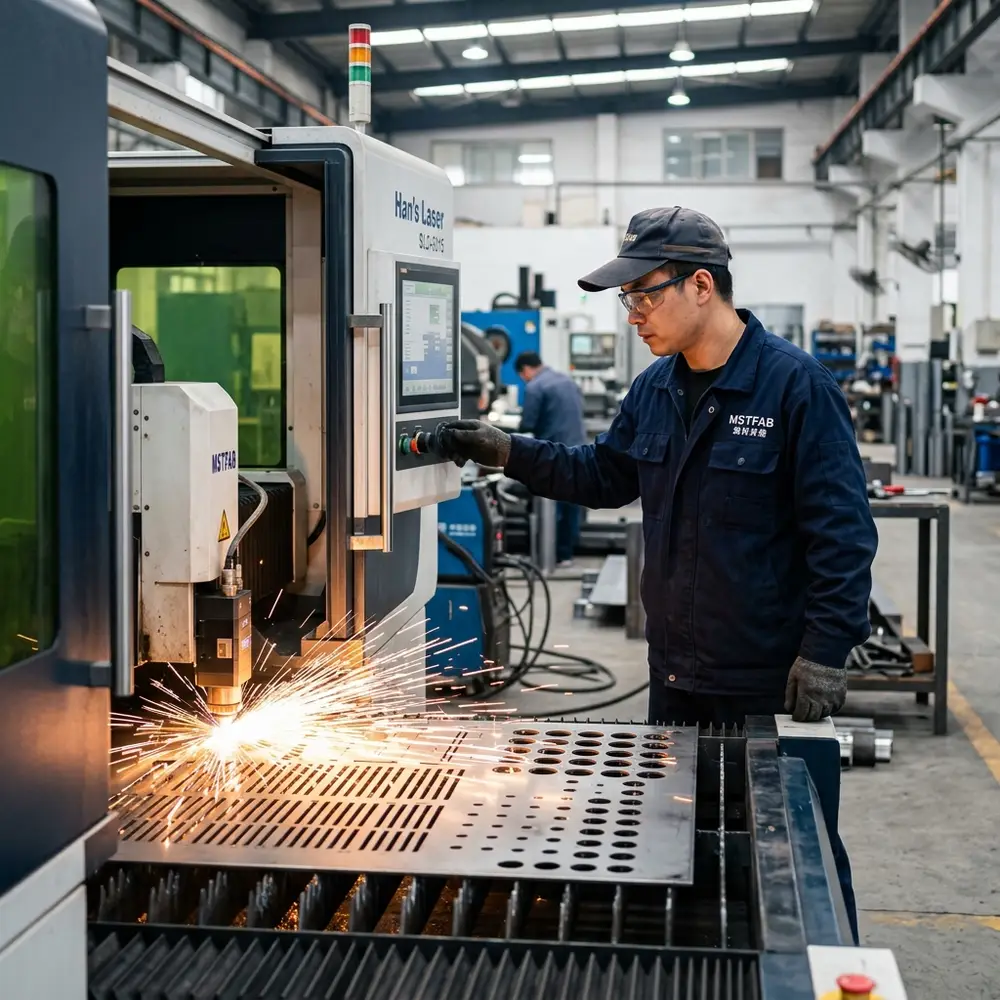
Laser cutting creates the initial flat pattern of the chassis, including outer profiles, display cutouts, screw holes, and cable entry slots. Because a chassis often contains dense arrays of holes for venting or components, maintaining dimensional stability is critical. MSTFAB utilizes CNC fiber laser cutters to hold tight tolerances across the entire flat blank, preventing hole pitch drift.
CNC Bending and Flange Alignment
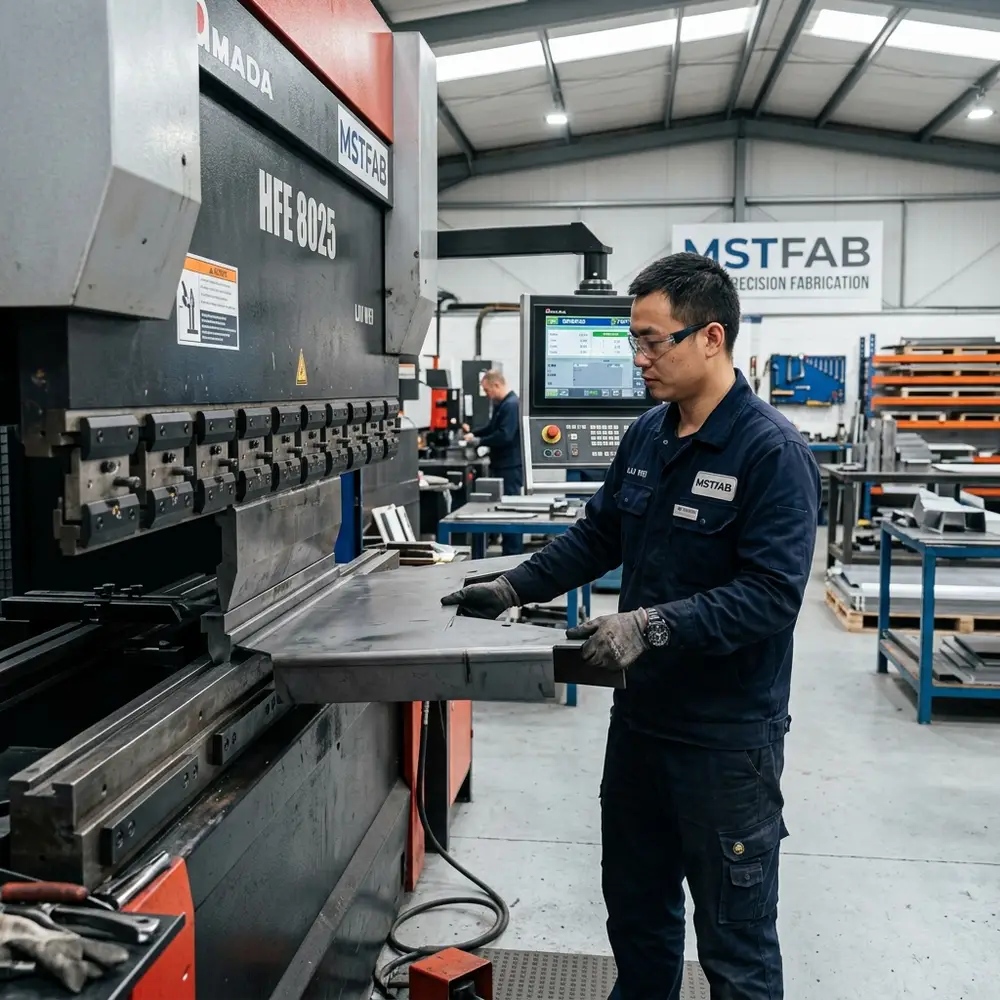
CNC press brakes form flat blanks into three-dimensional structures. Flange alignment and bend sequence are critical during chassis bending. If the bends are inaccurate, the chassis sides will flare or pull inward, making it impossible to slide the chassis into its outer enclosure or align mounting brackets. MSTFAB’s press brakes use precise back-gauge control and automatic crowning systems to ensure every bend angle is consistent across the entire length of the flange.
Hole-to-Bend Distance Considerations
If holes, slots, or cutouts are located too close to a bend line, they will deform during the bending process. This pulling effect distorts mounting holes, rendering them useless for screws or PCB standoffs. In our Design for Manufacturability (DFM) review, MSTFAB’s engineering team highlights these close-to-bend features. We may recommend moving the holes slightly, adjusting the bend relief, or modifying the bend sequence to maintain the hole shape.
Welded Chassis Frames and Distortion Control
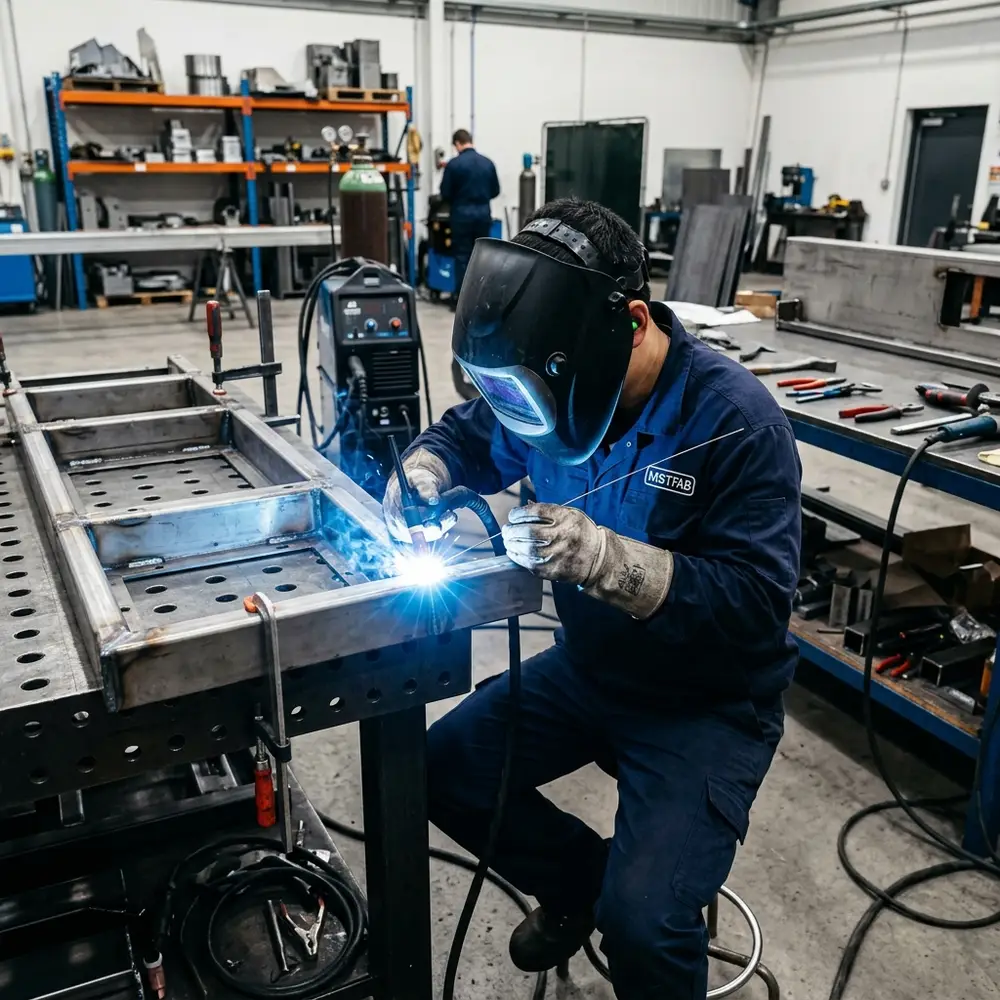
For heavy equipment bases or structural internal frames, welding is required to join corners and brackets. However, the heat introduced during welding causes steel to expand and contract, leading to warping, twisting, and loss of squareness. MSTFAB uses custom welding fixtures and optimized weld sequences to distribute heat evenly. After welding, weld joints are ground flat to ensure flush mounting faces for other components.
PEM Hardware and Threaded Standoffs
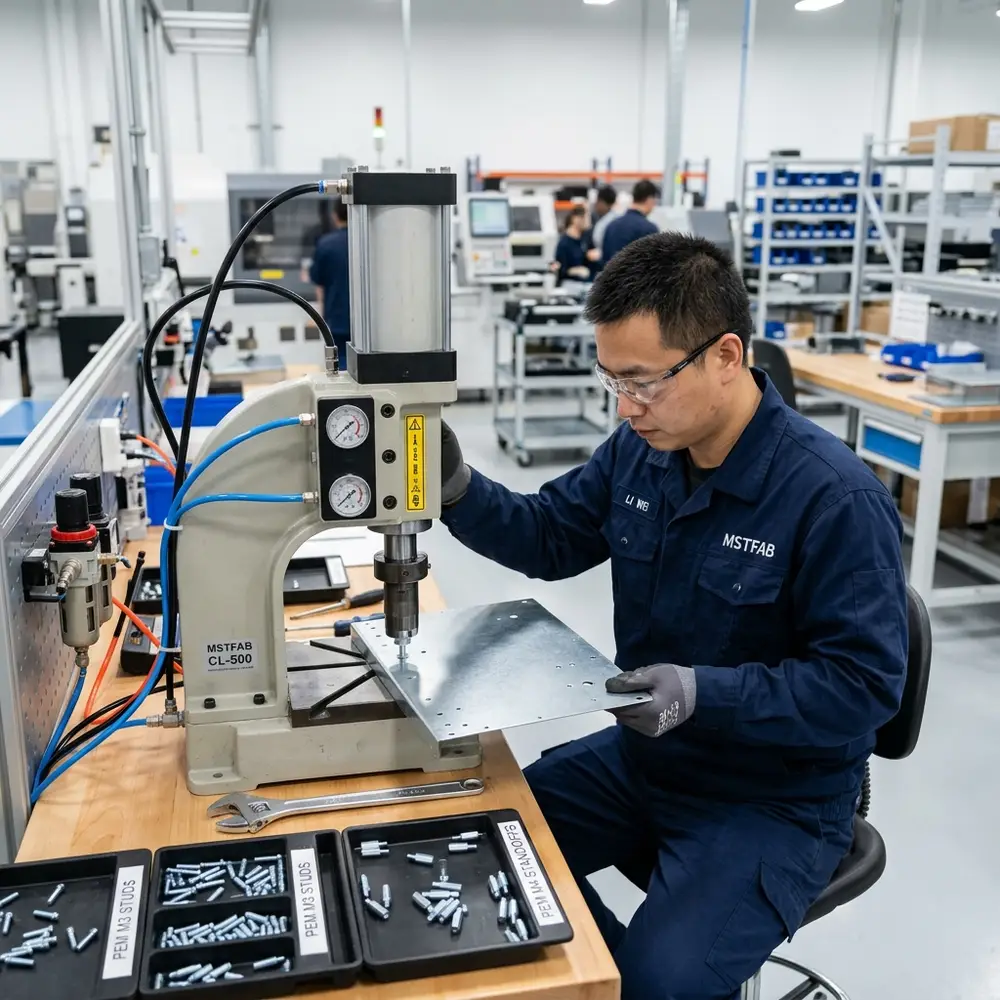
Chassis plates require threaded fasteners to mount circuit boards, power supplies, and brackets. Self-clinching PEM nuts, studs, and standoffs are pressed into pre-punched holes on the chassis. Installing this hardware requires precise pressure control. If the pressure is too low, the stud will spin when a screw is tightened; if it is too high, the sheet metal will warp. MSTFAB uses automated insertion machines to monitor and control tonnage, securing a reliable, spin-free fit.
Electrical Grounding and Surface Masking
Many chassis parts serve as the safety ground path for electrical assemblies. Therefore, grounding points must remain conductive. However, powder coating is an electrical insulator. A grounding stud coated in paint cannot establish an electrical path. MSTFAB applies heat-resistant silicone caps and masking tape to protect threads and grounding pads during powder coating, ensuring clean, paint-free metal-to-metal contact after baking.
Flatness and Dimensional Inspection
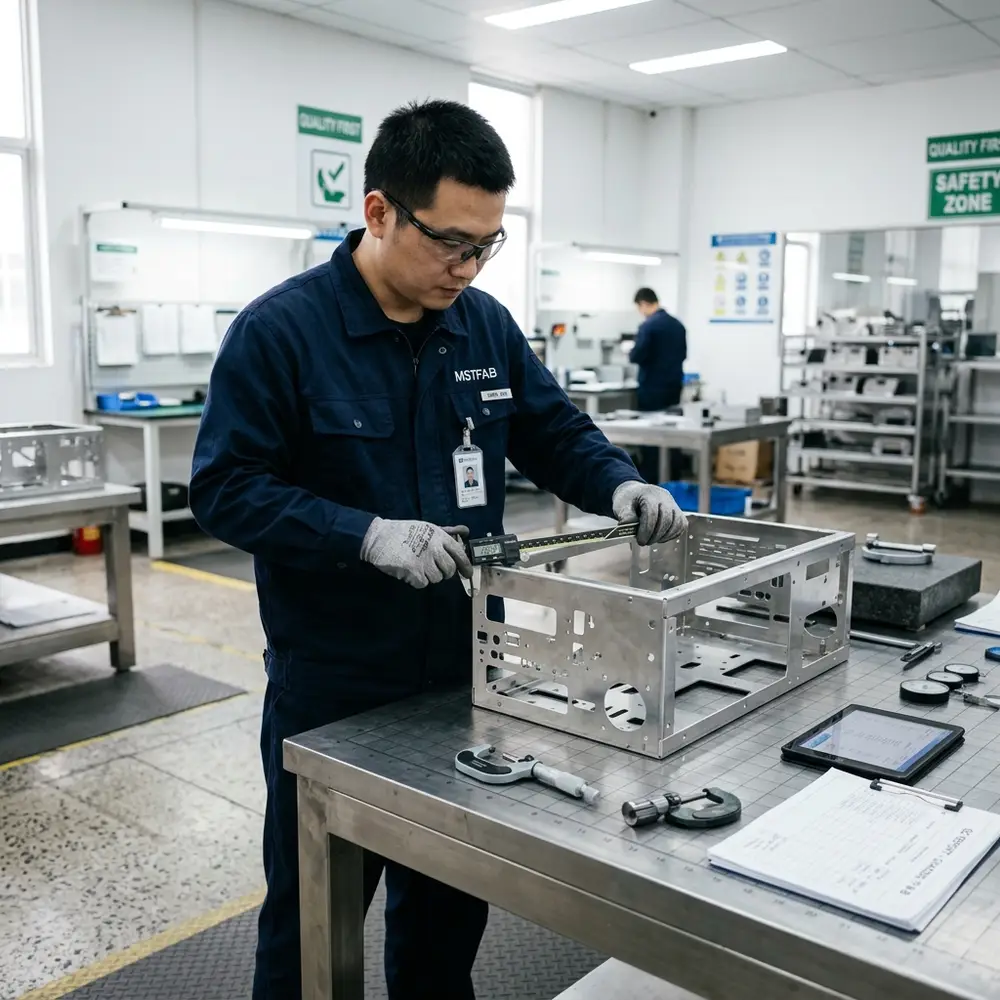
Flatness is critical for chassis mounting trays because uneven surfaces put stress on mounted PCBs, causing solder joints to crack over time. During quality control, inspectors place the chassis on a certified granite surface plate and use dial indicators or feeler gauges to verify flatness. All mounting dimensions, flange alignments, and PEM thread orientations are verified before parts are approved for packaging.
Trust Comparison: Standard Sheet Metal Shop vs. MSTFAB Chassis
| Feature | Standard Sheet Metal Shop | MSTFAB Chassis Manufacturing |
|---|---|---|
| Mounting Hole Alignment | Uses manual layouts or uncalibrated machines; hole pitch drifts over long runs, causing assembly failure. | Maintains strict CNC laser calibration to guarantee repeatable hole pitch down to ±0.1mm. |
| Flatness Control | Ignores welding heat warp; delivers twisted or bowed chassis bases that crack PCBs during installation. | Uses custom fixtures, controlled weld paths, and flat-press operations to ensure flatness within drawings. |
| PEM Hardware Installation | Installs hardware using hand tools; studs spin or push out under minimal torque. | Uses automated clinching presses with monitored tonnage to ensure permanent, spin-free hardware lock. |
| Grounding Stud Protection | Coats grounding threads and contact pads in powder coating, requiring the buyer to scrape paint during assembly. | Applies high-temperature masking caps and tape to ensure clean, paint-free conductive grounding paths. |
| Edge Deburring | Performs basic grinding; leaves sharp internal slots and cutouts that slice through cables or installer fingers. | Deburrs all laser-cut profiles, cable entries, and ventilation holes to deliver hand-safe, snag-free edges. |
| Packaging & Shipping | Piles chassis parts together with basic wrap; parts arrive bent, requiring manual straightening. | Packs parts in custom foam trays and ships them in heavy wooden crates to prevent shipping deformation. |
Prototype to Repeat Batch Production
MSTFAB supports prototype and batch production. Prototypes allow customers to check component clearance, verify assembly stack-ups, and test grounding continuity. Once approved, the manufacturing file, laser nesting program, and press brake sequence are locked. This documentation control ensures the 500th chassis fits exactly like the first article approved sample.
Request a Custom Chassis Quote
Send MSTFAB your drawings and requirements. Our engineering team will review sheet thickness, bend radiuses, flatness needs, hardware positions, and coating specifications to prepare a manufacturability quote.
Upload Chassis Drawings →Frequently Asked Questions
What is a custom sheet metal chassis?
A custom sheet metal chassis is a fabricated metal framework that mounts, positions, and protects internal electronic or mechanical components. It acts as the structural foundation of the device. Learn more about our custom sheet metal enclosure fabrication capabilities.
What materials are used for custom chassis?
Common materials include cold rolled steel (ideal for indoor, painted parts), galvanized steel (for rust-resistant internal structures), stainless steel (for medical/corrosive use), and aluminum (for lightweight needs). Learn more about sheet metal fabrication material selection.
Why is flatness critical for a chassis base?
If the chassis base is warped or twisted, mounting a rigid circuit board to it will bend the board, risking solder joint cracks. Flatness is checked using granite plates and dial indicators. Learn more about sheet metal parts manufacturer from CAD drawings.
Can a chassis incorporate PEM nuts or studs?
Yes. Self-clinching PEM nuts, studs, and standoffs are standard features for mounting PCBs. They are installed before finishing using automated clinching presses. Learn more about PEM hardware installation and threaded inserts.
How do you protect grounding points during powder coating?
Powder coating is non-conductive. MSTFAB applies high-temperature masking caps to grounding studs and tape over grounding pads to keep them raw and paint-free. Learn more about sheet metal fabrication with powder coating.
Can sheet metal chassis parts be welded?
Yes. Frames and brackets can be spot welded or TIG welded. We use solid welding fixtures to control thermal distortion. Learn more about our laser cutting, bending, welding, and assembly supplier services.
What is the minimum hole-to-bend distance for a chassis?
Generally, a hole must be at least 2 to 2.5 times the sheet thickness away from the bend radius tangent line to avoid pulling or distortion. Learn more about our sheet metal bending design guidelines.
How are chassis parts protected during shipment?
Chassis parts can easily bend if stacked incorrectly. We wrap each chassis individually in foam padding and pack them in reinforced wooden crates. Learn more about sheet metal subcontract manufacturing supplier options.
What files do I need to submit for a chassis quote?
The best drawing package includes a 3D STEP/STP file for shape, a 2D PDF drawing detailing dimensions, hardware specs, and masking areas, and DXF files for flat patterns. Learn more about sheet metal fabrication drawing requirements.
Does MSTFAB install electronic components or wiring?
MSTFAB manufactures the physical metal chassis, brackets, and panels, and can install mechanical hardware (PEM, hinges, handles). Internal wiring, electrical design, and device testing are outside our scope. Learn more about custom metal fabrication with final assembly.
MSTFAB provides CNC press brake bending services for precision sheet metal parts, enclosures, brackets and OEM assemblies.
 WeChat Contact
 WhatsApp Me Directly