

Three Files Walk Into a Quote. They Are All Different Revisions.
The PDF says 2.0 mm steel. The STEP model looks like 1.5 mm. The DXF came from last Tuesday, the BOM came from last month, and the email says “please use the newest one” without identifying which one has earned that honor.
Sheet metal RFQ revision control keeps the supplier from pricing one design while production receives another. This checklist focuses on file hierarchy, assumptions, clarification records, change control and first-article release. If you only need a list of basic CAD formats, the existing file-preparation guide handles that job; this page solves the mess that begins after several versions exist.
1. Why Mixed Revisions Create Bad Quotes
A quotation is a technical and commercial response to a specific configuration. Change material, thickness, tolerance, hardware, welding, finish, inspection or quantity and the manufacturing route may change with it.
If the supplier cannot identify the quoted revision, price comparisons become theatre. Supplier A may include stainless hardware and full cosmetic grinding. Supplier B may price zinc-plated hardware and functional welds. The totals look comparable only because the missing assumptions are doing unpaid acting work.
Buyer pain point: “Use the latest file”
Latest by file date, email date, cloud upload date or drawing revision? REV_FINAL_v7_really-final.step is not configuration control. Give the released set an issue identifier and list every included file.
2. Create an RFQ Issue Sheet
The issue sheet can be one controlled PDF or spreadsheet. It does not need ceremonial complexity. It needs enough information for another person to reconstruct exactly what was quoted six weeks later.
For the basic list of STEP, PDF, DXF, BOM, material and finish information, see what files are needed for a sheet metal fabrication quote. Keep that prerequisite separate from the revision-control workflow here.
3. State Which File Controls
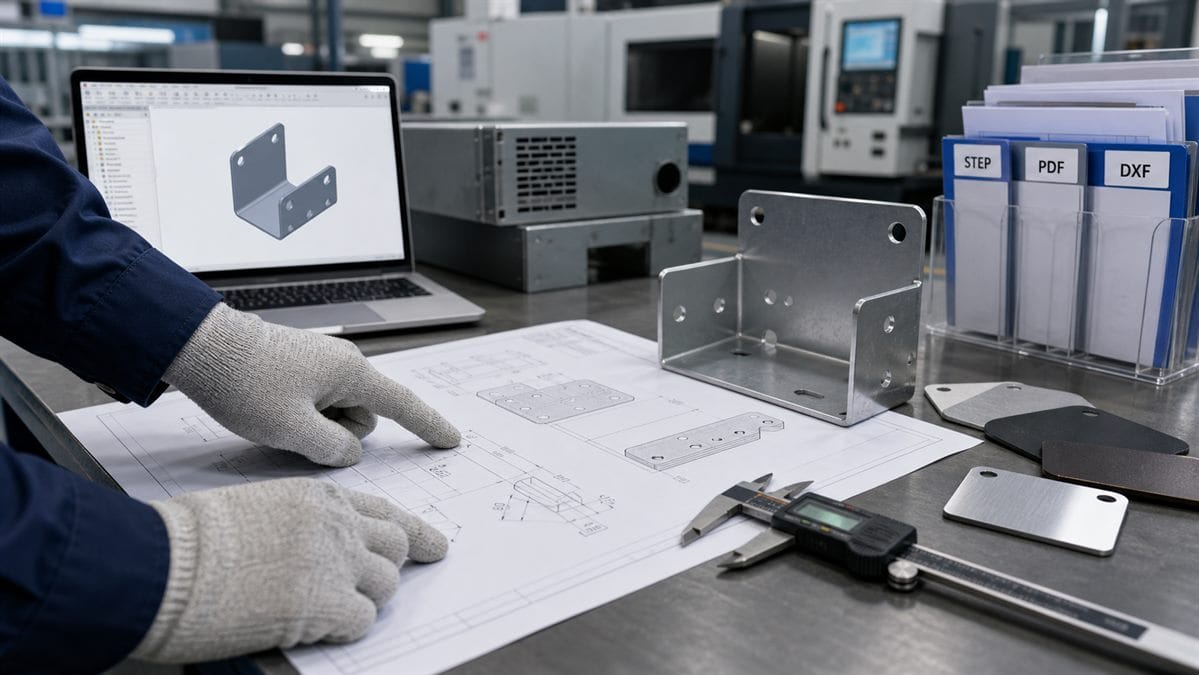
Different files carry different information. The 3D model may control nominal geometry, while the 2D drawing controls material, tolerances, welds, finish and inspection notes. A DXF may support flat-profile review without overriding the formed part. The BOM may control purchased hardware and quantities.
| Document | Typical role | Conflict to prevent | Useful RFQ statement |
|---|---|---|---|
| STEP or STP | Nominal formed geometry and assembly relationships | Model geometry differs from dimensioned drawing | State whether model or 2D drawing controls nominal geometry |
| Controlled PDF | Material, dimensions, tolerances, welds, finish and inspection | General notes conflict with model or purchase specification | Name drawing number and revision as the controlled manufacturing document |
| DXF or DWG | Flat profile, cut features or customer-supplied pattern | Old cut pattern remains attached after a design change | State whether supplier may regenerate the flat from the approved model |
| BOM | Part quantities, hardware and purchased components | Hardware finish or manufacturer differs from drawing callout | Define BOM revision and approved-alternative policy |
| Email or RFQ notes | Commercial request and temporary clarification | A casual message silently overrides a released drawing | Require approved changes to return to the issue sheet or drawing |
4. Record Supplier Questions and Buyer Answers
Clarifications belong in a numbered query log. Each question should identify the affected part, file and feature; each answer should identify the person and date. Close the question only when both sides understand whether the answer changes the quote.
Reference the part, revision, drawing zone and conflicting requirement.
Name who must answer instead of forwarding the email to a crowd.
Write the approved answer and whether documents will be revised.
Confirm cost, lead time and scope impact before closing the item.
A phone call can solve a problem quickly. It should not become the only record of what was solved. After the call, add the decision to the query log or controlled issue sheet.
5. Make Quotation Assumptions Visible
A good quote states what is included, excluded and assumed. If a tolerance is missing, the supplier should not hide a guess inside the unit price. If a finish note says only “black,” the quote should identify the priced coating route or flag it as open.
| RFQ gap | Weak response | Controlled response | Why it matters |
|---|---|---|---|
| Material not finalized | Quote whichever sheet is cheapest | Price the named provisional grade and mark final approval open | Grade changes forming, welding, finish and cost |
| Tolerance missing | Assume everything is tight | Apply stated standard tolerances and list critical exceptions | Prevents unnecessary inspection and later fit disputes |
| Weld appearance unclear | Include basic welding and hope | Separate structural, sealed and cosmetic weld assumptions | Grinding and blending can dominate labor |
| Finish incomplete | Price generic powder coating | Name color basis, texture, masking and cosmetic scope | Finish details affect fit, handling and rejection risk |
| Inspection unspecified | Include “standard QC” | State sampling, report and first-article assumptions | Inspection evidence has real time and cost |
6. Control Changes After the Quote
When engineering releases a new revision, send a change summary with the replacement files. Do not ask the supplier to compare two large assemblies and discover every difference by eyesight unless that comparison is explicitly part of the scope.
If nothing commercial changes, record that too. Silence is not approval; it is just an empty cell waiting to become a meeting.
7. Freeze the Production Package
The purchase order should reference the accepted quotation and released manufacturing set. Before production starts, both sides should confirm part number, revision, quantity, material, finish, hardware, inspection, packaging and delivery.
Prototype approval does not automatically approve an undocumented production change. If the prototype was hand-adjusted, locally ground or assembled with substitute hardware, capture that learning in a new drawing or controlled deviation before the batch begins.
| Release checkpoint | Buyer confirms | Supplier confirms |
|---|---|---|
| Quotation acceptance | Scope, assumptions, price, lead time and open items | Quoted file manifest and exclusions |
| Purchase order | Part, revision, quantity, delivery and document requirements | PO matches accepted quotation or differences are flagged |
| Manufacturing release | All technical questions closed or formally deferred | Production package loaded and obsolete files isolated |
| First article | Required measurements, appearance and fit evidence | Sample tied to drawing revision and inspection record |
| Repeat production | Approved changes and current sample status | Setup, fixture and inspection plan use the released revision |
8. Tie Inspection Evidence to the Revision
A dimensional report without a drawing revision is a list of numbers with excellent manners and limited usefulness. Marked drawings, first-article reports and deviation approvals should all identify the inspected part and released revision.
For repeat orders, confirm whether the previous approved sample remains valid. If geometry, material, process, supplier hardware or finish changed, define what must be re-approved rather than assuming the old sample can supervise the new design from retirement.
9. Final RFQ Revision-Control Checklist
Frequently Asked Questions
Should the STEP model or PDF drawing control?
The buyer should state the hierarchy. A common arrangement uses the model for nominal geometry and the PDF for material, tolerances, finish, welding and inspection, but the released project documents must define the actual rule.
Can an email override a released drawing?
It can authorize a temporary decision if both sides accept that process, but critical changes should return to a controlled drawing, issue sheet or deviation record before production.
What should a supplier do when files conflict?
Stop the affected review, identify the exact conflict and ask a numbered clarification question. Quietly choosing the easiest file creates a fast quote and a slow correction.
Does every revision require a new quotation?
Not always. The supplier should review whether the change affects material, process, tooling, labor, inspection, scrap risk or schedule. The result may be no commercial change, but that decision should still be recorded.
How does sheet metal RFQ revision control support repeat orders?
It links the order, approved sample, inspection plan and production files to one released configuration. Before repeating the batch, both sides can verify that later revisions or deviations did not quietly change the product.
Send One Controlled RFQ Package
Share the released file manifest, quantities, change summary and open questions. MSTFAB will review the manufacturing scope and return clarifications and quotation assumptions against the identified revision.
 WeChat Contact
 WhatsApp Me Directly