
The Short Answer
A qualified sheet metal subcontract manufacturing supplier acts as a dedicated build-to-print production extension of your engineering team—consolidating fiber laser cutting, CNC bending, hardware insertion, welding, and finishing under one ISO 9001 quality system. To eliminate multi-vendor delays and tolerance stack-up disputes, choose a subcontractor that locks flat-pattern bend deductions during DFM, verifies every lot with First Article Inspection (FAI), and maintains clear mechanical scope boundaries.
Explore this guide
01 / Build-to-Print Subcontract Model
Replace fragmented job-shop sourcing with single-source subcontract accountability.
For OEM equipment builders, automation integrators, and engineering contractors, splitting a mechanical bill of materials across separate laser-cutting, bending, welding, and powder-coating vendors creates a management nightmare. Whenever a mounting hole misses alignment on your assembly floor, each sub-tier shop blames the previous step.
Partnering with a full-process custom sheet metal fabrication subcontractor puts flat-pattern engineering, forming tooling, weld fixturing, surface treatment, and final dimensional sign-off under one contract and one quality system.
Pre-production DFM and K-factor lock
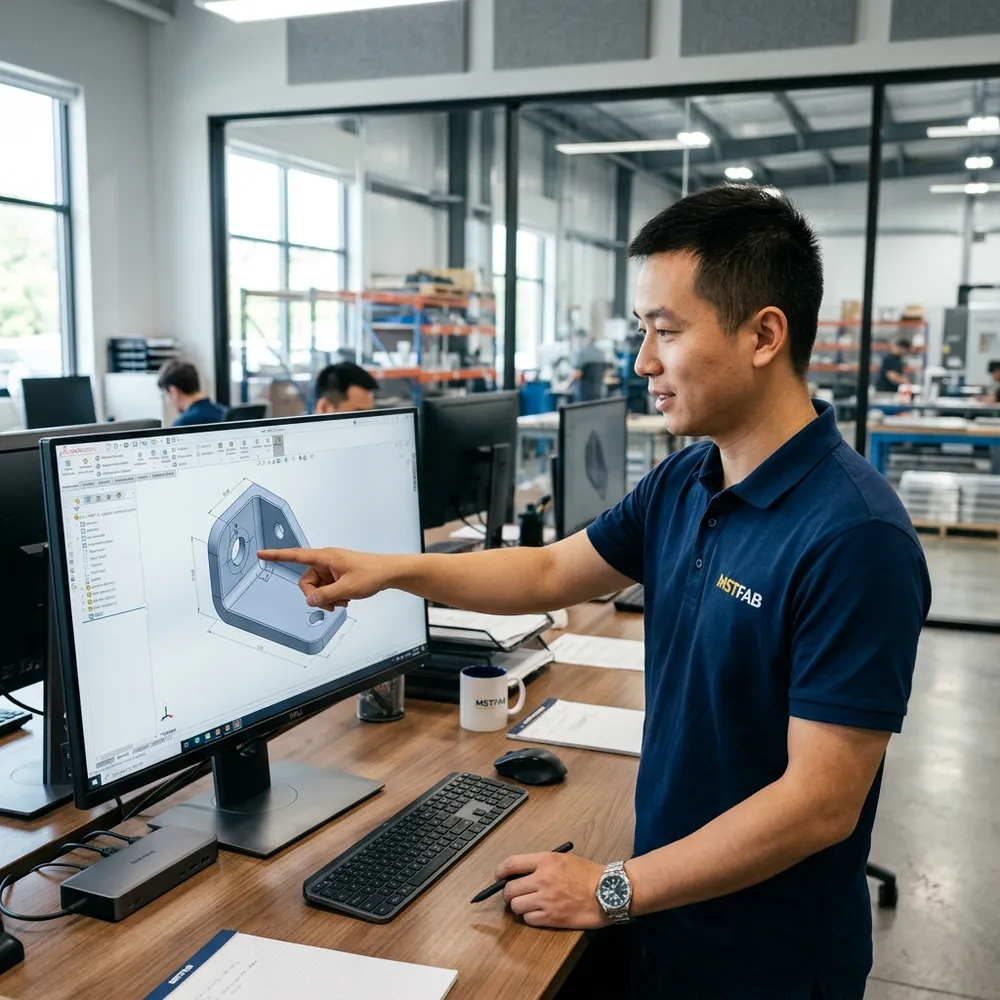
Before cutting steel, our engineers unfold your 3D STEP models using the exact V-die radii and press-brake deduction tables on our floor—flagging tight hole-to-bend margins early.
Multi-part BOM synchronization
Instead of chasing ten vendors for twenty mating brackets and panels, we nest, form, finish, and kit complete mechanical sub-BOMs so every mating part arrives in the same shipment.
Scalable prototype-to-series capacity
Start with 1 to 10 First Article validation units using soft fiber-laser and press-brake tooling, then scale seamlessly into recurring batch production with locked NC programs.
Company verification: Procurement teams conducting vendor onboarding can review our facility capabilities, certifications, and core equipment list on the MSTFAB Company Fact Sheet.
02 / Integrated Manufacturing Route
Control every fabrication step from raw sheet blanking to finished weldment.
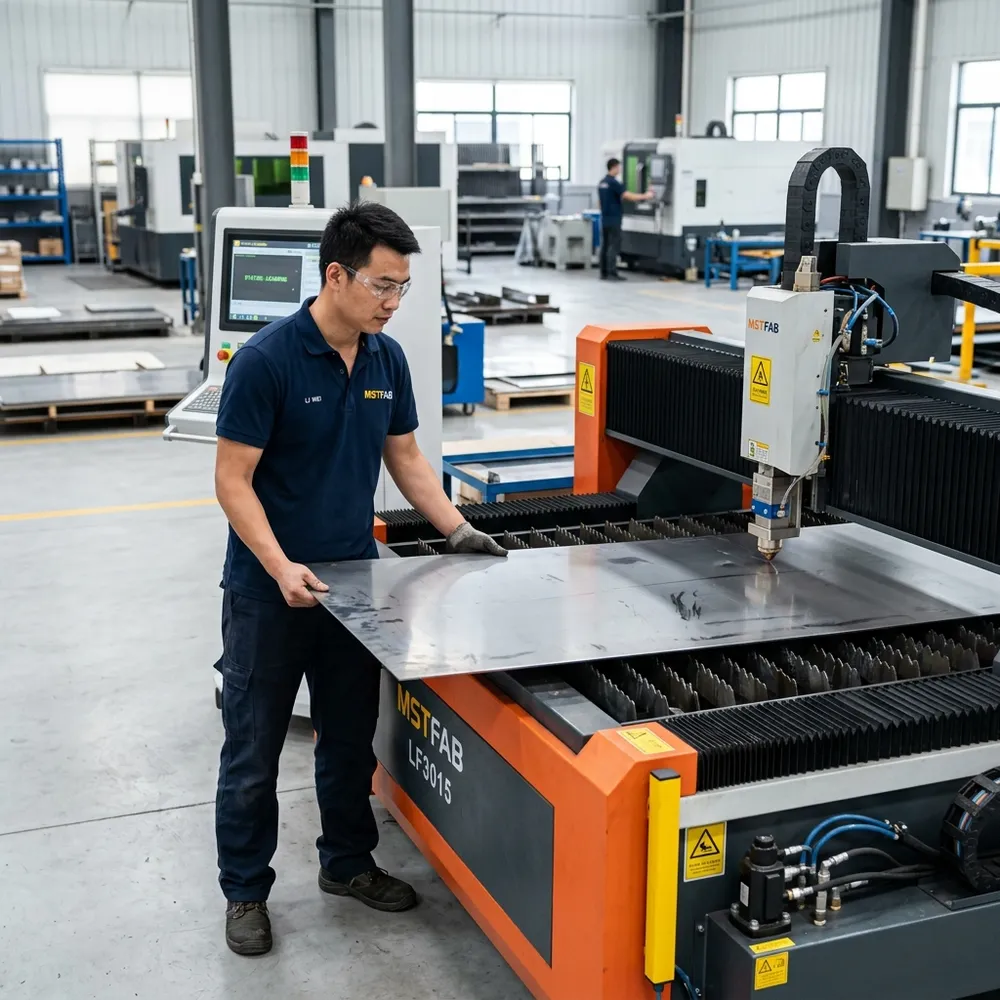
Consistent subcontract parts require tight handoffs between upstream cutting and downstream forming, fastening, and welding. A 0.2 mm laser kerf shift or an unremoved edge burr will throw off press-brake backgauge registration and open gaps in welding fixtures.
- Fiber laser cutting and mechanical deburring: High-power fiber lasers cut carbon steel, stainless steel (304/316L), aluminum (5052/6061), copper, and brass with nitrogen or oxygen assist gas, followed by wide-belt and rotary-brush edge conditioning.
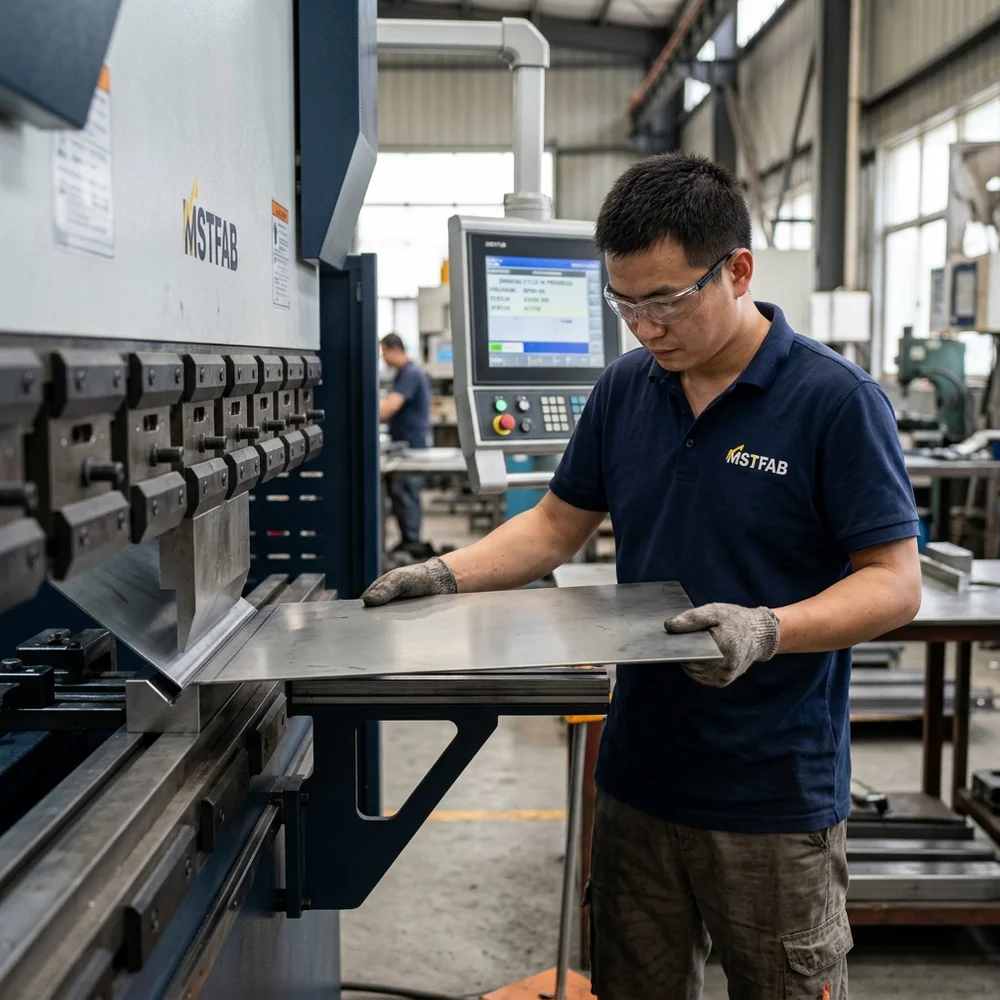
- CNC press brake forming and PEM hardware: Multi-axis CNC press brakes form complex return flanges, deep channels, and hems, while hydraulic insertion presses install self-clinching nuts, studs, standoffs, and captive fasteners with repeatable force.
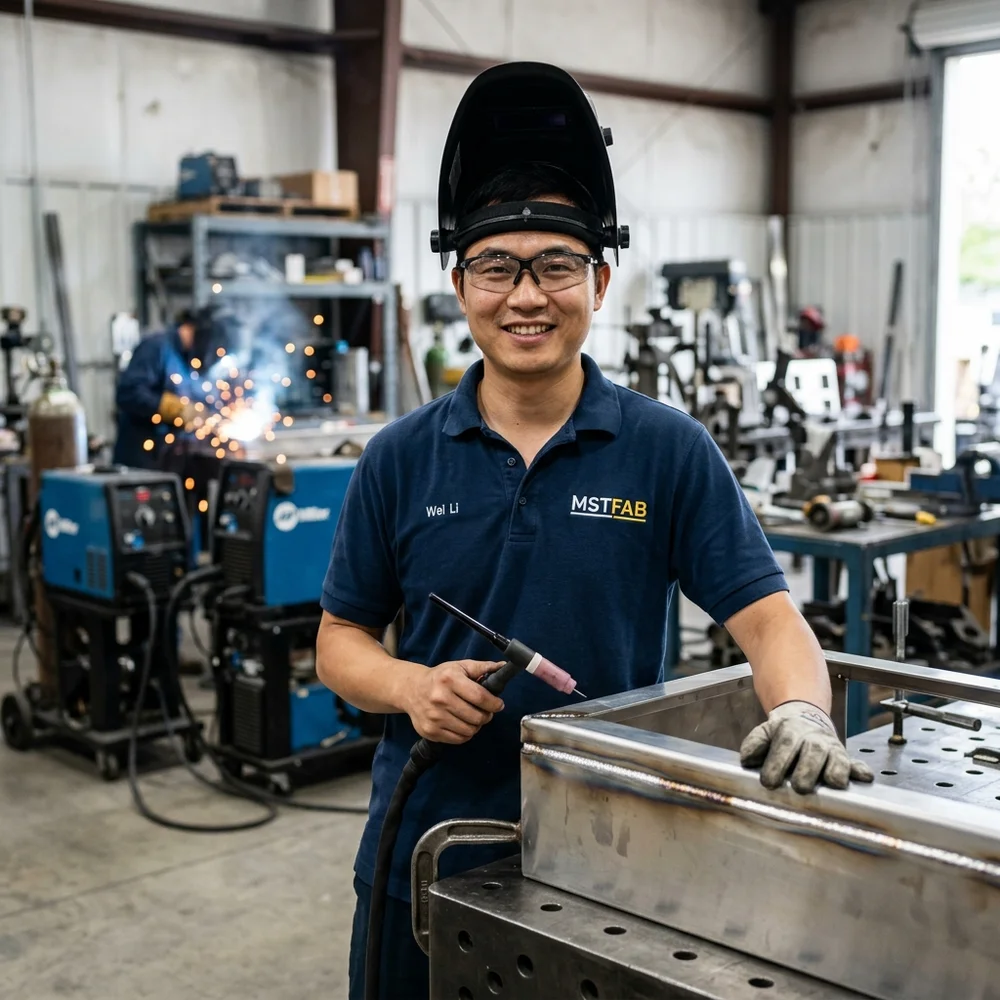
- Fixture-controlled MIG, TIG and laser welding: Dedicated modular welding tables and custom clamping jigs hold diagonal squareness across structural frames, fluid tanks, and cosmetic cabinets.
- In-house and managed surface finishing: Complete pretreatment, polyester/epoxy powder coating, silk-screen/laser marking, anodizing, zinc electroplating, and stainless passivation with selective thread and grounding masking.
Because our sheet metal welding services and forming teams work from the same ERP router, tab-and-slot tolerances and weld-prep bevels are engineered directly into the laser flat pattern.
03 / Core Subcontract Deliverables
Source precision brackets, structural chassis, machine guards, and enclosure shells.
Whether you are launching a new industrial automation cell, energy storage cabinet, or commercial kiosk, most equipment BOMs rely on four foundational sheet metal part families that benefit from consolidated subcontracting.
- Custom electrical and industrial enclosure shells, hinged doors, gland plates, DIN-rail subplates, and outdoor weather-hood canopies.
- Heavy-duty machine base frames, tubular weldments, fork-pocket skids, and structural mounting plates fabricated from Q235B/A36, Q355B/S355, or stainless steel.
- Precision internal chassis trays, card cages, heat-sink shrouds, busbar support brackets, and multi-bend sensor mounts with pre-installed PEM fasteners.
- Exterior machine safety guards, acoustic panels, louvered ventilation covers, and brushed stainless steel operator fascia panels.
Consolidating these part families with a single subcontractor allows us to check actual physical fitment between mating doors, hinges, subplates, and frames before parts leave our factory.
Explore our custom build-to-print sheet metal enclosures and cabinets →
04 / Clear Mechanical Scope Boundaries
Keep subcontract responsibilities clear between metal fabrication and OEM system integration.
Reliable subcontracting depends on honest technical boundaries. When a fabrication factory overpromises on complex electronics integration or regulatory system testing outside its core competency, project schedules slip and quality suffers.
- What MSTFAB manufactures: We manufacture 100% build-to-print mechanical sheet metal parts, machined/stamped brackets, welded structural frames, and empty enclosure shells strictly to your released 2D/3D engineering drawings.
- Mechanical hardware and sub-assembly we support: We install self-clinching PEM fasteners, weld studs, mechanical hinges, compression latches, viewing windows, EPDM/PU perimeter gaskets, casters, and unpowered mechanical sub-assemblies.
- Quality and environmental management systems: Our manufacturing operations run under certified ISO 9001, IATF 16949, and ISO 14001 management systems with full material and dimensional documentation.
- What remains with the OEM: Final electrical wiring, PCB/PLC installation, active powered testing, and end-product regulatory compliance or system-level safety certification remain the responsibility of the OEM.
Defining this mechanical-vs-electrical boundary upfront ensures fast, accurate quotations and protects your intellectual property and compliance chain.
05 / Supplier Qualification Matrix
Compare ad-hoc job shops against structured OEM subcontract standards.
Use this five-point audit matrix when qualifying a long-term sheet metal subcontract manufacturing partner for recurring OEM programs.
06 / Inspection Handoff
Enforce First Article sign-off and in-process patrol checks across every subcontract lot.
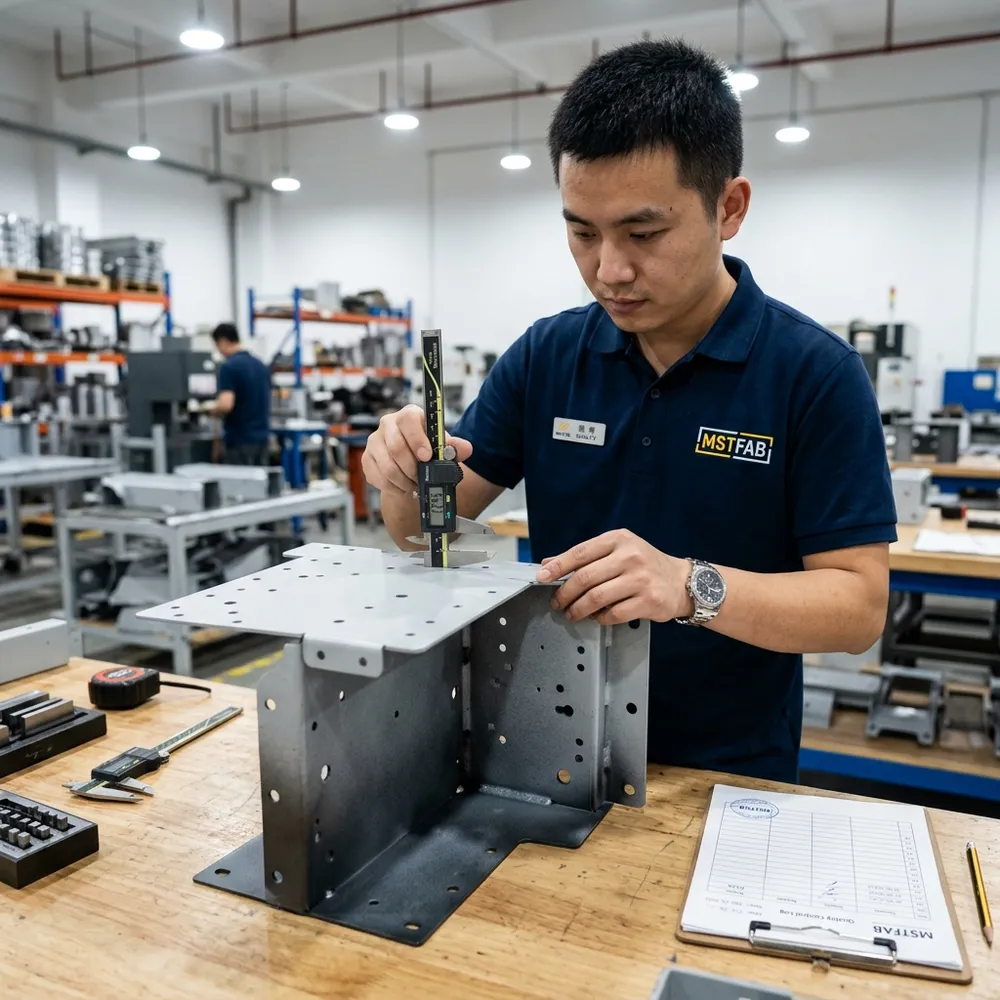
Outsourcing sheet metal only saves your engineering team time if the parts pass incoming inspection on arrival. Waiting until a container lands at your dock to discover a missed tapped hole or a warped mounting flange halts your entire build schedule.
Our quality department executes a three-stage verification loop: incoming raw sheet gauge and grade verification, mandatory First Article Inspection (FAI) against ballooned drawings prior to batch release, and roving in-process checks at laser cutting, press-brake bending, welding, and powder coating.
Under our ISO 9001 and IATF 16949 quality frameworks, we supply complete dimensional inspection reports, material certs, and pre-shipment photos with every subcontract delivery.
Review our sheet metal quality control and inspection workflow →
07 / Packing and Release
Receive kitted, crate-protected parts organized by your bill of materials.
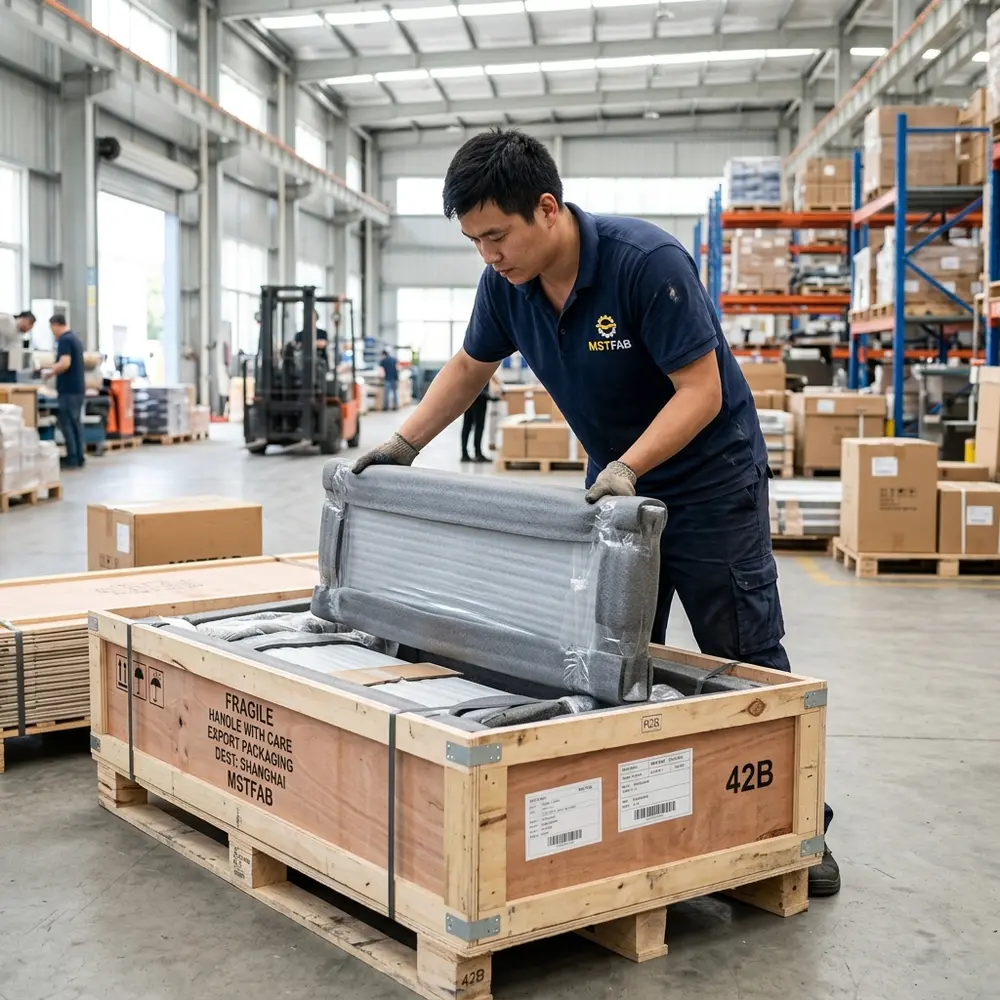
Subcontract manufacturing should simplify your receiving dock—not bury your warehouse team in unmarked bulk pallets. We organize outbound shipments around your production sequence.
Through our assembly and export packaging service, components are individually wrapped or foam-separated, grouped into labeled sub-kits by machine assembly or part number, and packed into reinforced plywood export crates.
Manufacturing scope: MSTFAB operates under ISO 9001, IATF 16949, and ISO 14001 standards as a build-to-print manufacturer of custom sheet metal parts, weldments, and empty enclosure shells. Final powered equipment integration and end-system regulatory certification belong to the OEM.
08 / Ready-to-Review RFQ
Include eight details in your subcontract sheet metal RFQ package.
- 3D STEP models + 1:1 DXF filesInclude 3D STEP files for all formed and welded assemblies plus clean 1:1 DXF flat profiles where applicable.
- 2D PDF drawings with tolerancesProvide revision-controlled 2D drawings calling out critical dimensions, general tolerance class (e.g., ISO 2768-mK), and threads.
- Structured Bill of Materials (BOM)Supply an Excel or CSV BOM listing part numbers, descriptions, quantities per machine set, and parent-child relationships.
- Material grades and thicknessesSpecify exact material standards (SPCC, Q235B/A36, 304/316L stainless, 5052/6061 aluminum) and sheet gauges.
- Hardware and fastener calloutsList all PEM self-clinching nuts, studs, standoffs, weld nuts, or mechanical latches/hinges to be installed.
- Welding and cosmetic standardsDefine stitch vs. continuous welds, leak-test requirements, and which exterior A-surfaces require flush weld blending.
- Surface treatment and maskingState RAL powder coat codes, anodizing, zinc plating, or passivation along with masked grounding studs or mating faces.
- Prototype and batch scheduleShare initial FAI prototype quantities, recurring batch volumes, and any kitting-by-assembly instructions.
Sending a structured BOM with complete 3D STEP and 2D PDF files allows our estimation and DFM engineers to quote your entire mechanical package accurately.
Sheet metal subcontract manufacturing questions from OEM buyers
Can you quote and manufacture a complete multi-part sheet metal BOM rather than single brackets?
Yes. Many of our OEM customers send complete mechanical BOM packages containing 15 to 100+ unique part numbers—from heavy welded base frames and exterior cabinet doors down to small laser-cut shims and busbar brackets. We fabricate, finish, inspect, and kit the entire set so all mating parts arrive together.
How do you handle international material equivalents when our drawings specify US or European grades?
During quotation and DFM, we cross-reference your ASTM, SAE, EN, or DIN callouts (such as A36, S235JR, S355MC, 304L, or 5052-H32) with exact certified equivalents or direct mill stock, and we provide EN 10204 3.1 mill test reports verifying chemical and mechanical properties for your engineering approval.
Do you sign Non-Disclosure Agreements (NDAs) to protect our proprietary OEM drawings?
Absolutely. As a strictly build-to-print subcontract manufacturer with no competing brand products of our own, we routinely sign mutual or buyer-drafted NDAs before receiving 3D CAD assemblies and restrict file access to internal engineering and production teams.
How do you ensure mating subcontract parts actually fit together before shipping overseas?
When we manufacture mating components—such as an enclosure frame, hinged door, inner mounting subplate, and removable covers—our QC team performs a physical trial fit-up during First Article Inspection to verify hinge alignment, latch compression, and hole-to-hole clearances before releasing the batch.
What quality certifications does MSTFAB hold for subcontract manufacturing?
MSTFAB operates under certified ISO 9001, IATF 16949, and ISO 14001 management systems. We manufacture custom drawing-based sheet metal parts and empty enclosure shells, while final powered equipment certification belongs to the OEM.
What is the typical lead time for First Article prototypes versus recurring subcontract batches?
First Article prototype samples typically ship within 7 to 14 days depending on welding and surface coating complexity. Once the FAI is approved and tooling/programs are locked, recurring production batches typically run 2 to 4 weeks.
Technical references
Reference these international standards when establishing quality management requirements, general sheet metal tolerances, and material certification rules in subcontract agreements.
Send your subcontract BOM, STEP models, and PDF drawings for a DFM review.
Upload your drawing package and target batch volumes. MSTFAB will review manufacturability, verify material specs, and return an itemized subcontract quotation.
Request a Subcontract Manufacturing Quote →
Have a question first? caroline@mstfab.com
 WeChat Contact
 WhatsApp Me Directly