
From ultra-lightweight aerospace avionics enclosures, high-current electric vehicle battery housings, and marine radar consoles to architectural facade panels, medical diagnostic carts, and precision heat sinks, aluminum is the metal of choice for modern engineering. Delivering an exceptional strength-to-weight ratio (one-third the density of structural steel), superior natural corrosion resistance, excellent thermal conductivity, and outstanding aesthetic versatility through anodizing, aluminum powers next-generation OEM hardware. As an ISO 9001:2015 and ISO 13485:2016 certified custom metal parts manufacturer for aluminum, MSTFAB delivers turnkey fabrication across 5052, 6061, 3003, and 7075 alloys—integrating high-speed fiber laser cutting, precision CNC forming, robotic AC TIG / CMT welding, multi-axis secondary CNC machining, and MIL-SPEC surface finishing.
Table of Contents
- 1. Aluminum Metallurgy & Alloy Selection: 5052-H32 vs. 6061-T6 vs. 3003-H14
- 2. Thermal and Mechanical Blanking: Fiber Laser Cutting vs. CNC Turret Punching
- 3. Precision CNC Press Brake Forming: Springback, K-Factors, and Non-Marking Tooling
- 4. Advanced Aluminum Welding: AC TIG, Robotic CMT, Filler Alloys (4043 vs. 5356), and Oxide Removal
- 5. Secondary CNC Milling and Extrusion Integration for Hybrid Assemblies
- 6. Surface Finishing & Corrosion Defense: Anodizing (Type II / III), Chem-Film, and Powder Coating
- 7. Hardware Insertion & Fastener Engineering: Clinch Fasteners (PEM) and Thread Inserts
- 8. Critical DFM Engineering Rules for Formed & Machined Aluminum Components
- 9. Quality Metrology: CMM Inspection, Anodize Eddy-Current Testing, and Seal Integrity
- 10. Comprehensive Engineering Data Matrices and Manufacturing Benchmarks
- 11. Real-World OEM Case Studies: High-Performance Aluminum Validations
- 12. Frequently Asked Technical Questions (40 Detailed Engineering Q&As)
1. Aluminum Metallurgy & Alloy Selection: 5052-H32 vs. 6061-T6 vs. 3003-H14
Selecting the optimal aluminum alloy is the most critical decision in sheet metal and machined component engineering. Aluminum alloys are categorized by their primary alloying elements in the International Four-Digit System. In precision contract manufacturing, four distinct alloys account for over 95% of custom production:
1. Aluminum 5052-H32 (The Premier Sheet Metal Forming Alloy)
Alloyed with 2.5% Magnesium and 0.25% Chromium, 5052 is a non-heat-treatable alloy strengthened through strain hardening and stabilized to the H32 temper. It is the universal industry standard for precision sheet metal enclosures, electronic brackets, and marine cowlings:
- Formability: Exceptional ductility (elongation 12% to 18%) allows sharp inside bend radii (R = 1.0 * T to 1.5 * T) without surface micro-cracking or orange-peel splitting.
- Corrosion Resistance: Outstanding resistance to salt spray, marine atmospheres, and industrial chemicals due to the protective magnesium-aluminum oxide surface film.
- Fatigue Strength: Very high endurance limit (115 MPa), making it ideal for mobile transportation structures and vibrating equipment.
- Weldability: Easily welded via AC TIG and MIG using ER5356 filler wire.
2. Aluminum 6061-T6 (The Structural & CNC Machining Workhorse)
Alloyed with 1.0% Magnesium and 0.6% Silicon, 6061 is a precipitation-hardened, heat-treatable alloy artificially aged to the T6 temper. Offering a high yield strength of 275 MPa (approx 40% stronger than 5052), it is the standard specification for structural frames, internal mounting rails, and CNC milled enclosures:
- Forming Considerations: Lower ductility (elongation approx 8% to 10%) means 6061-T6 is prone to cracking along the bend line. It requires generous inside bend radii (R >= 2.5 * T to 3.5 * T) and careful grain direction alignment. Alternatively, parts can be formed in the annealed O-temper (6061-O) and heat-treated to T6 post-forming.
- Machinability: Superb chip formation and high cutting speeds on multi-axis CNC mills.
- Anodizing: Yields a uniform, high-density anodic oxide layer, although the silicon content produces a subtle grayish-silver cast compared to pure aluminum.
3. Aluminum 3003-H14 (Deep Drawing & Heat Exchanger Alloy)
Alloyed with 1.2% Manganese, 3003 is a work-hardened alloy approximately 20% stronger than commercially pure 1100 aluminum. Its extreme ductility (elongation > 20%) makes it the premier choice for deep-drawn cans, seamless stamped shells, spun cowlings, and HVAC heat exchanger ducting.
4. Aluminum 7075-T6 (Ultra-High-Strength Aerospace Alloy)
Alloyed with 5.6% Zinc and 2.5% Magnesium, 7075-T6 achieves mechanical strengths comparable to many structural steels (yield strength > 500 MPa). Because it possesses negligible room-temperature formability and poor arc weldability, 7075 is utilized primarily for high-stress CNC machined brackets, aerospace avionics housings, and precision structural ribs.
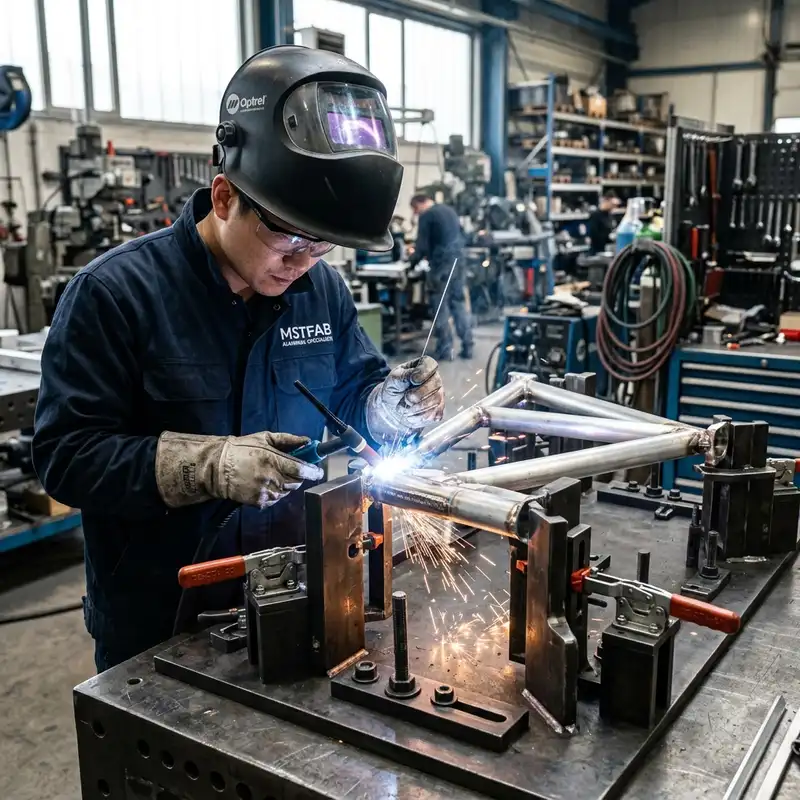
Figure 1: MSTFAB precision fabrication: certified technician executing AC TIG welding on an aluminum 6061-T6 equipment chassis held in a multi-axis modular welding fixture.
2. Thermal and Mechanical Blanking: Fiber Laser Cutting vs. CNC Turret Punching
Cutting aluminum blanks requires specialized machine technology to overcome the metal’s high thermal conductivity (k approx 138 W/m.K for 5052) and intense optical reflectivity:
High-Speed Fiber Laser Cutting with Nitrogen Assist Gas
Modern high-power fiber lasers (6 kW to 20 kW) operating at a 1.07-micron wavelength overcome aluminum’s reflectivity through beam polarization and active back-reflection optical isolators:
- High-Pressure Nitrogen Assist (18 to 25 bar): Molten aluminum is ejected mechanically from the kerf at supersonic velocities. High-purity nitrogen prevents oxidation of the cut edge, leaving a pristine, dross-free edge with an arithmetic roughness of Ra < 1.5 um.
- Intricate Geometries & Micro-Tabs: High-precision laser optics allow cutting tight perforation grids, narrow slot arrays, and complex mounting patterns with kerf widths down to 0.15 mm and positional accuracy of +/- 0.05 mm.
CNC Turret Punching & Forming
For high-volume electronic enclosures featuring hundreds of repetitive holes, louvers, countersinks, and embossed card guides, CNC turret punching offers rapid cycle times and low unit costs. MSTFAB’s automated punch presses feature:
- Non-Marking Brush Tables: Eliminates surface scratches and tool scuffing on pre-polished or cosmetic aluminum sheets.
- Specialized Forming Tools: Embosses louvers, stiffener ribs, grounding lance bridges, and extruded tapped collars in a single hit without secondary press operations.
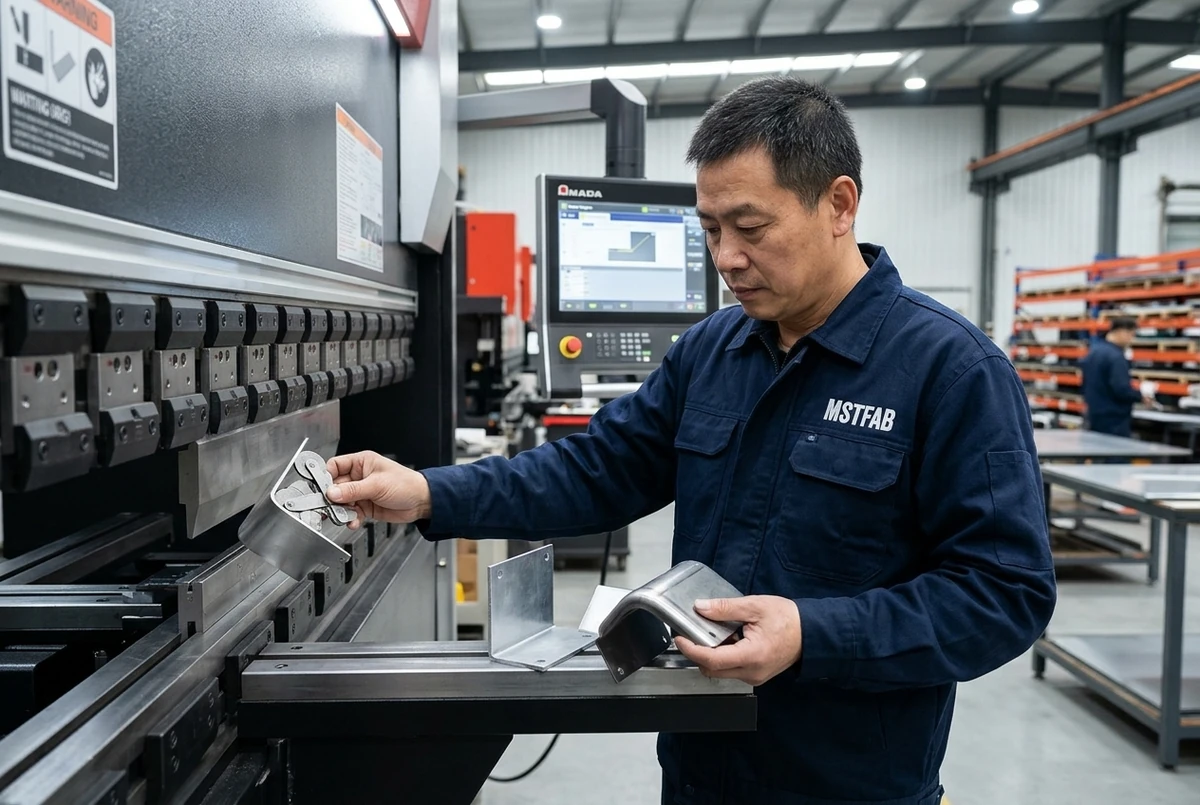
Figure 2: Precision CNC forming: bending 5052-H32 aluminum chassis components utilizing polyurethane protective die films to eliminate surface scuffs and tooling marks.
3. Precision CNC Press Brake Forming: Springback, K-Factors, and Non-Marking Tooling
Forming aluminum requires careful management of the material’s elastic recovery (springback) and surface sensitivity:
Low Modulus of Elasticity and Springback Management
Aluminum’s modulus of elasticity is approximately E = 70 GPa—roughly one-third that of structural steel (E = 205 GPa). Because springback is inversely proportional to elastic modulus (Delta_theta proportional to sigma_y / (E * T)), aluminum experiences significantly higher angular springback than mild steel (typically 2.0 to 4.5 degrees for 5052-H32, and up to 6.0 degrees for 6061-T6):
- Overbending Compensation: MSTFAB’s press brakes utilize acute 80-degree or 85-degree V-dies to overbend flanges by 3 to 5 degrees, allowing the metal to relax elastically to exact nominal 90.0-degree angles upon punch retraction.
- Real-Time Laser Angle Correction: Optical laser angle sensors mounted on the press brake continuously track flange angular deflection during the downward stroke, dynamically altering punch bottom dead center to compensate for coil-to-coil yield strength swings.
Empirical K-Factors and Minimum Bend Radii
MSTFAB enforces strict empirical K-factors to ensure multi-bend flat blank dimensions develop with zero accumulation error:
- 5052-H32: K = 0.44 (Recommended inside bend radius: R = 1.0 * T to 1.5 * T)
- 6061-T6: K = 0.40 (Recommended inside bend radius: R = 2.5 * T to 3.5 * T)
- 3003-H14: K = 0.46 (Recommended inside bend radius: R = 0.5 * T to 1.0 * T)
Non-Marking Tooling for Cosmetic Panels
Aluminum is a soft metal prone to tool galling and friction scuffs when dragged across hardened steel V-die entry shoulders. To preserve pristine Class A cosmetic surfaces for architectural and medical applications, MSTFAB utilizes:
- Polyurethane Die Inserts & Tapes: 80-micron elastomeric urethane film placed over die shoulders prevents metal-to-metal contact, eliminating horizontal die witness lines.
- Large-Radius Polished Punches: Mirror-polished punch tips (Ra < 0.2 um) eliminate localized stress concentrations that cause outer-fiber orange-peel micro-fissuring.
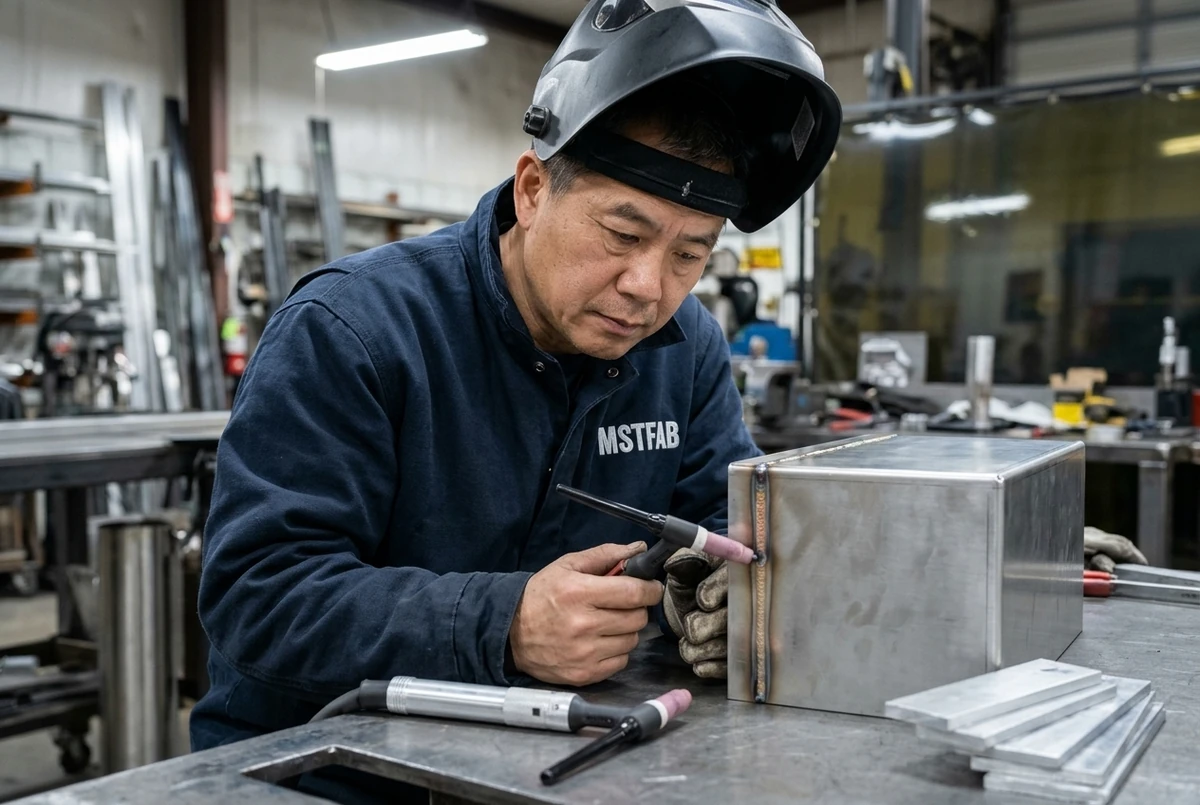
Figure 3: Welding excellence: executing AC TIG corner welds on an aluminum electronic enclosure, achieving smooth ripple-free fillets with 100% penetration and zero porosity.
4. Advanced Aluminum Welding: AC TIG, Robotic CMT, Filler Alloys (4043 vs. 5356), and Oxide Removal
Welding aluminum requires mastering the physics of its refractory native oxide layer. Fresh aluminum immediately forms a tenacious surface film of aluminum oxide (Al2O3):
- Aluminum Oxide Melting Point: 2072 deg C (3762 deg F)
- Base Aluminum Melting Point: 660 deg C (1220 deg F)
If welding is attempted without stripping this oxide layer, the base metal melts beneath the oxide skin while the skin remains solid, preventing weld puddle fusion and causing catastrophic cold-shut defects. MSTFAB utilizes alternating current (AC) TIG welding and robotic Cold Metal Transfer (CMT) to guarantee flawless fusion:
1. AC TIG Welding with Cathodic Cleaning
In AC TIG welding, the alternating current cycles between Electrode Positive (EP) and Electrode Negative (EN):
- Cathodic Cleaning Half-Cycle (EP): Electrons flow from the workpiece to the tungsten electrode. Heavy positively charged argon ions bombard the aluminum surface, shattering and blasting away the refractory oxide layer (cathodic etching).
- Penetration Half-Cycle (EN): Electrons flow into the workpiece, concentrating intense heat to melt base aluminum and establish deep penetration.
2. Robotic Cold Metal Transfer (CMT) & Pulsed MIG
For high-volume production of aluminum enclosures and frames, MSTFAB deploys robotic CMT welding cells. CMT incorporates automated mechanical wire retraction synchronized with electrical droplet detachment. By withdrawing the wire droplet at zero current, heat input is reduced by up to 50% compared to conventional pulsed MIG, virtually eliminating burn-through on thin sheet (T = 1.2 mm to 2.0 mm) and cutting thermal distortion by two-thirds.
3. Filler Wire Metallurgy: ER4043 vs. ER5356
Selecting the proper filler wire dictates weld strength, ductility, crack resistance, and post-weld anodizing appearance:
| Performance Feature | AWS ER4043 (Al-Si, 5% Silicon) | AWS ER5356 (Al-Mg, 5% Magnesium) | Engineering Application Guideline |
|---|---|---|---|
| Weld Crack Sensitivity | Superior: Silicon improves fluidity and lowers solidification shrinkage | Moderate: Higher shrinkage stress on crack-sensitive 6061 joints | Use ER4043 for highly restrained joints and complex frames |
| Shear & Tensile Strength | Lower (Shear strength approx 105 MPa) | Higher: Shear strength approx 180 MPa (70% stronger) | Use ER5356 for structural load-bearing brackets and chassis |
| Post-Weld Anodize Color Match | Poor: Silicon turns dark gray / charcoal black upon anodizing | Excellent: Matches base aluminum 5052/6061 bright silver | Mandatory to specify ER5356 if parts will undergo clear anodizing |
| High-Temperature Service (> 65 deg C) | Suitable: Stable up to 150 deg C | Unsuitable: Mg2Al3 precipitates cause stress corrosion cracking | Never use ER5356 in continuous service environments > 65 deg C |
5. Secondary CNC Milling and Extrusion Integration for Hybrid Assemblies
Many advanced aluminum assemblies cannot be produced solely by sheet metal bending. MSTFAB bridges sheet metal forming with precision 4-axis and 5-axis CNC machining under one roof:
- Secondary Machining on Formed Enclosures: High-speed CNC machining centers mill critical O-ring gasket gland grooves, chamfered connector cutouts, and tight-tolerance (+/- 0.012 mm) bearing bores directly into 3D-formed sheet metal chassis.
- Aluminum Extrusion Integration: We cut, notch, machine, and weld custom architectural and heatsink extrusions (6063-T5 / 6061-T6) together with sheet metal panels to create hybrid chassis combining deep cooling fins with lightweight sheet covers.
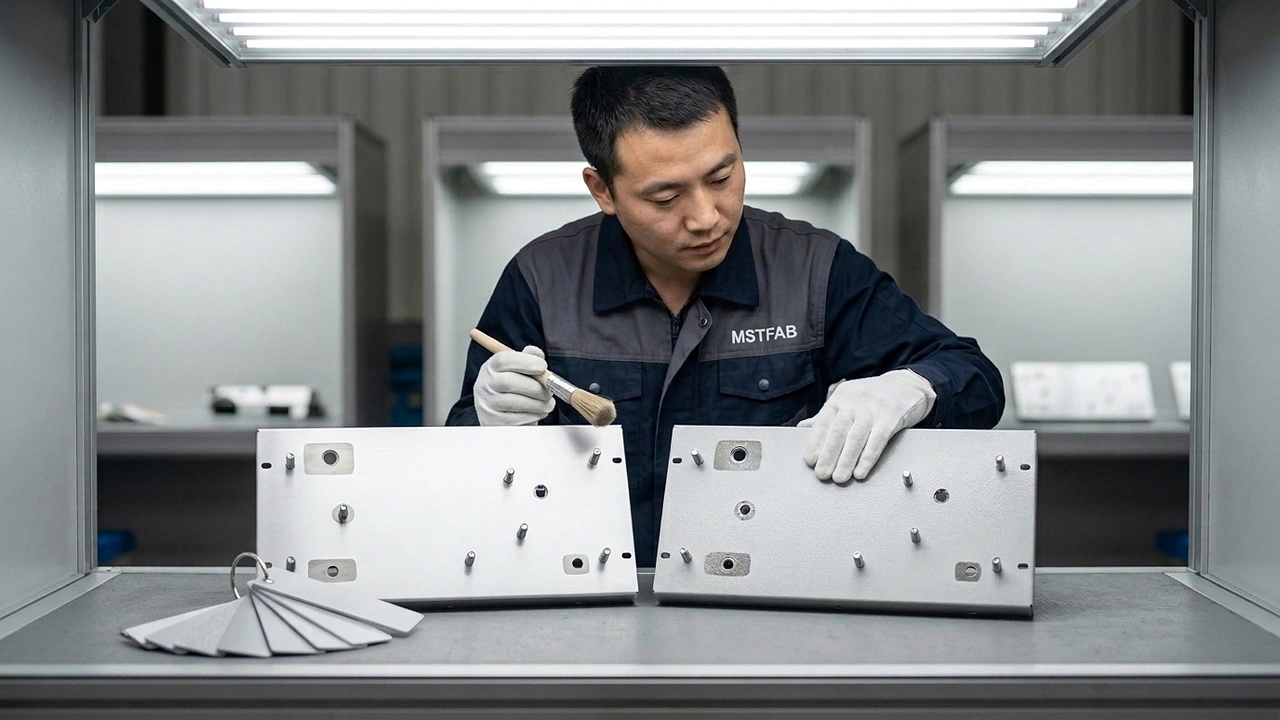
Figure 4: Aesthetic finishing: inspecting Type II black and clear anodized aluminum front panels featuring laser etching and precision silk-screened graphics.
6. Surface Finishing & Corrosion Defense: Anodizing (Type II / III), Chem-Film, and Powder Coating
Aluminum offers a wider range of high-performance aesthetic and functional surface finishes than any other engineering metal:
1. Anodizing per MIL-A-8625 / ISO 7599
Anodizing is an electrochemical passivation process that converts the surface aluminum into a dense, wear-resistant, integrated aluminum oxide ceramic film:
- Type II (Sulfuric Acid Anodizing): Coating thickness ranges from 10 to 25 microns (0.0004″ to 0.001″). Highly porous upon exit from the acid bath, it readily absorbs organic dyes (black, blue, red, gold) prior to hydrothermal nickel acetate sealing. It provides excellent corrosion resistance (1,000+ hrs salt spray) and Class A cosmetic appearance for electronic front panels.
- Type III (Hardcoat Anodizing): Conducted at near-freezing electrolyte temperatures (0 to 4 deg C) with high current densities. Produces a dense, ultra-hard ceramic layer (50 to 75 microns thick) with a micro-hardness exceeding 60 to 70 HRC (equivalent to hardened tool steel). Hardcoat anodize provides extreme sliding abrasion resistance for aerospace pistons, slides, and military enclosures.
2. Chemical Conversion Coating (Chem-Film / Alodine per MIL-DTL-5541)
For applications where electrical conductivity and EMI shielding must be preserved, anodizing is unsuitable because aluminum oxide is an electrical insulator. MSTFAB applies hexavalent-free trivalent chemical conversion coatings (SurTec 650 / Bonderite / Alodine 5200):
- MIL-DTL-5541 Class 3: Extremely thin barrier film providing corrosion protection while maintaining very low electrical contact resistance (< 5000 micro-ohms per square inch), mandatory for electrical grounding pads and RF shielding enclosures.
- MIL-DTL-5541 Class 1A: Thicker conversion film optimized as a corrosion-preventive primer beneath powder coating or liquid paint.
3. Electrostatic Powder Coating
When vibrant opaque colors, smooth orange-peel textures, or extreme outdoor UV resistance are required, electrostatic powder coating applies 70 to 100 microns of architectural TGIC-free polyester or fluoropolymer powder over a conversion-coated aluminum substrate, passing 3,000+ hour salt spray testing with zero blistering.
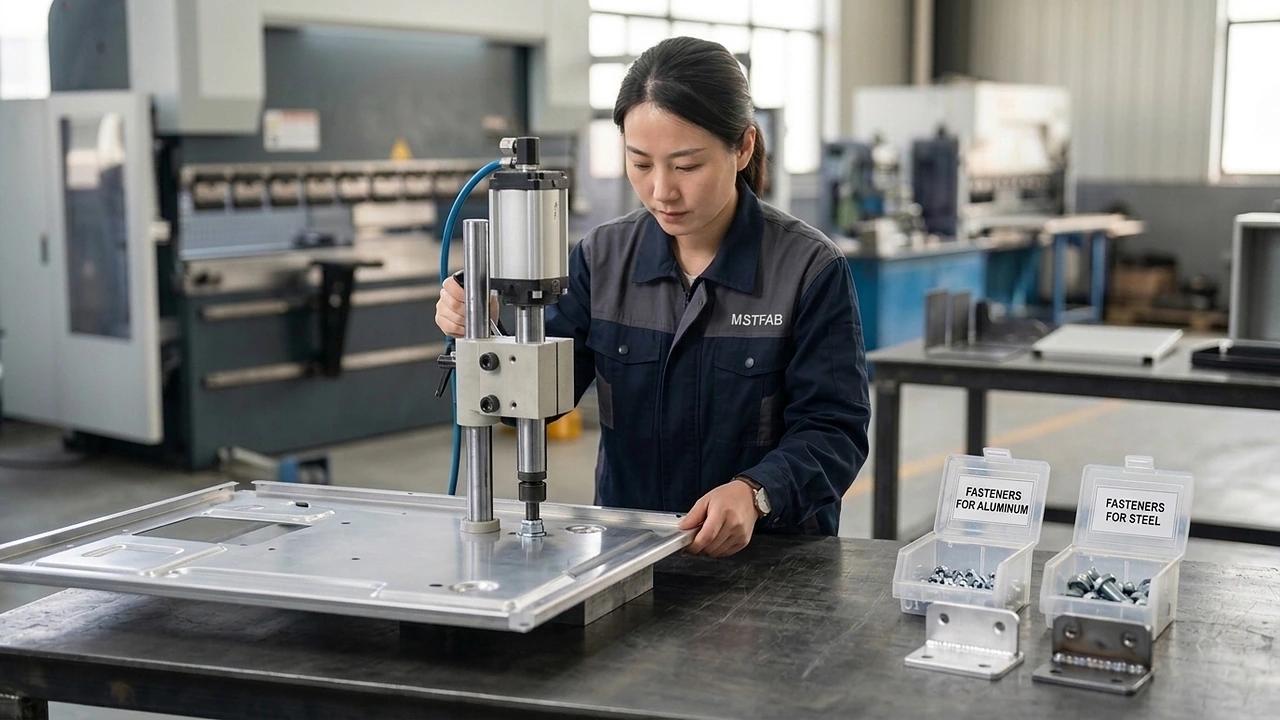
Figure 5: Hardware insertion: automated Haeger hydraulic insertion press installing self-clinching stainless steel studs and threaded standoffs into aluminum 5052-H32 chassis panels.
7. Hardware Insertion & Fastener Engineering: Clinch Fasteners (PEM) and Thread Inserts
Because aluminum is a relatively soft metal, tapping threads directly into thin aluminum sheet results in low stripping torque and galling under repeated fastener removal. MSTFAB provides dedicated fastening solutions:
1. Self-Clinching Hardware for Aluminum (PEM Fasteners)
Self-clinching fasteners must be harder than the host sheet metal to force sheet material to cold-flow into their undercut retention groove:
- Fastener Material Selection: When inserting into aluminum (hardness typically HRB 50 to 65), standard hardened 300-series stainless steel clinch nuts (e.g., PEM Type SP or Type S) must be used. Never specify soft 18-8 stainless or carbon steel hardware that will deform during insertion.
- Hole Sizing & Clearances: Mounting holes must be laser-cut or punched to strict tolerances (+0.08 mm / -0.00 mm) to guarantee rated push-out force (> 700 N) and torque-out resistance (> 4.5 N.m for M4 nuts).
2. Helical Wire Thread Inserts (Heli-Coil / Keensert)
In CNC machined blocks, structural bosses, and heavy mounting brackets where bolts are frequently torqued, MSTFAB installs precision 18-8 stainless steel wire inserts (Heli-Coils) or heavy-duty key-locking Keenserts to eliminate aluminum thread galling and double thread pull-out load capacity.
8. Critical DFM Engineering Rules for Formed & Machined Aluminum Components
Design engineers should apply the following Design for Manufacturability (DFM) rules when modeling aluminum components:
Rule 1: Minimum Flange Length (L_min)
To ensure the aluminum blank bridges across the press brake V-die opening without edge slippage:
L_min >= 4 * T + R
Rule 2: Minimum Distance from Hole to Bend Tangent (D_min)
Because aluminum undergoes significant plastic flow near the bend arc, holes placed too close will stretch into an oval. Maintain:
D_min >= 2.5 * T + R
Rule 3: Thermal Expansion Management
Aluminum has a high coefficient of thermal expansion (alpha = 23 * 10^-6 / K)—nearly double that of mild steel (12 * 10^-6 / K) and concrete (10 * 10^-6 / K). In large assemblies (such as outdoor architectural facades or long server frames) where aluminum mates with steel or glass, designers must incorporate slotted mounting holes and compliant silicone gaskets to accommodate differential thermal expansion without panel oil-canning or fastener shear.
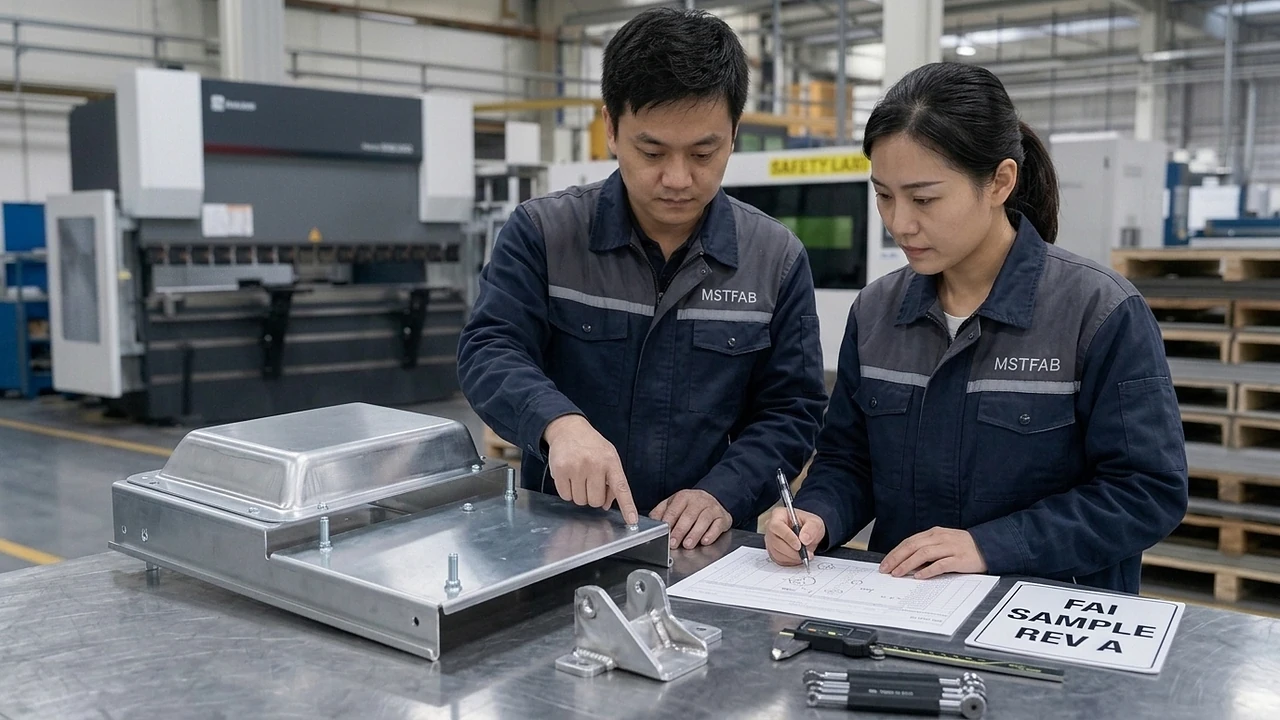
Figure 6: Quality validation: conducting First Article Inspection (FAI) on a 5052-H32 aluminum avionics enclosure, certifying GD&T true position and surface flatness on a CMM.
9. Quality Metrology: CMM Inspection, Anodize Eddy-Current Testing, and Seal Integrity
MSTFAB enforces comprehensive quality control certified under ISO 9001:2015 and ISO 13485:2016 for medical and industrial applications:
- Bridge CMM Touch-Trigger Probing: Automated Zeiss coordinate measuring machines probe multi-plane hole centerlines, perpendicularity, and profile tolerances to +/- 0.015 mm.
- Eddy-Current Coating Thickness (ASTM B244 / ISO 2360): Digital eddy-current gauges verify non-conductive anodic oxide film thickness (10 to 60 microns) across flat faces and formed edges.
- Anodize Seal Integrity Dye Testing (ASTM B136): Validates hydrothermal seal quality by exposing the anodic coating to concentrated acid followed by dye solution; zero color absorption confirms 100% complete seal closure.
- Surface Electrical Resistance Testing (MIL-DTL-5541): Digital micro-ohmmeters confirm surface contact resistance < 5000 micro-ohms on chemical conversion coated grounding zones.
10. Comprehensive Engineering Data Matrices and Manufacturing Benchmarks
The following engineering data matrices summarize mechanical properties, bend parameters, and surface finish specifications for aluminum manufacturing:
Table 1: Comprehensive Aluminum Alloys Comparison Matrix
| Alloy & Temper | Yield Strength (MPa) | Tensile Strength (MPa) | Elongation (%) | Min. Bend Radius (R_min) | Primary Application |
|---|---|---|---|---|---|
| 5052-H32 | 195 | 230 | 12% – 18% | 1.0 * T to 1.5 * T | Premier sheet metal alloy for electronics, marine, chassis |
| 6061-T6 | 275 | 310 | 8% – 12% | 2.5 * T to 3.5 * T | Structural frame weldments, CNC machined housings, extrusions |
| 3003-H14 | 145 | 160 | 16% – 22% | 0.5 * T to 1.0 * T | Deep drawing, seamless covers, heat exchangers, spun cowls |
| 5083-H116 | 230 | 315 | 10% – 16% | 2.0 * T to 2.5 * T | Heavy marine vessel structures, cryogenic storage vessels |
| 7075-T6 | 505 | 570 | 8% – 11% | Do not cold bend | Aerospace structural fittings, high-stress CNC machined ribs |
Table 2: Anodizing & Surface Finishing Specification Matrix
| Process & Specification | Thickness (um) | Hardness | Electrical Conductivity | Corrosion Resistance | Primary Purpose |
|---|---|---|---|---|---|
| Type II Anodize (MIL-A-8625) | 10 – 25 um | approx 35 HRC | Insulator (> 10^12 ohm.cm) | 1,000 hrs salt spray | Class A decorative color (black, clear, gold, red) |
| Type III Hardcoat (MIL-A-8625) | 50 – 75 um | 60 – 70 HRC | Dielectric breakdown > 1000V | 2,000 hrs salt spray | Extreme sliding wear resistance, military hardware |
| Chem-Film Class 3 (MIL-DTL-5541) | < 1.0 um | N/A (Thin film) | Conductive: < 5000 uOhm/in2 | 336 hrs salt spray | EMI/RFI shielding, electrical grounding continuity |
| Architectural Powder Coat | 70 – 110 um | 2H – 3H pencil | Complete insulator | 3,000+ hrs salt spray | Outdoor UV resistance, custom textures, high gloss |
11. Real-World OEM Case Studies: High-Performance Aluminum Validations
Case Study 1: Aerospace In-Flight Avionics Server Enclosure
- Application: 3U airborne satellite communications compute blade chassis.
- Material: 1.5 mm Aluminum 5052-H32 with selective surface treatment: Type II Black Anodize on exterior panels with masked MIL-DTL-5541 Class 3 chem-film on internal grounding planes.
- Customer Problem: Previous vendor had severe RF leakage and inconsistent electrical ground resistance because black anodizing had inadvertently coated contact bosses, failing MIL-STD-461 EMI compliance testing.
- MSTFAB Solution: Deployed precision robotic silicone masking over all electrical bonding pads prior to anodizing, followed by automated trivalent chem-film conversion. Switched hardware to stainless steel PEM Type SP clinch nuts.
- Results: Electrical ground contact resistance measured < 850 micro-ohms across all 48 grounding pads. Full MIL-STD-461 EMI shielding certification passed on the first test cycle.
Case Study 2: Marine Vessel Mast-Mounted Radar Antenna Console
- Application: Weatherproof IP67 marine radar transceiver housing exposed to continuous salt spray, high winds, and intense UV.
- Material: 2.5 mm Aluminum 5052-H32 with robotically welded corner seams and Class A super-durable white polyester powder coating.
- Customer Problem: Welded corners developed micro-cracks and pinhole leaks during marine vibration trials, allowing salt water ingress and destroying expensive transceiver microwave electronics.
- MSTFAB Solution: Transitioned corner welding to robotic CMT (Cold Metal Transfer) with AWS ER5356 filler wire, cutting thermal heat input and eliminating joint micro-fissures. Implemented 100% helium mass-spectrometer leak testing prior to powder coating.
- Results: Achieved certified IP67 ingress protection with zero leak failures across 1,800 marine units deployed globally.
Case Study 3: Commercial Electric Vehicle (EV) Rapid-Swap Battery Module Tray
- Application: High-rigidity lightweight battery tray supporting 120 kg of lithium-ion cells while serving as an active liquid cooling plate.
- Material: Hybrid assembly: 3.0 mm 5052-H32 sheet metal base with integrated 6063-T5 aluminum extruded cooling channels and secondary 4-axis CNC machined O-ring seals.
- Customer Problem: Heat distortion from manual MIG welding caused 3.8 mm of out-of-flatness across the cooling plate surface, preventing uniform thermal contact with the battery cells.
- MSTFAB Solution: Re-engineered assembly for continuous robotic CMT pulsed welding in a rigid pneumatic cooling fixture. Finished mating surfaces on a 4-axis CNC bridge mill in a single clamping setup.
- Results: Surface flatness held within 0.25 mm across the entire 1.2-meter tray. Thermal conductivity between cooling channels and battery cells improved by 34%, eliminating localized thermal hot-spots.
12. Frequently Asked Technical Questions (40 Detailed Engineering Q&As)
Q1: What is the main metallurgical difference between 5052-H32 and 6061-T6 aluminum?
5052 is alloyed with magnesium and strain-hardened; it offers superior ductility, fatigue life, and corrosion resistance, making it ideal for sheet metal bending. 6061 is alloyed with magnesium and silicon and precipitation-hardened; it has 40% higher yield strength and excels in CNC machining and structural frames, but requires generous bend radii to avoid cracking.
Q2: Why does aluminum require AC current rather than DC current for TIG welding?
Aluminum forms a refractory oxide film (Al2O3) that melts at 2072 deg C, far above base aluminum (660 deg C). AC TIG welding provides a cathodic cleaning half-cycle (Electrode Positive) that blasts away this oxide skin, while the negative half-cycle provides deep penetration into base aluminum.
Q3: When should I choose ER4043 vs ER5356 welding filler wire?
Use ER4043 (Al-Si) for crack-sensitive 6061 weldments and complex restrained joints. Use ER5356 (Al-Mg) when high joint shear strength is required, for 5052 sheet weldments, and whenever the assembly will undergo post-weld clear anodizing (ER4043 turns dark gray after anodizing).
Q4: Why does aluminum exhibit more angular springback during bending than steel?
Aluminum’s elastic modulus (E = 70 GPa) is one-third that of steel (E = 205 GPa). Because elastic recovery is inversely proportional to modulus, aluminum springs back roughly 3 times more than mild steel, requiring 2 to 5 degrees of press brake overbending compensation.
Q5: What is the minimum recommended inside bend radius for 6061-T6 aluminum sheet?
Due to its lower ductility (elongation ~8%), 6061-T6 requires a minimum inside bend radius of R >= 2.5 * T to 3.5 * T. Bending tighter than this will cause outer-fiber tensile cracking. For tight bends, form in the 6061-O temper and artificially age to T6 post-forming.
Q6: How does MSTFAB prevent tooling scuffs on cosmetic aluminum panels?
We deploy polyurethane V-die inserts, 80-micron protective urethane die tapes, mirror-polished punch tips, and low-tack protective surface masking films that eliminate metal-to-metal contact during press brake strokes.
Q7: What is the difference between Type II and Type III anodizing?
Type II (sulfuric anodize) is 10-25 um thick and used for decorative colors and moderate corrosion resistance. Type III (hardcoat) is conducted at near-freezing temperatures, producing a dense 50-75 um ceramic layer with hardness exceeding 60 HRC for extreme sliding wear.
Q8: Is an anodized surface electrically conductive?
No. Anodic oxide (Al2O3) is an electrical insulator with high dielectric breakdown voltage. For electrical grounding and EMI shielding, specify selective chemical conversion coating (MIL-DTL-5541 Class 3) or mask contact pads prior to anodizing.
Q9: What is Robotic Cold Metal Transfer (CMT) welding and what are its advantages?
CMT mechanically retracts the welding wire during droplet transfer at zero current, slashing heat input by 50%. It enables spatter-free, low-distortion welding on thin aluminum sheet (1.2 mm to 2.5 mm) with zero burn-through.
Q10: What clinch fasteners (PEM) should be specified for aluminum chassis?
Use hardened stainless steel self-clinching fasteners (e.g. PEM Type SP or Type S). The host aluminum sheet must be softer than the fastener to ensure material cold-flows into the undercut ring without deforming the fastener.
Q11: Why is nitrogen assist gas essential when laser cutting aluminum?
High-pressure nitrogen (18 to 25 bar) mechanically expels molten metal without oxidation, producing shiny, burr-free edges that can be welded or anodized immediately without mechanical deburring.
Q12: How does material grain direction affect aluminum press brake bending?
Bending perpendicular to the rolling grain direction allows tightest bend radii and minimizes cracking. Bending parallel to the grain aligns tensile stresses with grain boundaries, increasing cracking tendency by up to 40%.
Q13: What dimensional tolerances can be held on precision CNC-formed aluminum parts?
MSTFAB holds linear flange dimensions within +/- 0.12 mm and angular tolerances within +/- 0.25 degrees on CNC press brakes equipped with active laser angle compensation.
Q14: How do you prevent thread stripping in aluminum components?
We install stainless steel self-clinching PEM nuts in thin sheet metal and stainless steel Heli-Coil or Keensert threaded wire inserts in CNC machined blocks to eliminate thread stripping and galling.
Q15: Can aluminum 7075-T6 be formed on a press brake?
7075-T6 has high yield strength (> 500 MPa) and very low room-temperature ductility; cold forming will result in catastrophic brittle fracture. It is used primarily for CNC machined components.
Q16: How do you verify anodic coating thickness on aluminum parts?
We use digital eddy-current coating thickness gauges compliant with ASTM B244 and ISO 2360, measuring oxide layer depth across flat surfaces and formed edges.
Q17: What is the purpose of hydrothermal sealing in the anodizing process?
Anodized aluminum has millions of open microscopic pores. Hydrothermal nickel acetate sealing hydrates the aluminum oxide into boehmite, expanding crystal volume and sealing the pores to lock in dye and block corrosion.
Q18: How does thermal expansion affect aluminum mating with steel structures?
Aluminum expands twice as fast as steel (23 vs 12 * 10^-6 / K). Assemblies must include slotted mounting holes, shoulder bolts, or flexible gaskets to prevent panel buckling and fastener shear during temperature swings.
Q19: Can MSTFAB perform secondary 5-axis CNC machining on formed aluminum sheet chassis?
Yes. We mount pre-formed sheet metal chassis into custom CNC vacuum or modular fixtures to mill precision O-ring grooves, tight-tolerance bores (+/- 0.012 mm), and chamfered edges in a single setup.
Q20: What is the minimum flange length required for air bending aluminum?
The standard DFM guideline is L_min >= 4 * T + R to ensure the sheet bridges both die shoulders without slipping into the V-die opening.
Q21: How do you avoid galvanic corrosion between aluminum chassis and steel hardware?
Use zinc-nickel plated carbon steel hardware or 300-series stainless steel isolated with UV-stable nylon or EPDM non-conductive washers to prevent electrical bridging in humid environments.
Q22: What is chemical conversion coating (MIL-DTL-5541) and why is it used?
Chem-film (Alodine/SurTec) passivates aluminum, providing corrosion resistance while maintaining electrical conductivity (< 5000 uOhm/in2) for EMI shielding and serving as a primer for powder coat.
Q23: What is the typical K-factor used for 5052-H32 aluminum air bending?
For standard air bending of 5052-H32 with V = 6 * T to 8 * T, the empirical K-factor is K = 0.44. For tighter radii or bottoming, it shifts toward K = 0.46.
Q24: What quality management certifications does MSTFAB hold for aluminum fabrication?
MSTFAB is certified under ISO 9001:2015 and ISO 13485:2016, guaranteeing strict process validation, tooling calibration, and unbroken raw material heat lot mill test report (MTR) traceability.
Q25: Why must holes be positioned away from the bend tangent line?
Material in the plastic deformation zone stretches during bending. Any hole closer than D < 2.5 * T + R will deform into an egg shape, preventing bolt insertion and hardware seating.
Q26: What bead blasting media is recommended for pre-anodize cosmetic preparation?
Fine glass bead or ceramic bead blasting (mesh 100 to 170) at low pressure produces a uniform satin matte finish that hides light tooling marks and eliminates directional grain texture before anodizing.
Q27: How does 5052 aluminum compare to stainless steel in weight and thermal performance?
5052 has approximately one-third the weight of stainless steel (density 2.68 g/cm3 vs 8.00 g/cm3) and roughly 9 times higher thermal conductivity (138 W/m.K vs 16 W/m.K), making it vastly superior for mobile equipment and heat dissipation.
Q28: Can MSTFAB apply silk screening and laser engraving on finished aluminum panels?
Yes. We offer precision multi-color silk screening, pad printing, and high-contrast fiber laser engraving directly on anodized or powder-coated panels for logos, schematics, and dial scales.
Q29: How do you package custom aluminum parts for international ocean transport?
Parts are protected with low-tack surface film, packed into custom CNC-routed polyethylene foam trays inside vapor barrier bags with desiccant, and secured in ISPM-15 certified wooden crates.
Q30: What is the typical lead time for aluminum sheet metal prototypes and volume orders?
Prototypes typically ship within 5 to 7 working days. Production volumes (500 to 10,000 units) ship within 3 to 4 weeks depending on hardware and anodizing specifications.
Q31: Can aluminum extrusions be welded directly to formed sheet metal panels?
Yes. By matching alloys (e.g. 6063-T5 extrusions with 5052 or 6061 sheet) and selecting ER5356 or ER4043 filler wire, we produce hybrid structural chassis with high stiffness and integrated cooling fins.
Q32: How do you verify weld penetration and seal integrity on aluminum enclosures?
We use helium mass-spectrometer leak detectors for hermetic enclosures, dye penetrant inspection (ASTM E165) for surface defects, and cross-sectional macro-etch testing for structural weld roots.
Q33: Why is 3003 aluminum preferred for deep drawing and spun parts?
3003 contains manganese, providing superior plastic elongation (> 20%) and low work-hardening, allowing large draw ratios without intermediate annealing cycles.
Q34: How does MSTFAB ensure color uniformity across multi-piece anodized enclosures?
We process all mating enclosure components within the same anodizing rack batch, tightly control bath temperature (+/- 0.5 deg C) and current density, and verify color delta E < 0.8 using digital spectrophotometers.
Q35: What 3D CAD formats are preferred when requesting a quotation for aluminum components?
We accept 3D STEP (AP214/AP242), IGES, and SolidWorks CAD files, paired with 2D PDF engineering drawings specifying tolerances, alloy grade, grain direction, and surface finishing specifications.
Q36: How can global OEMs request a quotation for custom aluminum parts from MSTFAB?
Submit your CAD models and drawing packages through our secure RFQ portal. Our DFM engineering team will review your alloy specifications, optimize bend sequences and machining toolpaths, and return a comprehensive quotation within 24 to 48 hours.
Q37: How does Friction Stir Welding (FSW) compare to traditional fusion welding for aluminum cold plates?
Friction Stir Welding is a solid-state joining process that uses a rotating non-consumable pin tool to plastically soften and intermix aluminum plates without melting the metal. Because operating temperatures remain below the melting point, FSW eliminates solidification porosity, hot cracking, and dramatic strength loss in the heat-affected zone. It produces hermetic, high-strength liquid cooling plates with virtually zero thermal distortion.
Q38: What causes black smut during aluminum caustic etching and how is it removed?
When aluminum alloys containing copper, silicon, or iron (such as 6061 or 2024) undergo hot sodium hydroxide caustic etching to clean the surface, aluminum dissolves while the insoluble alloying elements remain on the surface as a dark residue called smut. MSTFAB removes smut completely by immersing the etched parts in an acidic deoxidizer/desmutting bath (nitric acid or ferric sulfate-based solution) before anodizing or conversion coating.
Q39: What is the dielectric breakdown voltage of Type III hardcoat anodizing?
A properly sealed 50-micron (0.002″) Type III hardcoat anodic oxide film provides an exceptional electrical dielectric barrier, typically exhibiting a dielectric breakdown voltage ranging from 1,000 to 2,000 Volts AC. This high electrical insulating capability makes hardcoat anodize ideal for high-voltage power electronics chassis, heat sink mounting plates, and aerospace motor housings.
Q40: How does MSTFAB prevent stress corrosion cracking (SCC) in marine aluminum structures?
In high-magnesium aluminum alloys like 5083, operating temperatures above 65 deg C can cause continuous beta-phase (Mg2Al3) network precipitation along grain boundaries, sensitizing the metal to intergranular stress corrosion cracking under tensile loads. MSTFAB uses stabilized H116 or H321 tempers, controls welding interpass temperatures strictly below 65 deg C, and avoids high-magnesium filler wires in elevated-temperature environments.
Partner with MSTFAB for Precision Custom Aluminum Manufacturing
Eliminate bend cracking, weld porosity, anodize color mismatch, and assembly bottlenecks. Partner with MSTFAB for ISO 9001 and ISO 13485 certified aluminum sheet metal fabrication and CNC machining—backed by high-pressure nitrogen laser cutting, non-marking press brake forming, robotic AC TIG / CMT welding, and MIL-SPEC anodizing. Contact our engineering team today for a comprehensive DFM review and quotation.
 WeChat Contact
 WhatsApp Me Directly