
The Short Answer
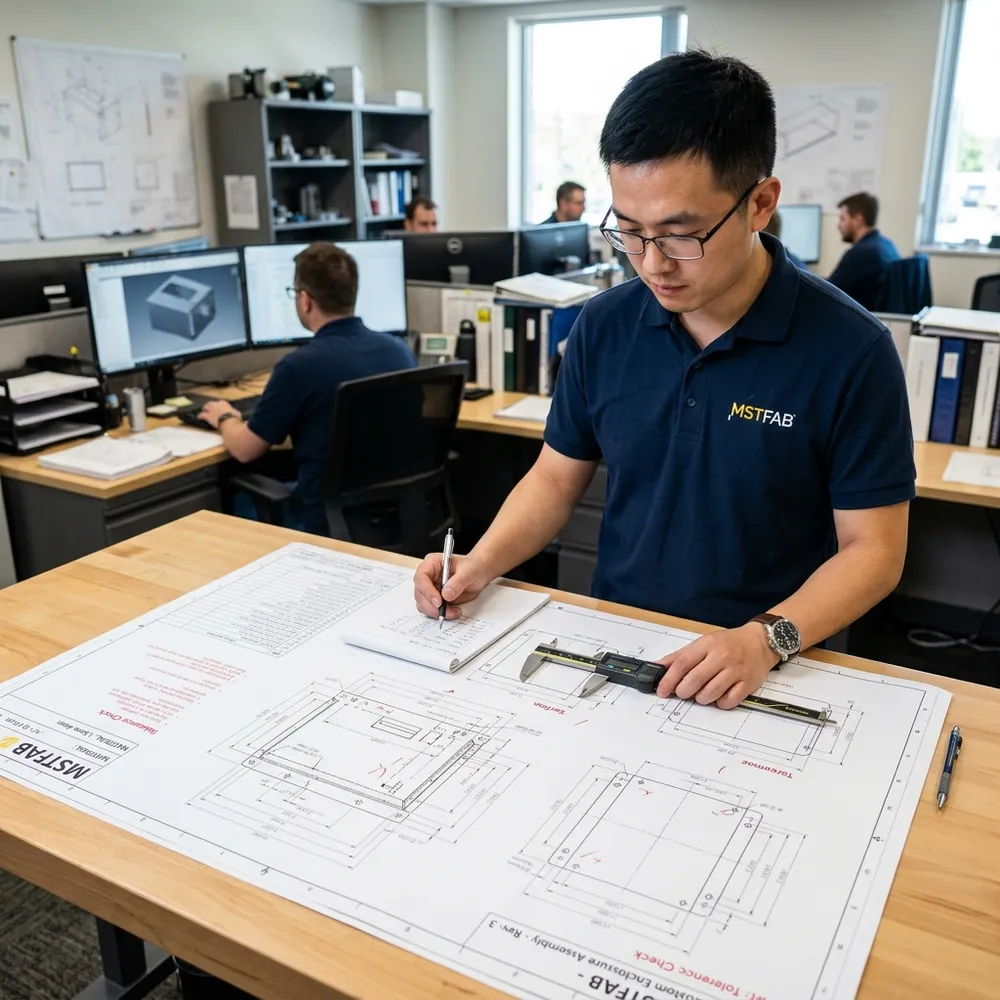
Consolidating your project with a single laser cutting, bending, welding, and mechanical assembly supplier eliminates inter-vendor tolerance stack-up, freight delays, and accountability gaps across complex sheet metal enclosures and chassis. Because laser flat-pattern compensation depends on press-brake V-die radii, and weld fit-up depends on consistent flange bend angles, managing all four stages plus powder coating and hardware installation under one roof guarantees that subassemblies bolt together cleanly on arrival.
Explore this guide
01 / Single-Source Process Accountability
Eliminate the tolerance stack-up that happens between disconnected job shops.
When a buyer splits a sheet metal build across a separate laser cutting bureau, a local bending shop, a contract welder, and an outside powder coater, nobody owns the final assembly fit. If a welded cabinet door binds against the frame, the welder blames the press-brake flange angle, the bender blames the laser flat blank, and the powder coater blames raw edge burrs.
As a turnkey precision sheet metal fabrication services partner supporting projects from a sheet metal prototype to batch production supplier through a custom sheet metal production run manufacturer and custom sheet metal parts mass production factory, we engineer every upstream step to serve final mechanical fit.
Closed-loop flat compensation
Laser blank dimensions are calculated directly from our in-house press brake V-dies and weld gap allowances rather than textbook CAD assumptions.
Self-fixturing weld prep
Interlocking laser tabs, relief notches, and calibrated bend angles ensure corners meet edge-to-edge without heavy gap-bridging filler welds.
Pre- & post-coat fit verification
Dry-fit checks before coating and controlled film thickness on hinge/mating rabbets guarantee smooth mechanical assembly after curing.
Volume flexibility: Whether you need a low volume custom sheet metal manufacturer for high mix low volume sheet metal fabrication, a small batch metal parts fabrication service, or a medium volume sheet metal fabrication supplier, keeping all processes under one quality system removes multi-vendor lead-time buffers.
02 / Laser Blanking to Press Brake Handoff
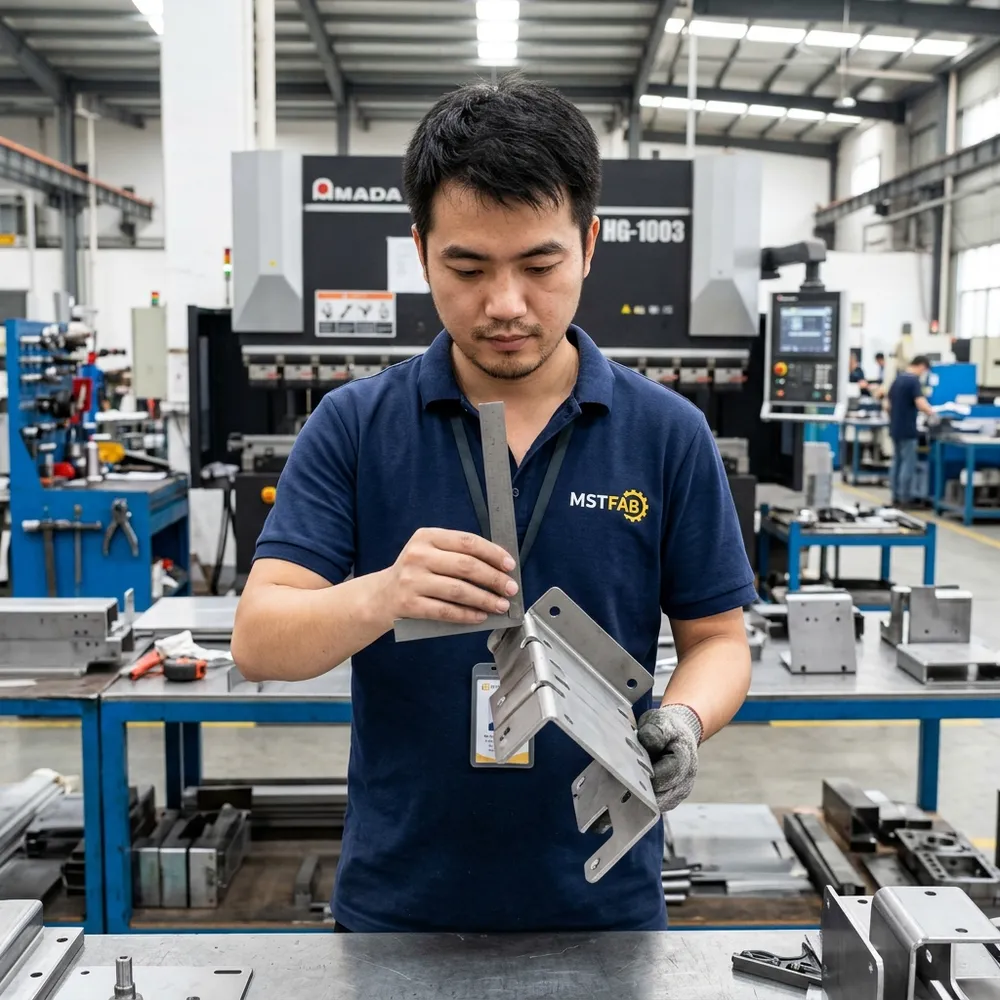
Calibrate laser flat patterns for real metal springback and V-die radii.
3D CAD models have zero springback, uniform wall thickness, and idealized tangent bends. Real sheet metal—especially 304/316L stainless steel and 5052-H32 aluminum—exhibits elastic springback and stretches across the neutral axis depending on rolling grain direction and V-die width.
- Incoming sheet lot verification: As a metal fabrication supplier with incoming material inspection, we check decimal sheet thickness and surface condition before releasing sheets to our laser cutting services cell.
- Corner miter and bend-relief geometry: For boxes and enclosure doors that will be corner-welded, we tailor laser corner miters and relief slots so bent flanges kiss cleanly with a uniform 0.1 mm to 0.3 mm root interface for autogenous or filler TIG welding.
- Hole-to-bend deformation protection: When mounting holes sit near a bend line, our DFM engineers recommend relief cuts or post-bend piercing/drilling so fasteners align effortlessly during mechanical assembly.
Our status as a precision sheet metal manufacturer with tolerance control and sheet metal manufacturer for repeatable production quality ensures that bent sub-components arrive at the welding bay square and repeatable.
03 / Low-Distortion Welding and Seam Finishing
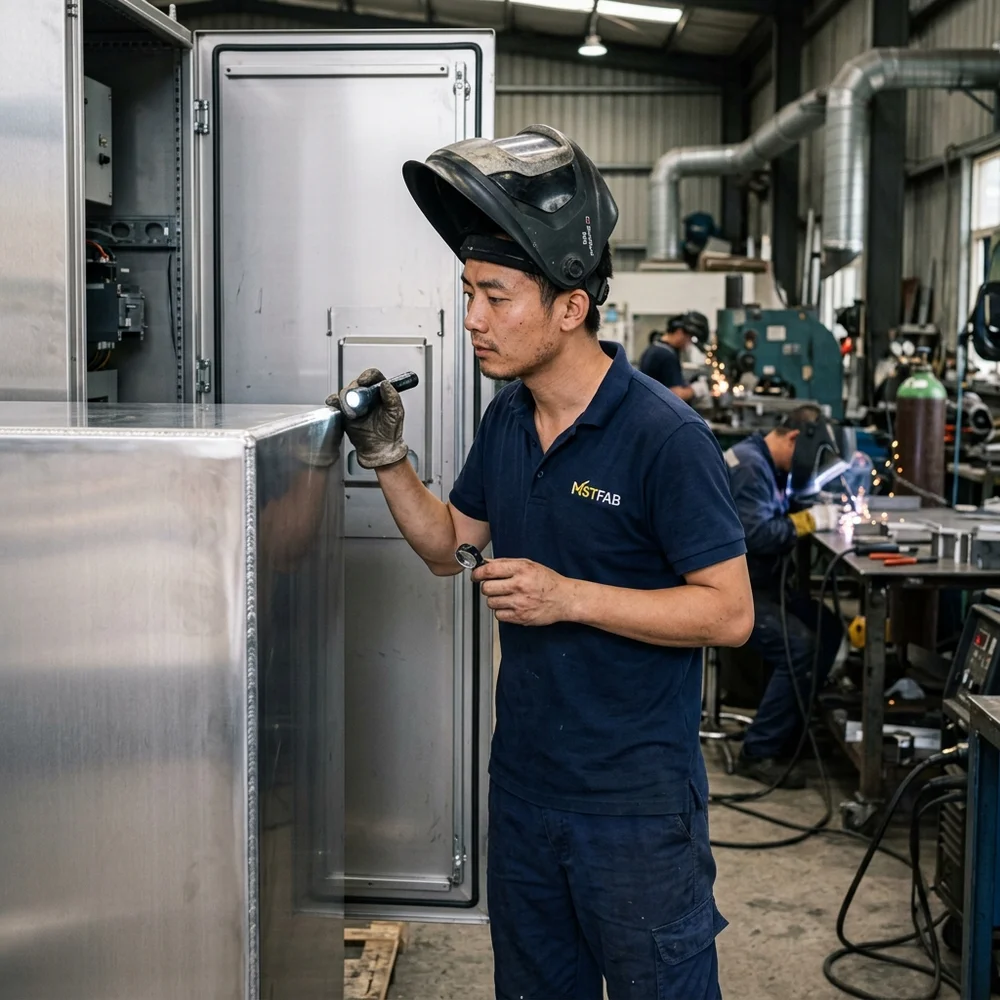
Prevent thermal warpage on welded frames, cabinets, and stainless shells.
Excessive heat input during welding is the primary cause of oil-canning on flat panels and twisted door openings. When upstream laser cutting and CNC bending hold tight corner fit-up, welders can use lower amperage, faster travel speeds, and minimal filler wire.
- Use TIG, pulsed MIG, and handheld fiber laser welding matched to material gauge and structural vs. cosmetic joint requirements.
- Clamp assemblies into rigid modular fixtures with copper chill blocks behind thin-gauge stainless and aluminum seams to draw heat away rapidly.
- Grind and multi-stage orbital sand exterior corner welds flush prior to powder coating or directional grain brushing so seams are invisible on finished enclosures.
By integrating our sheet metal welding services directly with upstream forming and downstream coating, we catch and correct any pinhole, undercut, or spatter before a single part enters the pretreatment wash line.
Explore our TIG, MIG, and laser sheet metal welding services →
04 / Sheet-Metal-Related Mechanical Assembly
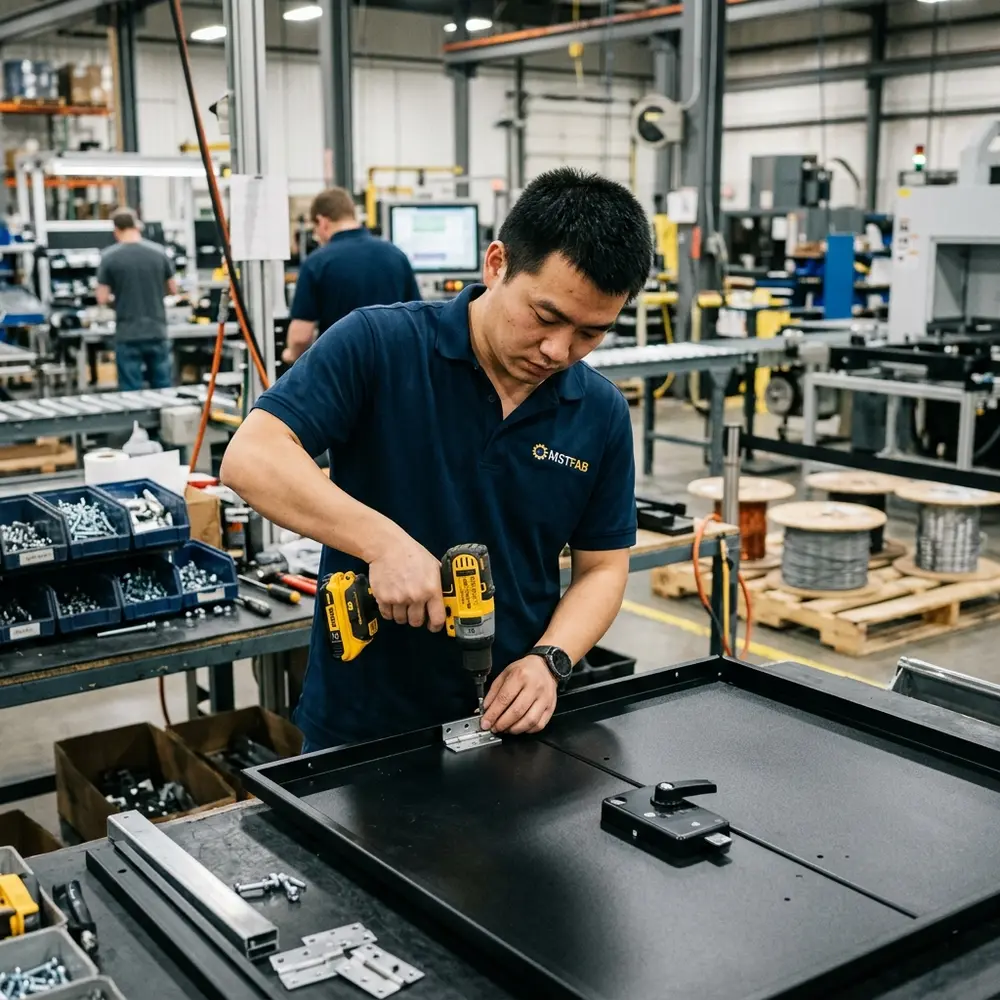
Deliver hardware-fitted, gasketed, and mechanically assembled enclosure shells.
Shipping loose panels and bags of fasteners forces your high-cost domestic technicians to spend hours pressing hardware, riveting slides, and aligning cabinet doors. Our mechanical assembly cells complete all sheet-metal-related hardware integration before export packing.
- Self-clinching & riveted hardware: Hydro-pneumatic installation of PEM nuts, flush studs, blind standoffs, cage nuts, structural blind rivets, and heavy projection weld nuts.
- Access hardware & mechanical sub-parts: Mounting of quarter-turn cam locks, compression latches, concealed hinges, gas struts, DIN rails, internal zinc-plated backplates, cooling louver filters, and polycarbonate viewing windows.
- Environmental sealing gaskets: Application of EPDM/neoprene closed-cell foam gasket strips, silicone extrusions, or conductive EMI shielding gaskets along door return flanges.
As a dedicated sheet metal fabrication supplier for recurring orders, we pre-assemble and test door swing, latch compression, and internal subplate bolt alignment on every unit.
05 / Integrated Workflow Control Matrix
Confirm five cross-process handoff checks before releasing an assembly RFQ.
Use this process control matrix to align your engineering drawing notes with our integrated laser, bend, weld, finish, and mechanical assembly workflow.
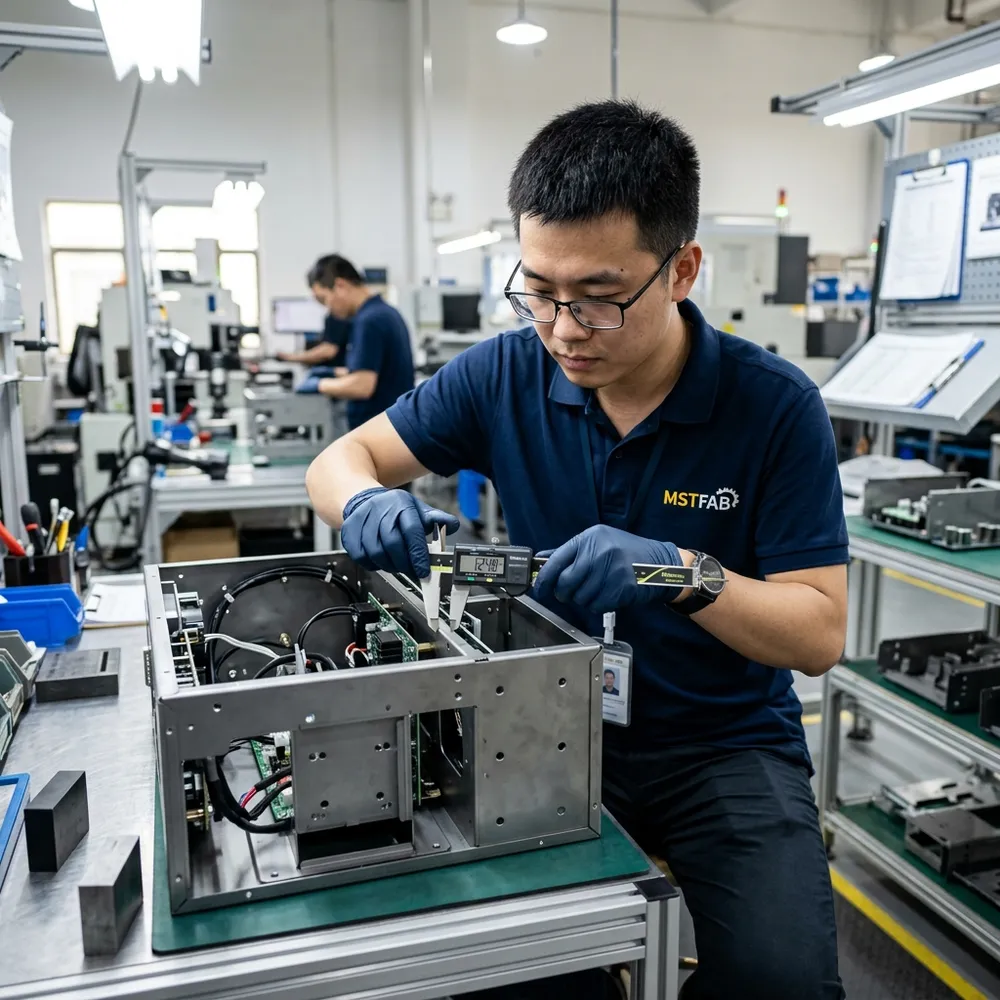
06 / Assembly Fit and Dimensional Inspection
Verify internal clearances, door gaps, and mating datums before crating.
Inspecting individual flat parts is not enough when delivering a complete mechanical assembly. As an ISO 9001 sheet metal parts manufacturer and sheet metal fabrication supplier with quality inspection, we verify both piece-part tolerances and final assembled geometry.
Our QC inspectors check overall envelope dimensions, internal chassis subplate clearance, door reveal symmetry, hinge bind, lock actuation, and surface finish quality under standardized inspection lighting.
Every project is backed by a documented sheet metal supplier with dimensional inspection report and full first article inspection records prior to bulk shipment.
Review our multi-stage sheet metal quality control and FAI workflow →
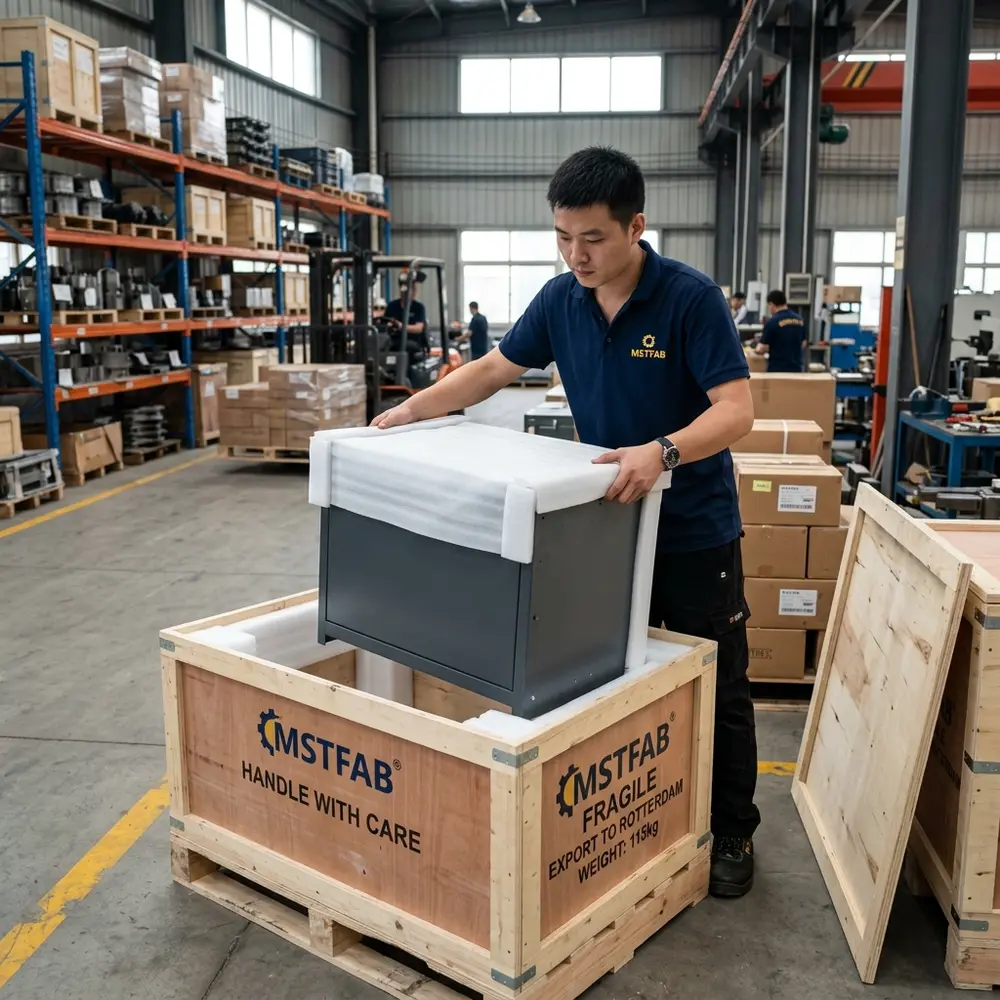
07 / Export Crating and Manufacturing Scope
Ship fully assembled enclosures or knock-down kits safely across global freight lanes.
Assembled sheet metal enclosures require internal bracing, locked doors with keys bagged inside, EPE foam corner cushioning, moisture-barrier VCI wrapping, and rigid ISPM-15 plywood export crates so frames never rack or scuff in ocean containers.
Working with a sheet metal fabrication factory with export packaging gives you the option to ship fully assembled cabinets or flat-pack knock-down kits engineered to optimize sea-container volume.
Manufacturing scope: MSTFAB manufactures custom drawing-based sheet metal parts, welded frames, and mechanically assembled enclosure shells (including hinges, latches, gaskets, windows, and mounting plates) under ISO 9001. We do not install active electrical wiring, PCBs, or power supplies, and final powered equipment certifications remain with the OEM.
08 / Turnkey Assembly RFQ Checklist
Include eight engineering items in your laser-bend-weld-assembly RFQ package.
- Top-level 3D STEP assembly modelInclude the complete 3D STEP assembly with all child sheet metal parts and hardware positioned in place.
- 2D PDF drawings for assembly & child partsShow overall assembled tolerances, critical internal clearances, and piece-part datum callouts.
- Structured Bill of Materials (BOM)List every sheet metal part number, material grade, thickness, quantity per assembly, and hardware item.
- Welding and seam finish instructionsIndicate continuous TIG vs. stitch welds, waterproof seams, and cosmetic Class-A ground-smooth corners.
- Surface treatment and masking mapSpecify powder coat RAL color, texture, zinc-plated internal backplates, and masked ground studs.
- Mechanical hardware & gasket calloutsProvide part numbers or functional specs for PEM fasteners, hinges, locks, handles, windows, and gaskets.
- Pre-shipment trial-fit requirementsNote any mating doors, removable access panels, or customer-supplied gauges that must be test-fitted.
- Assembled vs. knock-down packing preferenceState whether units should ship fully assembled or as flat-packed kits, along with order quantity and Incoterms.
Providing a complete 3D STEP assembly and structured BOM allows our engineering team to quote the entire laser, bend, weld, coat, and mechanical assembly workflow with single-source accountability.
Frequently asked questions about integrated laser, bend, weld, and assembly sourcing
What does “sheet-metal-related mechanical assembly” include at MSTFAB?
We assemble all mechanical hardware directly associated with the sheet metal structure: self-clinching PEM fasteners, blind rivets, weld nuts/studs, hinges, cam locks, compression latches, handles, gas struts, DIN rails, polycarbonate viewing windows, EMI/EPDM gaskets, and internal mounting backplates. We do not perform active electrical wiring, PCB soldering, or powered system testing.
How do you prevent powder coating from causing tight doors or sliding covers to bind during assembly?
During our upfront DFM review, we evaluate all mating gaps, hinge knuckles, and sliding tracks in your 3D STEP assembly and adjust the laser flat patterns to account for 60-90 microns per side of powder coat film build-up, while masking critical grounding pads and threaded bores.
Can you source standard enclosure hardware like hinges, locks, and gaskets on our behalf?
Yes. We can procure specified brand-name hardware (such as PEM, Southco, Dirak, or EMKA) or recommend cost-effective industrial equivalents with full dimensional and material spec sheets for your engineering approval before First Article build.
Should we ship large sheet metal enclosures fully welded and assembled or as bolted knock-down kits?
If structural rigidity and zero field-assembly labor are the top priorities, we ship fully welded and mechanically assembled enclosures in custom wooden crates. If ocean freight volume is the main cost driver on high-volume modular cabinets, we can review bolted knock-down kitting during DFM.
How do you verify that internal mounting subplates and hole patterns align inside a welded cabinet?
During First Article Inspection and batch QC, we physically install the internal zinc-plated mounting backplate, doors, and removable access covers onto every welded shell—verifying stud alignment, diagonal squareness, and latch compression before packaging.
What file package is needed to quote a multi-part welded and assembled enclosure?
Please send a top-level 3D STEP (.stp / .step) assembly file (which contains all child part geometries), 2D PDF drawings for critical tolerances and weld/finish notes, and an Excel or PDF Bill of Materials (BOM) listing quantities, materials, and hardware.
Technical references
These international standards cover fusion welding quality levels, general sheet metal tolerances, and enclosure environmental protection ratings referenced during mechanical assembly design.
- ISO 5817 — Welding: Fusion-Welded Joints in Steel, Nickel, Titanium and Their Alloys (Quality Levels for Imperfections)
- ISO 2768-1 & 2768-2 — General Tolerances for Linear, Angular, and Geometrical Sheet Metal Features
- IEC 60529 — Degrees of Protection Provided by Enclosures (IP Code Reference for OEM Enclosure Design)
Consolidate your laser cutting, bending, welding, and assembly in one RFQ.
Send your 3D STEP assembly, 2D PDF drawings, and hardware BOM. MSTFAB will review tolerances across every process stage and return a turnkey quotation within 24 hours.
Upload Assembly Drawings for Quote →
Have a question first? caroline@mstfab.com
 WeChat Contact
 WhatsApp Me Directly