
The Short Answer
A framed ISO 9001 wall certificate does not bend metal—for OEM buyers, real ISO 9001 sheet metal manufacturing means auditable shop-floor controls: ERP-locked drawing revisions, EN 10204 3.1 raw material heat traceability, calibrated laser and CNC press-brake setups, fixture-controlled welding, and documented First Article Inspection (FAI) before batch release. Use this practical checklist to separate paper compliance from repeatable production quality.

Explore this guide
01 / Certificate Scope vs. Shop-Floor Reality
Audit what happens between the ERP traveler and the press brake, not just the PDF certificate.
Almost every contract fabricator can email a PDF copy of an ISO 9001 certificate during supplier onboarding. Yet overseas OEM buyers still experience wrong drawing revisions, unannounced material substitutions, and batch-to-batch dimensional drift when a supplier treats ISO 9001 as an annual binder exercise rather than a live shop-floor control system.
When qualifying an ISO 9001 sheet metal manufacturer, verify both the accredited certificate scope and how the quality management system governs daily production travelers.
Verify accredited scope and site
Confirm the certificate covers “design/manufacture of custom sheet metal fabrication and enclosures” at the exact physical factory address producing your parts—not just a trading office.
Look for IATF 16949 & ISO 14001 depth
Suppliers that also maintain IATF 16949 automotive process discipline (FMEA, control plans, PPAP/FAI rigor) and ISO 14001 environmental compliance bring stronger defect prevention.
Trace a live shop-floor traveler
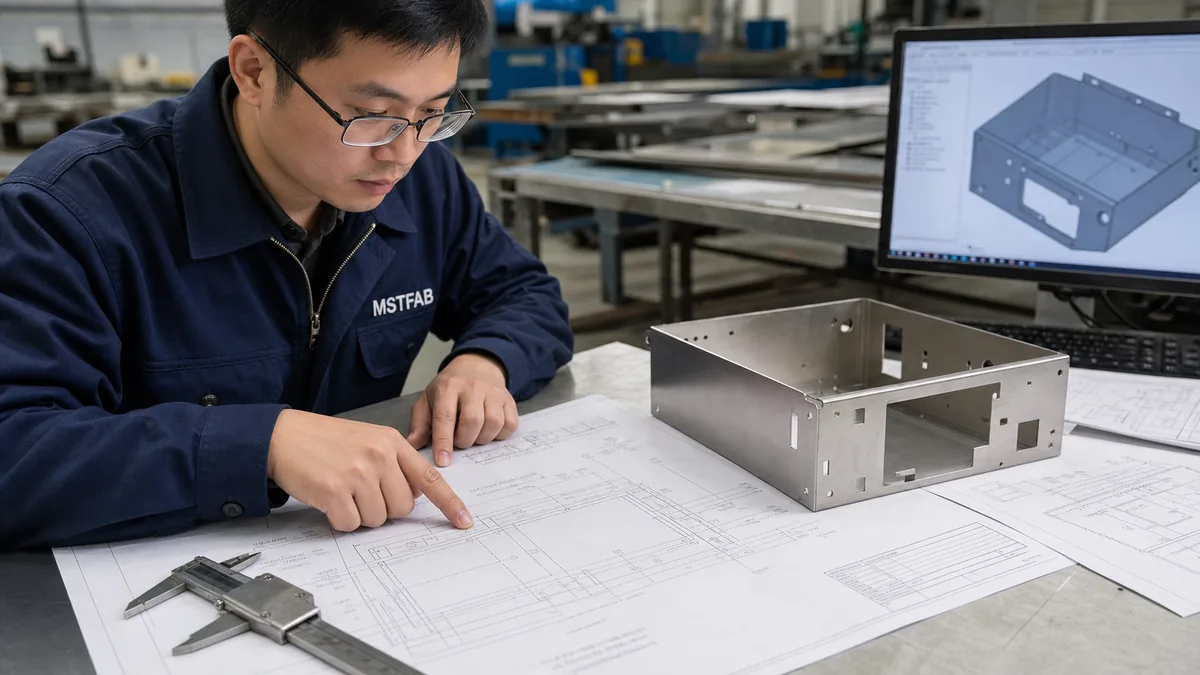
Ask to see a real production router showing how raw sheet heat numbers, operator sign-offs, and in-process patrol checks follow a part from laser cutting to crating.
Red flag to watch for: If operators at the fiber laser or press brake are reading un-stamped paper prints or loading DXF files from personal USB drives instead of a revision-locked ERP terminal, ISO document control has broken down.
02 / Revision Control and Material Traceability
Lock drawing revisions at DFM and trace every sheet lot back to its mill certificate.
Two of the most expensive failures in custom sheet metal sourcing occur before cutting even starts: fabricating an urgent batch to an obsolete Rev A drawing after you released Rev B, or cutting brackets from unverified commercial steel that cracks during bending.
- Closed-loop DFM and revision control (ISO Clause 7.5 / 8.2): Every customer PO is cross-checked against the 2D PDF revision block and 3D STEP model. When an Engineering Change Notice (ECN) arrives, obsolete NC laser and press-brake files are archived immediately so prior revisions cannot be loaded.
- Incoming raw material verification (ISO Clause 8.4): Incoming coils and sheets of carbon steel, stainless (304/316L), and aluminum (5052/6061) are checked for actual micrometer gauge thickness, surface flatness, and EN 10204 3.1 mill test certificates.
- Lot-coded shop travelers (ISO Clause 8.5.2): Each production batch receives a unique lot barcode linking the finished part pallet back to the specific raw material heat lot and surface-treatment batch.
Our engineering team combines build-to-print OEM fabrication with strict ERP revision gates so your latest drawing changes are verified before nesting.
03 / Laser Cutting and CNC Forming Controls
Standardize fiber laser parameters, deburring, and CNC press brake setups across batches.
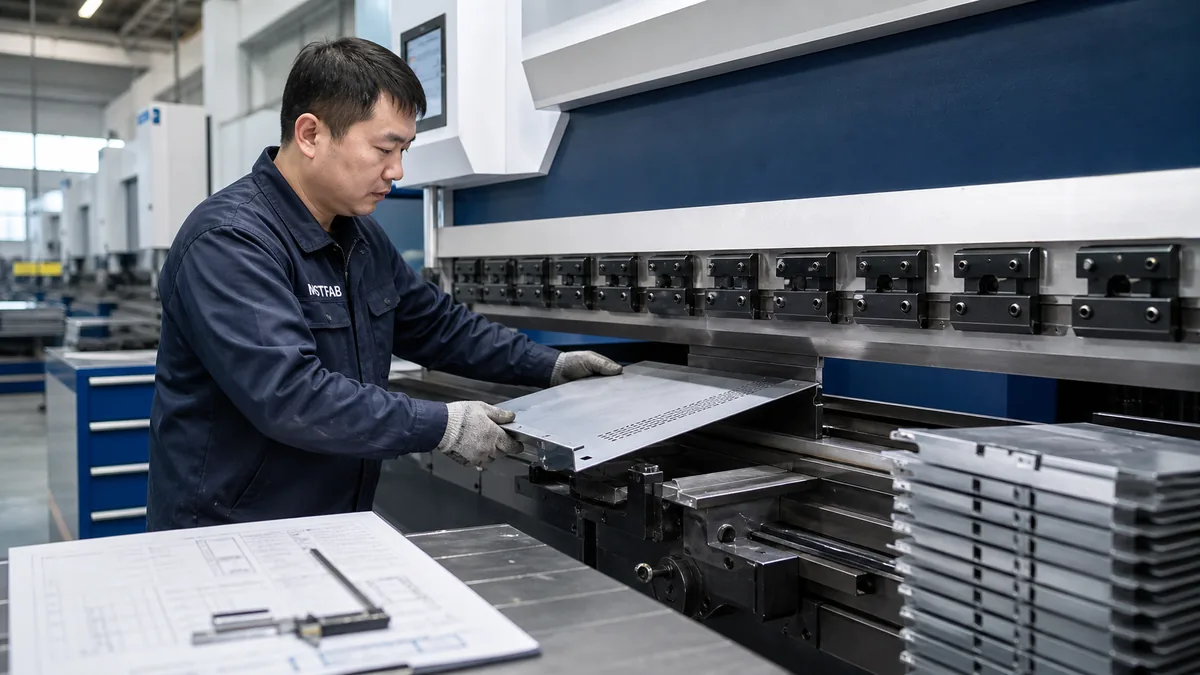
In custom sheet metal fabrication, dimensional repeatability depends on locking machine setup variables so a batch run six months from now matches your approved sample within tenths of a millimeter.
- Fiber laser parameter tables lock assist-gas purity/pressure (nitrogen vs. oxygen), nozzle standoff, kerf offset, and sheet grain orientation per part number.
- Dedicated mechanical deburring routes separate stainless steel and aluminum from carbon steel to prevent cross-contamination and galvanic rust spots.
- CNC press brake setup sheets specify the exact V-die opening, punch radius, backgauge finger stop positions, and sequence steps—backed by first-off and patrol angle checks every N pieces.
By standardizing flat-pattern K-factors and press-brake tooling on the digital router, flange lengths and hole-to-bend datums remain stable regardless of which shift runs the job.
See how CNC press brake process controls protect flange tolerances →
04 / Welding Fixtures, Hardware and Coating
Control special processes with modular weld jigs, torque-verified PEMs, and masking maps.
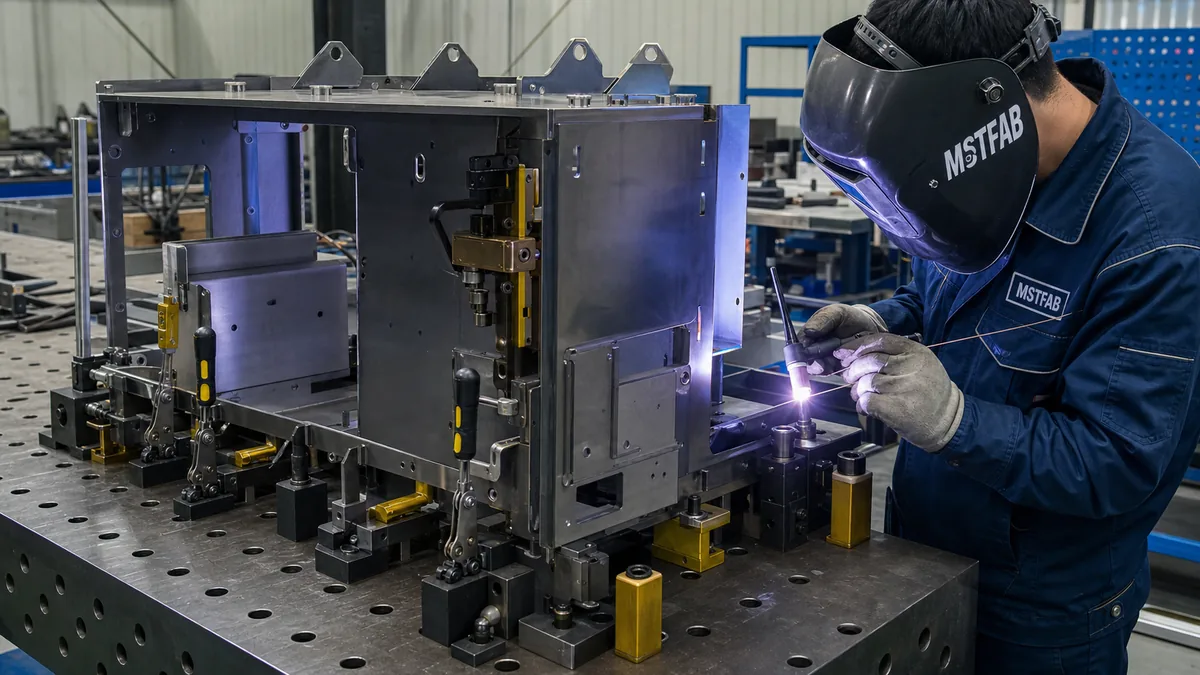
ISO 9001 classifies welding and surface coating as processes where output quality cannot be fully verified by simple caliper checks alone—requiring standardized fixtures, qualified operators, and preventive masking protocols.
- Modular welding and check fixtures: Enclosure frames and structural brackets are clamped into dedicated welding jigs with heat-sink chill bars to hold diagonal squareness and prevent TIG/MIG thermal distortion.
- Self-clinching hardware verification: PEM nuts, studs, and standoffs are pressed in using calibrated hydraulic insertion presses, with first-piece push-out and thread go/no-go plug verification logged on the traveler.
- Documented coating and masking work instructions: Visual masking maps show operators exactly which grounding studs, blind tapped holes, and conductive gasket flanges require silicone plugs or high-temp tape prior to powder coating or anodizing.
Explore our precision welding and surface finishing controls for custom mechanical assemblies and enclosures.
05 / Buyer Control Matrix
Audit five shop-floor quality gates before awarding OEM sheet metal production.
Use this evidence matrix during supplier qualification or remote video audits to verify that an ISO 9001 sheet metal supplier executes real process controls.
06 / Inspection Handoff
Require ballooned First Article Inspection (FAI) and calibrated CMM evidence.
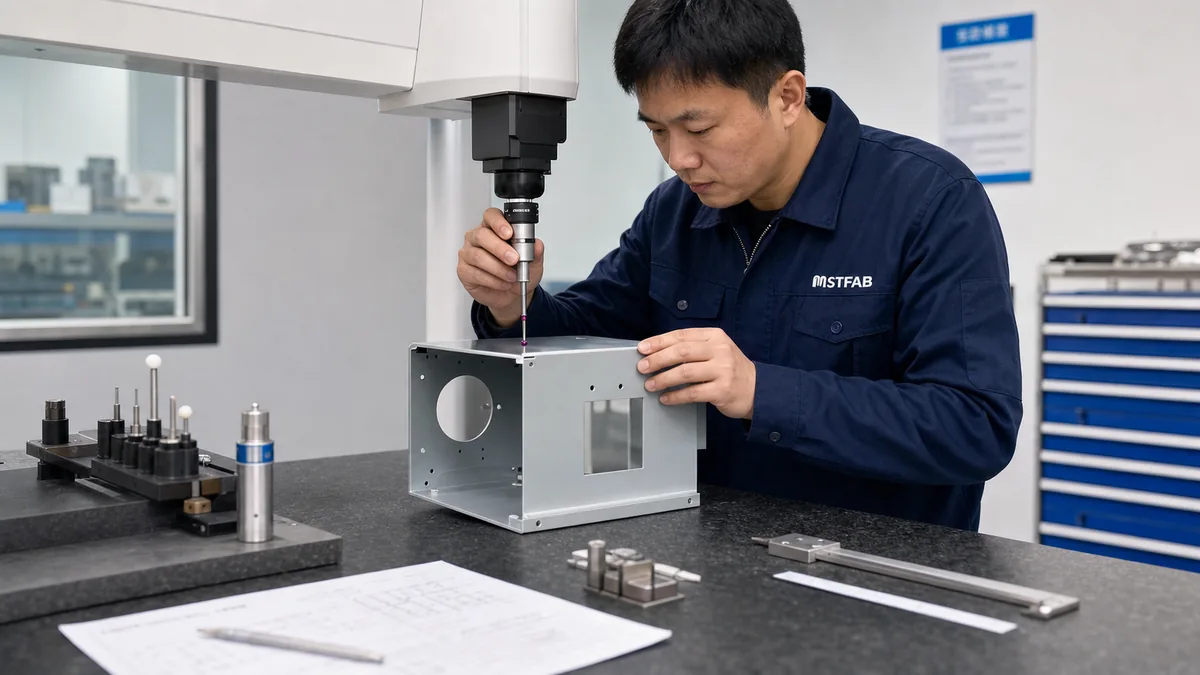
Under an effective ISO 9001 quality system, inspection is not a passive glance before boxing—it is a documented verification against every critical-to-quality (CTQ) callout on your engineering drawing.
For every new part number or drawing revision, our quality team produces a ballooned 2D drawing and records actual measurements for flat-pattern profiles, CNC bend angles, hole-to-datum positions, thread go/no-go gauge checks, and coating dry-film thickness (DFT) using calibrated CMMs, optical comparators, and surface plates.
Combining ISO 9001, IATF 16949, and ISO 14001 management systems, MSTFAB provides complete digital inspection packages—including FAI reports, material certs, and pre-shipment photos—before your order leaves our dock.
Review our FAI, CMM, and calibrated inspection capabilities →
07 / Packing and Release
Close the quality loop with final QC release and traceable export packaging.
Quality control ends only when your parts are unpacked on your assembly line without transit dents, rubbed powder coating, or mixed part numbers. ISO 9001 preservation rules (Clause 8.5.4) require formal packaging standards tailored to international freight.
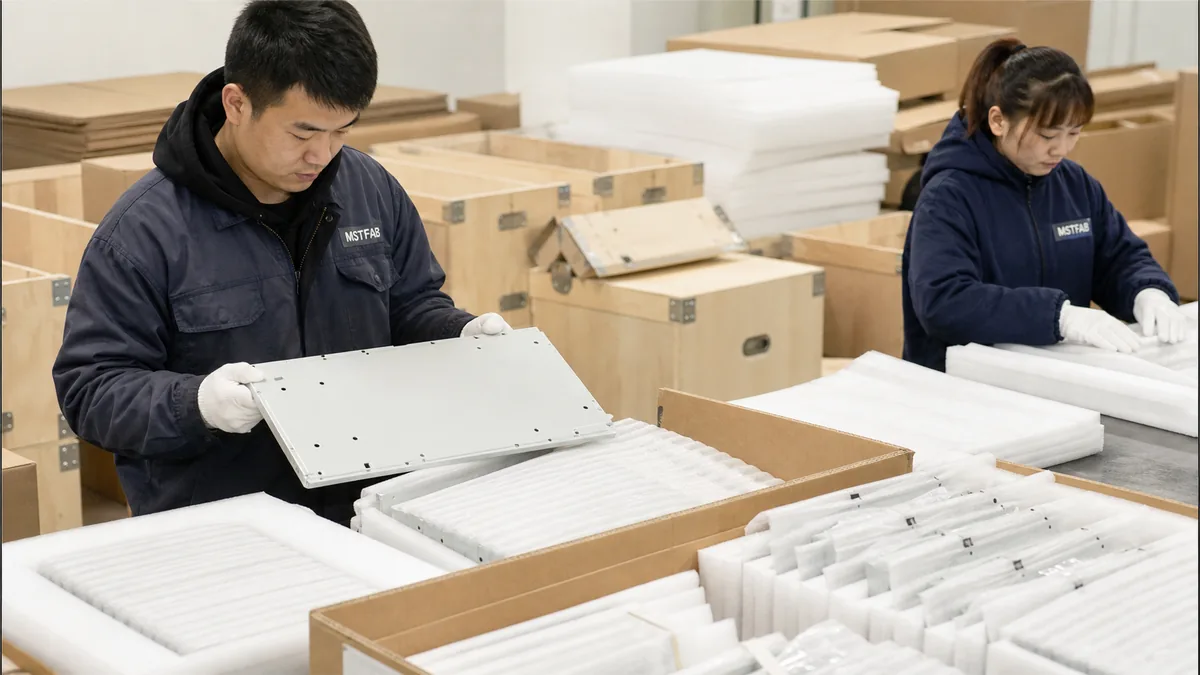
Through our export packaging and final QC process, finished parts are individually separated with foam or VCI anti-rust film, boxed with clear part-number/revision/PO lot labels, and secured inside fumigation-free plywood crates.
Manufacturing scope: MSTFAB manufactures custom build-to-print sheet metal components, precision brackets, welded frames, and empty enclosure shells to customer drawings under ISO 9001, IATF 16949, and ISO 14001 management systems. We do not supply finished electrical devices; final powered equipment assembly and end-system regulatory certification remain the responsibility of the OEM.
08 / Ready-to-Review RFQ
Include eight items in your RFQ to get an ISO-controlled sheet metal quotation.
- 3D STEP + revision-coded 2D PDFSupply neutral 3D STEP models and 2D PDF drawings with a clear title-block revision code and tolerance standard.
- Material grade and cert levelSpecify alloy, temper, sheet thickness, and whether EN 10204 3.1 mill certificates are required with shipment.
- Critical-to-quality (CTQ) dimensionsFlag specific hole patterns, datum flanges, or flatness callouts that require 100% or CMM verification.
- Hardware and thread specificationsList all self-clinching nuts, standoffs, studs, and tapped holes with exact thread class and seating face.
- Surface finish, masking & testingDefine powder coat RAL, anodize spec, salt-spray or cross-hatch adhesion needs, and masked ground zones.
- Welding and cosmetic zone rulesNote weld standard (e.g., ISO 13920) and mark visible A-surfaces versus internal structural surfaces.
- FAI and inspection deliverablesState whether ballooned FAI reports, in-process Cpk data, or pre-shipment QC photos are required.
- Batch quantity and packing labelsProvide prototype and recurring lot quantities plus barcode or lot-tag requirements for your ERP receiving.
Providing clear revision codes, CTQ callouts, and inspection expectations upfront lets our engineering and quality teams build a locked control plan from the first quote.
Auditing an ISO 9001 sheet metal parts manufacturer: OEM buyer FAQ
Does an ISO 9001 certificate automatically guarantee zero-defect sheet metal parts?
No. ISO 9001 certifies that a manufacturer has a documented Quality Management System (QMS)—it does not replace part-specific engineering controls. To get repeatable parts, you must verify that the supplier translates ISO 9001 into locked CAD flat patterns, calibrated press-brake setups, dedicated welding fixtures, and ballooned First Article Inspection (FAI) reports.
What should OEM buyers check on a supplier’s ISO 9001 certificate?
Check four things: (1) that the issuing registrar is accredited by an IAF member body, (2) that the certificate is currently valid, (3) that the registered address matches the actual factory floor where laser cutting and bending occur, and (4) that the scope statement explicitly covers sheet metal fabrication and mechanical manufacturing.
What quality certifications does MSTFAB hold for custom sheet metal manufacturing?
MSTFAB operates under certified ISO 9001 quality management, IATF 16949 automotive quality management, and ISO 14001 environmental management systems. This combination gives industrial, commercial, and equipment OEM buyers automotive-grade process control, FMEA thinking, and full lot traceability.
Does MSTFAB manufacture complete powered electrical equipment or certified end-user devices?
No. MSTFAB is strictly a custom build-to-print mechanical manufacturer of sheet metal parts, brackets, chassis, and empty enclosure shells made to customer drawings. Final electrical wiring, active component integration, and end-product safety or industry certification belong to the OEM.
What inspection evidence should we request before releasing a batch production order?
Always request a ballooned 2D drawing paired with a full dimensional First Article Inspection (FAI) report, EN 10204 3.1 raw material mill test certificates, coating dry-film thickness (DFT) and adhesion test records, and high-resolution photos of the finished part and export packaging.
How does an ISO 9001 and IATF 16949 system prevent quality drift on repeat orders?
Once your First Article is approved, the exact unfolded CAD file, laser cutting parameter table, press-brake tooling program, welding fixture ID, and inspection checklist are locked under your part number and revision in our ERP system. Repeat orders run the identical frozen process rather than being re-programmed from scratch.
Technical references
Reference these international quality, metrology, and material certification standards when qualifying an ISO-controlled sheet metal manufacturing partner.
Send your drawings for an ISO-controlled DFM review and quotation.
Upload your 3D STEP and 2D PDF files along with your inspection requirements. MSTFAB will review manufacturability, confirm quality gates, and return a detailed quote.
Request an ISO-Controlled Quote →
Have a question first? caroline@mstfab.com
 WeChat Contact
 WhatsApp Me Directly