
The Short Answer
A reliable custom sheet metal production run manufacturer eliminates batch-to-batch dimensional drift by locking flat-pattern bend deductions, press-brake tooling setups, modular welding jigs, and powder-coating color standards at First Article Inspection (FAI). While almost any job shop can hand-fit one or two prototypes, scaling to repeatable lots of 50 to 5,000+ units requires incoming coil/sheet thickness verification, revision-controlled CNC programs, and documented in-process quality gates under ISO 9001.

Explore this guide
01 / Prototype vs. Production Reality
Prevent the four process drifts that derail batch sheet metal production after sample sign-off.
Building three prototype enclosures is forgiving: a skilled technician can manually tweak a press brake backgauge, hand-file a tight slot, or clamp a weldment by eye. When you release a 500-piece production order without freezing process parameters, minor variations in sheet mill thickness, V-die selection, or weld sequence compound into assembly line stoppages.
Whether you are scaling from a scalable sheet metal manufacturing supplier pilot lot, ordering through a small batch metal parts fabrication service, or transitioning toward mass production as a long-term sheet metal fabrication supplier for recurring orders, process standardization must happen before full batch cutting begins.
Locked V-die & bend deduction
Changing a press brake lower V-die from V12 to V16 between batches shifts the inside radius and alters final flange lengths unless the V-die is locked in the work router.
Dedicated welding & checking jigs
Replacing manual layout clamping with pinned modular fixtures guarantees that piece #1 and piece #1,000 share identical mounting hole pitch and diagonal squareness.
Revision-controlled CAM travelers
Every released drawing revision is tied to a single frozen DXF flat pattern, CNC bend program, PEM hardware bill, and masking instruction sheet.
Soft tooling advantage: For annual volumes between 50 and 10,000 pieces, fiber laser cutting combined with CNC press brakes and modular welding fixtures avoids $15,000-$50,000 hard progressive stamping die costs while allowing rapid engineering revision updates.
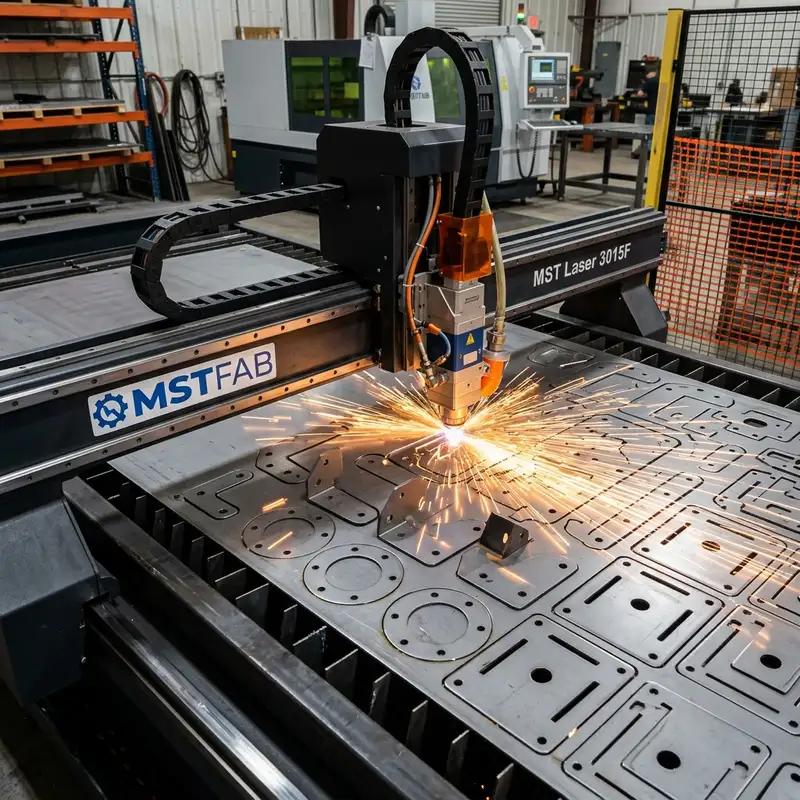
02 / Incoming Material and Nested Blanking
Verify mill sheet thickness tolerances and lock grain direction across nested sheets.
Commercial cold-rolled and stainless steel sheets carry allowable mill thickness tolerances (for example, nominal 2.0 mm sheet may arrive at 1.91 mm on one heat lot and 2.06 mm on the next). Across a four-bend U-channel, that 0.15 mm thickness delta changes air-bent flange dimensions by up to 0.5 mm if unmonitored.
- Incoming heat-lot gauging: As a metal fabrication supplier with incoming material inspection, we verify sheet gauge across multiple points per pallet and match heat lots to press-brake compensation tables.
- Grain-locked nesting rules: Our CAM engineers lock part rotation angles during multi-sheet nesting so brushed stainless grain and structural aluminum bend lines remain identical from batch to batch.
- Common-line and micro-joint stability: Standardized lead-in pierce locations and micro-tabs prevent small brackets from tipping on laser slats, ensuring clean, burr-free edges across thousands of cycles.
Operating as an ISO 9001 sheet metal parts manufacturer and precision sheet metal manufacturer with tolerance control, we trace every production lot from raw sheet heat number through final inspection.
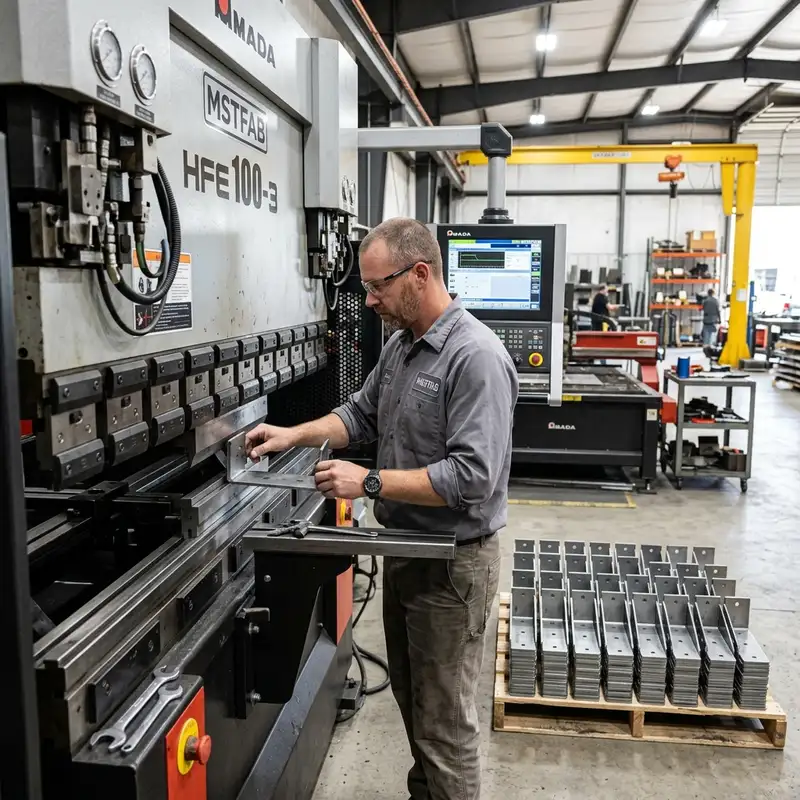
03 / Press Brake Repeatability and Welding Fixtures
Standardize CNC press brake setups and modular welding jigs for zero-rework assembly.
In repeatable batch production, operator skill must be backed by physical poka-yoke stops and recorded machine programs. We store graphical 3D press-brake setup sheets that specify the exact upper punch profile, lower V-die opening, tonnage crowning, and backgauge finger contact points for every bend sequence.
- First-piece and patrol inspection every 25 to 50 bends using digital protractors, height gauges, and dedicated go/no-go check templates.
- Self-fixturing laser tab-and-slot geometry combined with toggle-clamped welding jigs to prevent thermal twist during TIG, MIG, or handheld fiber laser welding.
- Standardized spot-weld electrode dressing schedules and peel-test coupons at shift start for multi-panel chassis and cabinet assemblies.
By partnering with a sheet metal manufacturer for repeatable production quality, your assembly line receives brackets and enclosures that drop onto mating studs without filing or prying.
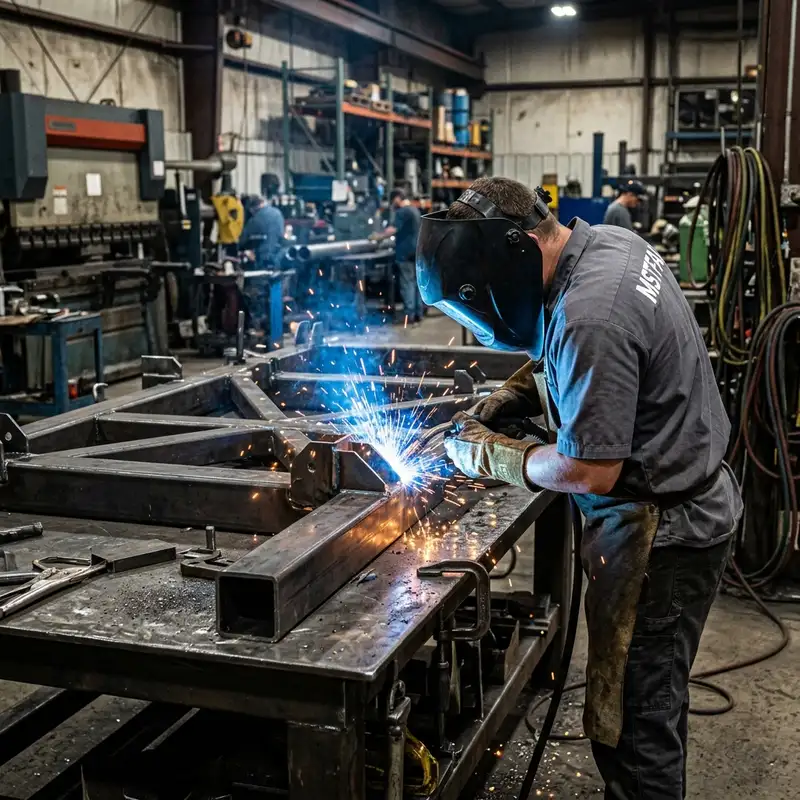
04 / Batch Finishing and Hardware Masking
Maintain RAL color uniformity and clean threads across recurring deliveries.
Nothing frustrates an OEM buyer faster than receiving Batch #2 enclosure doors that are visibly a different shade of gray than Batch #1 frames, or discovering powder coat inside M4 PEM nuts during final assembly.
- Master color plaques and powder lot control: We retain physical master color panels and specify exact powder manufacturer codes, gloss percentages (at 60 degrees), and oven cure profiles so replacement doors match frames shipped months earlier.
- Automated PEM insertion and thread masking: Self-clinching nuts, studs, and standoffs are pressed prior to coating using calibrated hydro-pneumatic insertion machines, then masked with high-temp silicone plugs and polyester grounding discs.
- Silkscreen and laser-etched serialization: Production runs can include UV-stable silkscreened operator legends, epoxy ink markings, or permanent fiber-laser part number and revision engraving.
As a full-scope contract sheet metal fabrication manufacturer, we inspect 100% of masked threads and critical cosmetic faces under standardized lighting before staging parts for packing.
05 / Production Run Control Matrix
Verify five repeatability controls when qualifying a batch sheet metal supplier.
Use this engineering matrix during pilot-to-production handoff to confirm that your supplier has locked the variables that govern batch consistency.
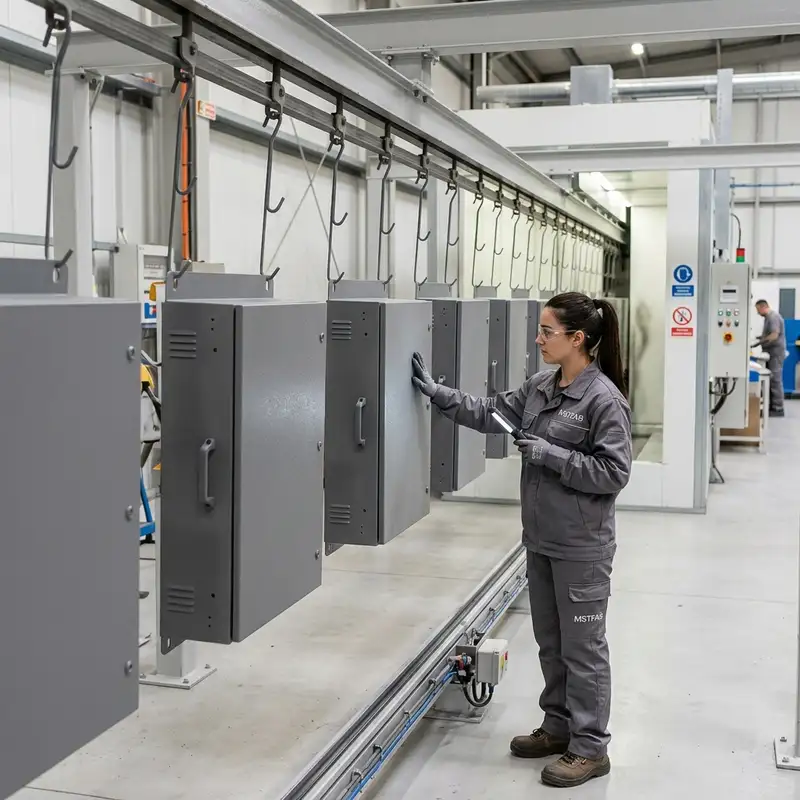
06 / First Article & Patrol Inspection
Bridge pilot samples and recurring batches with documented dimensional reports.
Before any new tool setup or recurring production batch runs at full speed, our quality team performs a formal First Article Inspection (FAI) and locks the golden sample parameters. Working with a sheet metal fabrication supplier with quality inspection ensures that dimensional capability is proven early.
During the production run, roving inspectors conduct scheduled patrol checks at laser cutting, CNC bending, hardware insertion, welding, and powder coating stations—recording critical dimensions on statistical check sheets.
Every shipment from our sheet metal supplier with dimensional inspection report workflow includes ballooned inspection records, material certificates, and lot traceability tags.
Explore our first article inspection and batch QC standards →
07 / Standardized Export Packaging and Scope
Repeatable crating and kitting that integrate directly into your assembly line.
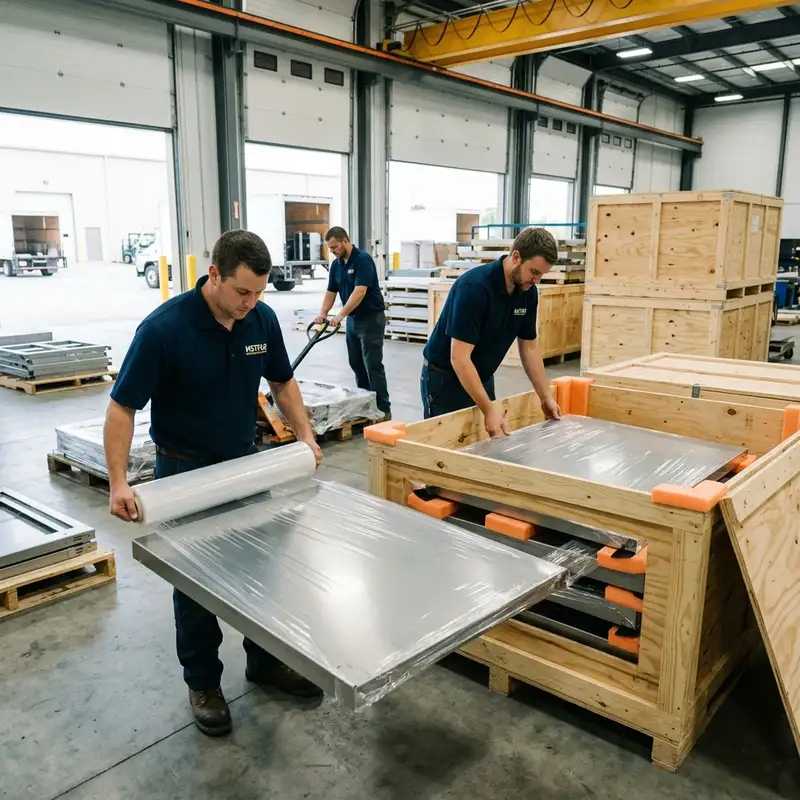
In recurring production programs, inconsistent packaging wastes warehouse receiving labor and causes transit damage. We create a standardized packaging specification sheet for every part number—defining carton or cellular partition counts, EPE foam pads, VCI anti-rust bags, pallet footprint, and maximum stack height.
Our export packaging process supports barcode/QR part labeling, PO/revision tagging, and multi-part subassembly kitting inside ISPM-15 fumigation-free wooden crates.
Manufacturing scope: MSTFAB manufactures custom build-to-print sheet metal brackets, chassis, welded frames, and empty enclosure shells under an ISO 9001 quality management system. Active electrical components, PCB assemblies, and final powered product certifications remain the responsibility of the OEM.
08 / Production Run RFQ Checklist
Include eight details when quoting a custom sheet metal production run.
- 3D STEP and 2D PDF drawing packageEnsure the revision block matches across all CAD files and call out critical-to-quality (CTQ) tolerances.
- Material grade, temper, and thicknessSpecify exact sheet specification (e.g., SPCC, SECC, SGCC, 304L, 5052-H32) and acceptable international equivalents.
- Hardware and fastener bill of materialsList exact PEM nut/standoff/stud part numbers, installation side, and torque/push-out expectations.
- Welding and cosmetic surface classesDefine A-side cosmetic faces, weld seam blending smoothness, and permissible fixture or spot-weld marks.
- Surface treatment and masking mapState powder coat RAL/Pantone code, texture, gloss level, anodizing or plating spec, and masked ground areas.
- Batch quantity and annual forecast (EAU)Provide pilot lot size, standard release batch quantity (e.g., 100, 250, or 1,000 pcs), and estimated annual usage.
- FAI and patrol inspection deliverablesNote required ballooned FAI reports, EN 10204 3.1 mill certs, or specific gauge fixture checks.
- Kitting, labeling, and crating rulesSpecify pieces per carton/layer, barcode label fields, and delivery Incoterms (FOB, DAP, or DDP).
Sharing your batch release quantities and critical datum tolerances allows our engineering team to design the most cost-effective nesting, press-brake tooling, and welding fixture strategy for your recurring program.
Frequently asked questions about custom sheet metal production runs
What quantities define a custom sheet metal production run at MSTFAB?
For soft-tooled precision sheet metal (fiber laser cutting, CNC bending, welding, and powder coating), a typical production run ranges from 50 to 5,000+ pieces per release, or 20 to 200+ sets for large welded industrial cabinets and frames.
How do you guarantee part consistency between our approved prototype and recurring batches?
Once your first article sample is approved, we freeze the exact unfolded DXF flat pattern, press-brake punch/V-die tooling combination, CNC backgauge program, welding jig setup, and powder coating parameters in our ISO 9001 job router so operators cannot alter setups on future releases.
When should we keep using laser and CNC press brakes versus investing in hard stamping dies?
Soft tooling (fiber laser + CNC press brake) is almost always more economical up to 5,000-10,000 pieces per year because there is zero stamping die amortization, and you can implement engineering drawing revisions immediately. When a single small bracket exceeds 10,000-20,000 pieces annually with frozen geometry, we can evaluate hybrid or progressive stamping.
How do you handle Engineering Change Orders (ECOs) on active production parts?
When you issue a new drawing revision, our quality system quarantines the previous revision CAD files, updates the traveler and flat pattern under the new revision code, and triggers a delta First Article Inspection on the modified features before full batch cutting.
Can you hold blanket order schedules or ship recurring monthly batches?
Yes. Many OEM customers issue scheduled release orders where we procure raw sheet materials in bulk for cost stability and manufacture/ship scheduled batch lots (monthly or quarterly) packed in standardized export crates.
What quality reports are included with each production batch shipment?
Each batch shipment includes a final dimensional inspection report tied to your drawing revision, EN 10204 3.1 material mill certificates, surface coating thickness/adhesion logs, and pre-shipment part and packaging verification photos.
Technical references
These international quality and metrological standards provide the framework for statistical batch sampling, general sheet metal tolerances, and quality management in recurring manufacturing.
Transition your sheet metal parts from prototype to repeatable production runs.
Upload your 3D STEP models, 2D PDF drawings, and batch release quantities. Our engineering team will review DFM repeatability and return a tiered production quote within 24 hours.
Request a Production Run Quote →
Have a question first? caroline@mstfab.com
 WeChat Contact
 WhatsApp Me Directly