
By: Yong Zhong (General Manager)
Technical Review: Frank (Senior Welding Engineer)
Last Updated: July 2026
A welding robot can be impressive.
It moves smoothly, repeats the same motion for hours, and does not complain about Monday mornings.
But buyers do not purchase a robot. They purchase consistent welded sheet metal assemblies that fit their assembly, look acceptable, survive the intended use, and arrive without becoming an expensive box of surprises.
That is the real question behind robotic welding: Will automation make this part more consistent, more practical to source, and easier to repeat?
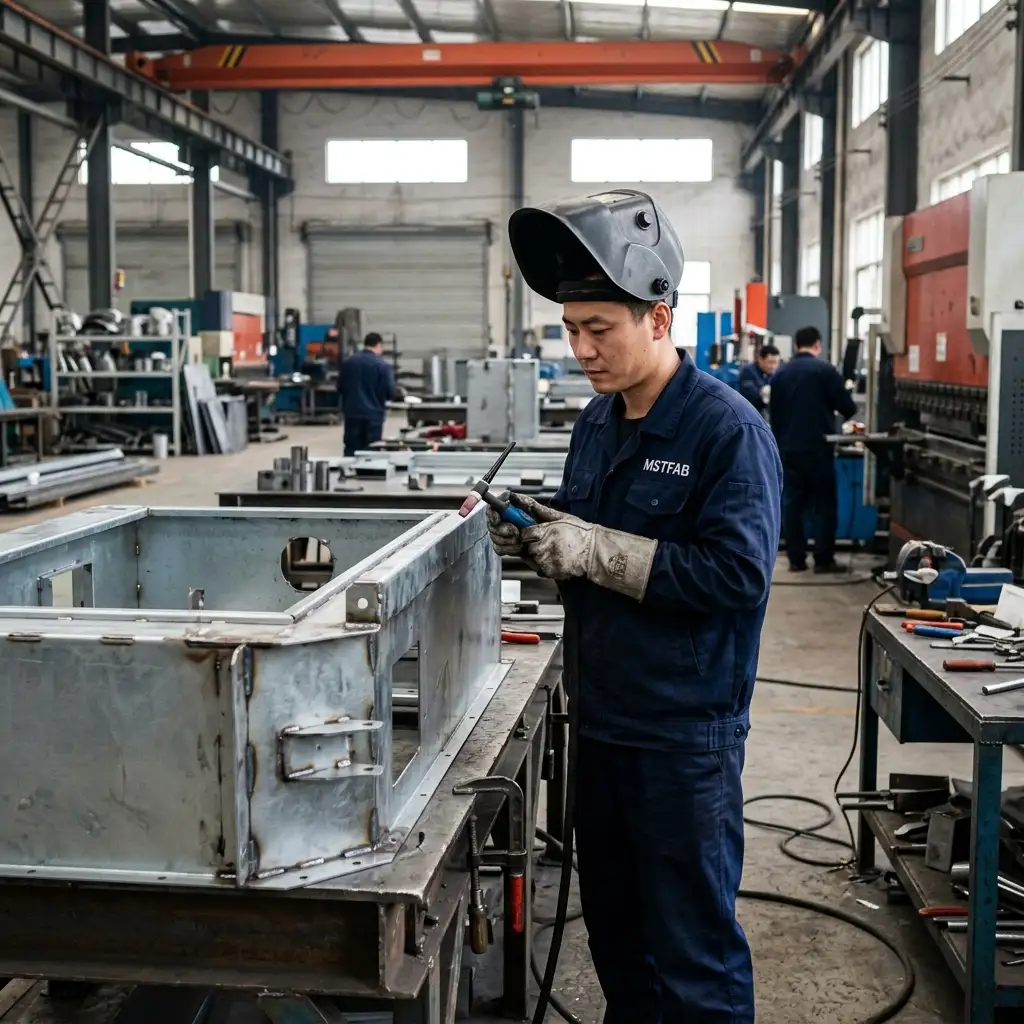
For the right project, robotic welding can improve consistency across repeat parts. For the wrong project, it can automate confusion very efficiently. A robot is not a magic welding toaster. It cannot fix an unclear drawing, poor part fit-up, unstable material condition, or a design that changes every week.
This guide explains when robotic welding is a strong fit for custom sheet metal fabrication projects, what buyers should prepare before requesting a quote, and how to avoid common sourcing problems before they become production problems.
The Real Procurement Question Is Not “Do You Have a Welding Robot?”
A better question is: “Is robotic welding the right process for my part, quantity, geometry, quality expectation, and repeat-order plan?”
Robotic welding is generally most useful when the project has repeatable conditions:
- Stable drawings — start with fabrication from drawings
- Consistent material thickness
- Repeated joint geometry
- Practical weld access
- A clear fixture strategy
- Repeat quantities — ideal for mass production or recurring orders
- Defined visual and dimensional requirements
- A controlled inspection plan
The robot can repeat a proven process very well. But it will also repeat a bad setup with remarkable discipline. That is why production planning should start before programming begins.
When Robotic Welding Is a Good Fit
Robotic welding is often worth reviewing when a buyer needs repeatable welded assemblies rather than one-off handmade samples.
| Project Condition | Why It Matters |
|---|---|
| Repeat production | Setup and fixture effort can be spread across future batches |
| Stable part geometry | The robot needs predictable joint locations and access |
| Controlled material thickness | Consistent inputs support more repeatable welding parameters |
| Repeated weld locations | Similar seams are easier to fixture and program |
| Defined cosmetic expectations | Weld appearance, cleanup, and visible surfaces can be planned early |
| Functional inspection points | Critical dimensions can be checked after welding |
| Reliable part fit-up | Good welding begins before the arc starts |
Common suitable applications may include: welded sheet metal frames, equipment housings, cabinet bodies, repeated metal brackets, machine guards, structural supports, panel-and-frame assemblies, enclosure corners, base frames, multi-part metal assemblies, and repeated chassis structures.
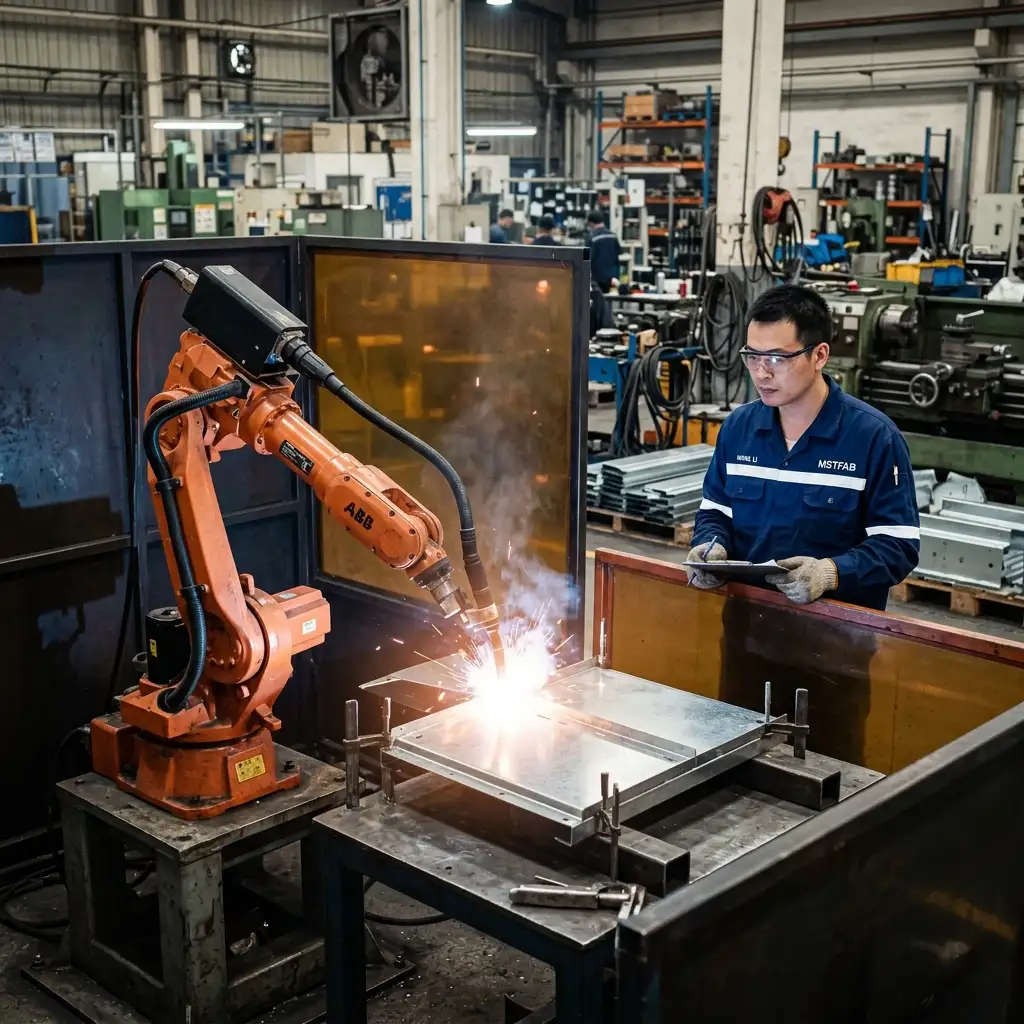
When a Robot May Not Be the Best First Choice
Automation is not automatically the best route for every welded part. A manual, handheld TIG welding, or mixed process may be more practical when the project involves one-off prototypes, frequent drawing changes, very low quantities, irregular geometry, difficult weld access, unconfirmed material selection, unstable fit-up between parts, or cosmetic requirements that still need sample approval.
Sometimes the smarter route is: Prototype → validate fit and weld access → approve design → build fixture → prepare repeat production.
Good Welding Starts Before the Robot Moves
The biggest welding problems often begin before the welding process. They start with drawings that do not define enough information, parts that do not locate consistently, gaps that vary, or assemblies that only fit when someone holds them “just right.”
That is not a robot problem. That is a manufacturing-planning problem. A solid DFM review before quoting can prevent most of these issues upfront.
Fixtures: The Quiet Hero of Repeatable Welding
Buyers often focus on the robot. The fixture deserves just as much attention. A fixture helps control how parts are positioned before welding. It may use locating points, clamps, stops, supports, pins, or dedicated surfaces to keep components in the correct relationship.
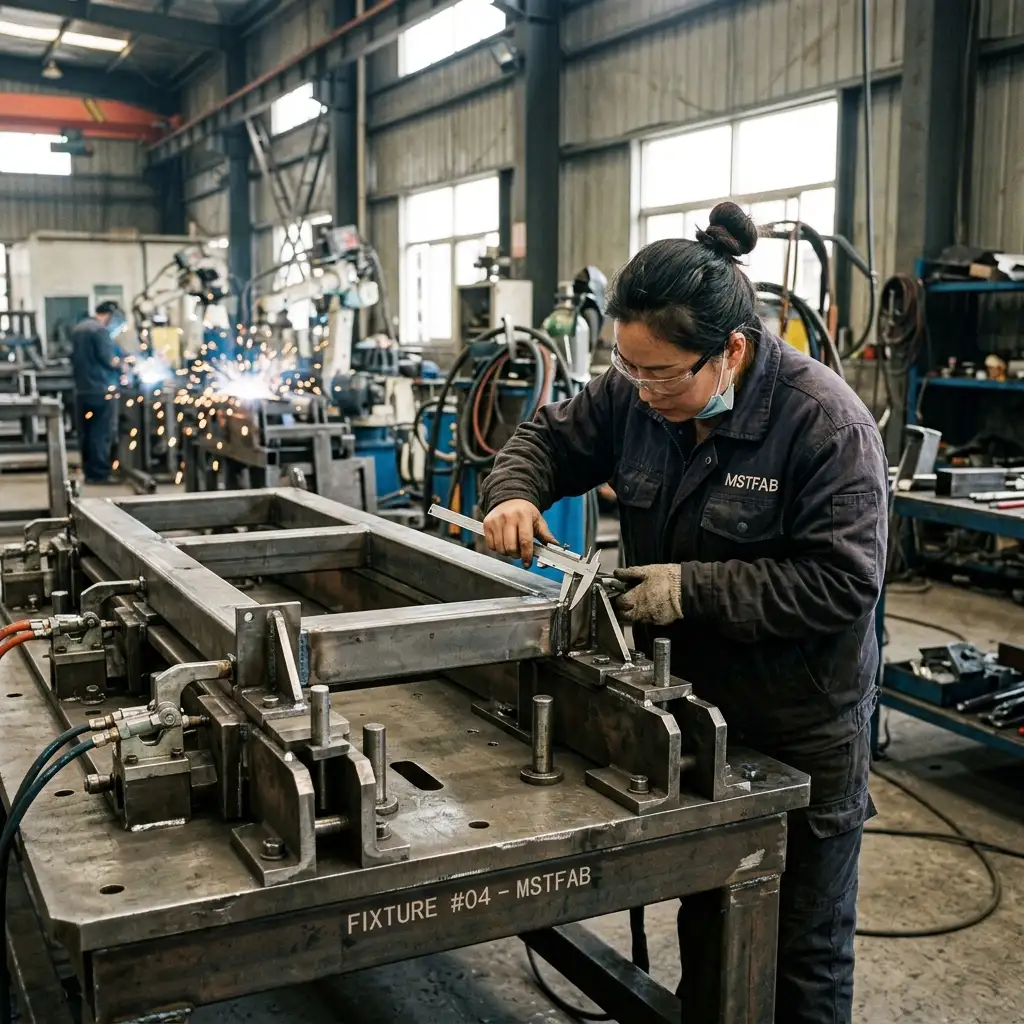
Without a stable fixture, a robot can become very consistent at welding slightly different parts. That is not the kind of consistency anyone wants. A fixture is not just a production accessory. It is part of the quality plan.
A Robot Repeats the Process—Not the Buyer’s Intent
Buyers sometimes assume robotic welding automatically guarantees perfect results. Automation can improve process consistency, but the final result still depends on the full manufacturing route.
For example, a poor fit-up can create inconsistent seams. A thin panel can still move from heat. A weld sequence can still affect flatness. A visible corner can still need cleanup. A finished housing can still have door-fit issues if the frame moves.
Heat Distortion: Automation Helps, Physics Still Attends the Meeting
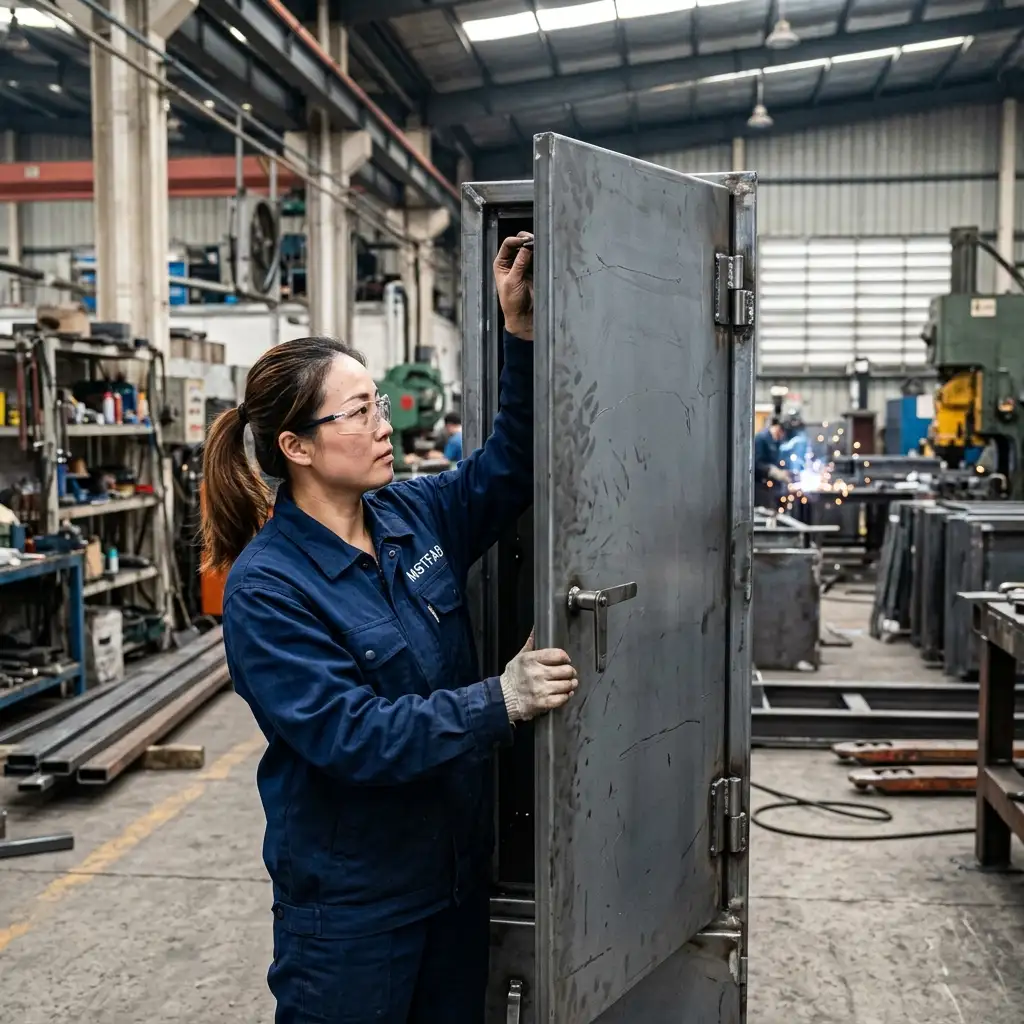
Welding adds heat. Heat can affect flatness, squareness, hole position, panel alignment, and final assembly fit. Robotic welding can help apply a controlled and repeatable sequence, but it does not make heat disappear. For projects requiring tight post-weld tolerances, our tolerance control process includes mid-weld and post-weld dimensional checks.
Common Buyer Problems—and What to Define Before Quoting
| Buyer Concern | What to Define Before Production |
|---|---|
| “Previous supplier gave us uneven welds.” | Weld location, visible areas, cleanup standard, approved sample expectations |
| “The frame twists after welding.” | Fixture plan, weld sequence, critical squareness and flatness checks |
| “Our holes no longer align after assembly.” | Critical dimensions, post-weld inspection points, assembly-fit requirements |
| “The part looks fine but the door does not close.” | Door gaps, hinge locations, frame squareness, hardware sequence |
| “The coating damaged the threads.” | Hardware timing, thread masking, no-coating areas, finish route |
| “We cannot install the fasteners after welding.” | Tool access, flange clearance, hardware direction, assembly sequence |
| “The parts arrived scratched.” | Visible-face protection, foam separation, edge guards, packing plan |
| “Every repeat order looks slightly different.” | Controlled drawing revision, fixture records, sample approval, inspection plan |
The goal is not to turn every RFQ into a 90-page engineering novel. The goal is to prevent the supplier from guessing. For more on what makes a quote accurate, see our guide: How to Get an Accurate Sheet Metal Fabrication Quote.
Robotic Welding, Manual Welding, and Laser Welding: Choose the Process That Fits the Part
Different welding methods can suit different project conditions. The best process is not the one with the most impressive video. It is the one that produces the required result with a practical cost, repeatable quality, and manageable delivery risk. Our sheet metal welding services cover MIG, TIG, spot, and robotic processes—matched to the project, not the other way around.
First Article: A Useful Checkpoint Before Repeat Production
For repeat welded parts, a first article inspection or approved pre-production sample can help confirm assembly position, weld location, visible weld appearance, frame squareness, panel flatness, door fit, hole alignment, hardware access, surface-finish compatibility, and packaging protection.
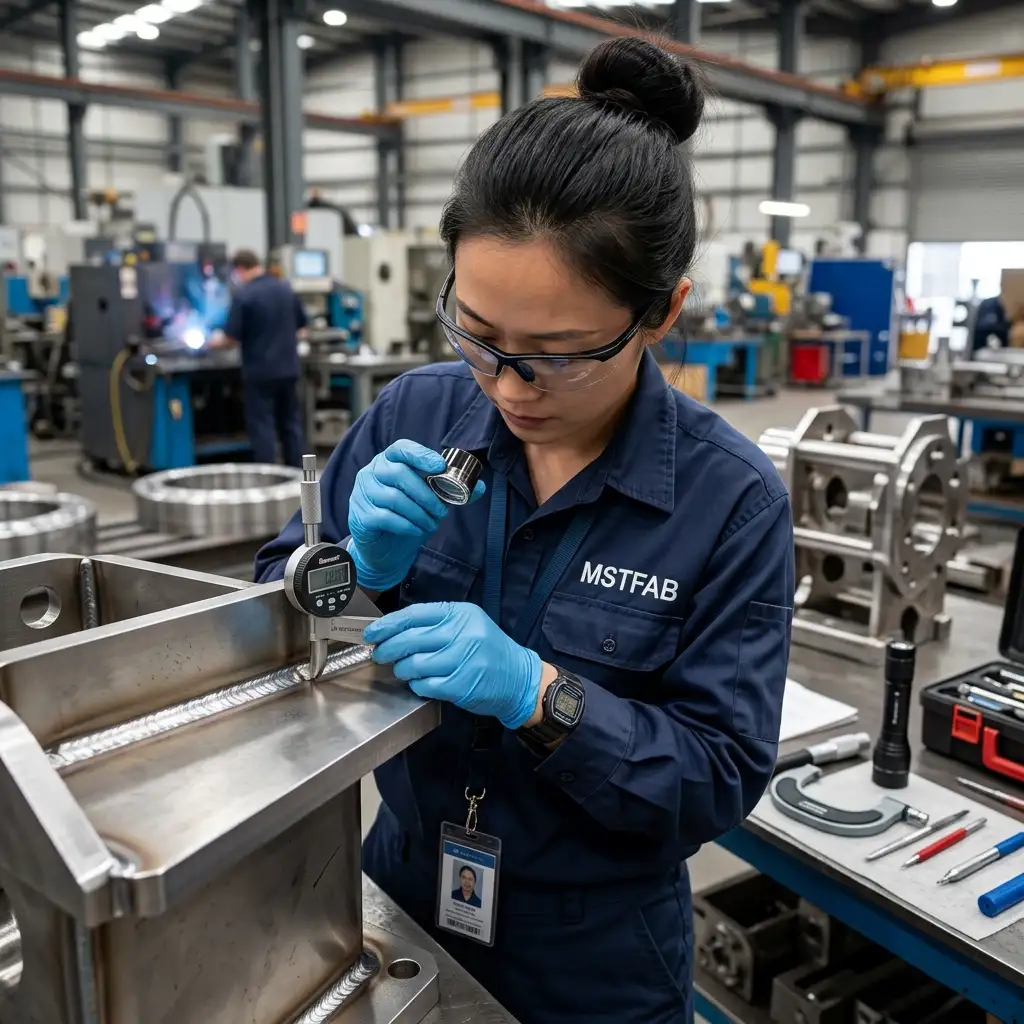
It is easier to adjust a fixture, weld sequence, or assembly detail before repeat production than after a full batch is already coated and packed.
Trust the Process: Supplier Quality Assurance Table
When assessing a supplier, it’s not just about what equipment they have, but the quality controls wrapped around that equipment. We call this our Trust Guarantee. See how we manage quality inspection across all fabrication stages.
| Quality Metric | MSTFAB Standard | Why You Care |
|---|---|---|
| First Article Inspection (FAI) | Mandatory for all new parts before mass production. | Prevents a full batch of scrap parts and costly delays. |
| Material Traceability | Mill test reports (MTR) tracked and maintained. | Ensures you get the grade of metal you actually paid for. |
| Dimensional Tolerance | Measured pre-weld, mid-weld, and post-weld. | Guarantees that your final assembly will bolt together smoothly. |
| Fixture Certification | Dedicated precision fixtures logged and maintained. | Ensures order #100 is identical to order #1. |
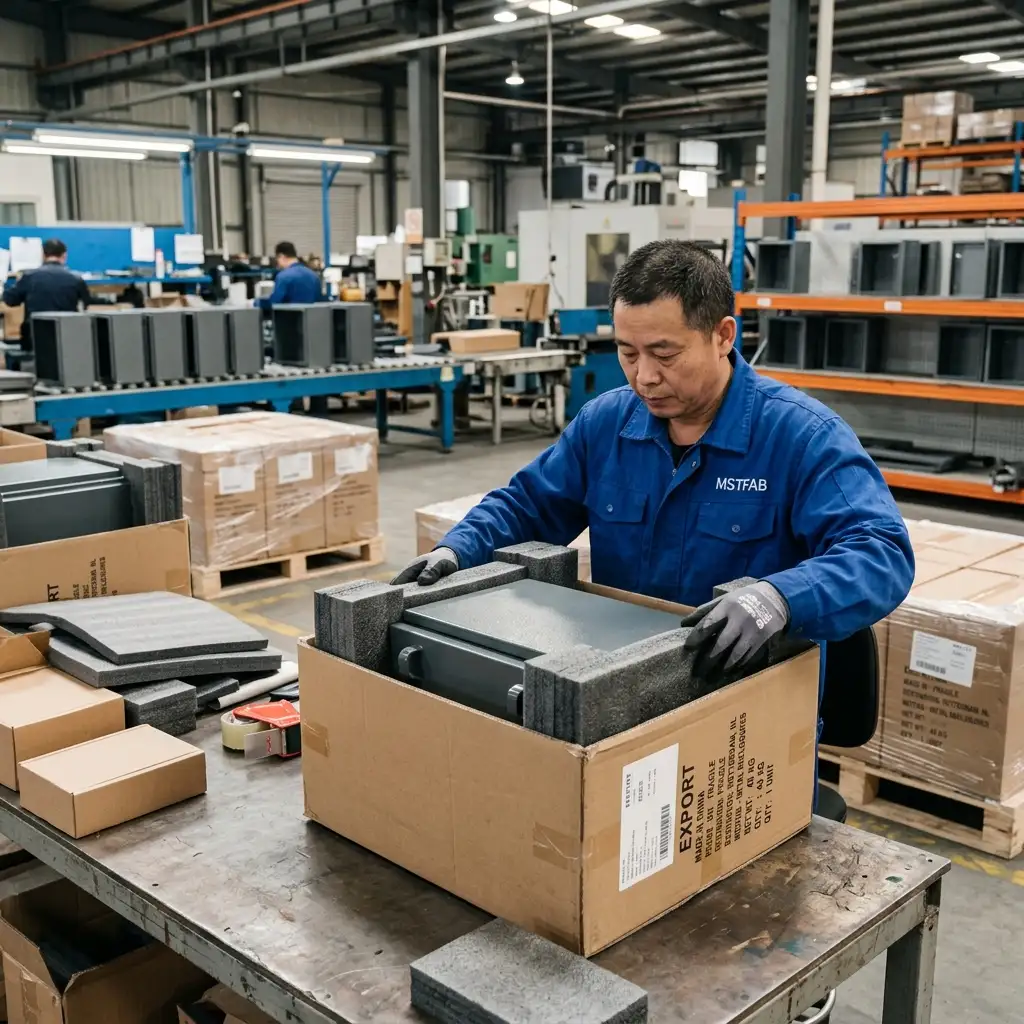
| Transit Protection | Custom-cut foam inserts and edge protection standard. | Ensures the perfect weld doesn’t get ruined by a rough delivery. |
Related Fabrication Capabilities
Robotic welding is one stage in the full manufacturing route. Depending on your project, these related capabilities may also apply:
- Custom Laser Cutting and Bending Services — precision blanks for welded assemblies
- Powder Coating for Sheet Metal Parts — surface finish after welding and cleanup
- Custom Metal Fabrication with Final Assembly — hardware, wiring, and packaging in one facility
- PEM Hardware Installation — threaded inserts and fasteners installed before or after welding
- Export Packaging — foam-lined crates and edge protection for international delivery
- Export Metal Parts Manufacturing — full route from RFQ to port
Request a Robotic Welding Review
A robotic welding project should not begin with a question about how many robots are in the workshop. It should begin with a question about whether the part can be located, welded, inspected, finished, packed, and repeated without creating problems for your production team.
Because the goal is not to automate welding for the sake of automation. The goal is to deliver welded parts that keep fitting long after the robot has gone home.
Ready to discuss your welded assembly project? Contact MSTFAB with your drawings and specifications. We will review fit-up, weld access, fixture requirements, and inspection criteria—before quoting begins.
Before robotic welding begins, the quality of laser-cut blanks directly affects fit-up, gap consistency and fixture alignment. Learn more about our precision laser cutting ensure flat patterns are dimensionally accurate before bending, welding or finishing.
 WeChat Contact
 WhatsApp Me Directly