
Custom PLC Control Cabinets for Industrial Automation
A PLC control cabinet is not just a metal cabinet with electrical parts inside. It is the physical structure that supports PLC modules, relays, terminals, power supplies, DIN rails, wiring ducts, mounting plates, HMI screens, switches, fans, filters, grounding points, cable glands, service doors, locks, hinges, and field maintenance access.
If the cabinet is poorly fabricated, the automation system may still look perfect on the electrical drawing, but the assembly floor will suffer:
- The mounting plate does not fit.
- The DIN rail holes are off.
- The cable entry is in the wrong location.
- The HMI cutout is slightly crooked.
- The fan opening blocks wiring space.
- The door does not close evenly.
- The powder coating blocks threaded holes.
- The technician starts drilling into finished coated metal.
That is not PLC control cabinet manufacturing. That is a control system trapped inside a sheet metal problem.
MSTFAB manufactures custom PLC control cabinets based on customer STEP files, 2D PDF drawings, DXF files, CAD files, samples, or project requirements. Our sheet metal fabrication support can include DFM review, laser cutting, CNC bending, welding, grinding, powder coating, stainless steel finishing, mounting plates, cable entry plates, hardware installation, inspection, and export-ready packaging.
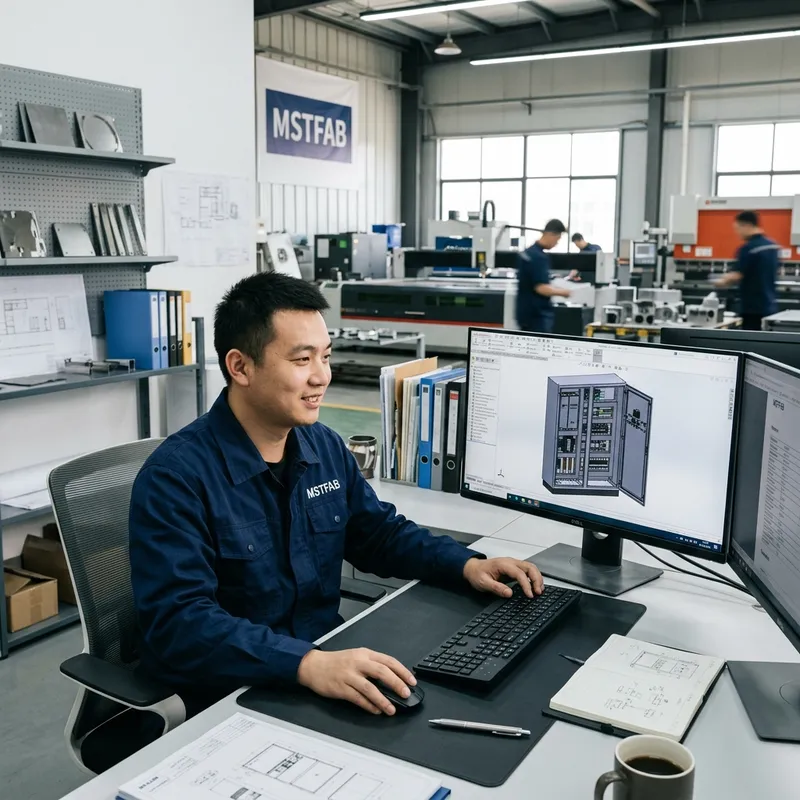
Need production capability? This article focuses on plc cabinet drawing checklist for automation integrators. For manufacturing scope, process capability and drawing-based quotation support, review MSTFAB’s PLC enclosure fabrication.
Why PLC Control Cabinets Need Custom Fabrication
Standard electrical boxes are useful for simple projects.
But OEM automation equipment often needs custom cabinet structures that match the real PLC layout, wiring route, HMI position, installation space, thermal design, maintenance access, and production workflow.
Custom PLC control cabinet fabrication helps solve practical problems such as:
- PLC module mounting layout
- DIN rail and wire duct support
- Removable mounting plates
- HMI touchscreen openings
- Push button and emergency stop holes
- Cable gland plate design
- Bottom, top, side, or rear cable entry
- Fan, filter, and ventilation openings
- Grounding and bonding points
- Door, hinge, lock, and gasket integration
- Wall-mounted or floor-standing cabinet structure
- Powder coating or stainless steel finishing
- Prototype to batch production consistency
A good PLC control cabinet should arrive ready for assembly. It should not arrive as a “nearly correct” enclosure that your technicians must finish with drills, files, and extremely creative vocabulary.
Common PLC Control Cabinet Applications
Custom PLC control cabinets are used for industrial automation systems, machine control cabinets, industrial electrical control boxes, HMI and PLC cabinets, VFD control cabinets, robotic control cabinets, conveyor control systems, packaging machine control cabinets, CNC machine control cabinets, motor control cabinets, factory automation cabinets, and OEM machinery control enclosures.
Each project has different priorities.
A machine control cabinet needs clean internal mounting and wiring space. An HMI and PLC cabinet needs accurate screen and button cutouts. A VFD control cabinet needs stronger ventilation and thermal planning. A robotic control cabinet needs reliable cable routing and service access. An outdoor PLC cabinet needs sealing, corrosion protection, and weatherproof structure review.
The Real Cost of a Poor PLC Cabinet
A cheap PLC control cabinet quote can look attractive during sourcing. Then the cabinet reaches assembly.
| Enclosure Manufacturing Flaw | The Result on Your Assembly Floor |
|---|---|
| Mounting Plate Mismatch | Technicians are forced to drill new holes, wasting hours and creating metal shavings inside the cabinet. |
| Poor Airflow & Fan Placement | VFDs and PLCs overheat in the field, causing unpredictable equipment shutdowns. |
| Inaccurate HMI Cutouts | The premium touchscreen sits crooked on the front door, destroying the machine’s cosmetic value. |
| Threaded Holes Blocked by Powder | Assembly grinds to a halt while workers manually tap out every blocked thread before installing relays. |
The cabinet price is one number. The rework cost is another number. And that second number usually arrives later, louder, and with more people copied in the email chain.
A reliable PLC control cabinet manufacturer helps reduce these risks before production begins through DFM review, controlled fabrication, practical inspection, and export packaging.
Built Around the PLC Layout
A PLC control cabinet should be designed around the actual internal control architecture. Before fabrication, the design should consider:
- PLC module position
- Relay and terminal block layout
- DIN rail positions & Wire duct clearance
- Power supply location & Circuit breaker layout
- VFD or motor control component clearance
- Mounting plate size & Grounding studs
- Cable entry direction & Cable bending clearance
- Door opening direction & HMI or button layout
- Fan and filter positions & Service access
If the internal layout is ignored, the cabinet may look clean outside but become painful during wiring. A beautiful powder-coated cabinet that blocks cable routing is not premium manufacturing. It is expensive decoration with a lock.
Mounting Plate, DIN Rail, and Wire Duct Support
The mounting plate is the working surface of a PLC control cabinet. It supports PLC modules, relays, terminal blocks, power supplies, circuit breakers, contactors, DIN rails, wire ducts, communication modules, and grounding parts.
Custom sheet metal fabrication can support removable mounting plates, reinforced mounting brackets, internal support rails, PEM nuts, threaded inserts, blind studs, grounding studs, cable clamp brackets, and side mounting structures.
A weak or inaccurate mounting plate slows assembly and creates wiring problems. A cabinet body may look strong from the outside, but if the internal mounting structure is wrong, your assembly team will know immediately. They always know.
HMI, Button, and Emergency Stop Cutouts
PLC control cabinets often include operator-facing features like HMI touchscreen openings, LCD display cutouts, push button holes, emergency stop openings, indicator light holes, selector switch holes, and USB or data port openings.
These features should be laser cut before powder coating or finishing. Cutting finished coated metal later damages the surface, exposes raw edges, creates burrs, and makes the final equipment look improvised.
Cable Entry and Wiring Support
Cable entry is one of the most common pain points in PLC control cabinet projects. Poor cable entry design can cause difficult wiring, cable bending stress, poor sealing, messy assembly, power and signal cable interference, extra drilling after coating, and field service problems.
Custom fabrication can support bottom cable gland plates, top cable entry plates, rear cable entry panels, side cable openings, removable gland plates, connector cutouts, cable clamp mounting points, grounding areas, and separate power and signal cable routes.
Cable entry should be planned before fabrication. Cutting holes into a finished PLC control cabinet is not engineering. It is panic with a hole saw.
Ventilation and Thermal Management
PLC control cabinets often contain heat-generating components. Common heat sources include power supplies, VFDs, transformers, PLC modules, relays, contactors, communication devices, and motor control components.
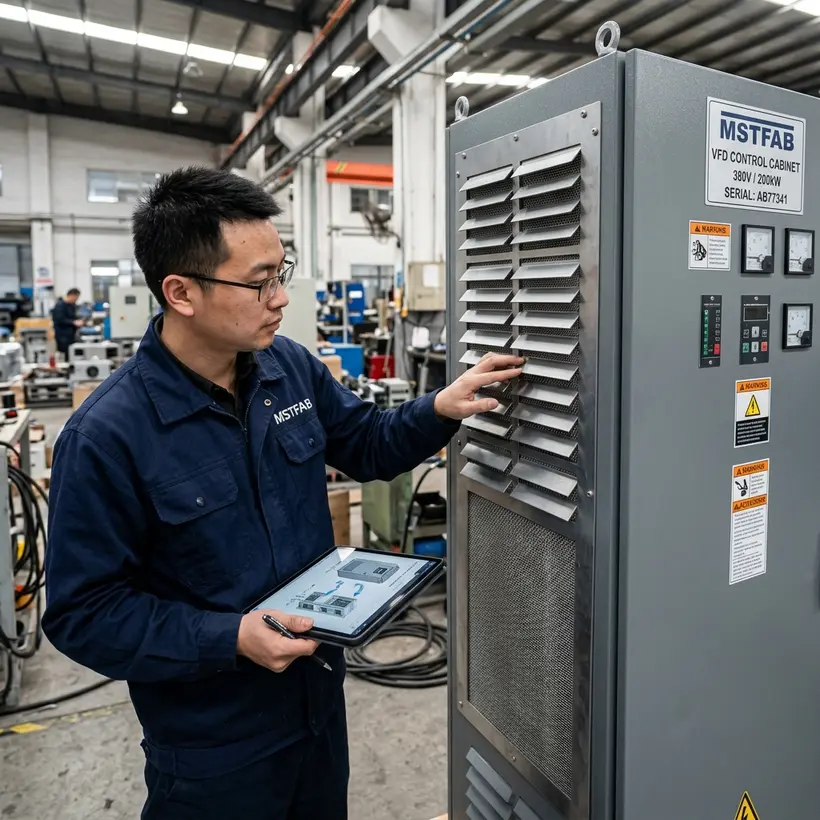
A sealed cabinet with no thermal plan can cook electronics. A ventilated cabinet with no protection can flood electronics. Both are bad. One is just wetter.
Door, Hinges, Locks, and Service Access
PLC control cabinets need reliable service access. Important door details include door flatness, hinge strength, locking pressure, door reinforcement, panel gap consistency, gasket contact, surface finish protection, and maintenance clearance.
A service door that sags after hardware installation is not a small issue. If the door sags, the cabinet feels cheap. If the gasket fails, the cabinet fails. Nobody wants a PLC cabinet door that behaves like an old kitchen cabinet after one month in service.
Material Options for PLC Control Cabinets
| Material | Application Environment |
|---|---|
| Cold-Rolled Steel | Indoor PLC cabinets, machine control panels, HMI control boxes. Easy to fabricate, but raw steel and moisture are not friends. |
| Galvanized Steel | Semi-outdoor PLC cabinets, power control enclosures. Cut edges and drilled holes still need protection. It is useful, not magic. |
| Stainless Steel | Washdown PLC control cabinets, food processing equipment, chemical environments. It costs more, but field corrosion usually costs more than that. |
| Aluminum | Lightweight control boxes, HMI panels, portable equipment. Aluminum is not soft steel. Treating it like steel is how nice CAD becomes annoying samples. |
Welding and Structural Assembly
PLC control cabinets may require welding for cabinet frames, base structures, internal brackets, mounting plate supports, reinforced doors, and outdoor cabinet bodies.
Welding adds heat. Heat moves metal. If welding is not controlled, the cabinet may look square in CAD and crooked in real life.
A PLC control cabinet should not come out of welding looking like a banana. Unless the machine is designed to sort fruit.
DFM Review Before Production
A 3D CAD model can look perfect on screen and still create production problems. Sheet metal has thickness. It bends. It springs back. It warps during welding. Powder coating adds thickness. Doors need flatness. Mounting plates need support. Cable entries need clearance.
A design issue found before production is a drawing update. A design issue found after production is a rejected sample, delayed assembly, and a meeting nobody wants to attend.
DFM review is not extra paperwork. It is risk control.
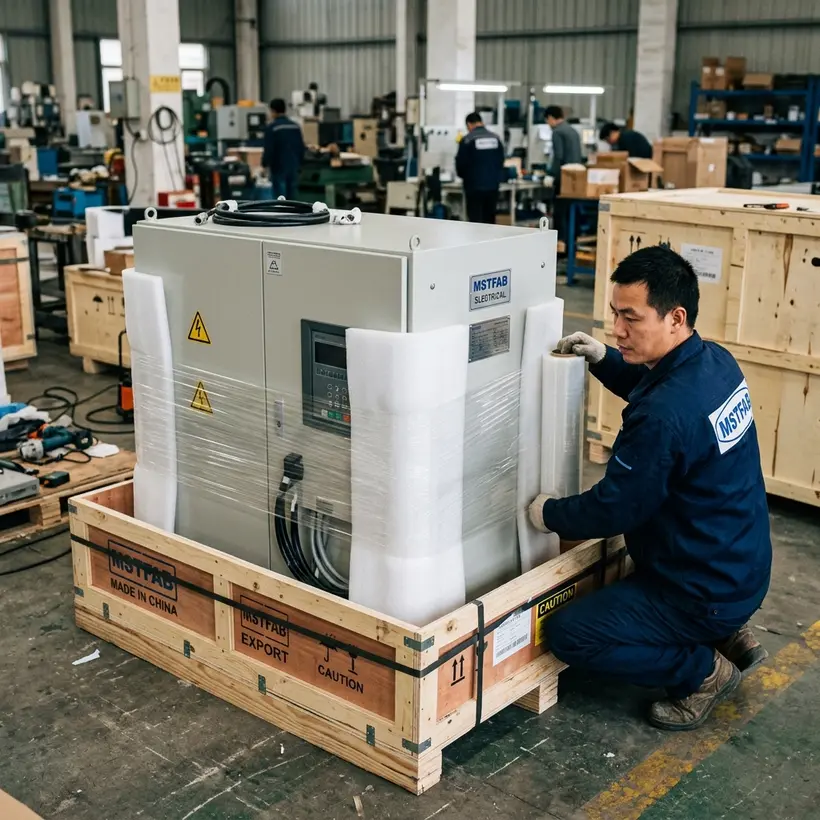
Why Choose MSTFAB for PLC Control Cabinets
MSTFAB is a custom sheet metal fabrication manufacturer in Guangzhou, China, supporting overseas OEM buyers with drawing-based enclosure manufacturing.
- Fast Quotation Support: With complete STEP and PDF drawings, our team can review projects faster and provide practical quotation support. Fast response matters when your project schedule is already breathing loudly behind you.
- DFM Review Before Production: We can review bending risks, welding distortion, cable entry, ventilation, gasket sealing, material choice, and packaging risks.
- Custom PLC Cabinet Experience: We support PLC control cabinets, HMI enclosures, industrial automation cabinets, electrical control cabinets, machine control boxes, and operator consoles.
- Clear Manufacturing Scope: We focus on physical metal enclosures and sheet metal parts. We do not ask for your proprietary PLC programs, source code, electrical logic, or automation software. You bring the automation intelligence. We build the cabinet that protects it.
Request a PLC Control Cabinet Quote
If you need PLC control cabinets for industrial automation, machine control systems, HMI panels, VFD controls, robotic equipment, conveyor systems, packaging machines, or OEM machinery, send us your STEP and PDF drawings.
FAQ
What are PLC control cabinets?
PLC control cabinets are metal enclosures used to house PLC modules, relays, terminals, power supplies, DIN rails, wiring ducts, circuit breakers, HMI panels, and other industrial automation control components.
Can PLC control cabinets be customized?
Yes. Size, material, thickness, mounting plates, DIN rail supports, HMI openings, button holes, cable entries, ventilation, doors, locks, hinges, surface finish, and hardware can be customized according to drawings.
What materials are used for PLC control cabinets?
Common materials include cold-rolled steel, galvanized steel, stainless steel, aluminum, and coated carbon steel depending on indoor or outdoor use, corrosion requirements, strength, weight, and budget.
Does MSTFAB provide PLC programming or wiring?
No. MSTFAB focuses on custom sheet metal fabrication. We manufacture the physical cabinet, enclosure, panel, bracket, chassis, mounting plate, and metal parts. PLC programming, wiring, electrical design, software, circuitry, and internal components are outside our standard scope.
Suggested Further Reading
- PLC Enclosure Fabrication Manufacturer
- HMI Enclosure Sheet Metal Fabrication
- Industrial Automation Enclosure
- OEM Electrical Control Cabinet
- Custom Electrical Control Enclosure
- Industrial Control Enclosure Manufacturer
- Custom Control Cabinet Fabrication
- Operator Console Enclosure Manufacturer
- Power Distribution Cabinet Fabrication
- Outdoor Electrical Enclosure Fabrication
- IP65 Sheet Metal Enclosure
- IP66 Metal Enclosure Fabrication
- Custom NEMA Enclosure Manufacturer
- DFM for Sheet Metal Enclosures
- Custom Sheet Metal Enclosure Design Guide
- Sheet Metal Enclosure Manufacturing
- Powder Coating for Sheet Metal Enclosures
- Custom Laser Cutting Service
- CNC Sheet Metal Bending
custom sheet metal enclosure fabrication
MSTFAB manufactures custom sheet metal enclosures, electrical cabinets, control boxes and industrial metal housings for OEM buyers.
 WeChat Contact
 WhatsApp Me Directly