
Prepare a complete operator console RFQ
Use one controlled document pack so suppliers quote the same mechanical scope. This checklist covers the empty console shell, panels, hardware interfaces and finish. Define electronics, wiring and final equipment verification separately.
Operator console drawing and specification checklist
| RFQ item | What to include |
|---|---|
| Drawing control | STEP model and 2D PDF, drawing number, revision, units and the document that controls any conflicting dimensions. |
| HMI and cutouts | Component model or cutout drawing, opening sizes, mounting holes, datums, required tolerances and cable-entry positions. |
| Console layout | Overall dimensions, panel angle, installation height, mounting pattern, door swing and service-access clearances. |
| Material | Material grade and thickness for each part. Identify where a proposed material substitution needs written approval. |
| Finish | Finish type, color reference, texture, visible faces, masking areas and the agreed cosmetic acceptance sample or criteria. |
| Hardware | Hinges, latches, seals, studs and inserts with part numbers, thread sizes, installation direction and buyer/supplier responsibility. |
| Sample acceptance | Critical dimensions, door and panel fit, inspection records, sample quantity and who approves the first article before repeat production. |
| Order and delivery | Prototype and batch quantities, repeat demand, required delivery date, destination and visible-surface protection or packing requirements. |
List unresolved items as questions for the drawing review. Record any agreed changes in the controlled drawing or specification before sample approval.
Review operator console fabrication scope Send the completed RFQ
Custom Operator Console Enclosures for Industrial Control Systems
An operator console enclosure is not just a metal desk with buttons.
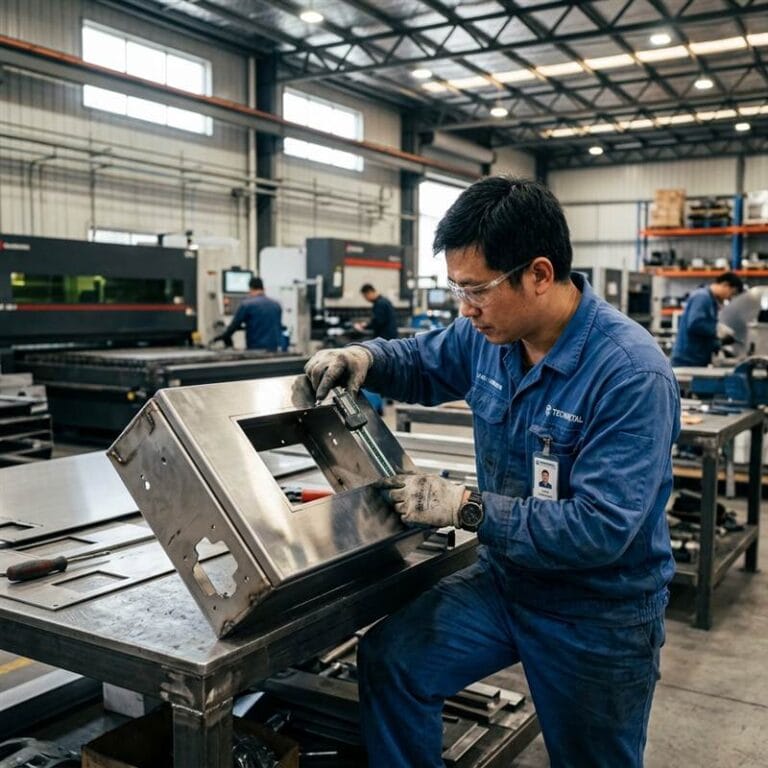
It is the control center where operators view machine status, press emergency stops, adjust production settings, manage HMI screens, access internal wiring, and interact with the equipment every day.
If the console is poorly manufactured, the problem becomes obvious immediately:
- The touchscreen cutout is slightly off.
- The control panel flexes when someone presses a button.
- The viewing angle creates glare.
- The door does not close cleanly.
- The internal mounting plate blocks cable routing.
- The powder coating scratches during shipment.
- The console looks like a premium automation system trapped inside a cheap metal table.
That is not operator console enclosure manufacturing.
Record each mismatch against the released drawing and resolve it before sample approval.
MSTFAB manufactures custom operator console enclosures based on customer drawings, STEP files, CAD files, PDF drawings, samples, or project requirements. Our process can include laser cutting, CNC bending, welding, grinding, powder coating, hardware installation, cable entry design support, ventilation review, DFM review, inspection, and export packaging.
Why Operator Console Enclosures Need Custom Manufacturing
Operator consoles usually need more engineering attention than standard control boxes.
A good console must match the real operator workflow, HMI layout, button positions, internal electrical layout, viewing angle, cable routing, ventilation, maintenance access, and installation environment.
Custom operator console enclosure fabrication helps solve problems such as:
- HMI touchscreen cutout accuracy
- Push button and emergency stop layout
- Sloped control panel design
- Ergonomic viewing angle
- Strong front panel structure
- Internal mounting plates and brackets
- Cable entry and cable routing
- Door, hinge, lock, and gasket integration
- Ventilation or fan openings
- Keyboard tray or drawer structure, if required
- Floor-standing or pedestal-style console structure
- Powder coating or stainless steel finishing
- Prototype to batch production consistency
A good operator console should feel solid, look professional, and make assembly easier.
Confirm the sample cutouts, hardware interfaces and door fit before releasing the design for repeat production.
Common Operator Console Applications
Custom operator console enclosures are used for:
- Industrial operator consoles
- Machine control consoles
- HMI operator stations
- PLC control consoles
- Automation control desks
- Robotic system operator consoles
- Packaging machine control stations
- CNC machine control consoles
- Conveyor control consoles
- Production line control desks
- Factory control room consoles
- Power equipment control consoles
- Process control operator stations
- OEM machinery control enclosures
Each project has different priorities.
A machine control console needs accurate HMI and button openings.
A control room console needs clean appearance and cable routing.
A robotic operator station needs strong mounting and service access.
A production line console needs durable powder coating and stable structure.
A washdown-area console may need stainless steel and sealing review.
That is why operator console enclosure manufacturing should start with the real operating layout, not only the outside dimensions.
The Real Cost of a Bad Operator Console
A cheap operator console quote can look attractive during sourcing.
Then the sample reaches the assembly floor.
A poor console enclosure may cause misaligned touchscreen openings, poor button layout, weak sloped control panel, door or access panel fit issues, cable entry rework, difficult internal assembly, poor operator viewing angle, ventilation problems, coating damage, extra drilling after finishing, failed sample approval, delayed machine shipment, and customer complaints.
The console price is one number.
The assembly cost is what happens after the console arrives.
If your team needs to modify finished powder-coated parts before installing the HMI, switches, cable glands, or internal components, the project has already lost time and money.
A reliable operator console enclosure manufacturer reduces those risks before production begins.
Built Around the Operator Layout
An operator console should be designed around the actual user interface and internal control layout.
Before fabrication, the design should consider:
- HMI touchscreen size and Display opening tolerance
- Button and selector switch layout, Emergency stop position
- Indicator light locations and Keyboard tray or mouse area
- Sloped panel angle and Operator viewing height
- Cable entry direction and Internal mounting plate layout
- PLC or power component clearance
- Fan and filter positions
- Door opening direction and Service access
- Floor anchoring or pedestal structure
- Surface finish requirement
If the operator layout is ignored, the console may look fine in CAD but feel terrible in real use.
A beautiful powder-coated console with a bad viewing angle is not premium manufacturing.
Confirm the viewing angle, control reach and intended operator position with the equipment designer before approving the layout.
HMI, Button, and Control Cutouts
Operator consoles often include many user-facing features.
Common cutouts include HMI touchscreen openings, LCD display cutouts, push button holes, emergency stop openings, indicator light holes, selector switch holes, key switch holes, USB or data port openings, cable gland holes, connector cutouts, fan openings, lock and hinge positions, and nameplate or label areas.
These features should be laser cut before powder coating.
Cutting finished coated metal later damages the surface, exposes raw edges, creates corrosion risk, and makes a professional control console look improvised.
A touchscreen opening should not be “almost right.”
Use the device supplier’s cutout drawing and agreed inspection dimensions to verify fit before coating.
Ergonomic Console Design
Operator consoles are used by people, not robots.
That means ergonomics matter.
A custom sheet metal operator console can support sloped control surfaces, angled HMI panels, comfortable standing or seated operation, pedestal-mounted structures, floor-standing control desks, integrated keyboard trays, service-friendly front or rear doors, cable routing through the base, reinforced panel areas, and stable base structures.
A flat metal box may be easy to fabricate, but it may create glare, awkward reach, poor visibility, or operator fatigue.
Good operator console design respects the user.
Review screen visibility, control access and maintenance clearance with the buyer during layout approval.
Front Panel Rigidity
Operator consoles get touched all day.
Buttons are pressed. Emergency stops are hit. Screens are tapped. Technicians open doors. Operators lean on the console whether the drawing allowed it or not.
The enclosure must be strong enough to prevent flexing, rattling, and long-term deformation.
Important structural details include front panel thickness, sloped panel reinforcement, internal stiffeners, welded support brackets, mounting plate strength, reinforced button areas, strong hinge and lock positions, base frame rigidity, and console anti-twist structure.
Define the expected operating loads and any allowable panel deflection in the project specification.
Where panel movement could affect controls or seals, confirm the support arrangement and inspection method with the equipment designer.
Agree how panel rigidity and hardware retention will be checked on the first article.
Cable Entry and Wiring Support
Cable entry is one of the most common pain points in operator console projects.
Operator consoles may need to manage power cables, signal cables, Ethernet cables, PLC connection cables, HMI communication cables, sensor cables, grounding cables, and field wiring connections.
Poor cable entry design can cause difficult wiring, cable bending stress, messy assembly, power and signal cable interference, poor service access, extra drilling after coating, and cable damage during maintenance.
Custom fabrication can support bottom cable entry plates, rear cable openings, side cable openings, removable gland plates, connector cutouts, cable clamp mounting points, grounding studs, separate power and signal cable paths, protected cable entry zones, and cable routing through pedestal or base structures.
Cable entry should be planned before fabrication.
Release cable-entry positions, gland sizes and removable plate details before cutting and finishing.
If a finished part needs modification, agree the drawing revision, deburring and coating-repair requirements before rework.
Ventilation and Heat Management
Operator consoles may contain power supplies, PLC modules, relays, communication equipment, monitors, HMI screens, and other heat-generating components.
Custom operator console enclosures can include ventilation slots, fan openings, filter frames, air inlet and outlet paths, heat sink clearance, internal airflow zones, removable service panels, and protected ventilation structures.
But random holes are not thermal engineering.
Review openings together with the required filters, seals, drainage and the buyer’s environmental validation plan.
The console needs to support airflow without making the internal electronics dirty, wet, or unsafe.
An operator console that looks good but overheats the control electronics is still a failed enclosure.
Material Options for Operator Console Enclosures
Cold-Rolled Steel
Cold-rolled steel is commonly used for indoor operator consoles, machine control desks, control panels, and powder-coated automation equipment.
Best for indoor control consoles, machine operator stations, PLC and HMI consoles, powder-coated control desks, and cost-effective OEM equipment.
Galvanized Steel
Galvanized steel provides better corrosion resistance than standard cold-rolled steel. Best for semi-outdoor control consoles, industrial control stations, and powder-coated automation enclosures.
Stainless Steel
Stainless steel is used when corrosion resistance, cleanliness, durability, or premium appearance is important. Common options include SUS304 and SUS316.
Best for washdown operator consoles, food processing control stations, medical equipment control consoles, chemical environment operator stations, harsh industrial control consoles, and NEMA 4X-style projects.
Stainless steel costs more. Field corrosion and failed cleaning environments usually cost more than that.
Aluminum
Aluminum is lightweight and naturally corrosion-resistant. Best for lightweight operator consoles, premium control panels, portable operator stations, and aluminum HMI console structures.
Surface Finishing for Operator Consoles
Surface finish affects appearance, corrosion resistance, durability, and customer perception.
Common finishing options include fine-texture powder coating, smooth powder coating, outdoor-grade powder coating, wet painting, brushed stainless steel, stainless steel passivation, anodizing for aluminum, anti-corrosion coating, and silkscreen printing or marking.
For operator consoles, the surface is visible and touched every day.
A console can be dimensionally correct and still be rejected if the finish is scratched, uneven, or cheap-looking.
Identify visible faces and agree a finish reference sample, handling protection and cosmetic acceptance criteria before production.
Welding and Structural Assembly
Operator consoles often require welding for frames, angled panels, base structures, mounting brackets, door stiffeners, and console bodies.
Poor welding can cause warped frames, misaligned doors, uneven panels, weak brackets, visible defects, coating problems, and assembly issues.
Welding adds heat. Heat moves metal.
If welding is not controlled, the console may look square in CAD and crooked in real life.
Mark the critical datums and check door openings, panel flatness and mounting interfaces after welding against the agreed drawing requirements.
Door, Hinges, Locks, and Service Access
Operator consoles often require reliable service access from the front, rear, side, or bottom.
Common door or cover features include hinges, locks, handles, gaskets, grounding connection, internal brackets, door stiffeners, service access panels, removable rear covers, and removable bottom plates.
A service door that sags after installation is not a small issue.
Check hinge alignment, latch engagement, door gaps and gasket fit on the sample.
State any required opening-cycle, retention or sealing test in the RFQ and agree its method and acceptance criteria separately.
Floor-Standing, Pedestal, and Console-Desk Designs
Floor-Standing Operator Consoles
Floor-standing operator consoles are used for machine control stations, production lines, control rooms, and industrial automation equipment.
For a floor-standing operator console, confirm the base, anchoring pattern, installed equipment mass and stability requirements with the buyer.
Pedestal Operator Consoles
Pedestal operator consoles are used where the HMI or control panel needs to be raised to a comfortable operating height. If the pedestal is weak, the console may shake, sag, or feel unstable during operation. That is not a good user experience.
Console-Desk Enclosures
Console-desk enclosures are used for larger control rooms, production monitoring systems, and industrial operator workstations. A console desk is not just a box. It is an operator workstation. Bad ergonomics become daily frustration.
Laser Cutting for Operator Console Parts
Laser cutting is used for operator console panels, doors, covers, mounting plates, cable entry plates, ventilation panels, brackets, and base structures.
These features should be cut before finishing. Cutting finished coated metal later damages the protection layer, exposes raw edges, and increases corrosion risk.
It also makes a precision operator console look like someone modified it in a hurry.
CNC Bending for Console Structure
CNC bending forms flat sheet metal into console bodies, doors, covers, flanges, mounting structures, side panels, angled operator surfaces, and internal supports.
For operator console enclosure manufacturing, bend radius and bend sequence should be reviewed before production.
Identify the inspection datums, critical formed dimensions and any mating-part fit check on the released drawing.
DFM Review Before Production
A 3D CAD model can look perfect on screen and still create production problems.
Sheet metal has thickness. It bends. It springs back. It warps during welding. Powder coating adds thickness. Touchscreen gaskets need flat surfaces. Buttons need clearance. Cable entries need space. Hardware needs access. Assembly sequence matters.
A Design for Manufacturability review helps identify risks before production.
A design issue found before production is a drawing update.
A design issue found after production is a rejected sample, delayed assembly, and a meeting nobody wants to attend.
DFM review is not extra paperwork. It is risk control.
Prototype to Batch Production
For operator console enclosure projects, prototype or first-article production is often useful before batch manufacturing.
For OEM buyers, one good sample is not the finish line. The real goal is stable repeat production.
Record approved sample changes in the controlled drawing and work instructions so later batches use the same agreed geometry and inspection criteria.
Quality Control for Operator Console Enclosures
Quality control should focus on fabrication accuracy, assembly fit, surface appearance, structural stability, and packaging protection.
If IP, NEMA, coating, load, or third-party testing is required, that requirement should be stated before quotation.
Do not assume. Assumptions are where procurement projects go to get expensive.
Export Packaging for Operator Consoles
Operator console enclosures are often large, coated, fitted with hardware, and shipped internationally.
Poor packaging can damage the console before assembly or installation.
Export packaging may include foam protection, corner protection, pallets, wooden crates, film protection, moisture protection, door protection, hardware protection, and separate protection for visible surfaces.
Good packaging is part of quality control.
Agree protection for coated faces, restraints for doors and loose hardware, handling points and the receiving inspection record before shipment.
Clear Manufacturing Scope and IP Protection
MSTFAB focuses on custom sheet metal fabrication and metal structure manufacturing.
We do not write HMI software.
We do not write PLC programs.
We do not design automation logic.
We do not design electrical schematics.
We do not configure machine control systems.
We do not require proprietary software, source code, circuit diagrams, machine control logic, or internal electronic system design.
Our scope is the physical metal enclosure, cabinet, panel, bracket, chassis, frame, or sheet metal component based on customer drawings and project requirements.
This keeps the manufacturing boundary clear and helps protect customer intellectual property.
What to Send for a Quote
A useful operator console quote starts with one controlled drawing package, not a list of enclosure keywords. Identify the mating equipment and mark any dimension that would stop assembly if it moved.
| Buyer input | Why it matters to the quotation |
|---|---|
| STEP or STP assembly and 2D PDF drawing with revision | Confirms overall geometry, angles, service clearance and the source of truth for inspection. |
| Buyer-controlled DXF or DWG cutout data, if available | Helps verify HMI windows, button centers, gland plates and mounting holes against the released design. |
| Material, thickness, finish and quantity | Sets the fabrication route and allows a project-specific price, lead time and batch plan. |
| Display, control and mounting interfaces | Prevents an attractive shell that does not fit the actual screen, controls or host machine. |
| Environmental target and buyer’s validation plan | Defines gasket, cable-entry and ventilation details without assuming the empty shell carries an IP or NEMA rating. |
| Critical dimensions, first-article evidence and packing destination | Shows what to measure, what to approve and how to protect the finish in transit. |
Scope to confirm: MSTFAB is the international brand of Guangzhou Maisituo Sheet Metal Manufacturing Co., Ltd. We supply drawing-based fabricated mechanical parts and empty enclosure shells. The buyer or OEM owns electrical selection, integration and completed-system validation. Selected finishing processes may be completed by qualified long-term partners. MOQ, lead time and tolerances are confirmed for the approved drawing and quotation, not promised as one fixed number for every console.
If a STEP file is not ready, send the controlled PDF and identify what remains open. A question before cutting is much cheaper than a beautifully finished part that will not accept the display.
Request an Operator Console Enclosure Quote
Send the controlled assembly, drawing revision, target quantity and critical interfaces through the MSTFAB contact page. We will review the mechanical scope and flag missing decisions before quotation.
FAQ
What is an operator console enclosure manufacturer?
An operator console enclosure manufacturer produces custom sheet metal control consoles, operator stations, control desks, HMI console housings, panels, doors, brackets, mounting plates, cable entry plates, ventilation parts, and chassis structures for industrial equipment.
What are operator console enclosures used for?
Operator console enclosures are used for machine control systems, HMI operator stations, PLC control consoles, automation control desks, robotic systems, production lines, control rooms, and OEM machinery.
Can operator console enclosures be customized?
Yes. Size, material, thickness, touchscreen openings, button holes, emergency stop positions, cable entries, ventilation, doors, locks, hinges, mounting plates, internal brackets, surface finish, base structures, and hardware can be customized according to drawings.
What materials are used for operator console enclosures?
Common materials include cold-rolled steel, galvanized steel, stainless steel, aluminum, and coated carbon steel depending on indoor or outdoor use, corrosion requirements, weight, strength, appearance, and budget.
Can you make sloped operator console enclosures?
Yes. Sloped control surfaces, angled HMI panels, floor-standing consoles, pedestal consoles, and console-desk structures can be fabricated according to customer drawings and project requirements.
Can you support IP65, IP66, NEMA 3R, or NEMA 4X design requirements?
Yes. Fabrication can be designed to support customer IP or NEMA requirements based on drawings and specifications. If formal testing, certification, or third-party reports are required, the requirement must be confirmed before quotation.
What drawings are needed for quotation?
A 3D STEP file and 2D PDF drawing are recommended. DXF or DWG files can also help with flat laser-cut parts. The drawing package should include material, thickness, touchscreen cutouts, button layout, cable entry, ventilation, surface finish, hardware, and inspection requirements.
Do you provide HMI software, PLC programming, or electrical design?
No. Our main scope is custom sheet metal fabrication. We manufacture the physical enclosure, cabinet, panel, bracket, chassis, mounting plate, and metal parts. HMI software, PLC programming, electrical schematics, automation logic, circuitry, and internal electronics are outside our standard scope.
MSTFAB Capabilities
- Industrial Operator Console Support
- Sloped HMI Panel and Button Layout Design
- Cable Entry and Internal Mounting Review
- Steel / Galvanized Steel / Aluminum / Stainless Steel
Related engineering resource: If your project involves EV charging infrastructure, review our custom EV charger enclosure fabrication capabilities for outdoor sheet metal cabinet design, powder coating, and export-ready manufacturing.
Related factory capability: For OEM buyers comparing a sheet metal enclosure factory, review how MSTFAB handles final assembly, protective packaging, export packing checks, and shipment-ready enclosure delivery.
MSTFAB manufactures custom sheet metal enclosures, electrical cabinets, control boxes and industrial metal housings for OEM buyers.
 WeChat Contact
 WhatsApp Me Directly