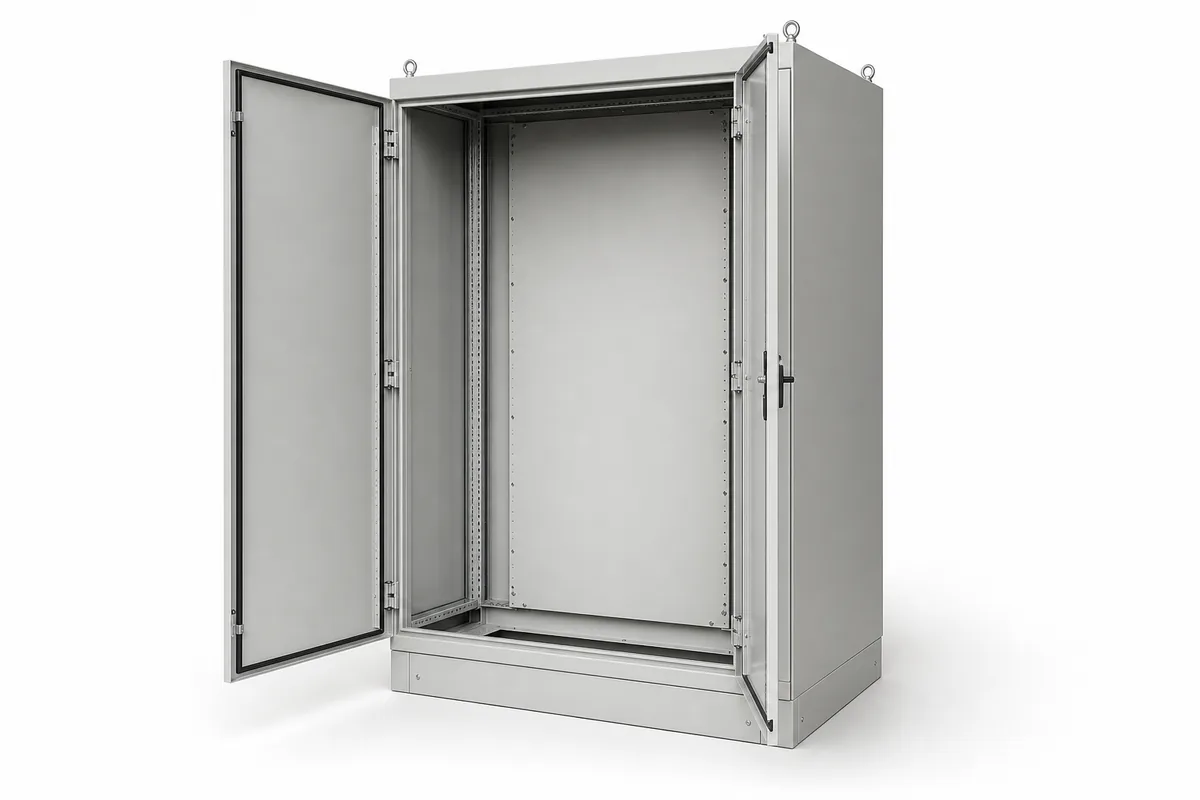
Short answer: MSTFAB fabricates empty floor-standing sheet metal cabinet shells, doors, base plinths, blank mounting plates, gland plates, brackets and drawing-defined mechanical hardware. We do not supply PLCs, breakers, terminal blocks, wiring, busbars, batteries or energized electrical systems.
A tall cabinet can look simple in CAD and still become an expensive lesson in gravity. Long panels amplify bend variation, welding heat can pull the body out of square, and a small hinge error becomes a very visible door-gap problem. This guide explains the mechanical details an OEM buyer should define before quotation.
What MSTFAB can fabricate
- Empty floor-standing cabinet body and blank doors
- Fabricated base plinths, lifting and reinforcement features
- Blank removable mounting plates and gland plates
- Drawing-defined hinges, locks, studs and PEM hardware
- Laser cutting, bending, welding and surface finishing
- Mechanical trial fit, inspection evidence and export packing
What remains outside our scope
- PLCs, breakers, relays and terminal blocks
- Busbars, batteries, power supplies and control electronics
- Electrical layout design, component installation and wiring
- Continuity, dielectric, functional or energized testing
- Finished-product NEMA, IP, UL or CE approval
- Field installation, commissioning and system validation
Why floor-standing cabinet shells need different DFM
Floor-standing shells are taller and usually heavier than wall-mounted boxes. Panel flatness, frame squareness, base rigidity and door alignment become more sensitive as the cabinet grows. The fabrication route should therefore be reviewed as one mechanical system, not as a collection of unrelated flat parts.
A practical RFQ should identify overall dimensions, material and thickness, supported load assumptions supplied by the buyer, floor or plinth mounting points, door swing, removable panels, gland-plate locations, critical interfaces, finish, quantity and packing constraints. MSTFAB reviews how those requirements affect the sheet metal fabrication route.

Cabinet geometry buyers should control
| Mechanical feature | Why it matters | What to define in the drawing | Useful evidence |
|---|---|---|---|
| Body squareness | Controls door fit, panel interfaces and installation alignment | Overall size, diagonals, flatness references and critical datums | Overall dimensions and diagonal comparison |
| Door and hinge line | Affects door gap, closing force and visible quality | Hinge model, position, door gap, swing and lock interfaces | Door-gap and mechanical trial-fit photos |
| Base plinth | Transfers cabinet weight and affects floor installation | Material, reinforcement, anchor pattern, access and load inputs | Key dimensions, weld review and visual inspection |
| Blank mounting plate | Provides a controlled mechanical interface for later integration | Plate size, thickness, studs, holes, removal direction and clearance | Hole-position and flatness checks as agreed |
| Gland or entry plate | Allows buyer-defined cable entry without redesigning the cabinet body | Blank or cut plate, location, size, fasteners and sealing interface | Cutout dimensions and plate fit |
| Coating interfaces | Threads, grounding locations, gasket faces and fit areas may need masking | Finish system, color, texture, masking and acceptable cosmetic limits | Sample approval and coating checks when specified |
Base plinth and reinforcement are drawing decisions
The base is more than a dark rectangle placed under the cabinet. It influences load transfer, anchoring, forklift access, toe clearance and packing. The buyer should provide the installed load, mounting method and any lifting requirements. MSTFAB can fabricate the plinth and reinforcement features to the approved drawing, but we do not invent structural ratings from a product photo.
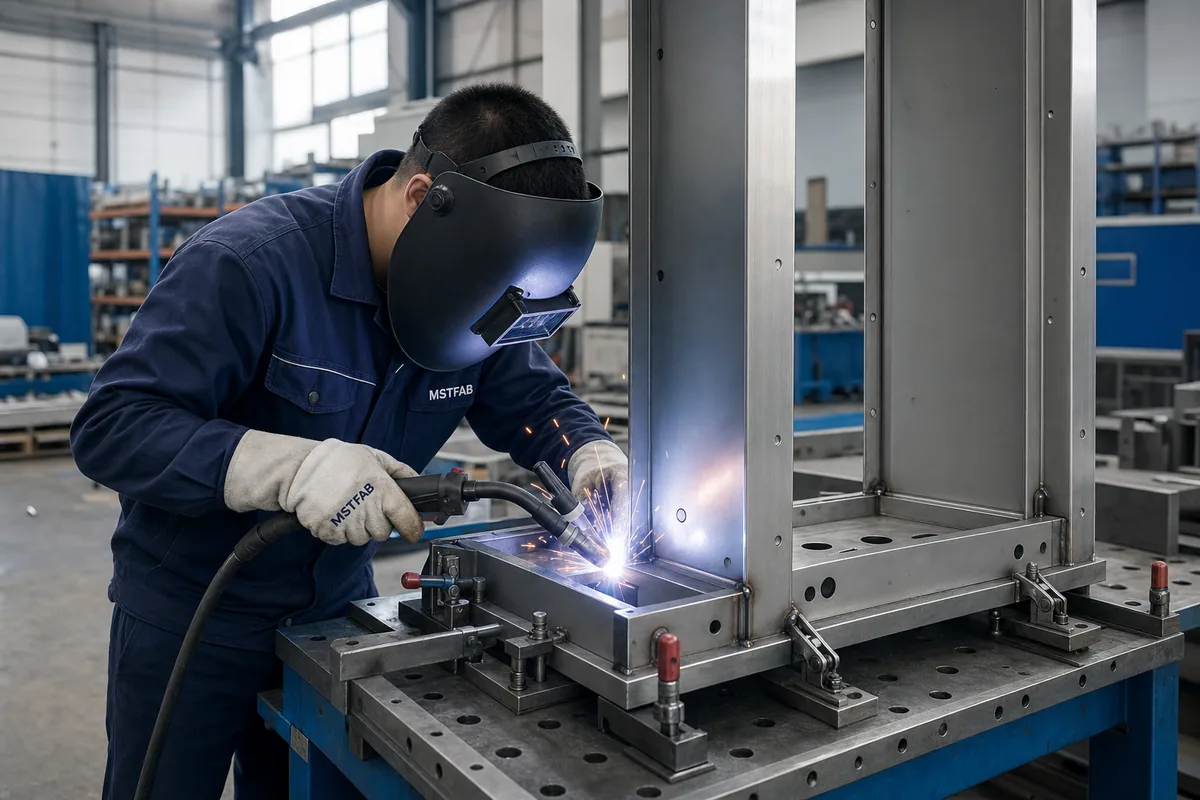
Weld sequence and fixture strategy matter because heat distortion near the base can move the side panels and hinge references. For tall bodies, the sheet metal welding process should be planned together with bending datums and final mechanical inspection.
Blank mounting plates, not complete electrical assemblies
MSTFAB can supply a blank or drawing-machined mounting plate, welded studs, PEM hardware and the cabinet-side interfaces required to hold it. The buyer or electrical integrator remains responsible for selecting and arranging PLCs, drives, breakers, relays, busbars, wiring ducts and other electrical equipment.

Door, lock, gasket and removable-panel fit
Doors reveal fabrication quality immediately. Buyers should specify hinge and lock models, opening direction, target door gaps, gasket channel geometry, compression assumptions provided by the gasket supplier, removable panels and any visible-surface criteria. Hinges and locks may be installed as drawing-defined mechanical hardware, but final environmental performance depends on the complete product configuration.

Mechanical evidence that improves buyer confidence
Inspection evidence should match project risk instead of becoming a ceremonial stack of paper. Define the records needed in the RFQ or purchase order so quotation includes the correct work.
Buyer-defined evidence can also include first-article photos, weld visual criteria, hardware verification and packing photos. The important part is agreeing what proves acceptance before production starts, not after the crate is already closed.
Material and finish selection
Cold-rolled steel is commonly selected for indoor powder-coated shells. Galvanized steel may be useful where additional substrate corrosion protection is required. Stainless steel and aluminum can serve corrosion, weight or appearance needs, but they change forming, welding, finish and cost decisions. Use the sheet metal material selection guide to frame the discussion, then confirm the exact grade and thickness on the drawing.
Finish requirements should identify pretreatment, color or sample, gloss or texture, masking zones, threads, grounding locations, gasket faces and cosmetic surfaces. MSTFAB’s surface treatment planning focuses on the fabricated metalwork, not the electrical system that may later be installed.
Export packing for tall empty shells
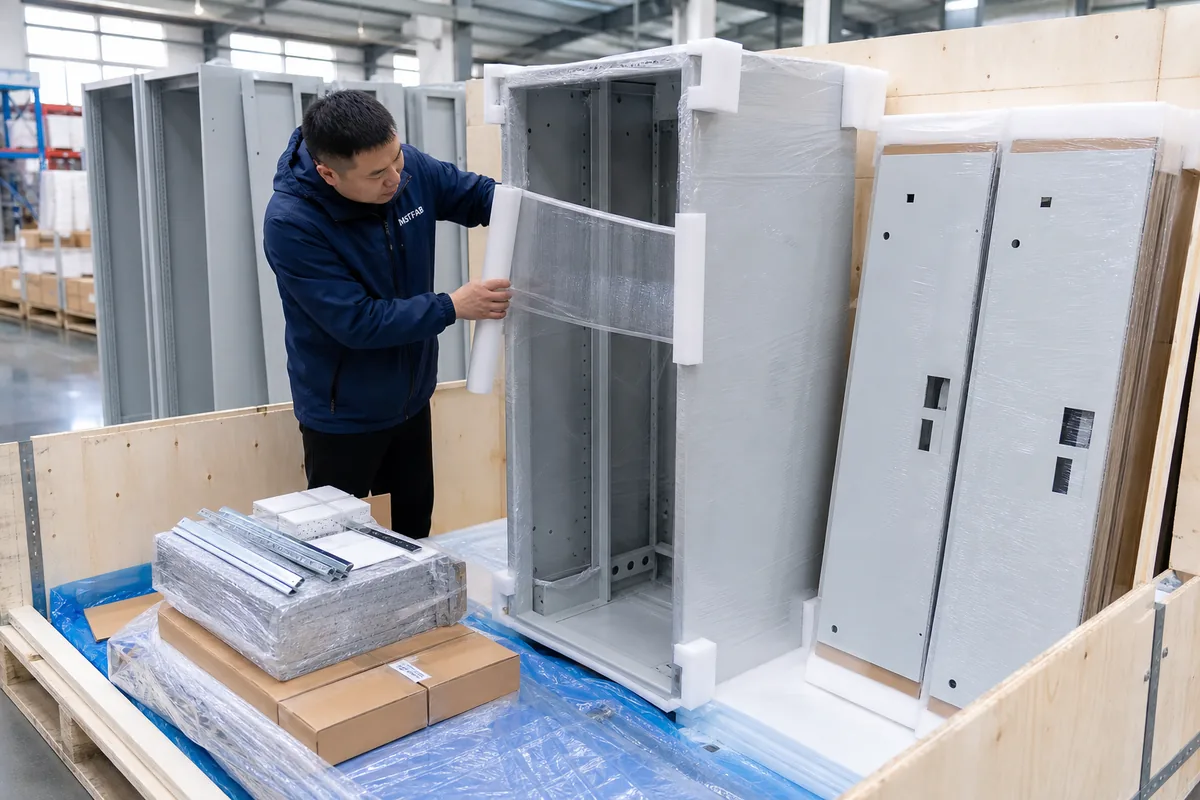
Tall cabinet bodies can rack during transport, while doors and loose plates can scratch one another. Packing should account for center of gravity, corner protection, internal blocking, moisture protection and whether doors or mounting plates ship installed or separately. The mechanical assembly and export packaging plan should be reviewed before the first production lot.
What to send for a useful quotation
| RFQ item | Preferred information | Why buyers benefit |
|---|---|---|
| Geometry | STEP plus dimensioned PDF, DWG or DXF | Reduces interpretation and version confusion |
| Material | Grade, thickness and any certificate requirement | Prevents unsuitable substitutions |
| Interfaces | Door, hinge, lock, plinth, plate, cutout and anchor details | Focuses inspection on assembly-critical features |
| Finish | System, color/sample, texture, masking and cosmetic zones | Aligns appearance and fit before batch release |
| Evidence | First article, dimensional report, photos or finish sample | Makes acceptance measurable |
| Commercial | Prototype/production quantity, destination and packing method | Lets the quote reflect the real manufacturing route |
Related manufacturing resources
Buyer questions
Does MSTFAB supply a complete wired floor-standing electrical cabinet?
No. MSTFAB supplies the empty sheet metal cabinet shell and drawing-defined mechanical parts. Electrical devices, wiring, energized testing and final product compliance remain with the buyer or qualified integrator.
Can MSTFAB install hinges, locks and PEM hardware?
Yes, when the exact mechanical hardware, orientation, quantity and acceptance criteria are defined in the drawing or BOM. Electrical component installation remains outside our scope.
Can you manufacture a blank mounting plate and gland plate?
Yes. We can cut, bend and finish blank or drawing-machined plates and verify their mechanical fit. The electrical layout and cable-entry engineering remain buyer-controlled.
Can the shell support outdoor or rated products?
We can fabricate the geometry, materials, hardware interfaces and finish specified by the buyer. Final NEMA, IP, UL, CE or other product rating, testing and marking apply to the complete product and remain with the product owner or qualified integrator.
What files are needed for quotation?
Send STEP plus dimensioned PDF, DWG or DXF files, material and thickness, hardware, finish, critical tolerances, required evidence, quantity, destination and packing requirements.
Can MSTFAB support prototypes and production batches?
Yes, subject to drawing review, material availability and quotation. A first article or trial fit can be planned when the project risk justifies it.
Send the cabinet shell drawing, not a shopping list of electrical parts
MSTFAB will review fabrication risk, mechanical interfaces, finish, inspection evidence and export packing before quotation. Electrical integration stays with the team qualified to own it.
 WeChat Contact
 WhatsApp Me Directly