
⚡ Direct Answer: How Do You Manage CNC Bending Springback and Sequences?
Managing CNC bending springback and bend sequence requires calculating material-specific elastic recovery angles (1° to 4° overbending on air-bending tooling) and programming logical step-by-step bend orders (typically: internal bends first, shortest flanges before long sections, outer enclosure returns last). Employing 3D offline CAM simulation software prevents punch/die collisions, while hydraulic dynamic crowning compensates for machine bed deflection to hold ±0.3 mmmm flange tolerances across 3-meter sheet lengths.
Bend Sequencing Rules & Collision Avoidance Strategy
| Sequencing Priority | Bending Rule | Manufacturing Rationale |
|---|---|---|
| Step 1: Short & Internal Flanges | Bend small inner tabs, mounting returns, and internal brackets first. | Maintains a flat outer sheet profile, allowing easy positioning against backgauges. |
| Step 2: Intermediate Flanges | Form intermediate side panels and structural stiffener ribs. | Prevents previous formed bends from crashing into the press brake ram or upper tooling. |
| Step 3: Outer Enclosure Returns | Form major external perimeter enclosure wraps and deep box walls last. | Requires tall gooseneck punches and window tooling to clear completed 3D box depths. |
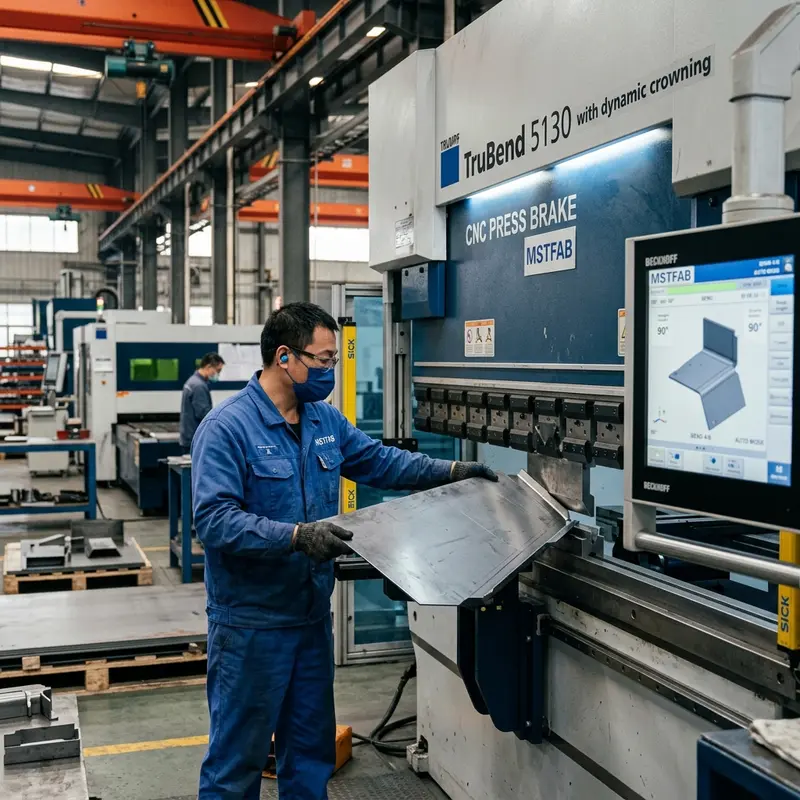
Precision Bending Without Tooling Interference
MSTFAB operates 160-ton to 300-ton CNC press brakes equipped with laser angle feedback systems and multi-station sectional tooling.
Frequently Asked Questions on Bending Sequences
How does dynamic crowning prevent the “canoe effect” in long sheet metal bends?
Under bending tonnage, press brake rams and lower beds naturally deflect in the center, causing under-bending in the middle of long parts (the canoe effect). MSTFAB’s CNC press brakes feature automated hydraulic dynamic crowning that counter-deflects the lower table, maintaining identical angle along the entire 3000mm length.
 WeChat Contact
 WhatsApp Me Directly