
Laser cut blanks often move into bending, welding, hardware insertion or powder coating. A part that looks acceptable after cutting can still fail later if tolerance, burrs, hole position or coating allowance were not planned. This checklist focuses on downstream process risk after laser cutting.
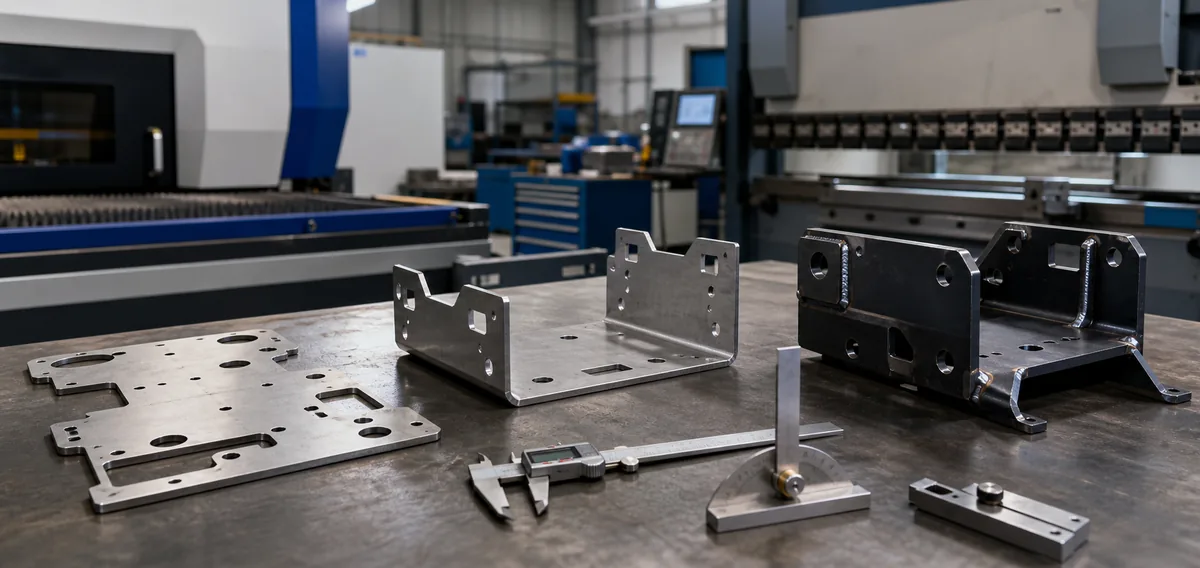
Quick answer: when laser cut parts will be bent, welded or finished, confirm datum points, hole-to-bend distance, burr direction, flatness, tab removal, coating build-up, hardware locations and inspection points before releasing production.
Why Downstream Processes Change the RFQ
A flat laser cut profile is only the first step for many OEM parts. Bending may shift hole positions. Welding may distort flatness. Powder coating may reduce thread clearance. Hardware insertion may fail if the wrong hole size or sheet thickness is used. The RFQ should reflect the full process route, not only the cutting file.
Checklist for Laser Cut Parts with Later Bending
- Confirm bend lines, bend radius and material grain direction if relevant.
- Check hole-to-bend distance and slot distortion risk.
- Mark dimensions that must be inspected after bending, not only after cutting.
- Define burr side if it affects cosmetic surface or assembly.
Checklist for Laser Cut Parts with Welding
- Confirm weld access and fixture requirements.
- Define flatness or alignment requirements after welding.
- Plan tabs, slots or self-locating features if repeatability matters.
- Agree on weld grinding and cosmetic expectations.
Checklist for Laser Cut Parts with Finishing
| Finish concern | What to define |
|---|---|
| Powder coating build-up | Masking for threads, grounding points, hinges and gasket faces. |
| Brushing or graining | Visible face and grain direction. |
| Plating or anodizing | Thickness, appearance standard and contact marks. |
| Deburring | Edge break standard and safety requirement. |
How This Differs From a General RFQ Checklist
A general laser cutting RFQ checklist covers files, quantities and finish. This article focuses on parts where downstream bending, welding or assembly can create hidden quality risk. For broad laser cutting capability, see our laser cutting services page.
Frequently Asked Questions
Should tolerances be checked before or after bending?
Functional dimensions should usually be checked after forming because bending changes geometry. Mark this clearly on the drawing.
Why does burr direction matter?
Burr direction can affect visible surfaces, assembly fit, gasket contact and worker safety. Define the preferred side when it matters.
What files help the supplier most?
Send PDF drawings with tolerances plus DXF/DWG/STEP files. Add notes for bend sequence, finish, hardware and critical inspection points.
 WeChat Contact
 WhatsApp Me Directly