
Steel enclosure fabrication is one of the most common solutions for industrial cabinets, electrical enclosures, control boxes, machine housings, power distribution cabinets, telecom cabinets, and OEM sheet metal assemblies.
Steel is strong, cost-effective, easy to cut, easy to bend, easy to weld, and suitable for many industrial applications.
Sounds simple.
But in real OEM procurement, steel enclosure problems usually do not come from steel itself.
They come from:
- wrong material selection
- poor welding control
- weak corrosion protection
- powder coating failure
- door deformation
- poor cable entry design
- inaccurate mounting holes
- damaged coating during shipping
At MSTFab, we often see buyers ask for a “steel enclosure” without clearly defining whether they need SPCC, mild steel, galvanized steel, or powder coated steel.
That is where problems begin.
Because “steel enclosure” is not a complete specification.
It is the beginning of a sourcing conversation.
And if that conversation is skipped, the cabinet usually explains the mistake later — with rust, deformation, or assembly problems.
For an overview of our broad capabilities, see Custom Sheet Metal Enclosure Fabrication.
Planning an RFQ? This guide focuses on steel enclosure material corrosion welding coating. For production capability, drawing review and quotation support, see MSTFAB’s custom sheet metal enclosure design and fabrication.
1. Steel Enclosure Fabrication Is Not One Material
Many OEM buyers use the word “steel” broadly.
But different steel materials behave differently in fabrication and field use.
Common steel enclosure materials include:
SPCC Cold Rolled Steel
SPCC is commonly used for indoor electrical boxes, control enclosures, electronic housings, and powder coated sheet metal parts.
It has a smooth surface and good bending performance.
Best for indoor control boxes, instrument enclosures, electrical panels, small and medium OEM housings, and powder coated equipment covers.
Main risk: it needs coating or surface protection to prevent rust.
Recommended internal link: Custom SPCC Sheet Metal Enclosure Fabrication
Mild Steel
Mild steel is widely used for stronger industrial cabinets, welded structures, machine housings, and large equipment enclosures.
Best for heavy-duty steel cabinets, welded equipment housings, power cabinets, machine guards, and industrial frames.
Main risk: it needs proper powder coating or painting for corrosion protection.
Recommended internal link: Mild Steel Enclosure Fabrication Manufacturer
Galvanized Steel
Galvanized steel provides better base corrosion resistance than bare cold rolled steel because of its zinc coating.
Best for electrical cabinets, control boxes, semi-protected industrial enclosures, cost-sensitive steel cabinets, and SGCC sheet metal enclosures.
Main risk: laser-cut edges, holes, and welded areas still need protection.
Recommended internal link: Galvanized Steel Enclosure Fabrication
Powder Coated Steel
Powder coated steel is one of the most common solutions for industrial enclosure projects.
Best for electrical cabinets, telecom cabinets, power distribution enclosures, EV charger cabinets, automation control cabinets, and outdoor cabinets with proper coating system.
Main risk: coating failure around edges, weld seams, and cable holes.
Recommended internal link: Powder Coated Steel Enclosure Fabrication
The right steel material depends on environment, budget, corrosion risk, strength requirement, and appearance expectations.
Choosing “steel” is easy.
Choosing the right steel is procurement.
2. Corrosion Protection Is the First Serious Question
Steel is strong.
Steel is affordable.
Steel is widely available.
Steel also rusts if you disrespect it.
For steel enclosure fabrication, corrosion usually starts around laser-cut edges, cable entry holes, mounting holes, weld seams, bottom panels, scratches, sharp corners, and poorly coated areas.
This is especially important for outdoor electrical cabinets, telecom enclosures, power distribution cabinets, EV charger enclosures, battery storage cabinets, and industrial automation enclosures.
OEM buyers should confirm indoor or outdoor use, humidity level, salt air exposure, chemical exposure, coating requirement, surface pretreatment, edge protection, and packaging method.
A steel enclosure for an indoor control room is not the same as a steel enclosure installed beside a coastal telecom site.
The environment always gets the final vote.
And the environment does not care about your purchasing budget.
3. Powder Coating Quality Determines Long-Term Steel Cabinet Performance
For many steel enclosure projects, powder coating is the main corrosion protection method.
But powder coating is not just color.
It affects corrosion resistance, outdoor durability, appearance consistency, assembly fit, grounding control, and shipping protection.
Common powder coating problems include peeling near weld seams, rust around cable holes, coating chips on corners, blocked threaded holes, inconsistent texture, color difference between batches, and poor adhesion after poor pretreatment.
Buyers should clarify RAL color, gloss level, texture requirement, coating thickness, indoor or outdoor application, masking areas, salt spray expectation if required, and visible surface standard.
Recommended internal link: Powder Coating Service
A powder coated steel cabinet should not only look good in factory photos.
It should survive assembly, shipping, installation, and actual use.
Otherwise, it is just a very well-painted future complaint.

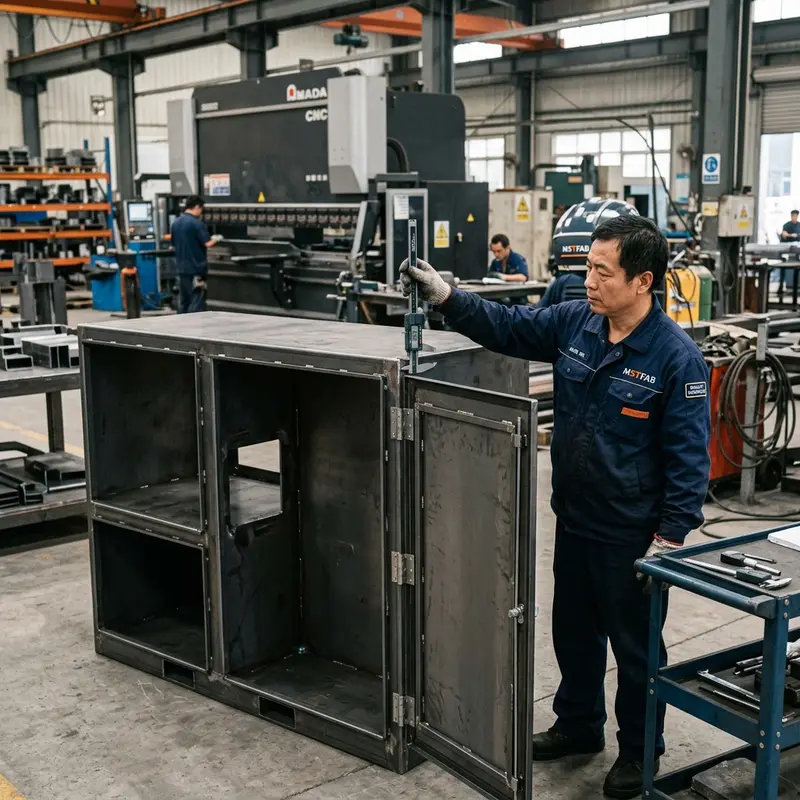
4. Welding Control Is Critical for Steel Enclosures
Steel enclosure fabrication often requires welding for cabinet frames, corner structures, mounting brackets, reinforcement parts, base structures, door frames, and internal supports.
Poor welding control can cause panel warpage, cabinet frame twisting, door misalignment, uneven gaps, mounting hole movement, poor sealing surface, and powder coating defects around welds.
This is especially common in large welded cabinets and power enclosures.
A common mistake is assuming more welding means stronger structure.
Not always.
Excessive welding can increase heat distortion and grinding workload.
Better enclosure design may use return flanges, reinforcement bends, folded structures, controlled weld length, mechanical fastening, and fixture-supported welding.
Recommended internal link: TIG Welding Service
The best steel enclosure is not the one with the most welds.
It is the one that remains square after welding.
Metal likes confidence.
But it respects process control.
5. CNC Bending Accuracy Affects Assembly Fit
CNC bending is one of the most important steps in steel enclosure fabrication.
Small bending errors can create large assembly problems.
Common issues include door gaps not consistent, side panels not fitting, mounting holes shifting after bending, gasket sealing pressure uneven, internal brackets misaligned, and cabinet body not square.
For OEM buyers, bending quality depends on material thickness, bend radius, tooling selection, bend sequence, springback control, operator setup, and inspection process.
Recommended internal link: CNC Sheet Metal Bending Service
A steel panel can be laser-cut perfectly and still fail after bending.
Laser cutting gives the part shape.
Bending decides whether it will behave in assembly.
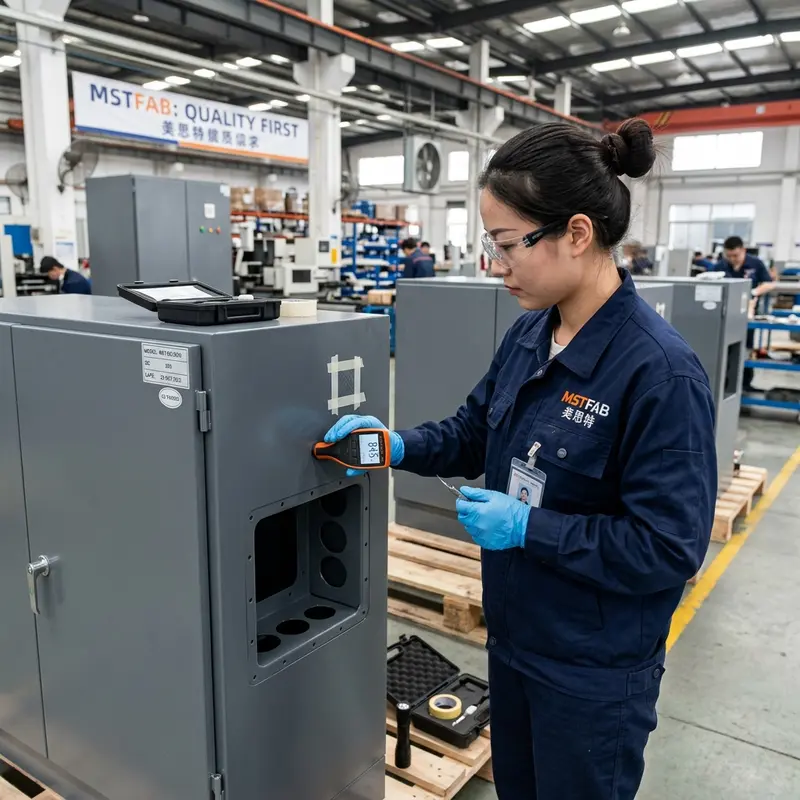
6. Cable Entry and Mounting Holes Need Practical Review
Steel enclosures often contain cable entries, gland plates, mounting holes, DIN rails, internal plates, hinges, locks, and grounding studs.
Poor hole placement creates real problems during installation.
Common buyer pain points include cable gland holes too close together, power cables cannot bend properly, mounting holes shift after welding, internal plates do not align, cable entry areas start rusting, and grounding points covered by powder coating.
For electrical and industrial steel enclosures, buyers should review cable bending radius, hole distance from bend lines, grounding contact areas, internal mounting layout, maintenance access, and coating masking requirements.
This matters especially for:
A steel cabinet that is hard to wire is not a low-cost solution.
It is a technician time trap.
7. Door Flatness and Frame Rigidity Affect Sealing
If the steel enclosure requires IP protection or gasket sealing, door flatness matters.
A gasket cannot fix a warped door.
Sealing performance depends on door flatness, frame squareness, hinge alignment, latch pressure, gasket compression, welding distortion, and coating thickness around sealing areas.
This is important for outdoor cabinets, telecom enclosures, power distribution enclosures, EV charger enclosures, battery storage cabinets, and climate controlled enclosures.
Recommended internal links:
- Outdoor Telecom Enclosure
- Custom EV Charger Enclosure
- Battery Storage Cabinet Fabrication
- Custom Climate Controlled Enclosures
A cabinet may pass basic dimensional inspection and still fail sealing performance.
Water does not read inspection reports.
It finds gaps.
8. Steel Enclosure vs Stainless Steel vs Aluminum
OEM buyers often compare steel with stainless steel and aluminum.
Steel Enclosure
Best for cost-effective industrial cabinets, strong structures, powder coated enclosures, electrical cabinets, machine housings, and large welded assemblies.
Main concern: needs corrosion protection.
Stainless Steel Enclosure
Best for food equipment, medical equipment, washdown environments, coastal projects, and high-corrosion outdoor use.
Recommended internal link: Stainless Steel Sheet Metal Enclosure Fabrication
Aluminum Enclosure
Best for lightweight equipment, electronic housings, heat-sensitive applications, telecom devices, and portable equipment.
Recommended internal link: Aluminum Sheet Metal Enclosure Fabrication
The best material is not the most expensive material.
It is the material that matches the environment, structure, cost, and service life.
Good procurement is not about buying the strongest metal.
It is about buying the right risk level.
9. Export Packaging Is Part of Steel Enclosure Quality
Steel enclosures are often heavy.
During export shipment, poor packaging can cause scratched powder coating, dented doors, bent corners, twisted cabinet frames, damaged mounting plates, moisture exposure, and loose hardware.
OEM buyers should confirm pallet strength, foam separation, corner protection, cabinet fixation, protective film, moisture control, accessory packaging, and wooden crate requirement if needed.
A steel enclosure that leaves the factory perfect but arrives damaged is not a finished product.
It is a logistics problem shaped like a cabinet.
10. What Buyers Should Send for an Accurate Steel Enclosure Quote
To get a reliable steel enclosure quotation, buyers should provide:
- STEP or 3D CAD files
- 2D PDF drawings
- steel material type and thickness
- indoor or outdoor application
- surface finish requirement and RAL color if powder coated
- cable entry positions and internal mounting layout
- critical tolerance notes and welding requirements
- annual order quantity and packaging requirement
For electrical or outdoor cabinets, buyers should also provide IP or sealing requirement, grounding requirement, ventilation requirement, corrosion exposure, and maintenance access requirement.
If the RFQ only says “steel enclosure, please quote fast,” the supplier has to guess.
And guessing is not procurement.
It is just a faster way to create revision emails.
MSTFAB OEM Trust Table for Steel Enclosure Fabrication
Steel fabrication requires discipline, not just welding capability. Here is how MSTFab delivers reliable steel cabinets for industrial OEMs:
| OEM Procurement Priority | MSTFAB Delivery Standard |
|---|---|
| Corrosion-Resistant Edges | Mandatory mechanical edge deburring before coating ensures powder adheres evenly to all cutouts, eliminating early rust on sharp edges. |
| Frame Squareness Control | Utilization of precision CNC bending for deep return-flanges to minimize welding length, reducing heat distortion and keeping frames perfectly square. |
| Clean Electrical Bonding | 100% application of heat-resistant silicone caps on all grounding studs during the powder coating baking cycle to guarantee uninterrupted electrical paths. |
| Flawless IP Gasket Sealing | Stringent pre-assembly checks on door flatness and frame alignment to ensure continuous, even compression of polyurethane poured gaskets. |
| Export-Grade Shipping Protection | Heavy steel cabinets are firmly bolted to solid timber pallets and isolated with non-abrasive foams to prevent transit abrasion and frame twisting. |
Final Thoughts
Steel enclosure fabrication is one of the most practical solutions for industrial OEM projects.
It offers strength, flexibility, cost control, and scalable production.
But buyers should not treat steel enclosures as simple metal boxes.
The real quality depends on correct steel material selection, welding distortion control, CNC bending accuracy, powder coating quality, edge protection, cable entry design, sealing performance, and export packaging.
At MSTFab, we support OEM customers with custom steel enclosure fabrication, CNC laser cutting, CNC bending, TIG/MIG welding, powder coating, enclosure assembly, and DFM review for electrical cabinets, automation enclosures, telecom cabinets, power distribution systems, EV charger cabinets, battery storage cabinets, and custom industrial equipment housings.
The best time to solve steel enclosure problems is before production starts.
Not after the cabinet arrives with rust, scratches, or a door that no longer wants to close.
custom sheet metal enclosure fabrication
MSTFAB manufactures custom sheet metal enclosures, electrical cabinets, control boxes and industrial metal housings for OEM buyers.
 WeChat Contact
 WhatsApp Me Directly