
The Short Answer
Powder-coated steel enclosure quality starts before powder reaches the cabinet. Define the substrate, edge preparation, weld cleanup, coating system, cure requirements and masking locations together. Check appearance against an approved sample and protect finished surfaces during packing. Color alone is not a corrosion or durability specification.
This guide focuses on coating-related purchasing and inspection decisions for empty OEM sheet metal enclosure shells. Keep the coating specification tied to the installation environment, assembly interfaces and agreed acceptance plan.
Planning an RFQ? This guide focuses on powder coated steel enclosure quality guide. For production capability, drawing review and quotation support, see MSTFAB’s custom sheet metal enclosure design and fabrication.
Substrate choice
Where powder-coated steel fits an OEM enclosure
Powder coated steel is popular because it gives buyers a practical balance of:
- structural strength
- cost control
- color customization
- corrosion protection
- scalable production
- good industrial appearance
It is commonly used for:
- electrical control cabinets
- power distribution enclosures
- PLC cabinets
- telecom equipment cabinets
- EV charger cabinets
- network enclosures
- industrial automation enclosures
- machine equipment housings
Compared with stainless steel, powder coated steel is usually more cost-effective.
Compared with aluminum, it often offers better rigidity for larger cabinets.
Compared with raw mild steel or SPCC, powder coating provides much better surface protection and visual consistency.
For complete enclosure capability, buyers can review:
Surface preparation
Define preparation before choosing the powder
Many buyers think powder coating quality depends only on the powder material.
That is only half true.
Most coating failures begin before spraying.
Common root causes include:
- oil residue on steel surfaces
- poor weld cleaning
- sharp untreated edges
- grinding dust contamination
- moisture before coating
- poor pretreatment
- inconsistent curing temperature
If the surface is not prepared correctly, even good powder will not save the enclosure.
Typical failure areas include:
- weld seams
- laser-cut edges
- cable entry holes
- bottom corners
- hinge areas
- mounting holes
- grounding points
These are the places where rust usually starts first.
For OEM buyers, the better question is not only:
“What powder brand do you use?”
The better question is:
“How do you prepare the steel before powder coating?”
That answer tells you much more about long-term quality.
Edge coverage
Protect cut edges and cable openings
Powder coating looks beautiful on flat surfaces.
But enclosure failures rarely begin in the middle of a clean flat panel.
They begin at edges.
During fabrication, steel panels go through:
- laser cutting
- punching
- bending
- drilling
- welding
- grinding
These processes create exposed edges, corners, and cutouts.
If these areas are too sharp or poorly prepared, powder coating may become thinner around the edge. That increases corrosion risk.
This is especially important for:
- outdoor electrical cabinets
- telecom cabinets
- EV charger enclosures
- battery storage cabinets
- power distribution enclosures
For outdoor powder coated steel enclosures, buyers should ask whether the supplier controls:
- edge deburring
- corner radius
- weld seam smoothing
- surface cleaning
- coating thickness at edges
- corrosion protection around cutouts
A cabinet can look perfect in a factory photo and still start rusting from one badly protected cable hole.
Cosmetic surfaces
Approve weld cleanup on visible panels
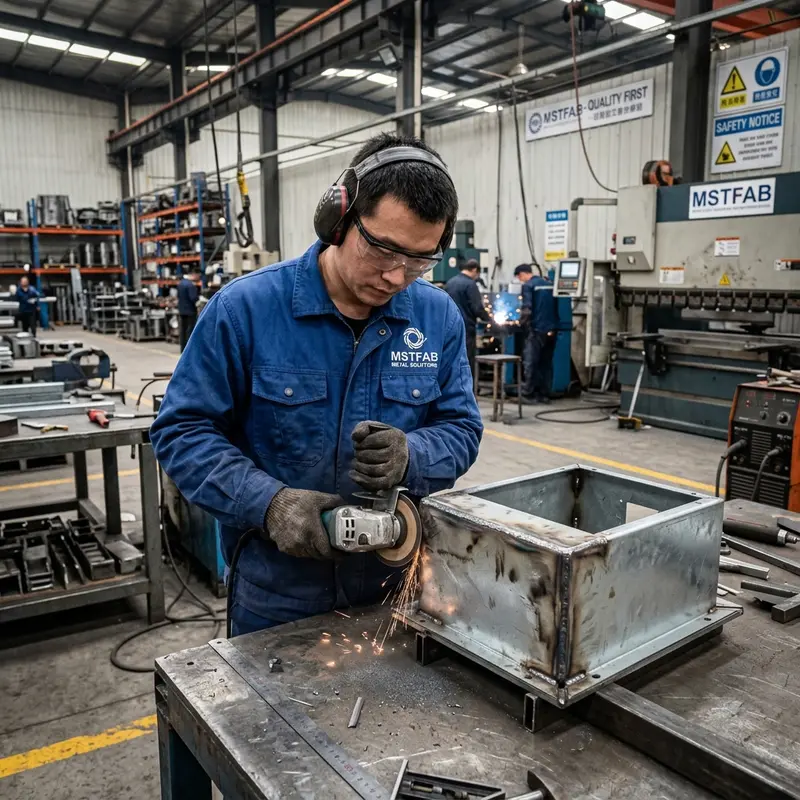
Coating is not a substitute for an agreed weld and grinding standard. Uneven welds, grinding marks and pinholes can remain visible after finishing.
Separate visible and hidden surfaces
- Customer-facing panels: agree weld cleanup, surface texture and the sample used for approval.
- Internal areas: define a suitable functional acceptance level rather than applying an undefined showroom finish everywhere.
- Corners and seams: review buildup, pinholes and local appearance before the production run.
This distinction is useful for EV charger shells, operator consoles, medical equipment housings and industrial cabinets. State which surfaces are cosmetic on the drawing; “good finish” is not a measurable acceptance criterion.
Film and masking
Set film thickness and masking around the assembly
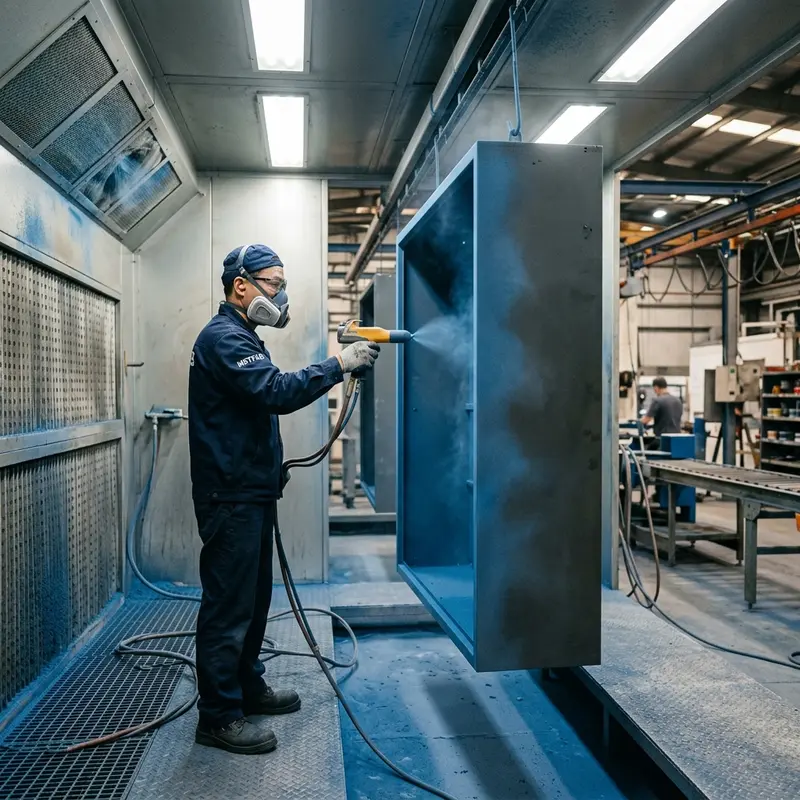
Set film thickness using the actual powder system and application. A thin film may leave inadequate protection, while excessive buildup can interfere with holes, hinges, gasket compression and mating parts.
Mark the masking plan on the drawing
- Electrical interfaces: identify grounding points and other required contact surfaces.
- Hardware: identify threaded holes, hinge zones and mounting interfaces.
- Fit: confirm precision mating faces, clearances and gasket paths after coating.
Agree measurement locations and assembly checks with the supplier. Film thickness is only one part of the system; surface preparation and cure requirements also need confirmation.
Related capability: Powder Coating Service for Sheet Metal Fabrication.
Outdoor exposure
Specify the complete system for outdoor exposure
For indoor electrical cabinets, standard powder coating may be enough.
For outdoor applications, buyers should be more specific.
For outdoor service, define the coating system and enclosure details together:
- UV-resistant powder
- stronger pretreatment
- thicker coating control
- salt spray resistance
- drainage design
- waterproof cable entries
- better packaging protection
Outdoor environments add risks such as:
- rain
- humidity
- sunlight
- dust
- temperature cycling
- salt air
- industrial pollution
If the enclosure will be used near coastal areas or chemical environments, powder coated steel may not be enough.
Buyers should compare with:
304 Stainless Steel Electrical Enclosure Manufacturer
316 Stainless Steel NEMA Enclosure Fabrication
Powder coated steel is excellent for many industrial projects.
But it should not be forced into environments where stainless steel is the more responsible choice.
Repeat-order consistency
Control color, gloss and texture between batches
For OEM buyers, one sample order may look fine.
The real test is repeat production.
Color consistency can become a problem when:
- powder batches change
- coating suppliers change
- curing temperature varies
- surface preparation differs
- old and new parts are assembled together
This matters for:
- branded EV charger cabinets
- visible telecom cabinets
- equipment housings
- operator control consoles
- customer-facing industrial products
If color consistency matters, buyers should define:
- RAL color
- gloss level
- texture type
- acceptable color tolerance
- sample approval process
- batch control requirement
“Black powder coating” is not enough.
Material comparison
Compare coated, galvanized and stainless substrates
OEM buyers often compare these three options.
Powder Coated Steel
Best for: cost-effective industrial cabinets, indoor electrical enclosures, outdoor cabinets with proper coating system, large OEM production, color-customized equipment housings.
Main concern: coating damage may expose steel and cause corrosion.
Galvanized Steel
Best for: indoor or semi-protected cabinets, better base corrosion resistance, electrical boxes, control enclosures.
Main concern: cut edges and weld areas still need protection.
Related page: Galvanized Steel Enclosure Fabrication
Stainless Steel
Best for: coastal environments, food processing, medical equipment, washdown areas, high-corrosion outdoor projects.
Main concern: higher material and fabrication cost.
Related page: Stainless Steel Sheet Metal Enclosure Fabrication
The best material is not the most expensive one.
It is the one that matches the working environment, budget, lifespan expectation, and maintenance reality.
Packing and delivery
Protect the finish through packing and transport
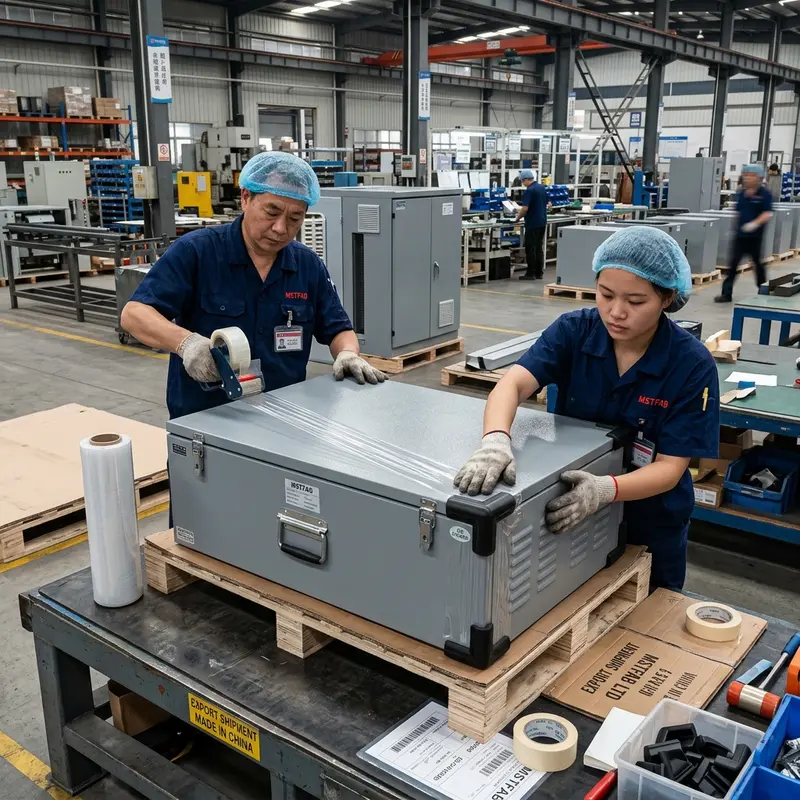
Protect coated surfaces beyond the final inspection. Stacking, pallet handling, transport vibration, moisture and metal-to-metal contact can damage a finished enclosure.
Agree protection before dispatch
- Surface separation: define protective film or suitable separators so finished faces do not rub together.
- Handling protection: agree corners, foam, pallet support and lifting or loading arrangements.
- Transit conditions: specify moisture precautions and the carton or crate requirement for the route.
Ask for the agreed packing checks and photos before shipment. The acceptance plan should cover how the cabinet is protected, not only how it looks immediately after coating.
Buyer control matrix
Agree the inspection evidence before production
Convert these topics into order-specific acceptance criteria. The table is a buyer checklist, not a lifetime coating warranty or a claim that a particular pretreatment, test or packaging method is automatically included.
| Control point | Confirm for your order |
|---|---|
| Preparation and edges | Confirm the cleaning and pretreatment route, cut-edge treatment and weld cleanup for the specified substrate. |
| Coating system and cure | Identify the powder product and follow its technical data sheet for film thickness and curing. Agree the records to retain. |
| Appearance | Approve RAL reference, gloss, texture and sample acceptance; define how repeat batches will be compared. |
| Masking and assembly | Mark threads, grounding contacts, gasket paths and mating faces on the drawing. Confirm assembly fit after coating. |
| Packing and release | Agree separation, corner protection and packing checks so coated faces do not contact each other during transport. |
RFQ checklist
Prepare a coating-specific enclosure RFQ
To get a reliable powder coated steel enclosure quotation, buyers should provide:
- STEP or 3D CAD files
- 2D PDF drawings
- steel grade and thickness
- indoor or outdoor application
- RAL color
- gloss or texture requirement
- coating thickness requirement
- salt spray or corrosion expectation
- visible surface standard
- masking requirements
- annual volume estimate
- packaging requirement
For enclosure projects, buyers should also provide:
- hinge and lock requirements
- gasket requirements
- cable entry locations
- internal mounting layout
- grounding requirements
The more complete the RFQ package, the fewer surprises during production.
Drawing review
Turn the finish requirement into a checkable order
Powder coated steel enclosure fabrication is a practical and cost-effective solution for many industrial OEM projects.
But buyers should not treat it as simple painting after metalwork.
Long-term quality depends on:
- steel substrate selection
- welding and grinding control
- surface preparation
- edge protection
- coating thickness
- curing stability
- masking control
- packaging quality
At MSTFab, we support OEM customers with powder coated steel enclosure fabrication, CNC laser cutting, CNC bending, TIG/MIG welding, powder coating, enclosure assembly, and DFM review for industrial electrical cabinets, telecom cabinets, EV charger enclosures, power distribution cabinets, and custom sheet metal products.
The best time to prevent coating failure is before powder coating starts.
Send the drawing and acceptance requirements
Request a review of material, fabrication, finish and packing for your empty sheet metal enclosure shell. Electrical devices, wiring, controls and finished-equipment compliance are outside this guide; confirm any additional scope separately.
Upload STEP/PDF Files for a Custom QuoteCoating references: Powder Coating Institute terminology covers edge coverage and film properties. IGP-KORROPRIMER processing guidance illustrates why edge preparation matters for that coating system. Use the technical data sheet for the actual product specified, not a universal film-thickness or cure value.
MSTFAB manufactures custom sheet metal enclosures, electrical cabinets, control boxes and industrial metal housings for OEM buyers.
 WeChat Contact
 WhatsApp Me Directly