
The Short Answer
Choose a 304 stainless steel enclosure around its actual exposure, not appearance alone. Review chlorides, cleaning chemicals and drainage before selecting the grade. Then agree welding distortion, door and flange fit, finish direction and packing checks. A material grade alone does not establish an IP rating or finished-equipment compliance.
This guide helps OEM buyers compare material and fabrication risks for empty stainless steel cabinet shells. For manufacturing capability and drawing review, use the related enclosure service pages rather than treating this article as a product specification.
Planning an RFQ? This guide focuses on 304 stainless electrical enclosure guide. For production capability, drawing review and quotation support, see MSTFAB’s custom sheet metal enclosure design and fabrication.
Material selection
Where 304 stainless steel fits the application
304 stainless steel is a practical material for many electrical enclosure projects.
It is commonly used for:
- indoor electrical cabinets
- industrial control boxes
- automation electrical enclosures
- medical equipment cabinets
- food processing equipment housings
- clean industrial environments
- protected outdoor electrical cabinets
Compared with mild steel or SPCC, 304 stainless steel offers much better corrosion resistance without relying only on powder coating.
Compared with 316 stainless steel, 304 is usually more cost-effective.
That makes it a strong choice when the application requires corrosion resistance, clean appearance, and long-term durability — but does not require extreme marine or chemical resistance.
For complete stainless steel enclosure capability, buyers can also review:
Corrosion exposure
When exposure calls for a different stainless grade
304 stainless steel is corrosion-resistant, but it is not magic metal.
It can still corrode in harsh environments, especially when exposed to:
- salt spray
- coastal air
- chemical vapor
- acidic cleaning agents
- high-humidity outdoor environments
- poor drainage conditions
For these applications, 316 stainless steel may be a safer choice.
A common buyer mistake is selecting 304 stainless steel because it looks “premium,” then installing the enclosure near coastal or chemical environments where 316 would perform better.
For high-corrosion projects, compare with:
316 Stainless Steel NEMA Enclosure Fabrication
Simple rule:
304 stainless steel is good for general corrosion resistance. 316 stainless steel is better for aggressive corrosion environments.
Grade selection needs the actual exposure and cleaning conditions. Neither 304 nor 316 is a blanket guarantee against corrosion.
Welding and fit
Control weld distortion before checking the door
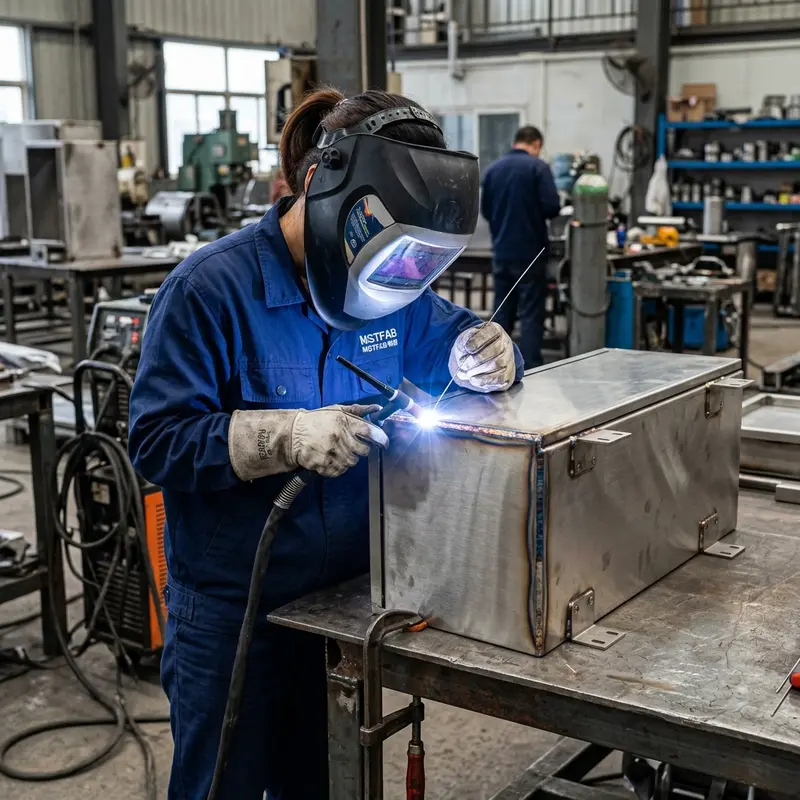
Cabinet corners, door frames, mounting structures, brackets and sealing flanges may need welding. The purchasing question is whether the finished shell still matches the drawing after heat has moved the sheet.
Check geometry after welding
- Doors and openings: check panel warpage, frame shape, hinge alignment and door gaps.
- Sealing faces: inspect flange distortion before installing the gasket.
- Visible surfaces: agree acceptable heat marks and grinding appearance.
Review the manufacturing route
Discuss weld sequence, fixtures, heat input and trial door fit. Reinforcement bends can reduce unnecessary long welds; more welding is not automatically better. Confirm these controls for the actual enclosure rather than assuming a general welding capability proves final fit.
Sealing interfaces
Verify the complete sealing interface, not only the gasket

A gasket cannot compensate for an unsuitable door or flange. Door flatness, hinge position, latch pressure, gasket contact and weld distortion all affect the assembled sealing interface.
Inspect the interface as an assembly
- Contact path: check flange consistency, surface condition and uninterrupted gasket contact.
- Door hardware: verify alignment, gaps and compression around hinges and latches.
- Release check: trial-fit the agreed hardware before shipment, not only the overall cabinet dimensions.
These checks matter for outdoor cabinets, automation and telecom shells, and equipment exposed to washdown. They are fabrication checks, not proof of an ingress-protection rating.
An IP target is not evidence of a tested rating. Agree the assembly configuration, test responsibility and acceptance evidence before ordering.
Surface finish
Specify the finish on the surfaces buyers will see

Brushed, polished, bead-blasted, passivated, natural and coated stainless surfaces serve different requirements. Confirm the proposed finish against cleaning conditions, corrosion exposure and appearance expectations.
Define cosmetic acceptance in the RFQ
- Visible faces: identify which panels require the agreed appearance standard.
- Finish reference: specify grain direction and an approved reference or sample.
- Handling: define scratch acceptance, protective film and packing separation.
Brushed equipment housings need consistent grain direction across mating panels. Review fingerprint and maintenance expectations as well as the initial appearance; a technically correct shell can still miss an undefined cosmetic requirement.
Material comparison
Compare 304 stainless with powder-coated steel
Many buyers compare 304 stainless steel electrical enclosures with powder coated steel cabinets.
Both can be good choices, but they solve different problems.
304 Stainless Steel Enclosures
Best for: corrosion resistance, clean industrial appearance, food processing environments, medical equipment, washdown or humid areas, long-term durability.
Main concern: higher material and fabrication cost.
Powder Coated Steel Enclosures
Best for: cost-controlled electrical cabinets, indoor industrial use, large power cabinets, color customization, general OEM production.
Main concern: coating damage may expose steel and cause corrosion.
Related pages:
If the application is indoor and cost-sensitive, powder coated steel may be enough.
If the environment is humid, hygienic, or corrosion-sensitive, 304 stainless steel may be the better long-term choice.
Supplier review
Questions to resolve before placing the order
Before choosing a 304 stainless steel electrical enclosure manufacturer, buyers should ask:
- Can the supplier fabricate stainless steel enclosures, not just flat parts?
- How do they control welding distortion?
- Do they check door fitment after welding?
- Can they control brushed surface consistency?
- Do they perform trial assembly before shipment?
- Can they support DFM review before production?
- How do they package stainless steel surfaces for export shipping?
The cheapest supplier may still produce acceptable flat brackets.
But stainless steel electrical enclosures require more process control.
Doors, hinges, sealing flanges, mounting plates, and surface finish all need to work together.
Application review
Match the enclosure shell to its equipment application
304 stainless steel electrical enclosures are commonly used in:
- food processing control systems
- medical equipment cabinets
- industrial automation cabinets
- electrical control boxes
- indoor washdown environments
- clean equipment housings
- laboratory equipment
- protected outdoor electrical systems
For medical and equipment housing applications, buyers can also review:
For automation control applications:
Buyer control matrix
Agree the inspection evidence before production
Use this as a purchase-order discussion checklist, not as a statement that every option or test is included. Ask the supplier to confirm the inspection scope and records for your own enclosure drawing.
| Control point | Confirm for your order |
|---|---|
| Material identity | Agree the 304 grade, sheet thickness and traceability documents required for the order. |
| Welding and geometry | Define door opening, hinge alignment and flange flatness checks against the approved drawing. |
| Sealing | Confirm gasket path, hardware and compression checks. Agree any required enclosure testing; do not infer an IP rating from steel grade. |
| Surface appearance | Approve visible faces, grain direction and a finish reference before repeat production. |
| Shipment protection | Agree surface separation, corner protection and packing photos before dispatch. |
RFQ checklist
Prepare a drawing-based enclosure RFQ
To get a reliable quotation, OEM buyers should provide:
- STEP or 3D CAD files
- 2D PDF drawings
- stainless steel grade, such as 304
- material thickness
- surface finish requirement
- IP or sealing requirement
- hinge and lock requirements
- visible surface standard
- annual volume estimate
- installation environment
- critical tolerance notes
- packaging requirements
If the RFQ only says “304 stainless steel electrical box, please quote fast,” the supplier has to guess.
Drawing review
Turn material selection into a checkable order
304 stainless steel electrical enclosure fabrication is not just about using stainless steel sheet.
The real value comes from controlling:
- material selection
- welding distortion
- sealing flatness
- surface finish
- assembly accuracy
- corrosion risk
- packaging protection
A good 304 stainless steel electrical enclosure manufacturer should help buyers reduce manufacturing risk before production starts.
At MSTFab, we support OEM customers with 304 stainless steel enclosure fabrication, CNC laser cutting, CNC bending, TIG/MIG welding, surface finishing, enclosure assembly, and DFM review for industrial electrical cabinet projects.
For complete enclosure capabilities, discover more about Custom Sheet Metal Enclosure Fabrication.
The best time to solve stainless steel enclosure problems is before the first sheet is cut — not after the cabinet is already installed in the field.
Send the drawing and acceptance requirements
Request a review of material, fabrication, finish and packing for your empty sheet metal enclosure shell. Electrical devices, wiring, controls and finished-equipment compliance are outside this guide; confirm any additional scope separately.
Upload STEP/PDF Files for a Custom QuoteMaterial selection reference: Outokumpu corrosion tables explain the limits of reference corrosion data. Confirm suitability for the actual chemical, concentration, temperature and surface condition; 316 is not a universal solution for every aggressive environment.
Related engineering resource: If your project involves EV charging infrastructure, review our custom EV charger enclosure fabrication capabilities for outdoor sheet metal cabinet design, powder coating, and export-ready manufacturing.
MSTFAB manufactures custom sheet metal enclosures, electrical cabinets, control boxes and industrial metal housings for OEM buyers.
 WeChat Contact
 WhatsApp Me Directly