316 stainless steel NEMA enclosures are usually not purchased for decoration.
Buyers choose them because the working environment is difficult.
Salt air. Chemical exposure. Outdoor humidity. Washdown conditions. Industrial dust. Rain. Heat. Corrosion risk.
In other words, the enclosure is not going to live a comfortable office life.
At MSTFab, we often receive RFQs for 316 stainless steel NEMA enclosures from buyers working on:
- outdoor electrical cabinets
- coastal telecom cabinets
- chemical plant control boxes
- food processing equipment
- marine electrical systems
- water treatment control panels
- harsh-environment industrial automation systems
The buyer usually wants one thing:
a cabinet that does not fail after six months in the field.
That sounds simple. But in real fabrication, the material grade alone does not guarantee reliability.
A 316 stainless steel enclosure can still fail if the supplier does not control:
- welding distortion
- gasket sealing flatness
- surface contamination
- hardware compatibility
- drainage design
- passivation or finishing quality
- export packaging protection
316 stainless steel gives you a stronger starting point.
It does not forgive poor fabrication.
Metal is patient, but corrosion is more patient.
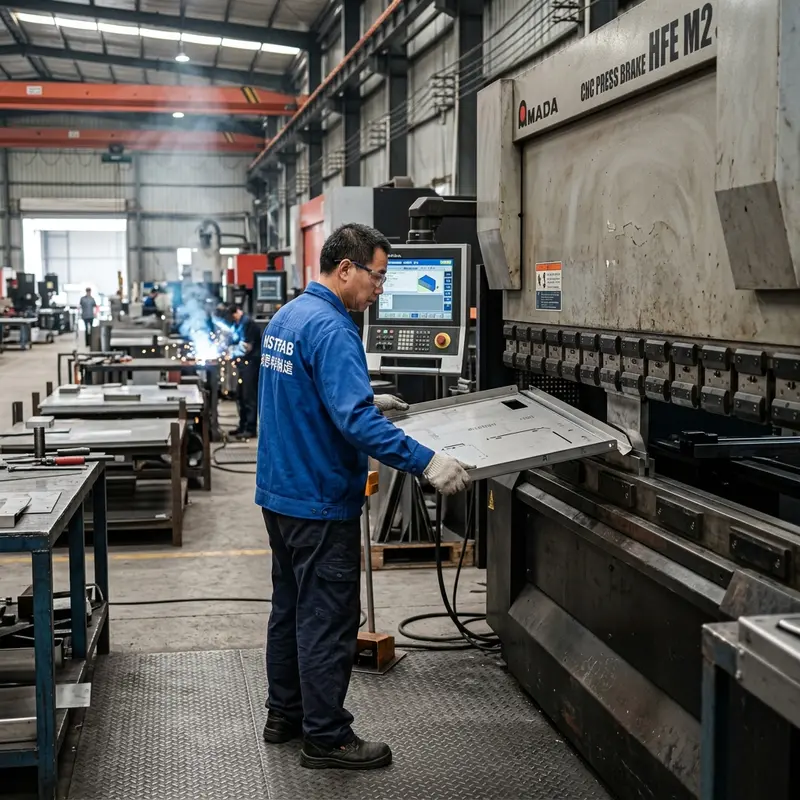
Planning an RFQ? This guide focuses on 316 stainless NEMA enclosure design. For production capability, drawing review and quotation support, see MSTFAB’s custom sheet metal enclosure design and fabrication.
1. Why OEM Buyers Choose 316 Stainless Steel
316 stainless steel is commonly selected when 304 stainless steel is not enough.
Compared with 304, 316 stainless steel offers better resistance in chloride-rich and corrosive environments. This makes it a strong choice for:
- coastal areas
- marine environments
- chemical processing plants
- food washdown areas
- high-humidity outdoor sites
- industrial wastewater facilities
- outdoor electrical infrastructure
For general indoor applications, 304 stainless steel may be enough.
For harsh outdoor or corrosive environments, 316 is often the safer long-term option.
Buyers comparing stainless steel grades can also review:
Stainless Steel Sheet Metal Enclosure Fabrication
and:
304 Stainless Steel Electrical Enclosure Manufacturer
The real procurement question is not:
“Is 316 more expensive?”
The better question is:
“What will field failure cost if the wrong material is used?”
For harsh environments, the cost difference between 304 and 316 may be small compared with replacement, downtime, and warranty claims.
2. NEMA Enclosure Performance Is Not Only About Material
Many buyers request:
“316 stainless steel NEMA enclosure”
but do not clearly define the actual performance requirement.
That creates risk.
NEMA-related projects may involve protection against:
- rain
- dust
- hose-directed water
- corrosion
- ice formation
- outdoor exposure
- washdown conditions
But the enclosure performance depends on more than stainless steel grade.
It also depends on:
- door sealing design
- gasket compression
- latch pressure
- hinge alignment
- cable entry sealing
- enclosure flatness
- welding distortion control
A cabinet made from 316 stainless steel can still leak if the door is warped.
A gasket can still fail if the sealing flange is uneven.
A NEMA-style enclosure is not just a stainless steel box with a label.
It is a controlled enclosure system.
For custom outdoor and climate-sensitive applications, buyers can also review:
Custom Climate Controlled Enclosures
3. Welding Control Is Critical for 316 Stainless Steel Enclosures
316 stainless steel fabrication requires careful welding control.
This is especially important for:
- large NEMA cabinets
- outdoor electrical enclosures
- welded control boxes
- stainless steel equipment housings
- washdown electrical cabinets
Poor welding can create:
- panel distortion
- door frame movement
- uneven sealing surfaces
- heat discoloration
- weakened corrosion resistance near weld areas
- grinding marks on visible surfaces
One of the biggest mistakes in enclosure procurement is assuming that more welding means stronger construction.
For 316 stainless steel enclosures, excessive welding may increase distortion and reduce sealing consistency.
At MSTFab, welding risk is typically reduced through:
- controlled weld sequence
- fixture support
- proper heat input
- structural bend reinforcement
- minimizing unnecessary long welds
- post-weld inspection
In many enclosure projects, smart bending and flange design reduce welding requirements and improve consistency.
The best enclosure is not the one with the most welds.
It is the one that still closes properly after fabrication.
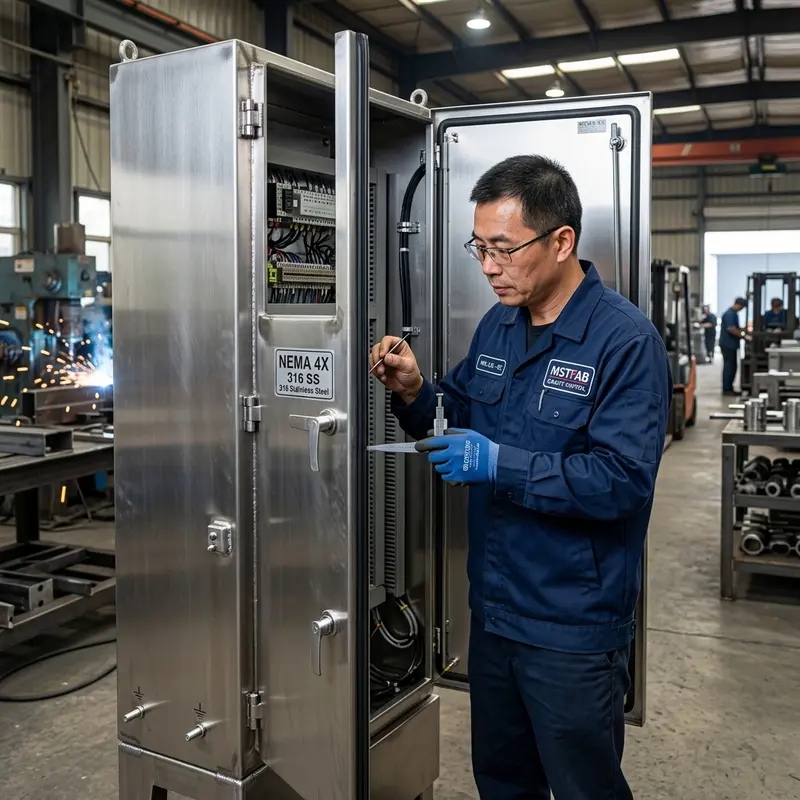
4. Gasket Sealing Depends on Flatness and Assembly Control
For NEMA enclosure fabrication, gasket sealing is one of the most important quality points.
Buyers often ask for high protection ratings but only inspect:
- material thickness
- surface finish
- final dimensions
That is not enough.
For reliable sealing, suppliers must control:
- door flatness
- flange surface consistency
- hinge position
- latch compression
- gasket contact area
- powder coating or finishing buildup
- weld distortion around the frame
If the sealing surface is uneven, the gasket will compress differently across the door.
That creates weak sealing points.
In outdoor or washdown applications, those weak points become failure points.
For serious OEM projects, buyers should ask whether the supplier performs:
- door fitment inspection
- sealing surface checks
- trial assembly
- latch alignment verification
- gasket compression review
A stainless steel enclosure can look beautiful in photos and still fail in rain.
Very rude, but very possible.
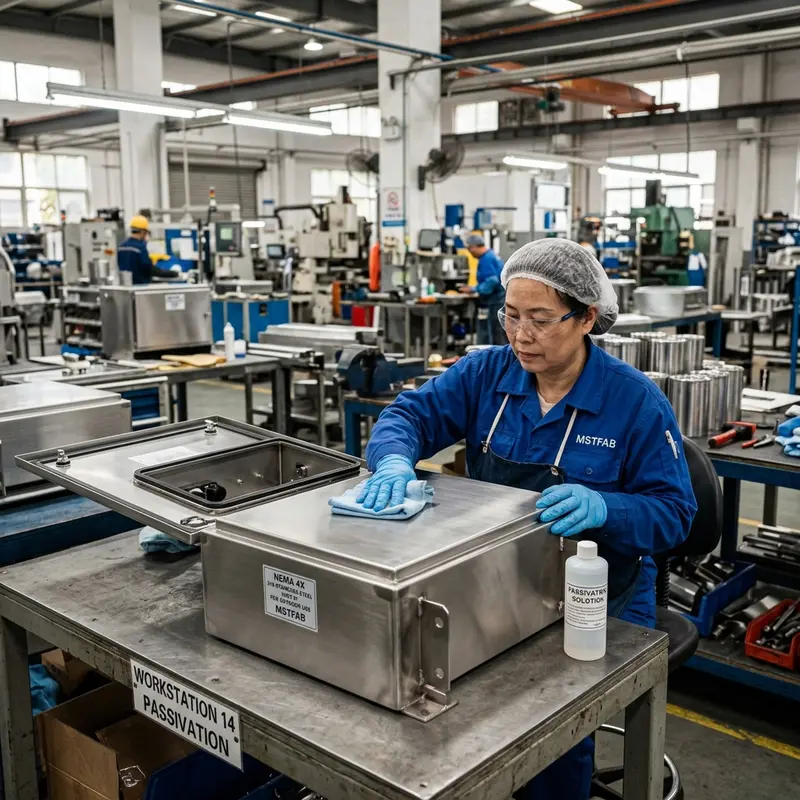
5. Surface Treatment Matters More Than Many Buyers Expect
316 stainless steel is corrosion-resistant, but fabrication can reduce surface performance if not handled correctly.
Common risks include:
- iron contamination from carbon steel tools
- welding discoloration
- grinding residue
- scratched surfaces
- poor cleaning before shipment
- surface contamination during handling
For harsh environments, buyers should discuss whether the project requires:
- brushed finish
- bead blasted finish
- passivation
- pickling treatment
- protective film
- special packaging
- directional brushing control
If the enclosure will be used in food processing, chemical plants, or marine environments, surface cleanliness matters.
A 316 stainless steel enclosure should not be treated like a regular painted steel cabinet.
The material is premium.
The process should be premium too.
For brushed stainless applications, buyers can review:
Brushed Stainless Steel Enclosure Manufacturer
6. Hardware Compatibility Can Cause Corrosion Problems
One issue that many buyers overlook is hardware compatibility.
A 316 stainless steel enclosure may still use:
- hinges
- locks
- screws
- mounting brackets
- grounding studs
- cable glands
- handles
If these components are made from incompatible materials, corrosion may begin around connection points.
This is especially common in outdoor or coastal installations.
Buyers should confirm:
- hinge material
- lock material
- screw material
- gasket material
- gland compatibility
- grounding hardware protection
For high-corrosion environments, stainless steel hardware selection matters.
It makes little sense to build the cabinet from 316 stainless steel and then install cheap hardware that starts rusting first.
That is like wearing a raincoat with paper shoes.
7. 316 Stainless Steel vs 304 Stainless Steel vs Powder Coated Steel
OEM buyers often compare material options before placing orders.
Here is the practical sourcing logic:
316 Stainless Steel
Best for: coastal environments, chemical exposure, marine applications, outdoor NEMA enclosures, washdown environments, high-humidity locations.
Main concern: higher material and fabrication cost.
304 Stainless Steel
Best for: general industrial environments, food equipment, medical equipment, indoor or protected outdoor applications.
Main concern: not ideal for aggressive chloride or chemical environments.
Related page: 304 Stainless Steel Electrical Enclosure Manufacturer
Powder Coated Steel
Best for: cost-controlled electrical cabinets, indoor industrial cabinets, general control enclosures, color-customized cabinets.
Main concern: coating damage may expose steel and cause corrosion.
Related page: Powder Coated Steel Enclosure Fabrication
If corrosion risk is high, 316 stainless steel may be the more reliable long-term choice.
If the environment is mild, 304 or powder coated steel may be more cost-effective.
Good procurement is not about choosing the most expensive material.
It is about choosing the right material before the field environment punishes the wrong one.
8. What Buyers Should Send for an Accurate Quote
To get a reliable 316 stainless steel NEMA enclosure quote, buyers should provide:
- STEP or 3D CAD files
- 2D PDF drawings
- required stainless steel grade
- material thickness
- NEMA or IP protection requirement
- application environment
- surface finish requirement
- hinge and lock requirements
- gasket requirement
- cable entry details
- annual volume estimate
- critical tolerance notes
- packaging requirements
The application environment is especially important.
A supplier quoting a cabinet for an indoor control room will not make the same recommendations as one quoting a cabinet for a coastal outdoor installation.
If the RFQ only says:
“316 stainless steel NEMA box, please quote fast,”
the supplier has to guess.
And guessing is not sourcing.
It is just gambling with stainless steel.
9. Typical Applications for 316 Stainless Steel NEMA Enclosures
316 stainless steel NEMA enclosures are commonly used in:
- outdoor electrical control cabinets
- marine electrical systems
- chemical plant control enclosures
- food processing control panels
- wastewater treatment systems
- coastal telecom cabinets
- industrial automation systems
- harsh-environment power distribution cabinets
For related application pages, buyers can also review:
- Outdoor Telecom Enclosure
- Power Distribution Enclosure
- Custom Control Station Enclosure Fabrication
- Electrical Cabinet Manufacturing
MSTFAB OEM Trust Table for 316 SS NEMA Enclosures
When you specify 316 stainless steel, failure is not an option. Here is how MSTFab protects your harshest outdoor and washdown deployments:
| OEM Procurement Priority | MSTFAB Delivery Standard |
|---|---|
| Material Authenticity | Guaranteed genuine SUS316/316L, equipped with verifiable mill certificates to ensure critical Molybdenum content. |
| Welding Purity & Distortion | Argon-shielded TIG and Laser welding strictly separated from carbon steel environments to prevent iron contamination and rust spots. |
| NEMA Grade Sealing | Precise control of continuous polyurethane gasket compression combined with measured door flatness testing before shipment. |
| Passivation & Finishing | Chemically treated weld zones and passivated surfaces to restore the chromium-oxide layer, ensuring true marine-grade performance. |
| Harsh-Environment Hardware | Use of compatible 316 SS hinges, latches, and grounding studs to eliminate galvanic corrosion risks in coastal installations. |
Final Thoughts
316 stainless steel NEMA enclosure fabrication is not just about buying expensive stainless steel.
The real value comes from controlling:
- material selection
- welding distortion
- sealing flatness
- gasket compression
- surface treatment
- hardware compatibility
- corrosion risk
- export packaging
For harsh environments, enclosure failure can create serious downstream costs:
- equipment downtime
- water ingress
- electrical failure
- corrosion damage
- field service cost
- warranty disputes
A reliable 316 stainless steel NEMA enclosure manufacturer should help buyers reduce those risks before production begins.
At MSTFab, we support OEM customers with 316 stainless steel enclosure fabrication, CNC laser cutting, CNC bending, TIG/MIG welding, surface finishing, enclosure assembly, and DFM review for outdoor electrical cabinets, NEMA-style enclosures, industrial control systems, and harsh-environment OEM projects.
For more about our core capabilities, you can review Custom Sheet Metal Enclosure Fabrication.
The best time to solve corrosion and sealing problems is before the first sheet is cut.
Not after the cabinet meets salt air for the first time.
For the wider decision across 304 and 316, NEMA Type responsibility, doors, gasket compression and penetrations, review the stainless steel NEMA enclosure shell guide.
Related engineering resource: If your project involves EV charging infrastructure, review our custom EV charger enclosure fabrication capabilities for outdoor sheet metal cabinet design, powder coating, and export-ready manufacturing.
custom sheet metal enclosure fabrication
MSTFAB manufactures custom sheet metal enclosures, electrical cabinets, control boxes and industrial metal housings for OEM buyers.
 WeChat Contact
 WhatsApp Me Directly