In the world of custom metal fabrication, there is a painful assembly-line truth: a door panel is not just a flat piece of sheet metal.
If you purchase a flat sheet metal panel, it sits there and looks simple. But a door panel? A door panel must open, close, latch, align, ground, seal, survive repeated daily slamming, and look absolutely premium. If the door on your electrical cabinet or control box is even slightly warped, or if the lock cutout is off by 1mm, your installer doesn’t have a finished enclosure. They have a rework emergency, an unplanned welding schedule, and a sudden need for emotional support.
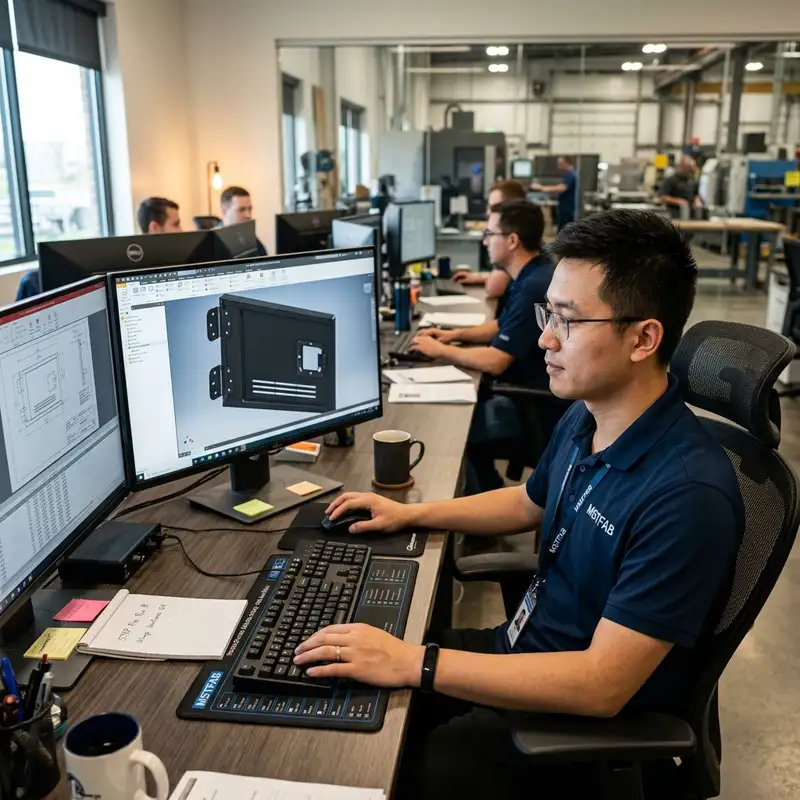
MSTFAB manufactures custom sheet metal door panels based strictly on customer 3D models (STEP, STP) and 2D engineering drawings (PDF, DXF, DWG). As an experienced OEM sheet metal factory in Guangzhou, China, we support global buyers with door panels that arrive flat, align perfectly with hinges, seal reliably, and install without force.
For assemblies requiring airflow and thermal protection, sourcing from an experienced custom louvered sheet metal panel supplier guarantees that formed louvers shedding water and dust line up perfectly with your fans and internal electronics.
To support cabinet thermal strategies, sourcing from an OEM metal ventilation cover fabrication manufacturer ensures that your fan mount patterns, filter slots, and grounding locations align perfectly during cabinet assembly.
During the machine build phase, sourcing from a specialized supplier of sheet metal fabrication for automation equipment ensures that robot guards, cable brackets, motor mounts, and sensors align flawlessly on your main assembly frame.
For high-end device designs, partnering with an experienced supplier of sheet metal parts for medical device manufacturers ensures that visual surfaces, rounded corners, and grounding points conform exactly to diagnostic instrument aesthetics.
During modular builds, choosing a reliable partner for custom metal fabrication for telecom equipment ensures that grounding studs, connector plates, and rack ears line up perfectly in your final network layouts.
For custom clean power setups, sourcing from a specialized supplier of sheet metal components for renewable energy systems ensures that solar inverter enclosures, heavy battery trays, and EV charger casings survive harsh outdoor environments.
During mechanical design iterations, sourcing precise components from a supplier of sheet metal parts for robotics manufacturers ensures that AGV shells, sensor brackets, and robotic arm guards fit together cleanly without extra field grinding.
For mobile setups exposed to high dynamic loads, partnering with a supplier of metal fabrication for transport refrigeration equipment ensures that condenser frames and evaporator housings endure severe road shock.
During the structural design review of the main frame, sourcing specialized fabricated metal parts for commercial machinery ensures that heavy motor plates, front door panels, and internal base plates align perfectly.
During the device housing review, consulting a specialist in custom sheet metal for laboratory equipment helps ensure that delicate display bezels, PCB pillars, and chemical-resistant finishes align seamlessly.
During the cabinet frame design phase, consulting a specialist in sheet metal parts for smart locker manufacturers ensures that multiple door clearances, latch positions, and weather seals align perfectly.
During the thermal cabinet design phase, consulting a specialist in custom metal fabrication for HVAC equipment helps optimize fan shroud tolerances, ventilation louvers, and condensate drain channels.
What Is a Sheet Metal Door Panel?
A sheet metal door panel is the functional opening-and-closing component of a cabinet, enclosure, equipment housing, or machinery console. Unlike basic covers or static panel plates, it requires a complex array of fabricated features to work successfully:
- Return Edges & Reinforced Flanges: Provide structural stiffness to keep the panel flat and prevent flexing.
- Hinge & Lock Holes: Laser-cut clearances for mechanical hardware installation.
- Gasket Contact Surfaces: Smooth flat returns designed to seal out moisture, dust, and debris.
- Grounding Studs & PEM Hardware: Embedded fasteners that must remain free of paint to ensure electrical continuity.
- Door Stiffeners: Welded channels that add structural rigidity to large doors.
Why OEM Buyers Need Custom Door Panels
Off-the-shelf standard door panels rarely match custom configurations. Sourcing custom door panels from a professional sheet metal parts manufacturer from CAD drawings solves major integration headaches:
- No Manual Correction: If your installer has to reach for a drill, grinder, or file on the assembly line, the door panel was fabricated poorly. Custom fabrication ensures a consistent 2.0mm door gap first time.
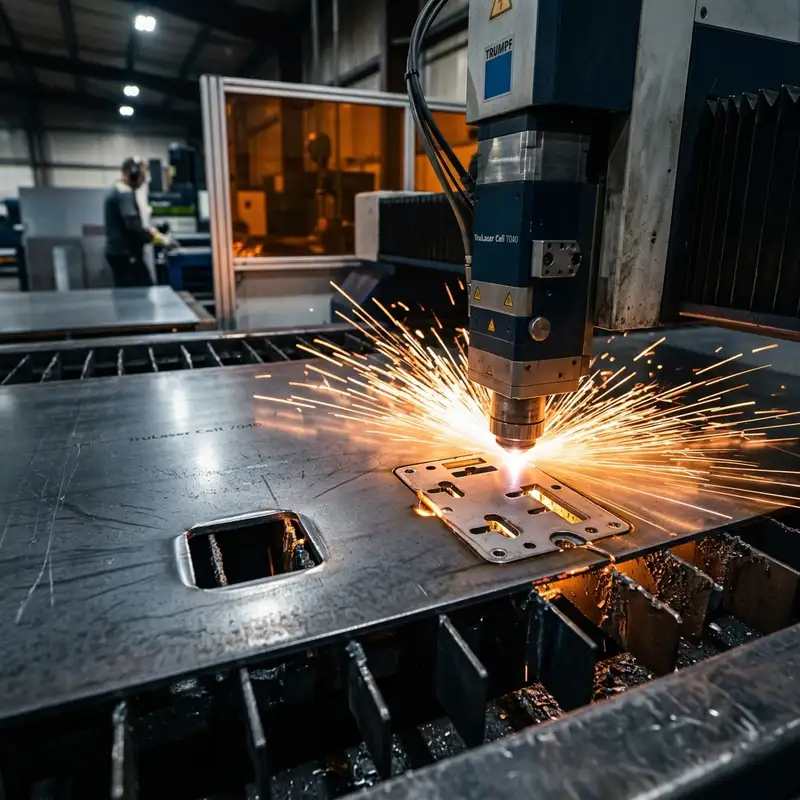
- Accurate Hardware Fits: We laser cut lock holes, handle slots, and hinge positions to ±0.1mm tolerances, matching your physical hardware specs.
- Protected Aesthetics: The front door is the most visible part of your machine. If the door panel looks poor, the entire product looks cheap. We enforce strict surface protection policies during transit.
Common Applications for Custom Door Panels
Electrical Cabinet Door Panels
Electrical door panels require absolute precision for environmental protection. We focus on continuous gasket interfaces, accurate lock cutouts, and pre-welded grounding studs. Our DFM review highlights paint masking requirements on thread inserts so your electrical technicians don’t waste time cleaning out powder coating.
control cabinet & HMI Doors
control cabinet doors often house push buttons, touchscreens, and indicator lights. We support custom button grids, HMI display openings, and viewing window cutouts. Flatness control is critical here; a warped door will prevent proper touchscreen seating, compromising the enclosure IP rating.
Industrial Enclosure & Access Panels
Industrial doors must survive severe operating environments. Whether you need a hinged access door or a heavy-duty removable panel, we fabricate robust flanges and double-deburr all corners to ensure operator safety.
Telecom & battery cabinet Door Panels
These applications require ventilation slots, perforated grills, or louvers to dissipate heat. We manage punch-sequence distortion to ensure large ventilated areas do not cause the metal panel to bow or warp.
Door Panel vs. Access Panel vs. Cover Plate
While they may look similar on a raw flat pattern, their manufacturing tolerances and complexities are vastly different:
Door Panel: Built for frequent, repeated opening/closing. Features hinges, latch cutouts, handle holes, tight door gaps (usually 1.5mm – 2.5mm), and gasket compression surfaces.
Access Panel: Built for infrequent maintenance access. Often screw-mounted or features simple slot-latch mechanisms. Tolerances are more relaxed.
Cover Plate: Static plate used to seal unused holes or entryways. Usually flat with basic mounting holes, requiring minimal DFM review.
Trust Table: Cheap Supplier vs. MSTFAB Door Panels
Why do leading OEM procurement managers choose MSTFAB over cheaper alternatives? Here is a practical comparison of what you get:
| Quality Metric | The Cheap Supplier’s Door | MSTFAB’s Assembly-Ready Door Panel |
|---|---|---|
| Hinge & Lock Fit | Slightly off-center. Requires hammering, force, and filed modifications. | ±0.1mm accuracy. Hinges and locks drop in and rotate smoothly. |
| Door Flatness | Bowed or twisted due to welding heat, causing uneven door gaps. | Controlled flatness with structural return edges and welded stiffeners. |
| Grounding & Threads | Powder coated over. Threads are clogged, requiring manual wire brushing. | Precision high-temperature silicone plugging. Threads arrive clean and conductive. |
| Edge Safety | Razor-sharp laser burrs left on returning edges, risk of operator injury. | Double-deburred, hand-safe edges before powder coating. |
| Transit Protection | Stacked metal-on-metal with thin plastic. Arrives dented or scratched. | Protective film, foam corner protectors, and heavy-duty export crates. |
Material Selection for Door Panel Fabrication
Choosing the correct raw material directly impacts weight, strength, and corrosion resistance. Our engineering team reviews your drawings for:
- Cold Rolled Steel (SPCC/DC01): Excellent cost-to-strength ratio. Ideal for indoor powder-coated cabinets. However, raw steel must be protected immediately to avoid rust.
- Galvanized Steel (SGCC): Deployed when zinc protection is needed for outdoor electrical cabinets. Provides reliable corrosion protection at cut edges.
- Stainless Steel (SUS304/SUS316): The premier choice for marine, food processing, or washdown environments. We offer beautiful brushed or polished finishes with scratch-controlled handling. Learn more about our stainless steel metal parts fabrication.
- Aluminum (5052-H32): Lightweight and easy to handle, reducing door load on large enclosures. Requires careful bend radius review to prevent cracking. We offer comprehensive aluminum sheet metal parts manufacturing.
Core Manufacturing Operations
CNC Bending Sequence
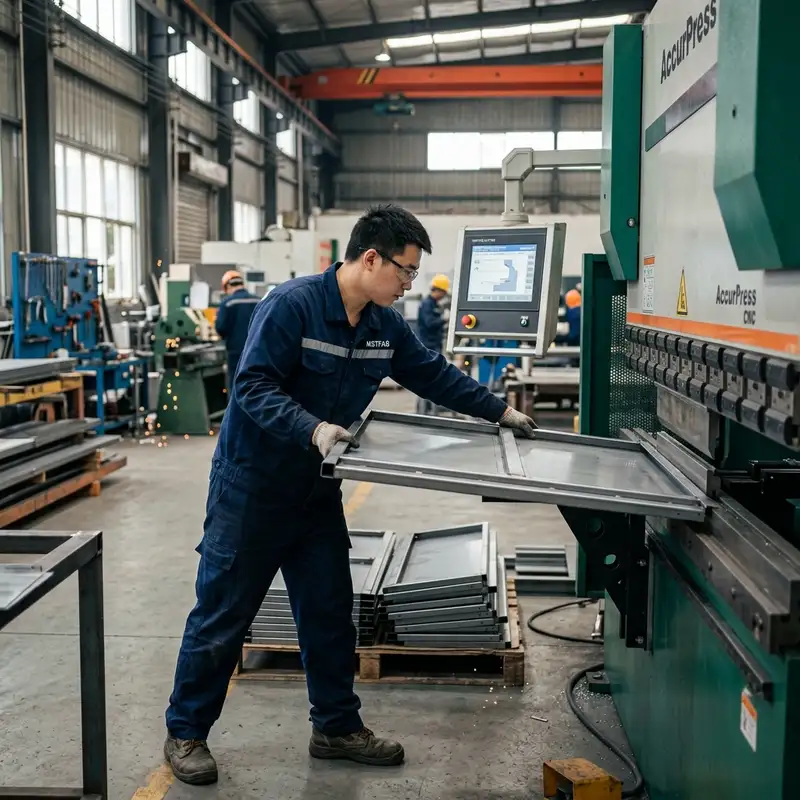
Bending forms the return flanges that dictate the door gap. If the bending sequence or K-factor calculations are wrong, the door will rub against the cabinet frame. We design custom bending tooling to access tight returning lips without distorting the outer face of the panel.
Welding & Flatness Control
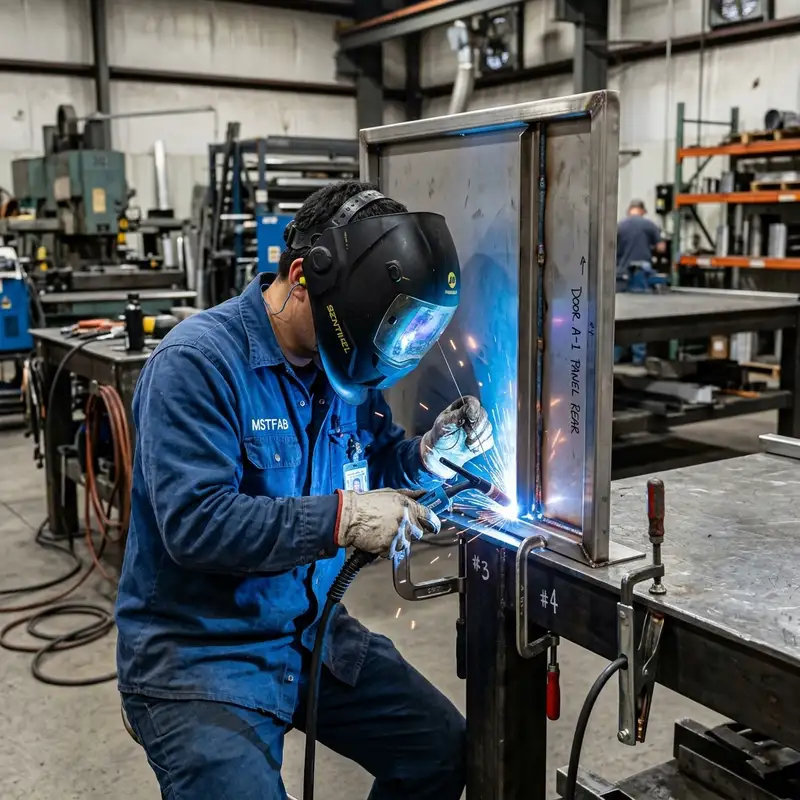
Welding stiffener channels onto a door panel adds immense strength, but welding introduces heat. And heat moves metal. Without proper clamping fixtures and controlled spot-welding sequences, the front face will warp. We utilize pneumatic welding fixtures to keep the panel perfectly flat.
Hardware Insertion & Thread Protection
We permanently insert PEM nuts, standoffs, and grounding studs using hydraulic insertion machines. Grounding points are masked with specialized plugs before powder coating to guarantee clean metal-to-metal contact during final assembly. Read more on our sheet metal fabrication with PEM hardware installation.
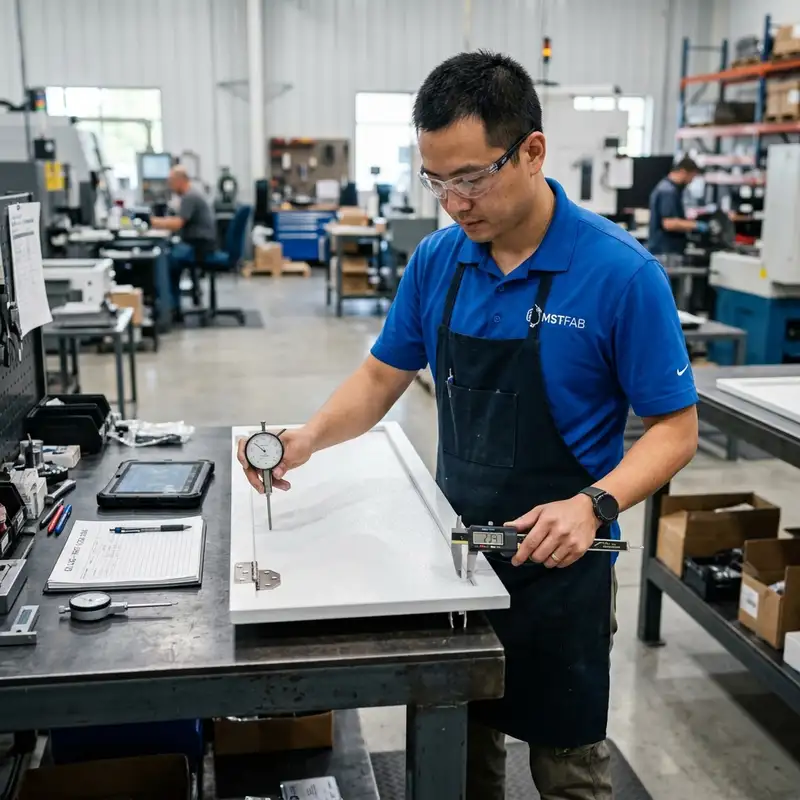
Design for Manufacturability (DFM) Checks
Before we begin cutting metal, our engineering department performs a complete DFM check on your files. We check:
- Hole-to-bend distances to prevent hole stretching during bending.
- Recommended bend radii based on material thickness and grade.
- Welding access for internal stiffeners.
- Proper clearances for hinges, latches, and seals.
Finding design issues in CAD is a quick adjustment. Finding them after bending, powder coating, and shipping to your assembly line is a financial disaster.
Export Packaging and Transit Protection
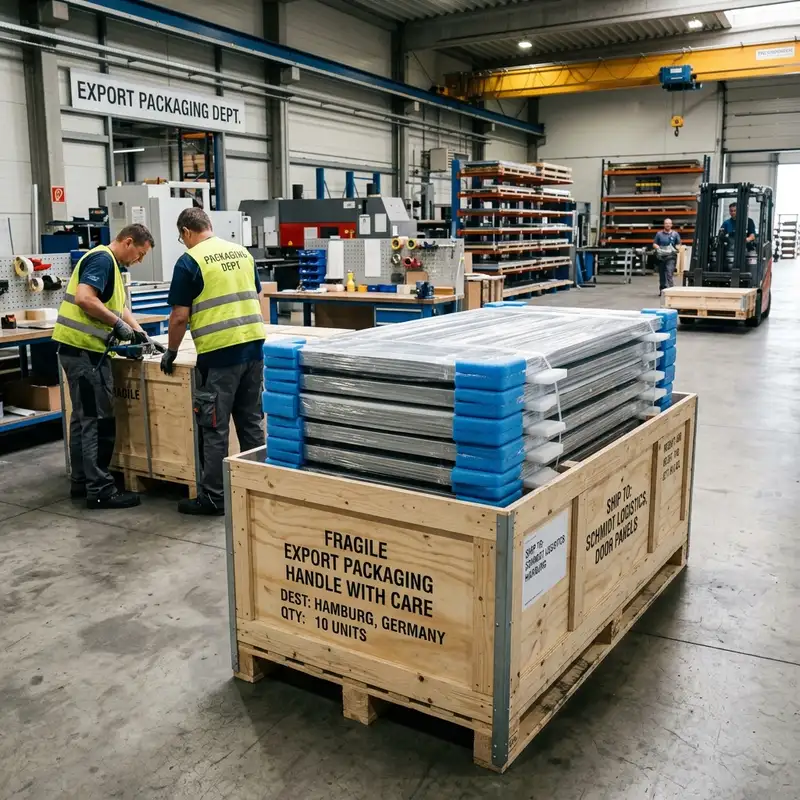
A door panel is a large, visible, and flat surface—making it highly vulnerable to scratches and dents during sea freight. A perfect door panel that arrives scratched is no longer a perfect door panel. We wrap all powder-coated and brushed stainless panels in protective film, place foam separators between layers, fit thick foam buffers over all flanges, and pack them into reinforced wooden crates.
Request a Sheet Metal Door Panel Quote
Ready to source door panels that actually fit your cabinets without field grinding? Send MSTFAB your native 3D STEP models and 2D engineering PDF/DXF drawings. Our engineering team will review your drawings, identify any DFM risks, and provide a competitive, factory-direct quotation.
Upload Drawings & Get QuoteFAQ: Sheet Metal Door Panels
What files are needed for a door panel quotation?
For an accurate quotation, please provide a 3D model (STEP or STP file) to confirm the shape, along with 2D drawings (PDF, DXF, or DWG) defining tolerances, material thickness, hardware part numbers, and powder coating specifications. Check out what files are needed for a sheet metal fabrication quote.
How do you control door panel flatness after welding?
We use heavy-duty clamping fixtures and precise spot-welding patterns for internal stiffeners. This limits the heat zone and prevents thermal warping on the visible outer door surface.
Can you deliver door panels with pre-installed hinges and locks?
Yes. We can install sheet metal hardware, hinges, locks, and latch assemblies according to your assembly drawings, delivering a plug-and-play assembly to your line.
How do you protect grounding studs during powder coating?
We use high-temperature silicone masking caps to cover grounding studs and threaded inserts before coating, leaving clean, highly conductive metal surfaces for electrical safety.
MSTFAB manufactures custom sheet metal enclosures, electrical cabinets, control boxes and industrial metal housings for OEM buyers.
 WeChat Contact
 WhatsApp Me Directly