
The Short Answer
Fabricated metal parts for commercial machinery must combine structural frame rigidity, operator-safe deburred edges, uniform gap lines on exterior doors, and repeatable hole alignment across recurring builds. Whether you are sourcing automated retail housings, food-processing machine skins, or packaging equipment guards, locking flat-pattern bend deductions, hardware installation specs, and powder-coat film thickness during DFM eliminates assembly-floor shimming and rework.

Explore this guide
01 / Core Machinery Part Categories
Engineer exterior housings, safety guards, and structural subframes as an integrated kit.
Commercial machinery—spanning commercial kitchen and beverage equipment, packaging lines, printing systems, automated kiosks, and textile machines—relies on dozens of mating sheet metal components. When exterior panels, internal brackets, and base frames are sourced from disconnected job shops, cumulative bend tolerances cause door binds, uneven gap reveals, and misaligned sensor mounts on your assembly line.
By consolidating the complete mechanical bill of materials under one custom laser cutting service and forming workflow, similar to how we support sheet metal parts for smart locker manufacturers and custom sheet metal for laboratory equipment, every panel and bracket is verified against the master 3D assembly model before cutting.
Machine Covers and HMI Doors
Cosmetic front doors, display bezels, top cowlings, and side skins formed with hemmed or double-return flanges for panel stiffness and clean visual gap lines.
Safety Guards and Louvered Panels
Interlock-ready drive guards, belt shields, finger-safe fan grilles, and acoustic/thermal access panels engineered for rapid field maintenance.
Base Plates and Internal Brackets
Heavy-gauge laser-cut motor mounts, actuator brackets, drip trays, and welded tubular or channel base frames that carry dynamic operating loads.
Assembly datum alignment: Reference both the outer cosmetic skin and the internal mounting brackets to the same primary frame datum holes on your 2D drawings so stack-up errors do not accumulate across multi-panel enclosures.
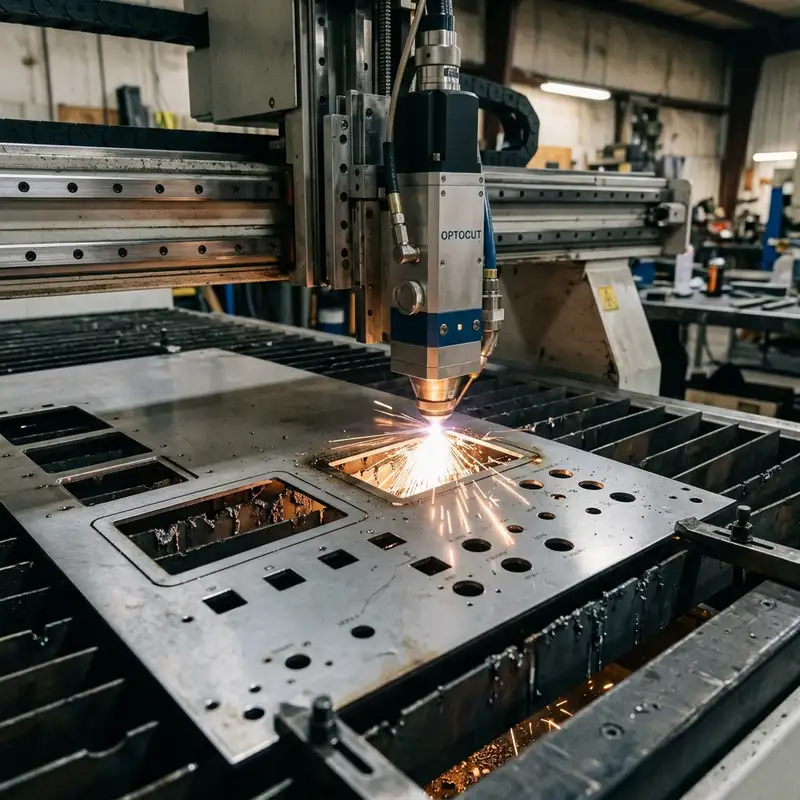
02 / Laser Profiling and Operator Safety
Eliminate sharp edges and kerf burrs on technician-facing access panels.
Commercial machines are cleaned, loaded, and serviced daily by operators and field technicians. A raw laser-cut edge or micro-tab burr inside a service opening or cable pass-through poses an immediate laceration and wire-chafing hazard. Precision profiling must be paired with mandatory mechanical edge conditioning.
- Nitrogen fiber laser cutting: High-pressure nitrogen assist gas produces clean, oxide-free cut edges on stainless steel, aluminum, and powder-coated carbon steel panels without slag buildup.
- Wide-belt and rotary-brush deburring: Every flat blank passes through automated abrasive-belt and oscillating rotary-brush machines to remove thermal burrs and radius sharp perimeter and cutout edges.
- Hemmed safety edges on access doors: Where operators reach into chutes, hoppers, or service doors, press-brake Dutch hems (180-degree flattened folds) double the edge thickness and eliminate exposed sheet edges.
Our sheet metal laser cutting services hold tight positional tolerances on HMI screen cutouts, cam-lock keyways, and ventilation patterns across every batch.
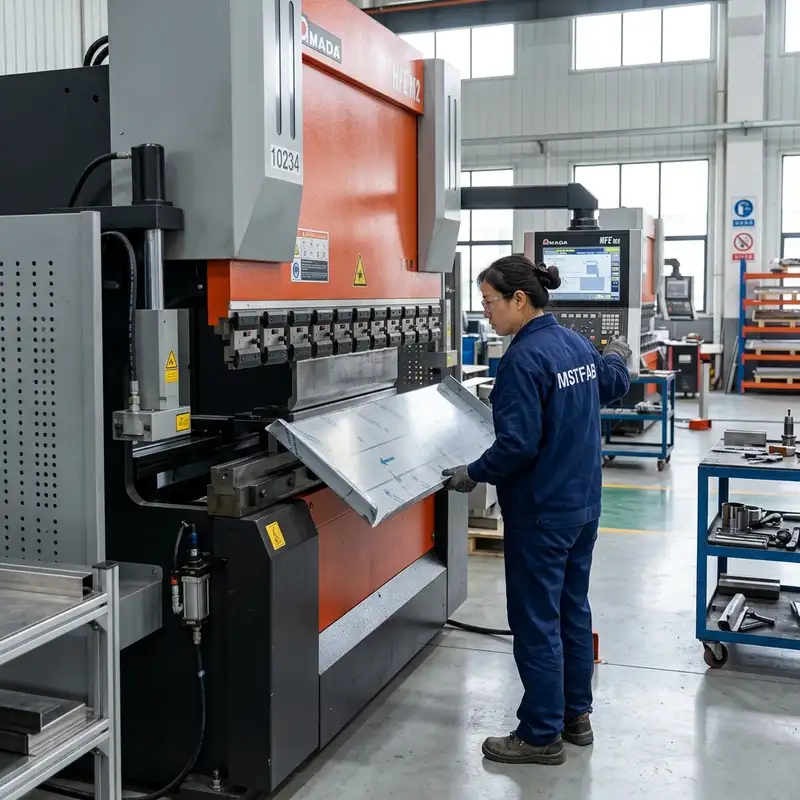
03 / Press Brake Forming and Frame Welding
Control panel oil-canning, flange springback, and weld distortion.
Large commercial machine side panels can drum or “oil-can” under motor vibration if left as unstiffened flat sheets, while heavy base weldments can twist out of plane if welded without rigid heat-sinking fixtures.
- Form perimeter return flanges, hat-section stiffener ribs, or cross-breaks on wide machine covers to raise natural frequency and damp operational vibration.
- Use optical angle verification and non-marring polyurethane V-die inserts during CNC press brake forming to keep multi-bend door channels square within +/-0.5 degrees.
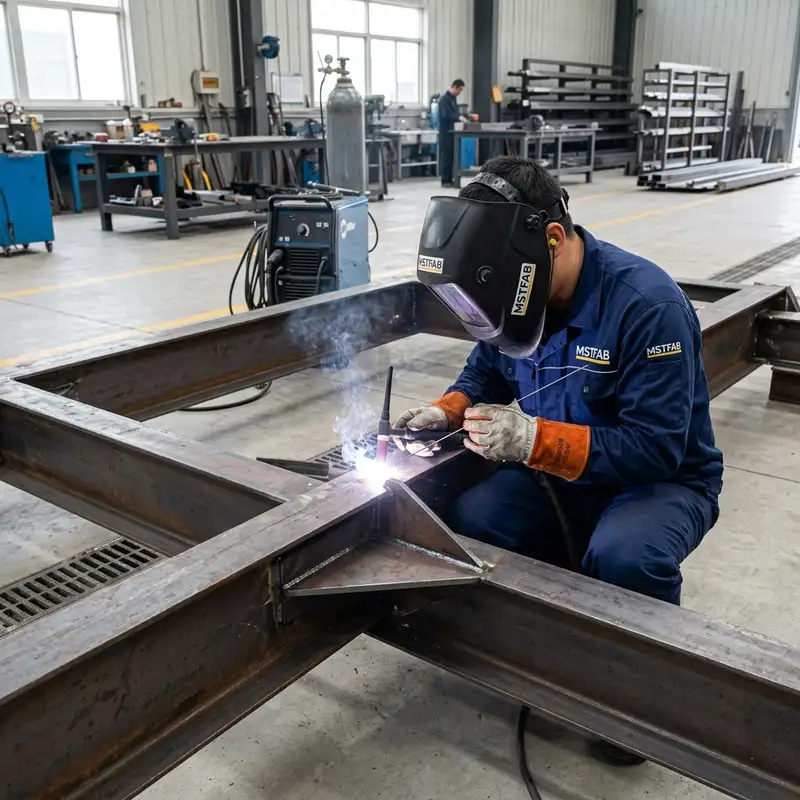
- Lock structural base frames and motor mounting brackets into precision modular welding tables, using balanced stitch or pulsed TIG/MIG sequences to control thermal shrinkage.
- Blend and grain-match visible exterior corner welds on stainless and painted machine housings so seams disappear after finishing.
Validating bend relief cutouts, minimum flange lengths, and tab-and-slot weld joints during pre-production DFM prevents assembly interference when doors, hinges, and gas struts are installed.
Explore integrated laser cutting and CNC press brake bending →
04 / Material Selection, Hardware and Coatings
Match metal grades, self-clinching fasteners, and finishes to the operating environment.
A commercial machine operating in a humid food-service kitchen faces very different corrosion and cleaning chemical demands than a dry warehouse packaging line or outdoor custom metal fabrication for HVAC equipment and sheet metal fabrication for battery equipment.
- Cold-rolled and structural carbon steel (SPCC / Q235B / Q355B): Cost-effective choice for rigid internal frames, heavy motor baseplates, and powder-coated exterior machine cabinets in indoor commercial settings.
- Stainless steel (304 / 316L with #4 brushed or 2B finish): Specified for commercial food, beverage, dishwashing, and clean-down machinery requiring corrosion resistance and hygienic wipe-down surfaces.
- Aluminum alloys (5052-H32 / 6061-T6): Used for lightweight moving gantry covers, hinged lift-up hoods, and heat-dissipating electronics plates.
- PEM hardware and masked powder coating: Hydraulic installation of self-clinching nuts, studs, and standoffs paired with durable polyester or epoxy finish from a specialized powder coated metal parts manufacturer, including high-temp silicone masking on grounding studs and bearing mounts.
Clearly calling out RAL color codes, texture (fine sand vs. smooth gloss), and grounding mask zones on your 2D drawing ensures parts arrive ready for direct electromechanical assembly.
05 / Buyer Control Matrix
Verify five manufacturing controls before releasing commercial machinery parts.
Use this engineering matrix during DFM and first-article qualification to confirm both structural brackets and cosmetic skins meet your assembly standards.
06 / Inspection Handoff
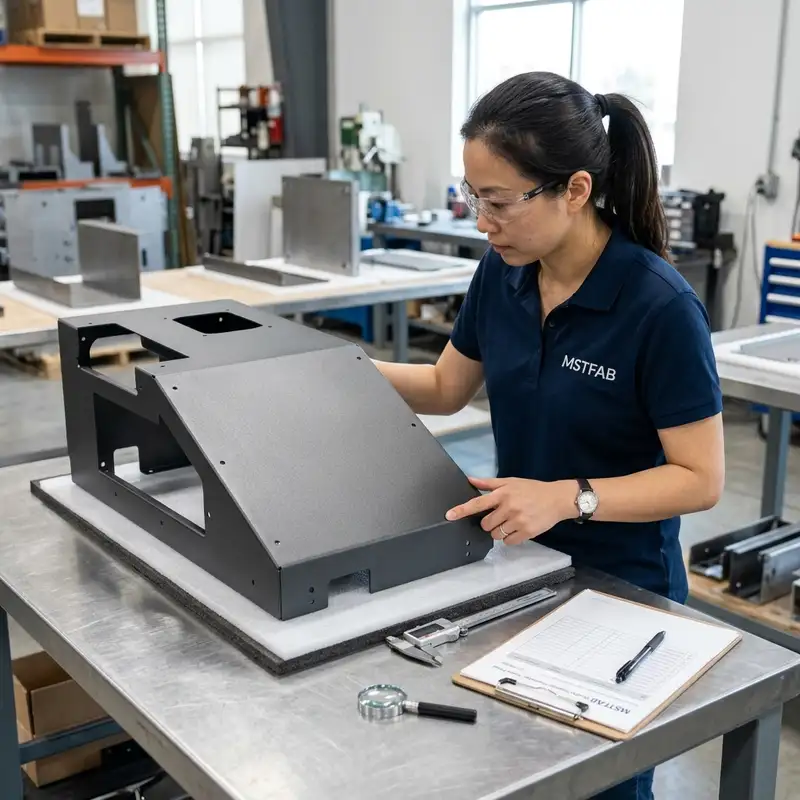
Validate dimensional accuracy, hardware torque, and finish consistency before shipment.
When a commercial machinery builder runs a mixed-model assembly line, a single batch of panels with drifted hinge holes or mismatched paint gloss can stall an entire production shift.
Our quality team executes First Article Inspection (FAI) on flat laser profiles and formed subassemblies—checking hole-to-bend datums, diagonal frame squareness, PEM fastener seating, and weld penetration against your ballooned 2D PDF drawings.
Operating under ISO 9001, IATF 16949, and ISO 14001 management systems, we document raw material mill certificates (EN 10204 3.1), dimensional inspection reports, and powder-coat thickness logs for every shipment.
Review our sheet metal quality control and inspection workflow →
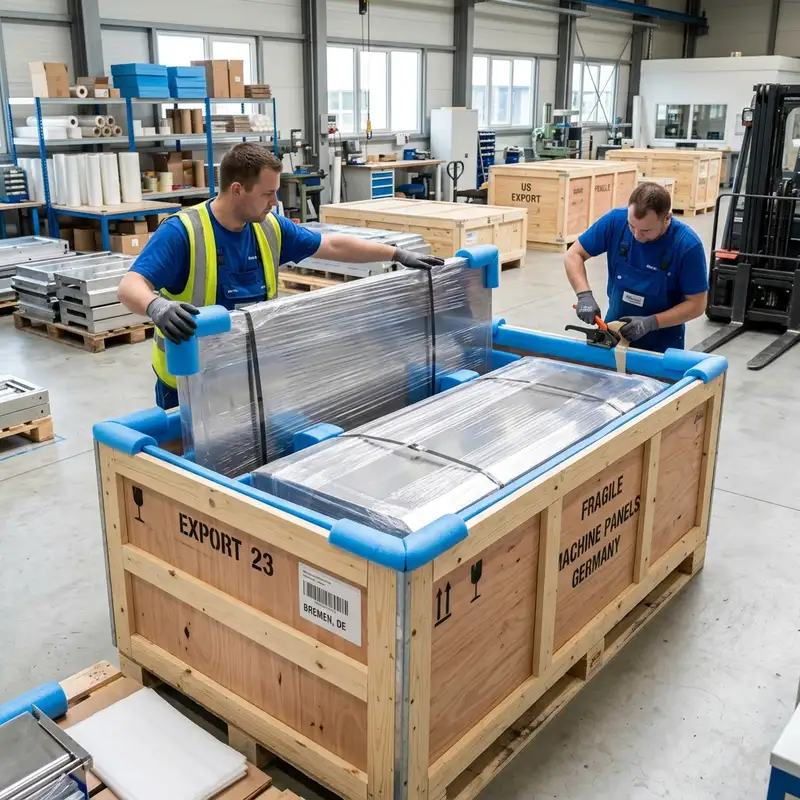
07 / Packing and Release
Protect large cosmetic machine skins and heavy frames during international freight.
Packing heavy 8 mm steel motor baseplates in the same unpartitioned crate as thin powder-coated or brushed stainless exterior doors is a common cause of transit denting and finish rub marks.
Our export packaging team separates heavy structural weldments from cosmetic skins, wraps finished panels in protective film and pearl-cotton sleeves, adds rigid foam corner buffers, and packs sets into fumigation-free plywood crates labeled by machine BOM kit.
Manufacturing scope: MSTFAB manufactures custom build-to-print sheet metal parts, machine guards, structural frames, and empty enclosure shells to customer drawings under ISO 9001, IATF 16949, and ISO 14001 controls. Final machinery wiring, powered safety interlock integration, and end-equipment regulatory compliance remain the responsibility of the OEM.
08 / Ready-to-Review RFQ
Include eight engineering details in your commercial machinery sheet metal RFQ.
- 3D STEP assembly and part filesProvide 3D STEP models for formed panels and weldments plus 1:1 DXF files for flat laser profiles.
- 2D PDF drawings with tolerancesCall out critical-to-assembly hole centers, flatness tolerances, weld symbols, and datum edges.
- Material grade and gaugeSpecify exact carbon steel (SPCC/Q235B), stainless (304/316L), or aluminum (5052-H32) grade and thickness in mm.
- Cosmetic A/B surface mapMark customer-facing exterior panels, stainless brush grain direction, and weld grinding classes.
- Hardware and fastener scheduleList self-clinching nuts, standoffs, weld studs, hinges, or latches with exact thread and length codes.
- Surface treatment and maskingDefine RAL powder coat code, gloss/texture, zinc plating, passivation, and paint-free grounding zones.
- Batch and annual release volumesState prototype quantity and recurring batch sizes so we can optimize multi-part sheet nesting.
- Kitting and crating preferencesIndicate whether parts should be packed by individual part number or kitted as complete machine sets.
Providing complete 3D STEP assemblies alongside 2D drawings allows our engineers to check mating panel clearances and return a fast, accurate quotation.
Commercial machinery metal fabrication questions from OEM buyers
Can you fabricate both the heavy structural base frame and the cosmetic exterior covers for our machine?
Yes. We routinely manufacture complete mechanical sets—combining thick laser-cut and MIG/TIG welded structural base frames with thin-gauge CNC-bent exterior skins, access doors, and internal sensor brackets so all mating hole patterns align.
How do you prevent sharp edges on machine doors and service cutouts where technicians reach inside?
Every laser-cut blank runs through automated wide-belt and rotary-brush deburring machines to remove burrs and break sharp edges. For high-contact access openings and door perimeters, we also form 180-degree flattened safety hems on our CNC press brakes.
How do you keep brushed stainless steel machinery panels from getting scratched during bending?
We process brushed 304 and 316L stainless steel with laser-safe PVC protective film applied on the cosmetic side, form bends over non-marring urethane press-brake die film, and keep the protective film intact until export crating.
Can you install PEM fasteners, hinges, and grounding studs before shipping?
Yes. We press in self-clinching nuts, studs, and standoffs on calibrated hydraulic insertion presses, capacitor-discharge (CD) weld grounding studs, and apply high-temperature silicone masks over threads and bonding pads prior to powder coating.
How do you prevent color or texture mismatch across adjacent powder-coated machine panels?
We coat complete machine panel sets using the same powder batch, pre-treatment line parameters, and curing oven profile, verifying color consistency and dry-film thickness (DFT) across mating doors and side covers before packing.
What file formats are required to quote a multi-part commercial machine enclosure?
Please send 3D STEP (.stp/.step) files for all formed and welded parts, 2D PDF drawings for tolerances, threads, and finish notes, and an Excel BOM listing materials, finishes, and quantities per machine.
Technical references
Reference these international standards when specifying general sheet metal tolerances, thermal cutting edge quality, and machine guard safety clearances on your drawings.
Send your commercial machinery STEP, DXF, and PDF files for a DFM quote.
Share your machine panel and bracket drawing package with your target batch volume. MSTFAB will review manufacturability and return an itemized quotation.
Request a Machinery Parts Quote →
Have a question first? caroline@mstfab.com
 WeChat Contact
 WhatsApp Me Directly