The drawing says 316. The quote says 316. Six months after installation, a tidy brown ring appears around a weld on the equipment cover your customer hoses down every evening. Nobody substituted the material. The weld simply left the factory with its heat tint intact, sitting in a corner where cleaning chemicals like to linger.
This is the frustrating part of corrosive-service sourcing: the grade is necessary, but it is not the whole specification. This guide explains what to define, what to ask for and what to check when you work with a 316 stainless steel sheet metal fabrication supplier.
Quick answer: For corrosive or washdown applications, a 316 stainless steel fabrication supplier should control material verification, welded surface condition, contamination prevention, assembly interfaces and finish requirements. The OEM defines chemical exposure and final performance; the fabricator manufactures the approved mechanical parts.
316 and 316L offer improved corrosion resistance over 304 in many demanding environments, but neither grade is universally resistant to every chemical or cleaning process. The real purchasing question: can the supplier deliver drawing-controlled stainless parts whose fabricated condition matches your operating and cleaning requirements?
Scope note: MSTFAB manufactures custom 316/316L brackets, panels, covers, guards, mounting plates and empty equipment enclosure shells from buyer-approved drawings. We do not supply finished electrical machines, wiring, electronics or system-level certifications, and we do not validate chemical resistance, hygienic design or enclosure ratings. You define the environment; we manufacture the approved sheet metal components.
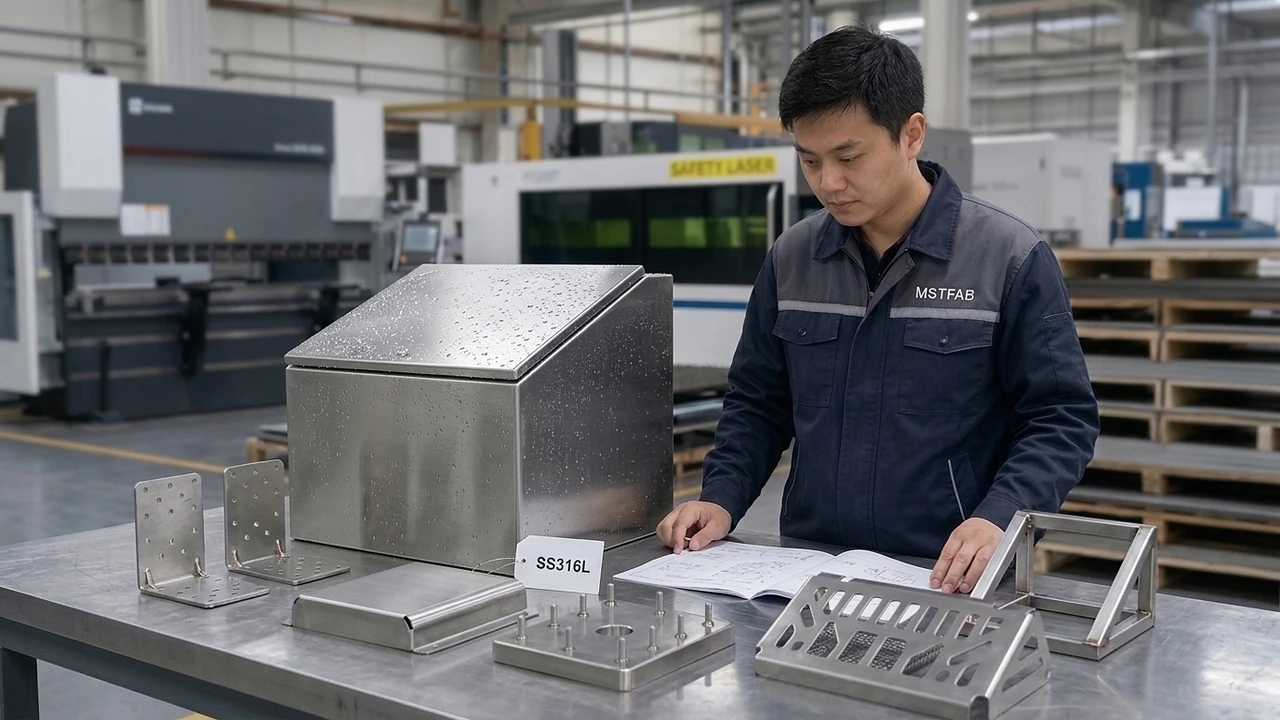
10 Checks Before You Release a 316 Stainless Part
1. Define the Actual Washdown Environment
“Washdown equipment” is a market description, not a material specification. Before requesting a quotation, tell the supplier how the part will actually be exposed.
| Operating condition | What OEM buyers should define |
|---|---|
| Water washdown | Frequency, temperature and drainage |
| Chemical cleaning | Chemical type, concentration and contact time |
| Chloride exposure | Source and expected exposure |
| Wet equipment areas | Water accumulation and drying conditions |
| Food or medical equipment | OEM-defined cleanability and surface requirements |
316 stainless steel may be appropriate for many demanding applications, but suitability depends on the real environment, including the cleaning chemicals nobody mentioned until the field report arrived.
316 is corrosion-resistant. It is not corrosion-proof.
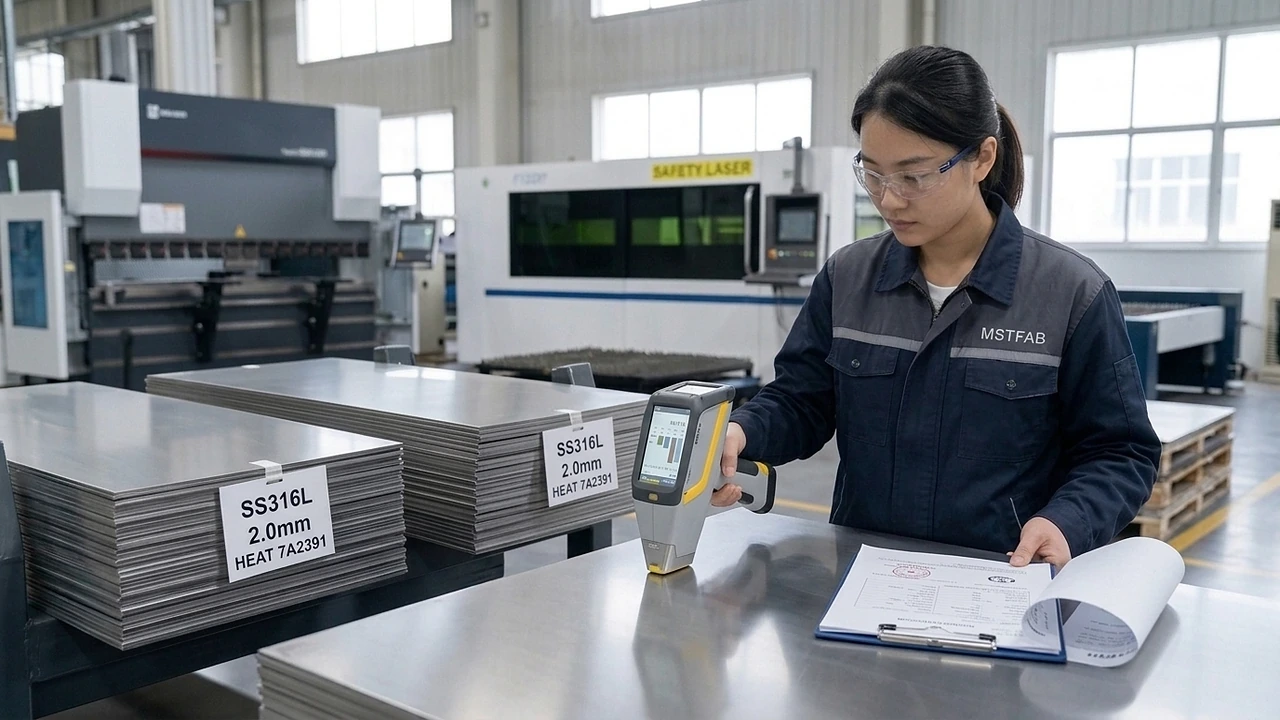
2. Confirm 316 or 316L Before Production
The drawing should state the exact grade. For welded assemblies, buyers often specify 316L because its lower carbon content reduces susceptibility to sensitization during welding. Even so, 316L should not silently replace 316 (or the reverse) without Engineering approval.
- Put on the RFQ: exact grade, thickness, and whether you need material certificates, heat traceability or positive material identification (PMI).
- Ask for evidence: grade confirmed in the quotation; certificates or PMI records where the order specifies them.
- Red flag: “SS316 or equivalent.” Equivalent to what, and approved by whom?
Material verification should match your actual risk. A hidden internal bracket and a chemical-contact panel rarely need the same paperwork.
3. Control Welds in Corrosion-Sensitive Areas
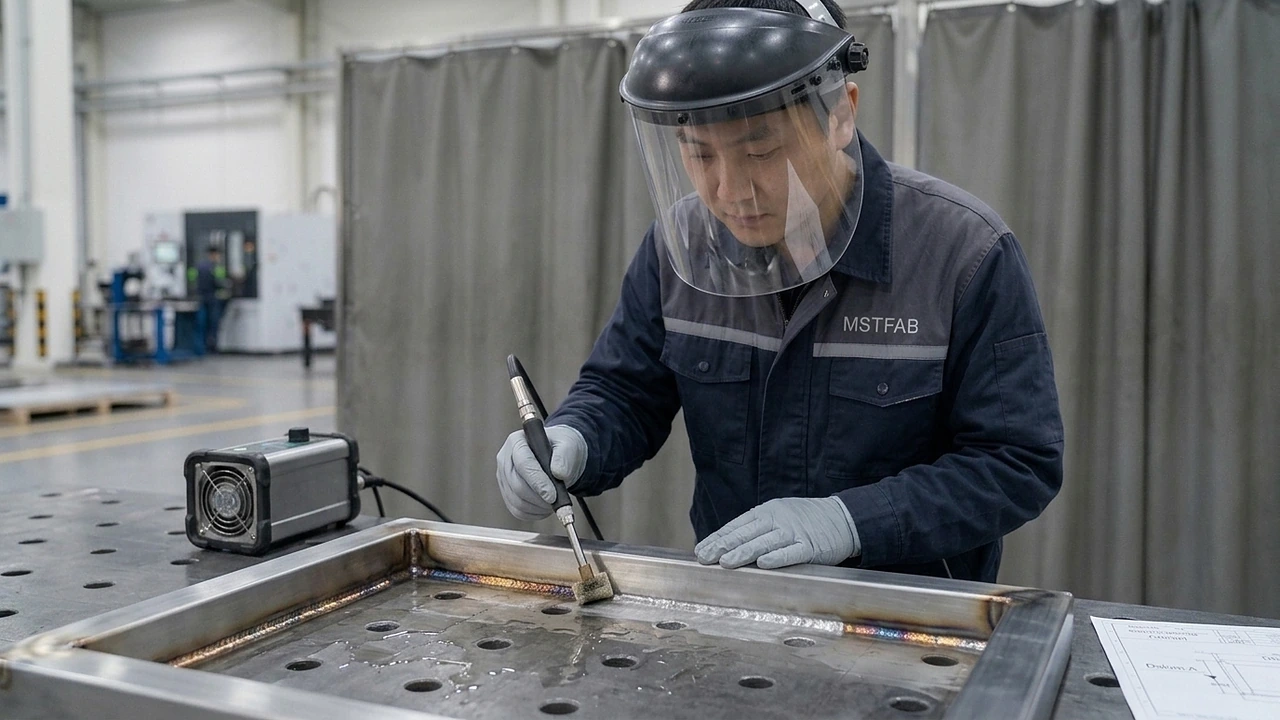
Welding can create heat tint, distortion and areas that need post-weld treatment. In wet or corrosive service, the oxide layer left by heat tint can reduce local corrosion resistance if it is not removed. Buyers should define:
- weld locations and workmanship requirements;
- surfaces that must remain accessible for cleaning;
- heat-tint removal requirements;
- weld blending, where specified;
- final welded dimensions;
- any additional surface treatment.
A beautiful weld is useful. A weld that is difficult to clean and quietly becomes a corrosion site is considerably less useful. For joint design and distortion control, see our sheet metal welding services.
4. Avoid Unnecessary Crevices and Water Traps
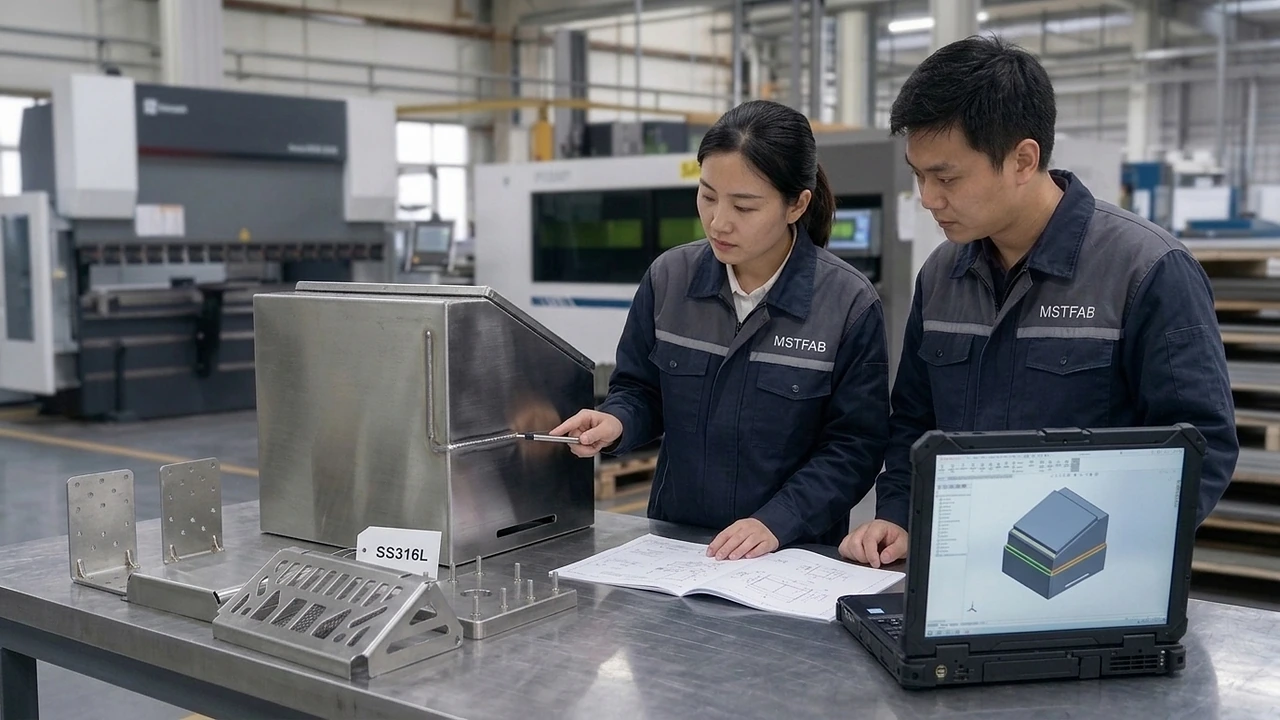
Even correctly specified stainless steel can suffer localized corrosion where moisture and contaminants stay trapped. For washdown-related parts, OEM Engineering should review overlapping joints, inaccessible corners, drainage paths, fastener interfaces and any area where cleaning chemicals may remain.
- Put on the drawing: continuous versus stitch welds, drain features, and which overlaps must be sealed.
- Ask for evidence: written DFM comments on features that may be hard to clean or fabricate consistently.
- Red flag: a supplier that quietly changes a seal weld to a stitch weld because it is faster.
MSTFAB reviews manufacturing feasibility and produces the approved geometry. The OEM decides whether the completed design meets its hygiene, drainage and service requirements. A more expensive alloy cannot always compensate for a design that holds water like a teacup.
5. Define the Required Surface Finish
An internal mounting bracket rarely needs the same finish as an exposed equipment panel. Possible buyer requirements include:
- deburred edges;
- controlled weld cleanup;
- brushed finish;
- polished finish;
- specified surface roughness where necessary;
- passivation or electropolishing when specified.
Do not assume every 316 part needs mirror polishing or passivation. If surface roughness matters, state a measurable acceptance requirement such as an Ra value and the faces it applies to. MSTFAB coordinates project-specific finishing according to the approved quotation.
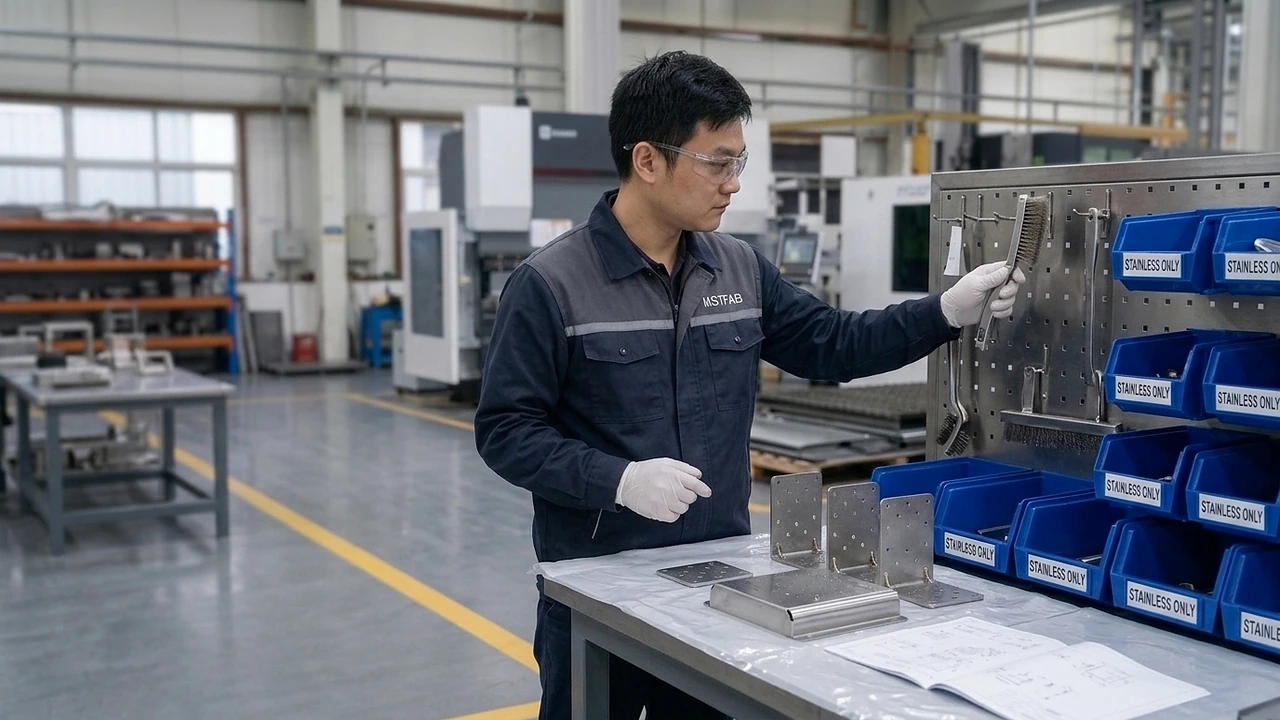
6. Prevent Carbon Steel Contamination
Stainless parts can develop surface rust staining when carbon steel particles are embedded during fabrication. The base metal is fine; the borrowed iron is not. Supplier qualification should consider handling and cleaning practices across cutting, grinding, brushing, workholding and storage.
- Ask: are abrasives, wire brushes and clamps dedicated to stainless?
- Ask: how are stainless parts separated from carbon steel work and stored before shipment?
- Red flag: one grinder, one brush, “we clean it later.”
The drawing may say 316. The surface still needs to arrive in an acceptable condition.
7. Check Bending and Mounting Fit
316 parts still require normal dimensional control. For formed brackets, covers and panels, the critical features usually include bend angle, flange height, mounting-hole pattern, hole-to-bend position and finished assembly datums. Where welding can move geometry, inspect critical features after welding, not before.
A corrosion-resistant cover that does not align with its mounting holes is still a rejected part.
8. Hardware Must Match the Approved Design
OEM parts may require studs, rivet nuts, threaded inserts, hinges or other mechanical hardware. Define the hardware part number, material, thread, quantity and installation side.
Where exposure creates a risk of galvanic corrosion, crevice corrosion or trapped cleaning chemicals, the OEM should review the assembled material combination. Using 316 sheet does not automatically make every installed fastener suitable for the environment; a zinc-plated stud on a 316 panel is a short story with a predictable ending.
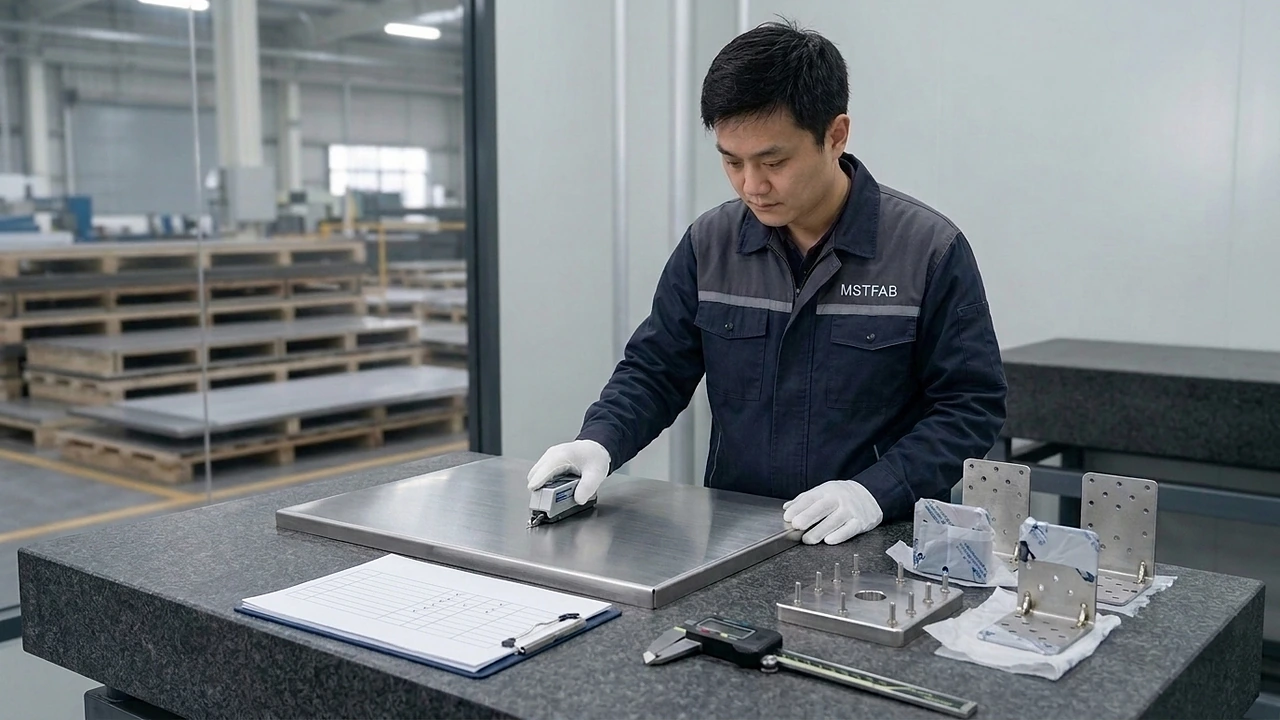
9. Approve the Finished First Article
For a new 316 project, first-article approval should cover the agreed finished manufacturing condition, not just a flat-part dimension check.
| Inspection area | Buyer check |
|---|---|
| Material | 316/316L specification and required records |
| Dimensions | Drawing-defined CTQs |
| Welding | Joint condition and post-weld geometry |
| Surface | Finish, cleanliness and specified treatment |
| Hardware | Correct parts and installation |
| Assembly | Mounting and mating fit |
| Packaging | Surface and edge protection |
Any corrosion, hygiene or chemical-resistance validation should be agreed separately with the responsible OEM team. A dimensional inspection report alone does not establish suitability for the service environment.
10. Compare Suppliers on the Same Scope
When reviewing quotations, confirm each supplier is pricing the same route:
Some quotations include only fabricated metal. Others include specified finishing and assembly. The lowest unit price does not always represent the lowest delivered manufacturing cost, especially once rework, field staining and an annoyed end customer join the conversation.
Trust Table: Who Controls What on a 316 Project
Corrosive-service parts go wrong most often in the gaps between “we assumed you” and “we assumed you.” Here is how responsibility is divided on an MSTFAB 316/316L project.
| Item | MSTFAB controls | Evidence you can request | Owner |
|---|---|---|---|
| Grade & material records | Uses the specified 316 or 316L; no substitution without written approval | Quote confirmation; certificates, heat traceability or PMI where specified | MSTFAB |
| Weld condition | Welds per drawing; agreed heat-tint removal and blending | Weld photos and first-article review | MSTFAB to OEM standard |
| Contamination control | Stainless-dedicated tools, segregated handling and storage | Process description and pre-shipment photos | MSTFAB |
| Crevices & drainage | Raises DFM comments; produces the approved geometry | Written DFM feedback | MSTFAB + OEM approval |
| Finish & treatment | Coordinates specified finish, passivation or electropolishing | Finish sample; roughness readings where an Ra is specified | MSTFAB to OEM spec |
| Dimensions & hardware | CTQs measured after forming and welding; hardware per drawing | First-article inspection report | MSTFAB |
| Chemical exposure, hygiene, NEMA 4X / food-equipment compliance | Not in fabricator scope | — | OEM |
What MSTFAB Manufactures
MSTFAB provides custom sheet metal fabrication services for overseas OEM equipment manufacturers. For buyer-approved 316/316L projects, the scope may include:
Typical components include custom brackets, covers, mounting plates, guards, panels and empty equipment enclosure shells. For enclosure-specific considerations such as doors, flanges and gasket surfaces, see our stainless steel sheet metal enclosure fabrication guide.
The OEM defines the operating environment. MSTFAB manufactures the approved mechanical sheet metal components.
Frequently Asked Questions
Is 316 stainless steel suitable for washdown equipment?
It can be suitable for many washdown environments, but the cleaning chemicals, chloride content, temperature, drainage and service conditions must be reviewed. Grade alone does not guarantee corrosion performance.
What is the difference between 316 and 316L for sheet metal fabrication?
316L has lower carbon content, which can reduce sensitization concerns during welding. The correct grade should follow the OEM drawing and applicable material requirements.
Does every welded 316 part need passivation?
No. Post-weld cleaning and any passivation or electropolishing should be determined by the actual corrosion and surface requirements, and stated on the drawing or purchase order.
Can MSTFAB fabricate 316 stainless steel brackets and enclosure parts?
Yes. MSTFAB’s manufacturing scope includes drawing-based SS316/316L brackets, mounting plates, panels, covers, guards and empty equipment enclosure components.
Does 316 stainless steel automatically meet NEMA 4X or food equipment requirements?
No. Material grade alone does not establish enclosure environmental ratings, hygienic design compliance or finished-product certification. Those remain the OEM’s design and validation responsibility.
What files should I send for a quotation?
Send STEP/STP and controlled PDF drawings with material grade, thickness, quantities, critical tolerances, welding requirements, surface finish, inspection and export packaging requirements, plus a short description of the operating environment.
Technical References
- British Stainless Steel Association: Post-weld cleaning and finishing of stainless steels (heat tint and its effect on corrosion resistance).
- Outokumpu: Post-fabrication treatment (surface contamination, pickling and passivation after fabrication).
Request a 316 Stainless Steel Fabrication Quote
Send your drawings and describe the actual operating environment, particularly if the part sees washdown, chemicals, chlorides or standing moisture. We will review the fabrication route and clarify material, welding, finish and inspection scope before quoting—not after the first stain appears.
- Email: [email protected]
- WhatsApp: +86 173 2831 6456
- Website: mstfab.com
Send your STEP and PDF drawings for a custom sheet metal fabrication quote.
 WeChat Contact
 WhatsApp Me Directly