
Need production capability? This article focuses on outdoor telecom enclosure design checklist. For manufacturing scope, process capability and drawing-based quotation support, review MSTFAB’s outdoor telecom enclosure fabrication.
Custom Outdoor Telecom Enclosures for Real Field Conditions
An outdoor telecom enclosure does not live a comfortable life.
It may sit on a rooftop in summer heat, next to a coastal road with salt air, beside a utility pole in heavy rain, or inside a remote base station where no technician wants to visit twice.
So no, an outdoor telecom enclosure is not just an indoor network cabinet with thicker paint.
It must protect routers, switches, rectifiers, fiber connections, power modules, batteries, cooling units, cable entries, rack rails, grounding points, and service access areas from weather, dust, heat, corrosion, vibration, and shipping abuse.
If the enclosure is poorly fabricated, the problems are predictable:
- The cable entry leaks.
- The cabinet overheats.
- The door gasket does not seal.
- The powder coating rusts around cut edges.
- The rack rails are slightly off.
- The field technician starts drilling holes into finished metal.
That is not outdoor telecom enclosure fabrication.
That is a deployment delay with a lock on the front.
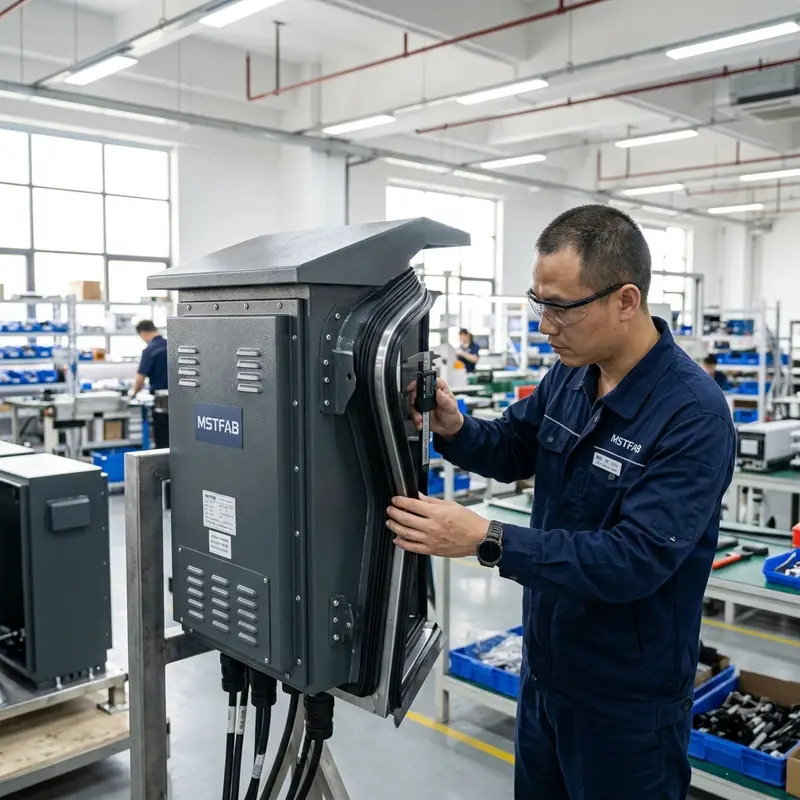
MSTFAB provides custom outdoor telecom enclosure fabrication based on customer drawings, STEP files, CAD files, PDF drawings, samples, or project requirements. Our process can include laser cutting, CNC bending, welding, grinding, powder coating, hardware installation, cable entry design support, ventilation review, DFM review, inspection, export packaging, and prototype-to-batch production support.
Why Outdoor Telecom Enclosures Need Custom Fabrication
Telecom equipment usually has specific installation requirements.
A standard cabinet may look acceptable, but real telecom projects often need custom structures for:
- 19-inch rack mounting
- Power module installation
- Battery backup compartments
- Fiber and copper cable routing
- Bottom cable gland plates
- Ventilation louvers or fan openings
- Filter frames
- Air conditioner or heat exchanger cutouts
- Grounding and bonding points
- Door locks and service panels
- Outdoor powder coating
- IP or NEMA design targets
- Export packaging for large coated cabinets
A good telecom enclosure should make field installation easier.
It should not arrive as a “nearly correct” metal box that forces technicians to solve design problems with drills, grinders, and bad language.
Common Applications
Outdoor telecom sheet metal enclosures are used for:
- 5G equipment cabinets
- Outdoor telecom cabinets
- Telecom power cabinets
- Rectifier cabinets
- UPS battery backup cabinets
- Fiber optic distribution enclosures
- Network equipment housings
- Edge computing cabinets
- Base station equipment cabinets
- Remote radio support cabinets
- Outdoor network cabinets
- Power distribution cabinets
- Wall-mounted telecom boxes
- Floor-standing telecom cabinets
- OEM communication equipment shells
Each project has a different risk profile.
A 5G cabinet needs airflow and cable access.
A telecom power cabinet needs safe wiring and grounding.
A battery backup cabinet needs reinforced structure.
A fiber cabinet needs clean routing and bend-radius protection.
An outdoor coastal cabinet needs stronger corrosion protection.
That is why outdoor telecom enclosure fabrication should start with the real equipment layout, not just outside dimensions.
The Real Cost of a Bad Outdoor Telecom Enclosure
A cheap quote can look good during procurement.
Then the cabinet reaches the installation site.
A poor outdoor telecom enclosure may cause water ingress, poor airflow, overheating equipment, rust around cable entries, misaligned rack rails, damaged powder coating, door alignment problems, failed gasket contact, slow cable installation, field service costs, delayed network deployment, and warranty complaints.
The enclosure price is one number.
The deployment cost is what happens after the enclosure arrives.
If technicians need to modify finished powder-coated cabinets on site, the project has already lost money.
A reliable outdoor telecom enclosure manufacturer reduces those risks before production begins.
Cable Entry Design
Cable entry is one of the most important parts of outdoor telecom enclosure design.
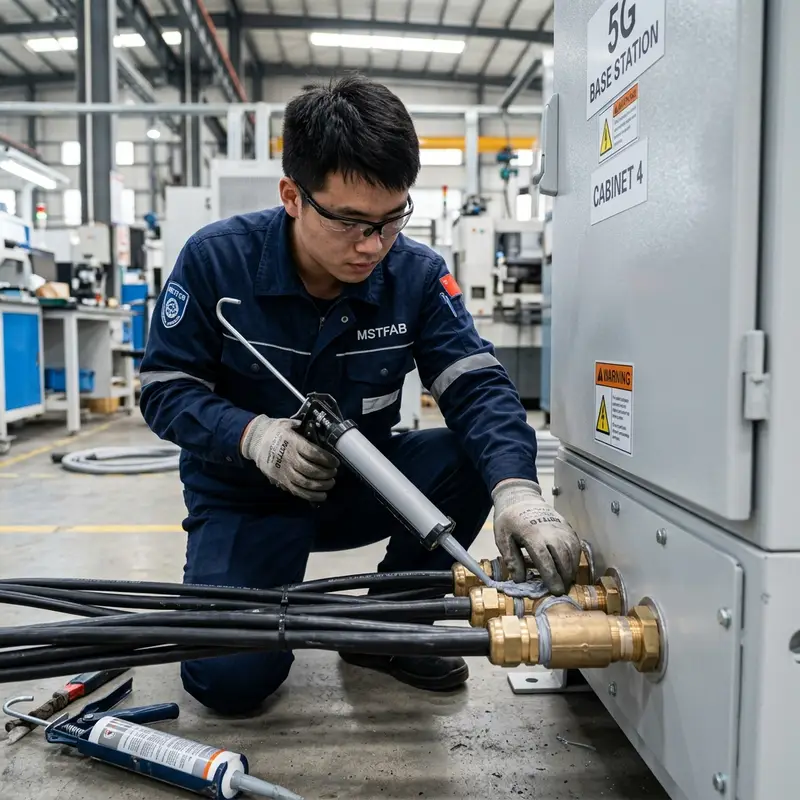
Telecom systems may include fiber optic cables, ethernet cables, power cables, battery cables, antenna cables, grounding cables, and control cables.
Poor cable entry design can cause cable bending stress, difficult installation, water ingress, dust entry, corrosion around cut holes, and ugly field modification.
Custom fabrication can support bottom cable gland plates, removable cable entry panels, rear cable entry plates, side cable openings, cable clamp mounting points, separate power and signal cable routes, fiber routing protection, grounding and bonding areas, and service-friendly access panels.
Cable entry should be planned before fabrication.
Cutting holes into a finished outdoor telecom cabinet is not engineering.
It is corrosion with a deadline.
Ventilation and Thermal Management
Telecom equipment generates heat.
Routers, switches, rectifiers, power supplies, batteries, and edge computing equipment can create serious thermal load.
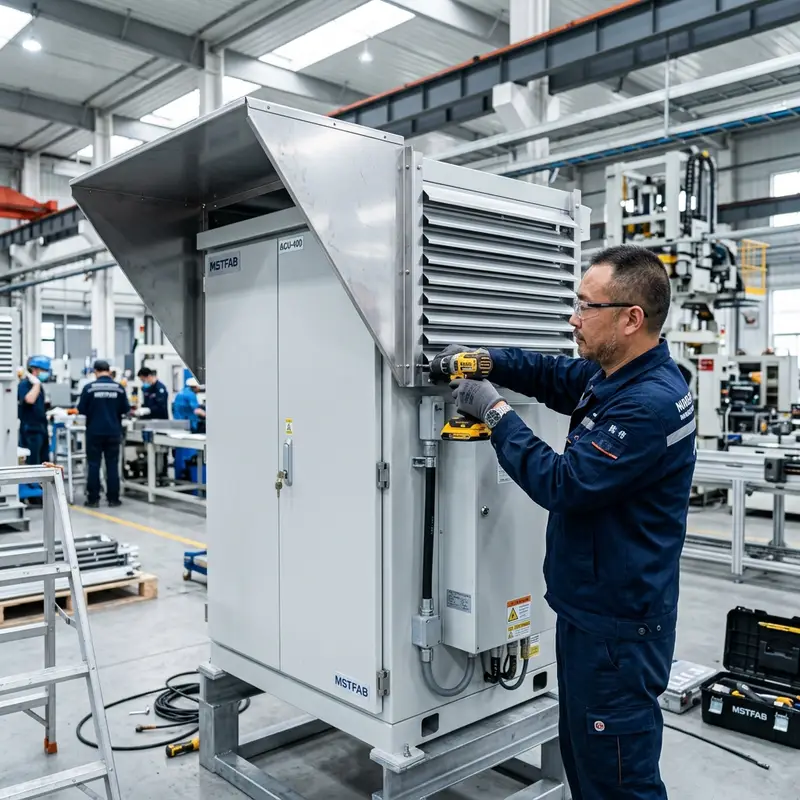
Outdoor telecom enclosures may require ventilation louvers, fan openings, filter frames, air inlet and outlet paths, heat exchanger cutouts, air conditioner mounting openings, internal airflow zones, double-wall sun shield design, clearance around heat-generating components, and removable service panels.
But random holes are not thermal engineering.
They are invitations for rain, dust, insects, and regret.
The enclosure needs to breathe without letting the weather move in.
A telecom enclosure that keeps rain out but cooks the electronics is still a failed enclosure.
Weatherproof Structure
Outdoor telecom enclosures may face rain, snow, dust, UV exposure, humidity, temperature changes, wind, coastal air, industrial pollution, and shipping vibration.
Useful outdoor design details may include sloped top surfaces, rain lips, drip edges, protected door seams, gasketed doors, bottom cable entry, protected ventilation, corrosion-resistant materials, outdoor-grade powder coating, stainless steel hardware, strong locks and hinges, and export packaging protection.
A flat-top outdoor cabinet can become a small swimming pool.
That is not a design feature.
That is how corrosion gets comfortable.
IP and NEMA Design Support
Outdoor telecom enclosures may be designed around protection targets such as:
These are not the same.
A weather-resistant telecom cabinet does not automatically need NEMA 4X.
A sealed cabinet without thermal design may protect against rain while slowly cooking the equipment inside.
A coastal cabinet needs corrosion protection, not just a gasket.
The correct target should be confirmed before quotation.
Important note: fabrication can be designed to support customer IP or NEMA requirements, but formal certification, laboratory testing, or third-party documentation must be confirmed project by project. Do not assume certification.
Material Options
Galvanized Steel
Galvanized steel is commonly used for outdoor or semi-outdoor telecom enclosures because it provides better corrosion resistance than standard cold-rolled steel. Galvanized steel is useful, but it is not magic.
Aluminum
Aluminum is lightweight and naturally corrosion-resistant. Aluminum is useful, but bend radius, welding method, coating adhesion, and galvanic corrosion risks should be reviewed early.
Stainless Steel
Stainless steel is used when corrosion resistance, durability, or premium appearance is important. Common options include SUS304 and SUS316. Stainless steel costs more. Replacing corroded telecom cabinets in the field costs more than that.
Cold-Rolled Steel
Cold-rolled steel can be used for indoor telecom cabinets, rack structures, and powder-coated telecom parts. For outdoor use, it requires proper pretreatment, coating, and edge protection. Raw steel and weather are not friends.
Surface Finishing
Outdoor telecom enclosures often require durable finishing.
Common options include outdoor-grade powder coating, wet painting, brushed stainless steel, stainless steel passivation, anodizing for aluminum, anti-corrosion coating, zinc plating for selected hardware, and silkscreen printing or marking.
For outdoor telecom cabinets, powder coating is not just color.
It is part of the protection system.
A telecom enclosure can be dimensionally correct and still fail if the finish peels, scratches, or rusts too early.
That is not cosmetic drama. That is field reliability.
Welding and Structural Assembly
Outdoor telecom cabinets often require welding for frames, base structures, mounting rails, internal brackets, reinforced doors, and cabinet bodies.
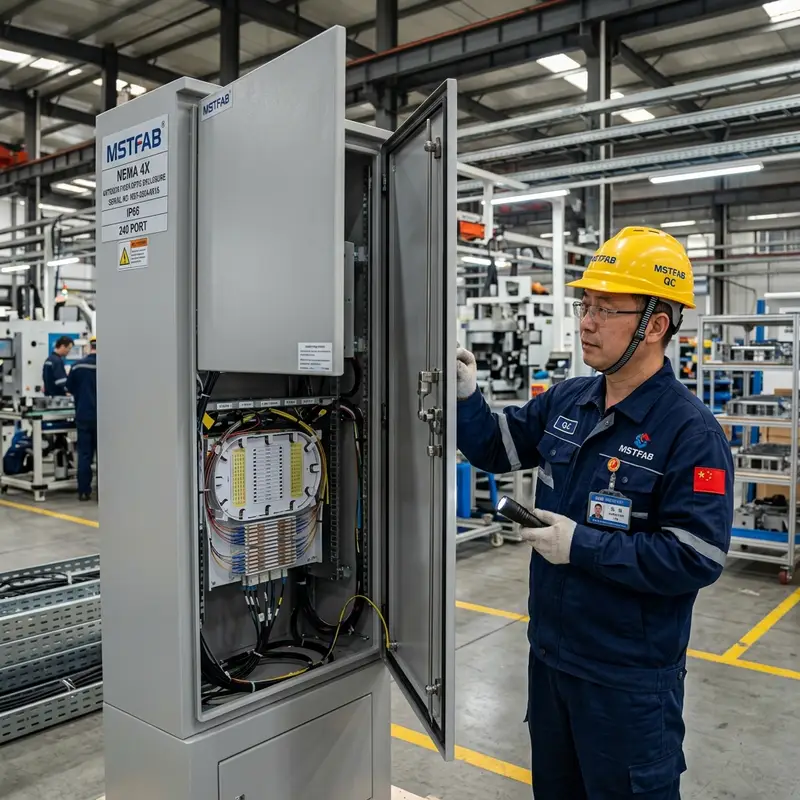
Poor welding can cause warped frames, misaligned doors, poor rack rail alignment, uneven gasket surfaces, visible defects, corrosion traps, and assembly problems.
Welding adds heat. Heat moves metal.
If welding is not controlled, the cabinet may look square in CAD and crooked in real life.
A telecom cabinet should not come out of welding looking like a banana.
19-Inch Rack and Internal Mounting Structure
Many telecom cabinets require 19-inch rack mounting.
Rack accuracy matters because network equipment must slide in, mount cleanly, and remain serviceable.
A telecom cabinet is not just a shell.
It is a precision mounting structure wrapped in sheet metal.
If the rack rails are wrong, everything inside becomes a fight.
DFM Review Before Production
A 3D CAD model can look perfect on screen and still create production problems.
A Design for Manufacturability review helps identify risks before production.
A design issue found before production is a drawing update.
A design issue found after production is a deployment delay, a field service ticket, and a conversation nobody wants to have.
DFM review is not extra paperwork. It is risk control.
Prototype to Batch Production
For outdoor telecom enclosure projects, prototype or first-article production is often useful before batch manufacturing.
For OEM buyers, one good sample is not the finish line. The real goal is stable repeat production.
A sample made with heroic manual correction is not a manufacturing process. It is a magic trick. Magic tricks do not scale.
Quality Control
Quality control should focus on both fabrication accuracy and field-use reliability.
If IP, NEMA, salt spray, coating, or third-party testing is required, that requirement should be stated before quotation.
Export Packaging
Outdoor telecom enclosures are often large, coated, fitted with hardware, and shipped internationally.
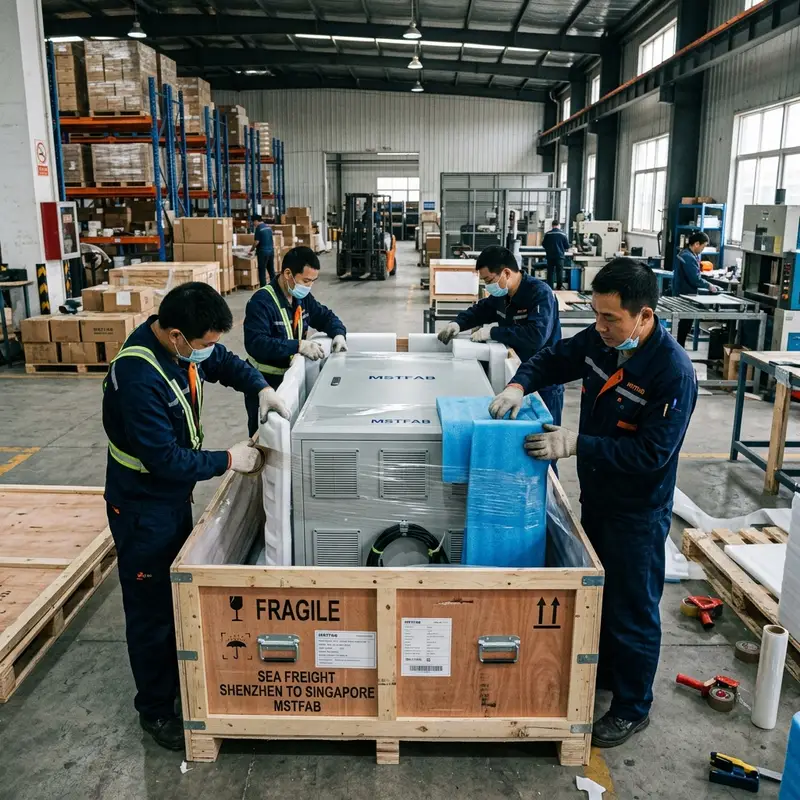
Poor packaging can damage the cabinet before installation.
Good packaging is part of quality control.
A perfectly powder-coated telecom cabinet that arrives scratched is no longer perfect. It is a customer complaint with forklift marks.
Clear Manufacturing Scope and IP Protection
MSTFAB focuses on custom sheet metal fabrication and metal structure manufacturing.
We do not design telecom circuitry.
We do not write network software.
We do not configure routers or switches.
We do not require proprietary network architecture, source code, signal logic, or internal electronic system design.
Our scope is the physical metal cabinet, enclosure, panel, bracket, chassis, frame, or structural component based on customer drawings and project requirements.
This keeps the manufacturing boundary clear and helps protect customer intellectual property.
What to Send for a Quote
To quote outdoor telecom enclosures accurately, please provide:
- 3D STEP file and 2D PDF drawing
- Material requirement and sheet thickness
- Quantity
- Indoor or outdoor application
- Required IP or NEMA design target, if any
- Surface finish requirement (Color, Gloss)
- Rack rail or mounting structure details
- Cable entry, Fiber routing, and Ventilation requirements
- Gasket, Hardware, and Welding notes
- Packaging or shipping requirement
Request an Outdoor Telecom Enclosure Quote
If you need outdoor telecom enclosure fabrication for 5G equipment, network systems, telecom power cabinets, rack structures, battery backup cabinets, fiber equipment, edge computing cabinets, or OEM communication devices, send us your drawings and project requirements.
A good outdoor telecom enclosure should protect the equipment, support clean installation, manage cable routing, control heat, and perform reliably in real deployment.
That starts with clear drawings, practical DFM review, controlled fabrication, and export-ready packaging.
FAQ
What is outdoor telecom enclosure fabrication?
Outdoor telecom enclosure fabrication is the process of manufacturing custom sheet metal cabinets, boxes, doors, panels, rack structures, mounting plates, cable entry plates, brackets, and chassis parts for outdoor communication and network equipment.
What are outdoor telecom enclosures used for?
They are used for 5G equipment, outdoor telecom cabinets, network systems, telecom power cabinets, rectifier cabinets, UPS battery backup cabinets, fiber optic equipment, edge computing systems, and OEM communication devices.
Can outdoor telecom enclosures be customized?
Yes. Size, material, thickness, rack rail position, cable entries, ventilation, doors, locks, hinges, mounting plates, internal brackets, surface finish, and hardware can be customized according to drawings.
What materials are used for outdoor telecom enclosures?
Common materials include galvanized steel, aluminum, stainless steel, cold-rolled steel with protective coating, and coated carbon steel depending on corrosion requirements, weight, strength, application, and budget.
Can you support IP65, IP66, NEMA 3R, or NEMA 4X design requirements?
Yes. Fabrication can be designed to support customer IP or NEMA requirements based on drawings and specifications. If formal testing, certification, or third-party reports are required, the requirement must be confirmed before quotation.
What drawings are needed for quotation?
A 3D STEP file and 2D PDF drawing are recommended. DXF or DWG files can also help with flat laser-cut parts. The drawing package should include material, thickness, rack structure, cable entry, ventilation, surface finish, hardware, and inspection requirements.
Do you provide telecom electronics or network configuration?
No. Our main scope is custom sheet metal fabrication. We manufacture the physical enclosure, cabinet, panel, bracket, chassis, rack structure, mounting plate, and metal parts. Telecom electronics, router configuration, software, circuitry, and internal network systems are outside our standard scope.
MSTFAB Capabilities
- Outdoor Telecom Cabinet Support
- 19-Inch Rack and Cable Entry Design
- Ventilation and Thermal Layout Review
- Steel / Galvanized Steel / Aluminum / Stainless Steel
 WeChat Contact
 WhatsApp Me Directly