Use this page when galvanized steel will also be powder coated
Galvanized plus powder coating can be a strong outdoor solution, but only when pretreatment, masking and coating thickness are controlled. This page narrows the topic to that finish stack.
This page has been separated from the broader powder coated steel fabrication page so Google and buyers can see the job of this article clearly. The useful question here is not “can someone make metal parts?” It is: what should a buyer check before sending drawings, approving a quote or moving into production?
- Confirm pretreatment compatibility for galvanized substrate.
- Mask threads, grounding zones and tight-fit interfaces.
- Control coating thickness around hinges, slots and PEM hardware.
- Check cut edges and welded areas for corrosion exposure.
- Require packing that prevents coated surfaces from rubbing.
| 1 | Confirm pretreatment compatibility for galvanized substrate. |
| 2 | Mask threads, grounding zones and tight-fit interfaces. |
| 3 | Control coating thickness around hinges, slots and PEM hardware. |
| 4 | Check cut edges and welded areas for corrosion exposure. |
| 5 | Require packing that prevents coated surfaces from rubbing. |
Powder Coating Galvanized Sheet Metal: Masking and Adhesion Checklist
Powder coated galvanized steel sheet metal parts are widely used in electrical cabinets, control boxes, telecom equipment, power distribution cabinets, industrial enclosures, mounting plates, brackets, cable entry plates, ventilation panels and OEM metal components.
For high-protection cabinet accessories, see our dedicated solutions for galvanized cable entry plates manufacturer services.
Many brackets require both material protection and coating finish. Read about our dedicated methods for galvanized steel brackets fabrication including grounding masking and thread protection.
Galvanized steel provides zinc-based corrosion protection. Powder coating provides color, surface protection and a more finished appearance. Together, they can be a practical solution for many industrial sheet metal projects.

It needs proper material review, surface cleaning, pretreatment, cut-edge control, grounding protection, thread masking, coating thickness control and packaging protection. A beautiful coating that peels is not a finish. It is a delayed complaint. The real issue is not whether a factory can powder coat galvanized steel — the real issue is whether the coating will adhere properly, whether holes and threads will still work after coating, and whether the final parts will arrive without scratches.
MSTFAB manufactures custom powder coated galvanized steel sheet metal parts from STEP files, STP files, PDF drawings, DXF files, DWG files, assembly drawings and BOMs. We support powder coated SGCC parts, brackets, mounting plates, cabinet panels, cable entry plates, ventilation panels, electrical enclosure parts, power distribution cabinet parts, telecom cabinet parts, network cabinet parts, machine covers, guards, door panels and OEM components.
Why Buyers Choose Powder Coated Galvanized Steel Parts
- Better Protection Than Raw Cold Rolled Steel: Raw steel and moisture are not friends. They are the beginning of a rust story. Galvanized steel adds zinc-based protection before coating. Powder coating adds another finish layer.
- Better Appearance Than Bare Galvanized Steel: Bare galvanized steel may not match visual requirements. Powder coating provides RAL colors, matte/semi-gloss/gloss/texture finishes and brand color matching.
- Practical Cost Control: Powder coated galvanized steel may be more cost-effective than stainless steel for many cabinet, bracket, panel and enclosure components.
- Suitable for Cabinet and Enclosure Parts: Commonly used for electrical enclosure parts, control cabinet panels, mounting plates, cable entry plates, ventilation panels, brackets, door panels, covers and guards.
The Main Buyer Concern: Coating Adhesion
The biggest buyer concern is coating adhesion. Galvanized steel has a zinc-coated surface that may contain oil, passivation layer, oxidation, white rust or other contaminants depending on material storage and processing. If the surface is not prepared correctly, powder coating may peel, bubble, separate or show pinholes.
A powder coated galvanized steel part may look acceptable when it leaves the factory. But if adhesion is poor, the problem may appear later during assembly, shipping or real use. A coating problem is rarely only a coating problem. It usually starts with material condition, cleaning, pretreatment or unclear requirements.
Surface Preparation Before Powder Coating
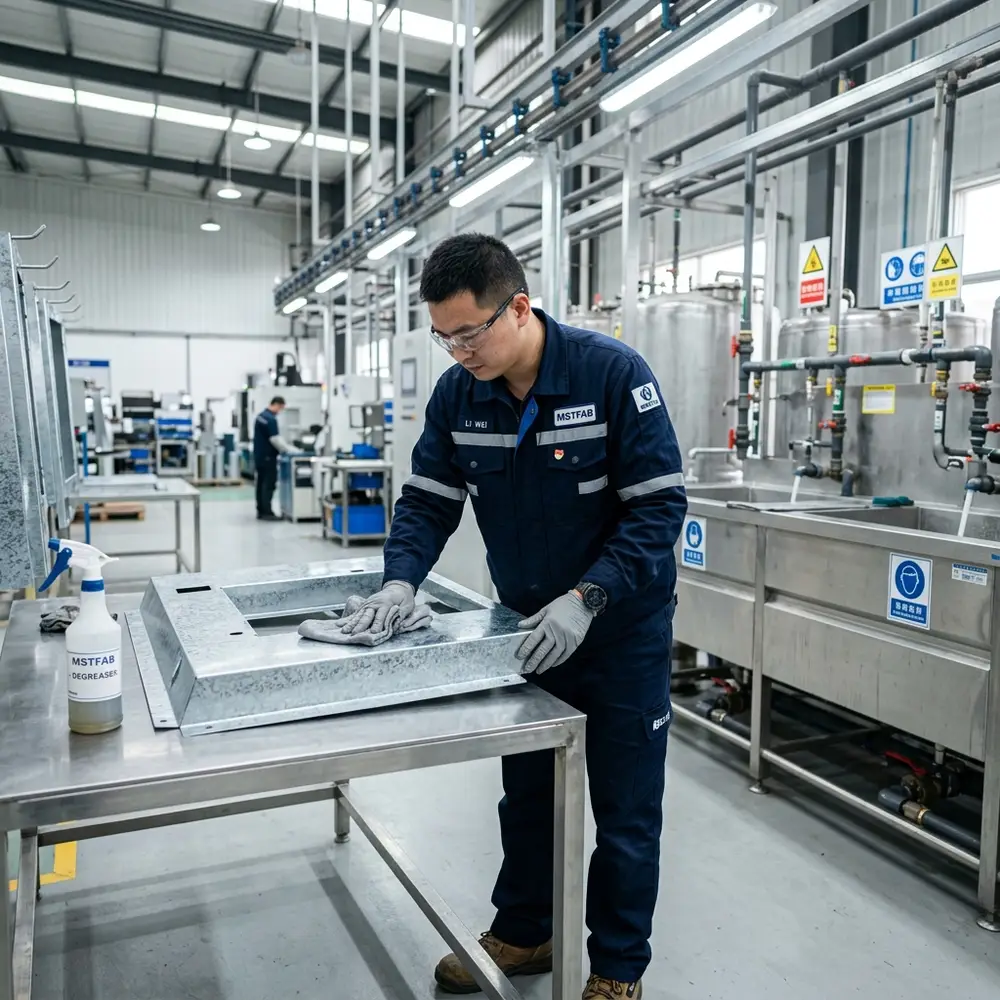
Surface preparation is the foundation of powder coated galvanized steel quality. Before powder coating, the galvanized steel part may require oil removal, dust removal, surface cleaning, proper pretreatment, drying, burr removal, edge smoothing, weld cleanup, masking, thread protection and grounding area protection.
Powder coating cannot fix poor surface preparation. It only covers it for a while. If the surface below the powder is wrong, the final coating may fail later.
Cut Edges Are Still a Risk
Laser cutting, punching, drilling and slot cutting expose steel at the edge. The flat surface of galvanized steel has zinc protection, but the cut edge is different. Cut edges may appear around outer profiles, mounting holes, cable entry holes, ventilation slots, door openings, hinge holes, PEM nut holes and internal cutouts.
For many indoor cabinet parts, this may be acceptable. For outdoor, humid, coastal or corrosive environments, cut-edge protection must be reviewed more carefully. Galvanized steel is useful. It is not magic. Cut edges, holes, bends and weld areas still need manufacturing review.

Welding Galvanized Steel Before Powder Coating
Welding galvanized steel burns or damages the zinc coating near the weld area, creating zinc layer damage, weld fumes, local corrosion risk, surface discoloration, welding spatter and powder coating adhesion risk. Welding adds heat. Heat moves metal. That is physics sending an invoice.
For powder coated galvanized steel welded parts, the buyer and supplier should review whether the best route is: galvanized steel with controlled welding and cleanup, cold rolled steel fabricated first then powder coated, stainless steel for higher corrosion requirements, or aluminum for lightweight applications. A welded part can be strong and still be wrong. Strong but crooked is not engineering. It is a heavy problem.
If steel is too heavy for your portable or outdoor system, consider our capabilities for powder coated aluminum sheet metal parts.
Powder Coating Thickness Can Affect Assembly
Powder coating adds thickness to the surface. This can affect holes, slots, threads, rivet nuts, PEM nuts, hinges, locks, door gaps, cable entries, gasket surfaces, grounding points and assembly contact surfaces.
A hole that fits before coating may become too tight after coating. A threaded insert filled with powder coating is not a finished feature. It is a delayed assembly complaint. A grounding point covered beautifully with powder coating is not useful. It is a decorative problem.
Grounding Areas Must Be Protected
Many galvanized steel parts are used in electrical cabinets, control boxes and power distribution equipment. These parts may need grounding points — grounding studs, grounding holes, conductive contact surfaces and mounting plate contact areas.
Powder coating, paint, oil or contamination can block electrical contact. If the entire part is coated without masking the grounding zone, the part may look beautiful but fail its electrical purpose. A grounding point covered beautifully with powder coating is not useful. It is a decorative problem.

Trust Comparison: Standard Powder Coating Shop vs. MSTFAB Integrated Manufacturing
| Feature | Standard Powder Coating Shop | MSTFAB Integrated Manufacturing |
|---|---|---|
| Surface Preparation | Sprays coating over oily or oxidized galvanized surface; coating peels or blisters within weeks. | Reviews galvanized steel surface condition, oil removal, passivation and pretreatment before coating. |
| Cut-Edge Review | Ignores cut-edge exposure; corrosion starts at laser-cut holes and slots within months. | Reviews cut-edge condition based on application environment; flags coating coverage requirements for critical edges. |
| Grounding Protection | Coats entire part including grounding areas; electrician scrapes coating on site during assembly. | Marks and masks grounding studs, conductive surfaces and no-coating zones before powder coating. |
| Thread Masking | Coats over threaded inserts and PEM nuts; screws do not fit. Assembly team re-taps threads. | Masks threads, PEM nuts, rivet nuts and studs before coating; verifies screw fit after coating. |
| Coating Thickness | Applies inconsistent thickness; doors stick, holes tight, gaskets compress unevenly. | Controls coating thickness; reviews impact on hole fit, door gaps, gasket surfaces and assembly clearance. |
| Weld Zone Prep | Coats directly over weld spatter and zinc damage; coating fails at weld areas first. | Grinds weld zones, removes spatter and cleans zinc-damaged areas before powder coating. |
| Hardware Sequence | Installs hardware after coating; coating builds up in holes, inserts do not seat correctly. | Plans hardware installation sequence relative to coating; controls hole size and insert fit. |
| Export Packaging | Stacks coated parts loose; surfaces scratch during shipping. Corrosion starts at damaged areas. | Uses protective film, foam separation, corner protection and reinforced crates for export packaging. |
Powder Coating SGCC Galvanized Steel

SGCC is a commonly used galvanized steel material in sheet metal fabrication. When SGCC parts require powder coating, the process must address zinc surface oil, passivation layer, pretreatment compatibility, cut-edge exposure, bend zone coating, masking and grounding protection. The value is not just applying color — it is ensuring the coating stays on the part, not on the assembly floor.
CNC Bending and Zinc Layer Review
CNC bending forms galvanized steel blanks into brackets, panels, covers, enclosure bodies and other parts. Bending may affect the zinc-coated surface at the bend area. If the bend radius is too tight, the coating surface may show stress or cracking.
Good bending looks boring. That is exactly why engineers like it. Boring means the holes line up, the panel sits correctly, the door closes and the assembly team does not need a hammer. For powder coated galvanized steel parts, bending must also consider final coating appearance and edge coverage. A bad bend does not become good because it is powder coated. It becomes a coated bad bend.
Indoor vs. Outdoor Use
Powder coated galvanized steel may be suitable for many indoor and semi-exposed industrial applications. For indoor use — control boxes, electrical cabinet panels, mounting plates, brackets, machine covers — focus on clean appearance, assembly fit and basic corrosion protection.
For outdoor use — telecom equipment, outdoor cabinet components, power equipment covers, EV charger enclosure parts — the review must include galvanized material grade, pretreatment, powder coating system, cut-edge exposure, UV resistance, drainage design and coating durability. A standard indoor powder coating should not automatically be used for outdoor parts. Outdoor durability starts with material and pretreatment. Not just powder color.

DFM Review for Powder Coated Galvanized Steel Parts
DFM review for powder coated galvanized steel may check material suitability, SGCC or GI requirement, sheet thickness, zinc coating, laser cutting profile, cut-edge exposure, bend radius, hole-to-bend distance, welding feasibility, powder coating adhesion risk, pretreatment, coating thickness impact, masking areas, grounding points, thread protection, hardware installation, assembly fit, packaging protection and batch repeatability.
A design issue found before cutting and coating is a question. A design issue found after cutting, bending, coating and assembly becomes rework, delay and cost. That is not cost saving. That is cost relocation.
Drawing Requirements for Quotation
For accurate quotation, buyers should provide STEP or STP files, PDF drawings, DXF or DWG files, galvanized steel grade (SGCC or GI), sheet thickness, quantity, powder coating color or RAL code, gloss level, texture, indoor or outdoor application, pretreatment requirement, masking areas, grounding points, thread protection, hardware requirement, welding notes, inspection requirement, packaging requirement and shipping destination.
A STEP file shows the shape. A PDF drawing defines the requirements. A finish note defines coating requirements. A screenshot is not a manufacturing file. A drawing that only says “galvanized steel powder coated” is not enough for accurate quotation.
Why Choose MSTFAB for Powder Coated Galvanized Steel Parts?
- Made to Customer Drawings: We manufacture from STEP files, PDF drawings, DXF/DWG files, assembly drawings and BOMs.
- SGCC and Galvanized Steel Review: We review material, zinc coating, cut-edge exposure, bend feasibility and powder coating risk.
- Laser Cutting and CNC Bending: We support brackets, panels, covers, cabinet parts, mounting plates and OEM components.
- Powder Coating and Masking Review: We review color, texture, gloss, pretreatment, masking, grounding protection, thread protection and assembly clearance.
- Hardware and Assembly Support: We install PEM hardware, rivet nuts, threaded inserts, studs, standoffs, grounding studs, hinges, locks and handles.
- Prototype to Batch: We support sample production, first article review and repeat batch manufacturing.
- Export Packaging: We protect coated surfaces, installed hardware, grounding areas and finished components during shipment.
Request a Powder Coated Galvanized Steel Sheet Metal Quote
Send MSTFAB your drawings and project requirements. We can review SGCC or galvanized material, sheet thickness, zinc coating, powder coating color, pretreatment, masking, grounding, thread protection, hardware, inspection and packaging for your project.
Upload Powder Coated Galvanized Part Drawings →Frequently Asked Questions
Can galvanized steel sheet metal parts be powder coated?
Yes. Galvanized steel parts can be powder coated, but surface cleaning, pretreatment, adhesion review, masking, grounding protection and thread protection should be considered before production.
Why does powder coating on galvanized steel peel?
Peeling may happen because of oil contamination, poor surface cleaning, unsuitable pretreatment, oxidation, passivation layer issues, white rust, poor curing or using the wrong coating process for the application.
What materials are used for powder coated galvanized steel parts?
Common materials include SGCC, GI steel, zinc-coated steel sheet, DX51D galvanized steel and other customer-specified galvanized steel materials.
Are powder coated galvanized steel parts suitable for outdoor use?
It depends on the galvanized material, pretreatment, coating system, cut-edge protection, weld zones and environment. Outdoor, coastal or corrosive applications should be reviewed carefully.
Does laser cutting affect galvanized steel corrosion resistance?
Laser cutting exposes steel at cut edges. The zinc-coated surface helps protect the sheet, but cut edges need review depending on application environment and coating coverage.
Can galvanized steel be welded before powder coating?
It can be welded in some projects, but welding damages the zinc layer around the weld area and requires careful process, safety, cleanup and post-treatment review.
Can powder coating block threads?
Yes. Powder coating can fill threads or affect hardware function if masking and thread protection are not planned. PEM nuts and threaded inserts should be reviewed with coating sequence.
Should grounding areas be masked before powder coating?
Yes, if electrical contact is required. Grounding points, conductive contact surfaces and no-coating areas should be marked clearly on the drawing.
What files are needed for a quote?
The best RFQ includes STEP or STP files, PDF drawings, DXF or DWG files, material grade, thickness, quantity, powder coating color, gloss, texture, masking areas, grounding points, hardware notes, inspection and packaging requirements.
How does powder coated galvanized steel compare to stainless steel?
Powder coated galvanized steel is more cost-effective for many indoor industrial parts. Stainless steel offers stronger inherent corrosion resistance for outdoor, medical or high-humidity applications. The choice depends on application, environment and budget.
MSTFAB manufactures custom sheet metal enclosures, electrical cabinets, control boxes and industrial metal housings for OEM buyers.
 WeChat Contact
 WhatsApp Me Directly