
STEP / STP file upload quote guide
Sheet Metal Fabrication From STEP Files
Yes, MSTFAB can review STEP and STP files for custom sheet metal fabrication quotes. The honest answer is simple: a STEP file shows the shape, but a good quote also needs the manufacturing rules. CAD is great. CAD also has no burrs, no springback, no coating thickness and absolutely no shame.

If you already have a 3D CAD model and want a supplier quote, this page is for you. Many overseas engineers and buyers come to MSTFAB with a STEP file, a rough quantity and a deadline that sounds like it was invented during a meeting. We can start the review from that STEP file, but the cleanest quote comes when the CAD file is supported by clear production details.
For a faster and more accurate RFQ, send your STEP or STP file together with a 2D PDF drawing, material grade, thickness, quantity, tolerance notes, surface finish, welding notes, hardware requirements and packaging needs. If you are not sure what to include, start with our sheet metal fabrication drawing requirements guide.
To convert design files into physical assemblies, partnering with an experienced sheet metal parts manufacturer from CAD drawings guarantees that all tolerances, material selections, and geometries are verified before fabricating.
What a STEP File Helps Us See
A STEP file is a neutral 3D CAD format used to exchange product geometry between CAD systems. For sheet metal fabrication, it is useful because it shows the finished 3D shape instead of leaving everyone to decode a flat drawing like an ancient map.
Good for geometry
STEP files help show formed shape, bend direction, flange relationships, enclosure bodies, cabinet doors, brackets, internal mounting parts and assembly clearances.
Good for DFM review
We can check bend feasibility, hole-to-bend distance, welding access, assembly fit, coating clearance, hardware position and packaging risk before production starts.
STEP files are especially helpful for custom sheet metal enclosures, electrical cabinets, telecom cabinets, network cabinets, EV charger enclosures, battery cabinets, medical equipment housings, machinery covers, machine guards, brackets and welded assemblies.
STEP File vs PDF Drawing: Please Send Both
The STEP file tells us what the part should look like. The PDF drawing tells us how it must be made. When buyers send only a STEP file, quotation often slows down because key production information is missing.
| File | What it tells the factory | Why buyers should care |
|---|---|---|
| STEP / STP | 3D shape, formed geometry, part relationships, assembly position, clearance and design intent. | It helps us understand the real structure faster, especially for bent enclosures and welded assemblies. |
| PDF drawing | Material, thickness, tolerance, bend radius, finish, weld notes, hardware, masking, grounding, inspection and revision control. | It turns a nice-looking model into a controlled manufacturing requirement. |
| DXF / DWG | Flat patterns, cut profiles, slots, holes, cutouts and ventilation patterns. | It helps laser cutting review when the part has many openings or tight profile requirements. |
Can MSTFAB Quote From STEP Files Only?
For early review, yes. For a final production quote, a STEP file alone is usually not enough. We can use the STEP file to review geometry, process route and obvious DFM risks, then ask for the missing information needed for a controlled price.
If you want a quote without five rounds of “please confirm,” send these items:
- STEP or STP file
- 2D PDF drawing with revision number
- DXF or DWG file if flat cutting data is available
- Material grade and sheet thickness
- Prototype quantity and future batch quantity
- General and critical tolerances
- Surface finish, powder coating color, texture or RAL code
- Welding notes, visible weld areas and grinding requirements
- Hardware details such as PEM nuts, studs, rivet nuts, hinges, locks and handles
- Masking areas, grounding points and thread protection
- Packaging requirement and shipping destination if freight is needed
For a deeper RFQ checklist, see custom sheet metal fabrication quote and sheet metal fabrication RFQ supplier.
How MSTFAB Reviews STEP Files
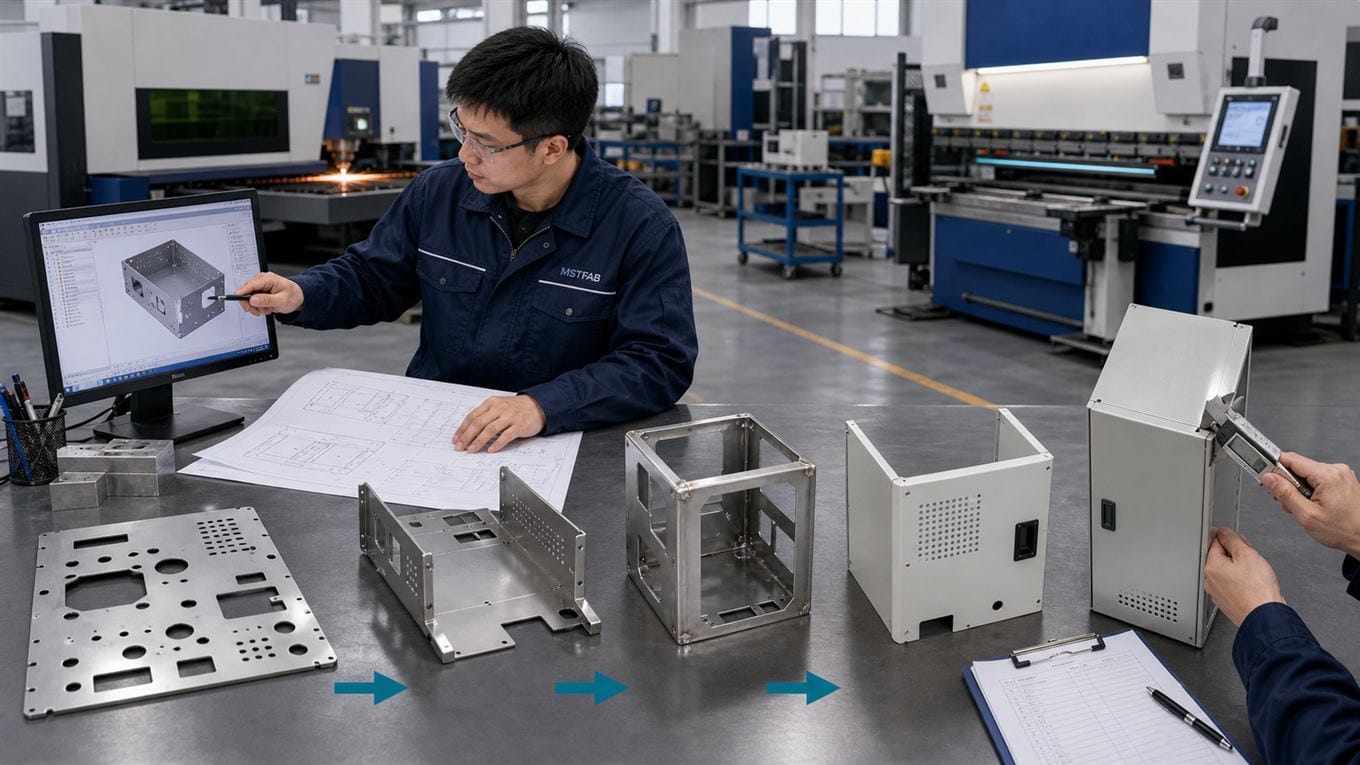
- Open the file and check geometry. We confirm whether the STEP file opens correctly and whether the model is clear enough for review.
- Identify the part type. Bracket, panel, cover, enclosure, cabinet, welded frame, guard or assembly. The process route depends on this.
- Review the fabrication process. We check whether the part may require laser cutting, CNC sheet metal bending, welding, hardware insertion, surface treatment, assembly and packaging.
- Check DFM risks. Short flanges, holes near bend lines, tooling collision, welding distortion, coating build-up and assembly conflict are the usual suspects. They rarely announce themselves politely.
- List missing quotation information. If material, thickness, finish, tolerance or hardware details are missing, we flag them before quoting.
- Prepare a practical quotation. Once scope is clear, the price can reflect real process, material, finish, inspection, packing and quantity.
For DFM details, review DFM for sheet metal fabrication and sheet metal fabrication design for manufacturability.
Trust Table: What MSTFAB Checks Before Quoting
| Buyer concern | What MSTFAB checks | Why it protects your project |
|---|---|---|
| Will the part bend correctly? | Bend direction, flange length, bend radius, hole-to-bend distance and tooling collision risk. | Reduces the chance of parts that look good in CAD but fight the press brake in real life. |
| Will assembly fit? | Mounting positions, door gaps, hardware locations, internal bracket clearance and formed dimensions. | Helps avoid the painful moment when holes are close, but not close enough. |
| Will welding move the part? | Joint access, weld sequence, distortion zones, fixture needs and post-weld inspection points. | Heat moves metal. We prefer to plan for physics before physics sends the bill. |
| Will coating affect dimensions? | Powder coating thickness, masking areas, grounding points, threads, hinges, locks and tight holes. | A hole that fits before coating may become a complaint after coating. |
| Will it ship safely? | Surface protection, sharp edges, export packaging, carton or crate method and inspection photos. | Good parts still need to survive the trip from factory floor to your assembly line. |
Where STEP Files Are Most Useful
STEP files are particularly valuable for projects where the final formed shape matters more than a simple flat profile. Examples include custom sheet metal enclosure fabrication, electrical enclosures, telecom cabinets, network cabinets, EV charger housings, battery cabinets, medical equipment housings, machine guards and machinery sheet metal parts.
For product-style design references, also see sheet metal enclosure design guidelines, sheet metal fabrication design guide and sheet metal fabrication tolerance guide.
Common Reasons STEP File Quotes Get Delayed
- The STEP file does not match the PDF drawing.
- No material or sheet thickness is specified.
- No quantity is provided.
- Surface finish, powder coating color or texture is missing.
- Hardware type, thread size or installation direction is unclear.
- Welding notes and visible surface requirements are not defined.
- Masking and grounding points are not marked.
- Revision control is confusing. Old DXF, new STEP, mystery PDF. That is not a file package; that is a small detective novel.
Prototype vs Batch Production From STEP Files
A prototype is not just a sample. It is the first manufacturing test of the drawing. If a sample only works because someone manually corrected every bend, that is not production. That is a magic trick, and magic tricks do not scale.
For batch production, MSTFAB checks repeatability, approved sample status, critical dimensions, hardware control, powder coating masking, inspection plan and packaging standard. The 200th part should still match the approved version, not just the first heroic sample.
Manufacturing Scope and IP Protection
MSTFAB manufactures physical sheet metal parts according to customer-provided drawings and agreed specifications. We do not need proprietary product logic, software, electrical circuit design, battery system design or control logic unless those details directly affect sheet metal dimensions, mounting, clearance, ventilation, grounding, cable entry or fabrication requirements.
You bring the product design. We build the custom sheet metal parts that support it.
Request a Sheet Metal Fabrication Quote From STEP Files
Send MSTFAB your STEP or STP files for review. For the fastest response, include PDF drawings, material, thickness, tolerance, finish, welding notes, hardware requirements, quantity and packaging needs.
FAQ
Can MSTFAB make sheet metal parts from STEP files?
Yes. MSTFAB can review STEP or STP files for custom sheet metal fabrication, including laser cutting, CNC bending, welding, hardware insertion, powder coating, assembly and packaging.
Is a STEP file enough for a sheet metal fabrication quote?
A STEP file is useful for early review, but accurate quotation usually also needs a PDF drawing, material, thickness, tolerance, finish, quantity, welding notes, hardware details and packaging requirements.
What is the difference between STEP and STP files?
STEP and STP usually refer to the same neutral 3D CAD file format. Both can be used for sheet metal fabrication review.
Why do I need a PDF drawing if I already have a STEP file?
A STEP file shows the 3D shape. A PDF drawing defines material, thickness, tolerances, critical dimensions, surface finish, welding notes, hardware, masking, grounding and inspection requirements.
Can MSTFAB review DFM from STEP files?
Yes. MSTFAB can review bend feasibility, hole-to-bend distance, welding access, hardware placement, coating clearance, assembly fit and packaging risk from STEP files and related drawings.
Meet the team behind the quote: If you want to know who reviews drawings, coordinates DFM questions, follows procurement details and communicates with overseas buyers, visit the MSTFAB sheet metal fabrication team.
MSTFAB provides TIG and MIG sheet metal welding services for structural assemblies, cabinets, frames and OEM metal components.
 WeChat Contact
 WhatsApp Me Directly