
Buyer guide: This guide explains the design, process, and quality checks OEM buyers should confirm before requesting production pricing for custom sheet metal parts.
Precision Custom Sheet Metal Parts Sourcing for OEM and Industrial Buyers
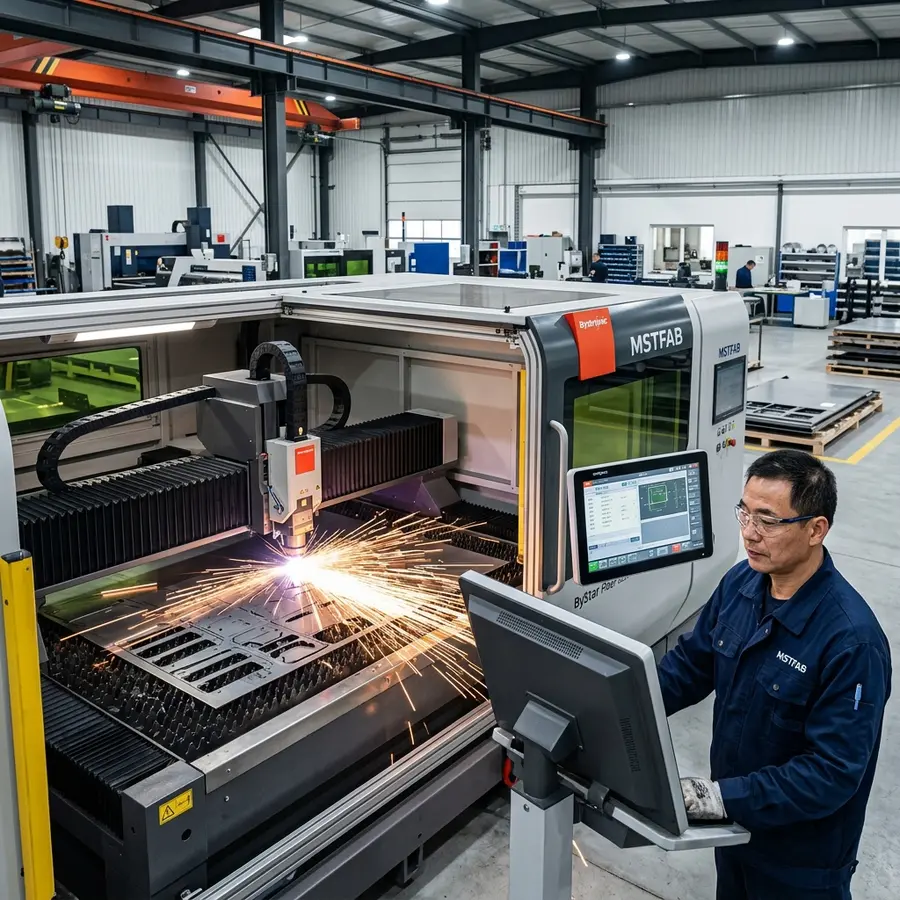
Sourcing parts from a custom sheet metal parts manufacturer is not just about finding a workshop with standard laser cutters and bending presses. Real manufacturing requires deep Design for Manufacturability (DFM) alignment, strict tolerance compliance, durable surface finishes, and batch-to-batch repeatability. MSTFAB is an OEM custom sheet metal manufacturer based in Guangzhou, China. We help industrial buyers turn 3D CAD designs into functional enclosures, brackets, covers, panels, and welded assemblies.
We work directly from customer-provided 3D STEP files, 2D PDF blueprints, and DXF patterns to support projects requiring:
- High-accuracy fiber laser cutting (flat profiling and hole blanking)
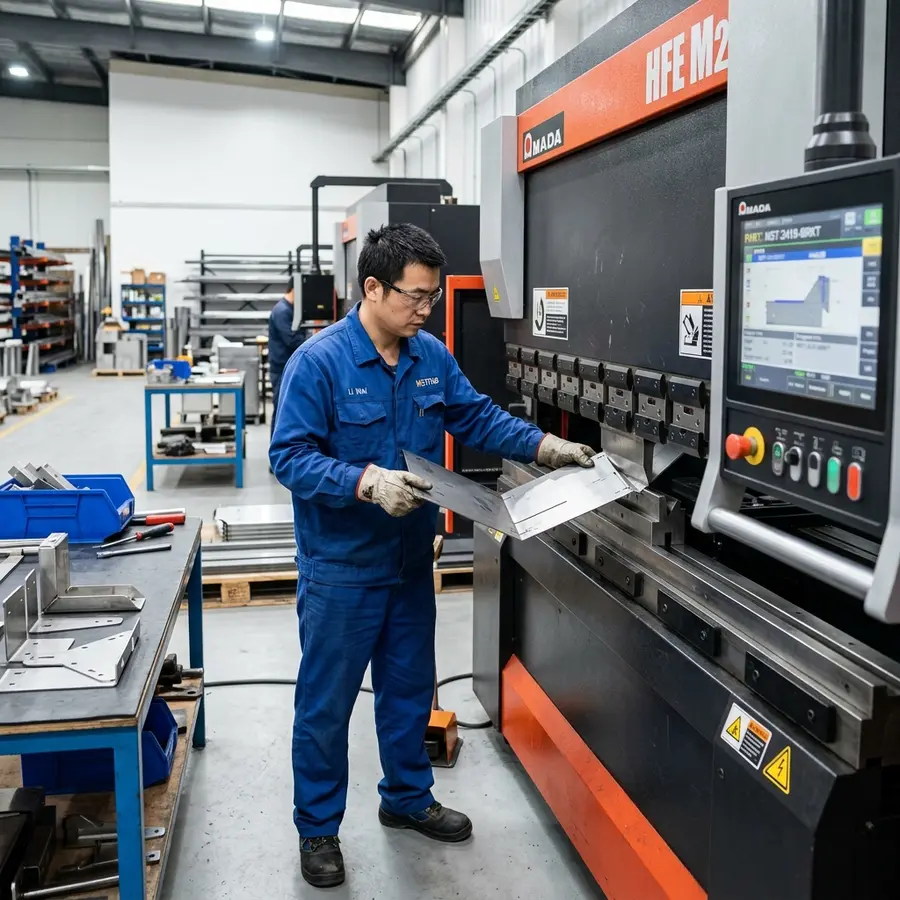
- CNC press brake bending (multi-stage formed profiles and brackets)
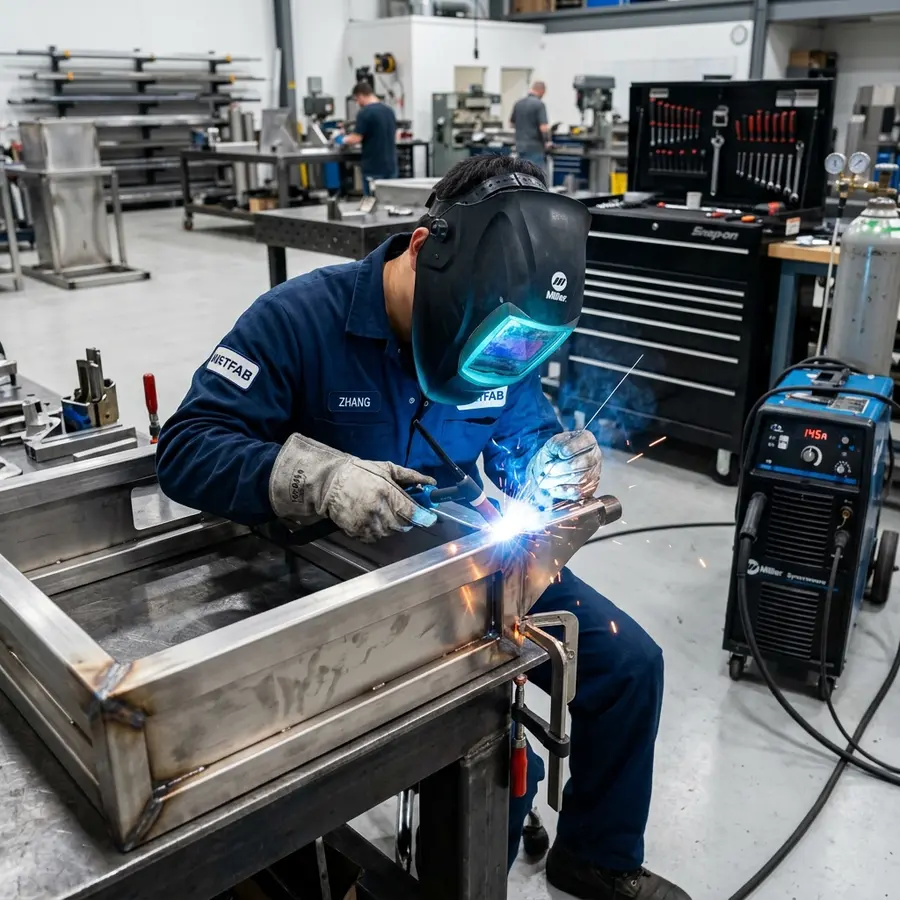
- Structural and cosmetic welding (TIG, MIG, and spot welding)
- Self-clinching hardware insertion (PEM nuts, studs, standoffs, and rivet nuts)
- Advanced surface finishing (multi-stage powder coating, wet painting, and anodizing)
- Cosmetic stainless steel finishing (brushed #4 finish, electropolishing, and passivation)
- Mechanical assembly, hardware installation, and test-fitting
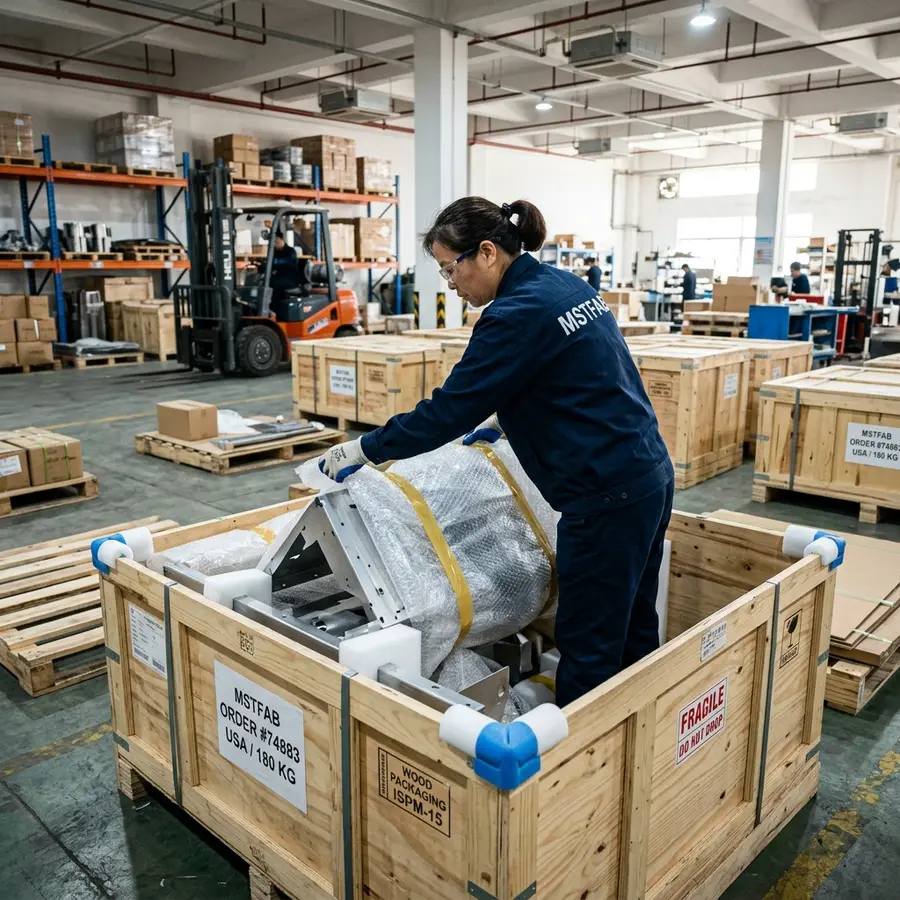
- Heavy-duty export packaging (custom foam casing and wooden crates)
Whether you need a dedicated partner for low-volume enclosures, a reliable supplier to manage mass production, or an ISO 9001-certified factory to handle your recurring orders, choosing a supplier that actively manages the transition from prototype to batch production ensures your drawing requirements translate perfectly onto the factory floor.
What Custom Sheet Metal Parts Can We Manufacture?
We supply custom fabricated parts for a wide range of industries including industrial automation, electrical, telecommunications, EV charging infrastructure, battery storage systems, agricultural machinery, medical devices, and heavy equipment. Common components include:
- Electrical & Electronics: Custom sheet metal enclosures, control boxes, terminal boxes, and internal mounting plates.
- Cabinets & Consoles: Telecom rack cabinets, network cabinets, power distribution consoles, and modular equipment rack frames.
- Brackets & Structural Elements: Heavy-duty mounting brackets, sensor brackets, adapter plates, reinforcement gussets, and base plates.
- Guards & Machinery Covers: Removable machine guards, belt guards, chain guards, ventilated motor shrouds, and access panels.
- Panels & Cable Plates: Cable entry plates, ventilation grilles, control faceplates, rack panels, and cosmetic fascia panels.
- Welded Assemblies: Structural sheet metal frames, hopper assemblies, chutes, and custom sheet metal cabinets.
A custom sheet metal part may seem simple. However, if the bend angles deviate, mounting holes drift out of alignment, welded joints warp the assembly, or powder coating clogs internal threads, the part becomes unusable. Working with a dedicated manufacturing partner ensures that all dimensions fit seamlessly in your final assembly line.
Engineering and DFM Review Before Production
Design for Manufacturability (DFM) is the foundation of high-yield sheet metal fabrication. When you send your project files for an RFQ, a proper technical evaluation must check physical material properties, bending clearances, and tooling limits rather than just executing automated quotes. Before we begin cutting, our engineers perform a complete DFM audit to ensure that designs can be fabricated repeatedly without warping, cracking, or dimensional drift.
Key DFM Review Parameters for Sheet Metal Parts
- Minimum Bend Radius (R): The bend radius should ideally match or exceed the sheet metal thickness (R ≥ T). For harder materials like aluminum 6061-T6, the radius must be larger (often R ≥ 1.5T to 2.0T) to prevent tensile cracking on the outer bend radius.
- Minimum Flange Height (H): To ensure the sheet metal registers securely against the press brake backgauge and wraps correctly around the die, the minimum flange height must satisfy the formula:
- Hole-to-Bend Distance (X): Placing holes too close to a bend line causes the holes to stretch into ellipses. To prevent distortion, holes must be placed outside the bending deformation zone:
- Laser Cut Kerf & Minimum Feature Size: The minimum hole diameter should never be less than the material thickness (D ≥ T) to avoid taper distortion and excessive dross buildup, especially when cutting stainless steel or thick carbon steel.
For more detailed design guidelines, please refer to our sheet metal bending design guidelines. Proactive engineering saves time and cost, ensuring that prototypes are validated correctly before starting batch production.
Advanced Bending, Welding, and Hardware Feasibility
CNC Bending and Springback Control
Forming sheet metal is more than applying pressure. Each metal grade has unique springback characteristics. Standard mild steel may spring back by 1° to 2°, while stainless steel and high-temper aluminum can spring back by up to 5° or 10° depending on the thickness and bend radius. To maintain tight linear and angular tolerances, our shop uses multi-axis CNC press brakes. These machines actively compensate for material deflection, ensuring that flange angles remain consistent across long parts.
Cosmetic and Structural Welding (TIG vs. MIG)
Welding introduces localized heat, which causes thermal expansion and subsequent contraction. If not managed, this creates warping, twisting, and loss of squareness. We utilize modular welding fixtures and tables to clamp parts securely. For cosmetic enclosures and thin-gauge brackets, we use TIG (GTAW) welding. TIG offers precise heat control, yielding narrow weld beads that require minimal grinding. For structural frames and thick-gauge brackets, MIG (GMAW) welding provides the depth of penetration required for mechanical strength. All external welds on visible enclosures are ground flush and polished to create seamless corners post-powder coating.
Pneumatic Hardware Insertion
We install a variety of self-clinching fasteners, including PEM nuts, studs, standoffs, and rivet nuts. PEM hardware relies on cold-flow displacement: the host metal flows into the fastener’s undercut groove, locking it in place against torque and push-out forces. To prevent failure, we control:
- Hole Size Tolerances: Laser cut holes for hardware must be cut within +0.08mm / -0.00mm. Holes that are too large fail to retain the fastener, while holes that are too small prevent seating.
- Placement Clearance: Fasteners must be positioned far enough from bend lines to avoid deformation during hardware insertion.
- Installation Force: Using pneumatic press machines rather than manual hammering ensures even force application, preventing panel distortion.
Advanced Surface Finishing and Chemical Pretreatment
Applying powder coating directly to raw, untreated metal is a common shortcut that leads to premature peeling and rust. Without chemical pretreatment, grease, mill scale, and cutting oils prevent the powder from adhering to the substrate.
To guarantee long-term adhesion and corrosion resistance (especially for outdoor EV charger housings and telecom cabinets), MSTFAB implements a multi-stage pretreatment process:
- Alkaline Degreasing: Hot chemical wash to remove surface oils, rust preventatives, and lubricants.
- Clean Water Rinse: Multiple washes to neutralize alkaline residues.
- Surface Conditioning & Phosphate Conversion Coating: Creates a micro-crystalline phosphate layer (for steel) or chromate conversion layer (for aluminum) that chemically binds the powder coat to the metal.
- Final Deionized Water Rinse & Dry-Off: Ensures no salt or mineral deposits remain on the parts before paint application.
After pretreatment, the parts are coated electrostatically with polyester or epoxy powder and cured in a convection oven at 180°C to 200°C. For threads and grounding studs, we apply high-temperature silicone masking caps to keep contact points conductive and threads clean.
Quality Control and Metrology
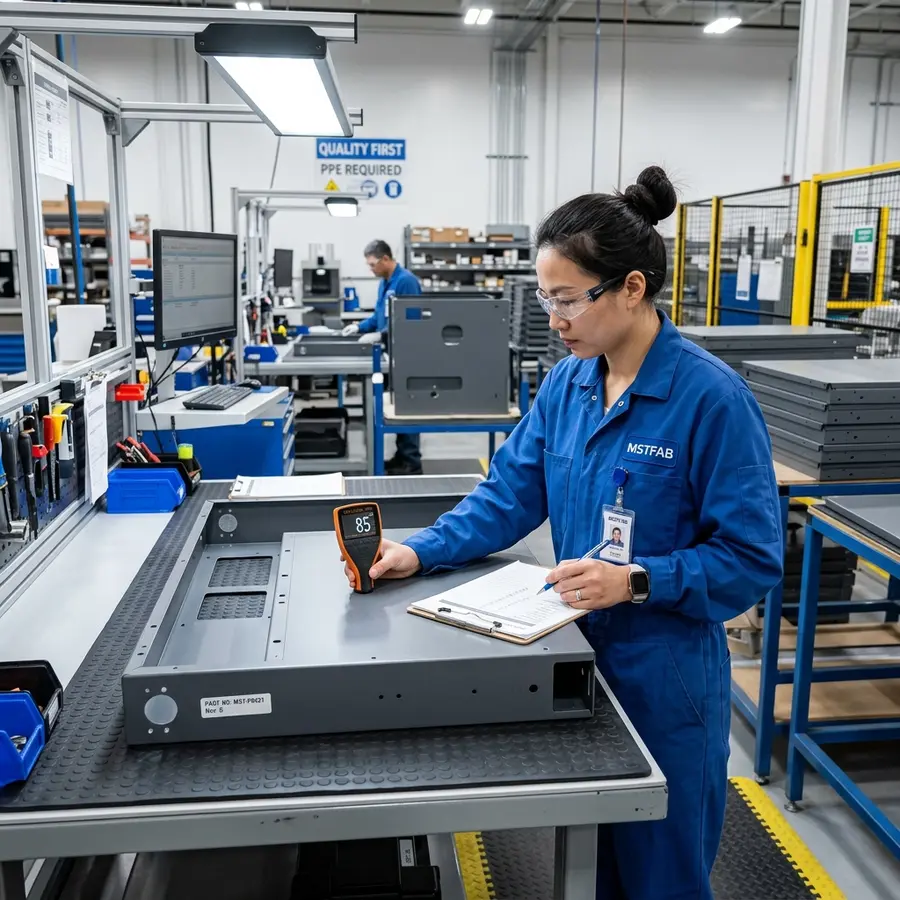
Quality inspection is not just a visual check before packing. At MSTFAB, dimensional control and finish testing are integrated into every stage of production. For precision custom parts, we offer complete quality documentation, including first article inspection (FAI) reports and Material Test Reports (MTR). We run inspections as an ISO certified sheet metal fabrication company.
Our quality verification processes include:
- Dimensional Inspection: Verification of laser cutout diameters, slot lengths, bend dimensions, and overall assembly squareness against specified drawings. We adhere to standard tolerance classes (e.g., ISO 2768-m or ISO 2768-f). For details, check our sheet metal fabrication tolerance guide.
- Coating Thickness Measurement: Using digital dry-film thickness (DFT) gauges to verify that coating thickness meets specification (typically 60µm – 100µm).
- Cross-Hatch Adhesion Testing: Executing ASTM D3359 cross-hatch tape tests on sample coupons to verify the powder coat adhesion quality.
- Assembly and Thread Checks: Thread go/no-go gauge checks for all PEM inserts, and mechanical test-fitting of doors, hinges, and lock hardware on cabinets.
Export Packaging for Custom Sheet Metal Parts
Even a perfectly fabricated custom sheet metal part can be ruined by improper packaging. During long-distance sea freight and domestic transport, parts are subjected to vibrations, stacking forces, moisture, and rough handling.
We treat packaging as a critical production step. Depending on part geometry and weight, we employ:
- Individual protective PE film wrapping for cosmetic stainless steel and aluminum panels.
- Thick custom EPE foam corners and edge protectors to absorb transport shocks.
- Heavy-duty double-walled corrugated cartons for brackets and smaller panels.
- Vacuum-sealed moisture-barrier bags with desiccant packs for carbon steel parts to prevent rust during transit.
- Fully enclosed, heat-treated wooden crates with internal timber bracing to prevent shifting.
As an experienced export sheet metal fabrication factory, we ensure custom parts are shipped in container-ready, forklift-friendly packaging.
Sourcing Comparison Matrix: Red Flag Factory vs. Reliable Partner
Before selecting a sheet metal job shop or sending out your RFQ, evaluate your manufacturer against this comparison table:
| Evaluation Parameter | Red Flag Factory | Reliable Partner (Like MSTFAB) |
|---|---|---|
| RFQ & Design Review | Automated quotes in minutes based on 3D geometry alone, without checking 2D tolerances. | Conducts formal DFM review, requests 2D drawings for critical features, and checks application environment. |
| Bending & Tooling | Bends components using worn tooling, resulting in radius cracks and angular variation. | Uses multi-axis CNC press brakes with automated deflection compensation for precise bending. |
| Welding distortion control | Welds without fixtures, causing heat warping and misaligned assembly joints. | Uses dedicated welding jigs and back-step welding techniques to minimize heat distortion. |
| Powder Coating Prep | Applies powder coat directly to oily raw steel. Paint peels off in sheets under impact. | Multi-stage alkaline degreasing and phosphate conversion coating for long-term paint adhesion. |
| Hardware Control | Manually presses PEM inserts, leading to loose threads and misaligned standoffs. | Pneumatic press insertion with strict hole tolerance checks to guarantee torque performance. |
| Quality Inspection | Visual checks only before packing. No metrology reports or FAI documents. | Full FAI reports, dry-film thickness checking, thread go/no-go verification, and test-fitting. |
| Export Packaging | Tosses heavy metal parts loosely into thin cardboard boxes. Parts arrive scratched or dented. | Corrosion-proof packaging with custom foam inserts, edge protectors, and solid wooden crates. |
Verified Engineering Standards & Regulatory References:
- ISO 9001:2015 Quality Management Systems – International requirements for precision manufacturing and quality assurance.
- ASTM B209 Standard Specification for Aluminum Sheet and Plate – Material specifications for 5052 and 6061 aluminum sheet metal.
- ASTM A240 Stainless Steel Sheet and Strip – Composition and mechanical tolerances for 304 and 316 stainless fabrication.
- AWS D1.1 Structural Welding Code – Steel – American Welding Society fabrication quality standards.
Request a Custom Sheet Metal Fabrication Quote
Need custom sheet metal parts fabricated to exact specifications? Submit your 3D STEP files and 2D PDF drawings to our team. We will complete a manufacturability review and provide an itemized fabrication quote.
FAQ: Sourcing Custom Sheet Metal Parts
What files do sheet metal manufacturers prefer for a quote?
You should always submit a 3D STEP file alongside a 2D PDF technical drawing. The 3D model communicates overall geometry, while the 2D PDF drawing defines tolerances, thread specifications, material grades, surface finishes, and inspection criteria.
How do I know if a factory can achieve my tolerance requirements?
Verify that the factory utilizes CNC press brakes and fiber lasers rather than manual machines, and ask them to confirm their standard tolerance class. A professional factory can easily hold ±0.1mm to ±0.2mm on laser cutting and ±0.3mm to ±0.5mm on formed dimensions. Tighter tolerances should be clearly highlighted on the 2D drawing.
Why is TIG welding preferred over MIG welding for cosmetic enclosures?
TIG welding (GTAW) allows the welder to control the heat input and weld pool independently, resulting in cleaner, flatter beads. This reduces the risk of warping thin sheet metal panels and requires less grinding and polishing, ensuring seamless corners after painting.
What is the most common mistake buyers make when sending an RFQ?
The most common mistake is failing to specify the operating environment (indoor vs. outdoor) and cosmetic surface requirements. An outdoor cabinet requires corrosion-resistant substrates (such as galvanized steel, aluminum, or stainless steel), stainless steel hardware, and UV-resistant powder coating.
sheet metal welding services
MSTFAB provides TIG and MIG sheet metal welding services for structural assemblies, cabinets, frames and OEM metal components.
 WeChat Contact
 WhatsApp Me Directly