
Push Button Enclosure Design: Start With the Operator Drawing
For an empty sheet metal push button box, define the selected operator model, mounting cutout, permissible panel thickness, behind-panel depth, cable entry and cover access. Nominal 22 mm or 30 mm labels are not fabrication instructions. Use the device manufacturer’s mounting drawing, then agree tolerances, finish and inspection for the completed metal shell.
- Cutout and anti-rotation: Transfer the specified opening, keyway, orientation and panel-thickness limits from the selected operator drawing.
- Spacing and depth: Check legend plates, guards, contact blocks, terminals, cable bends and service access in the actual arrangement.
- Sealing and responsibility: Agree the cover, weld, gasket and grounding interfaces. The OEM validates the installed electrical controls and complete equipment.
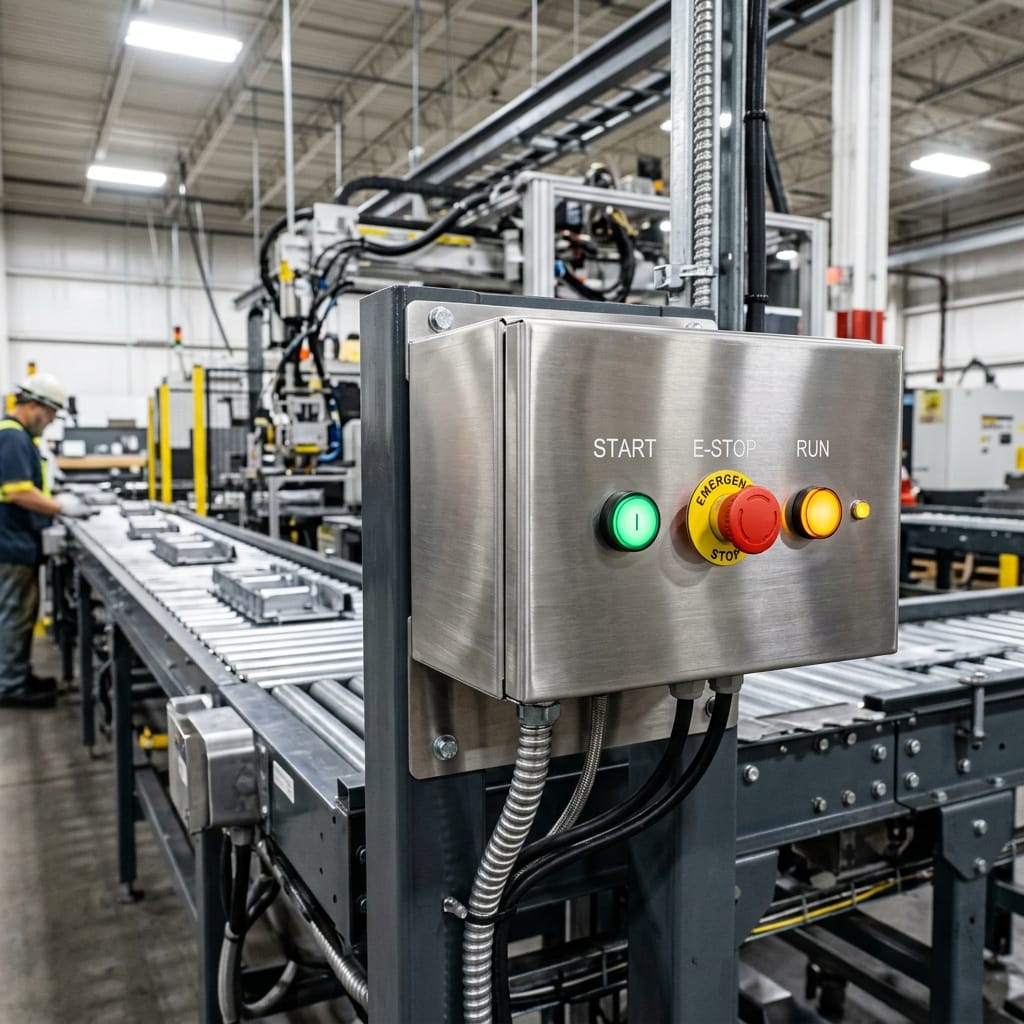
Push button enclosures are critical protective housings in industrial control systems. Sourcing custom sheet metal enclosure fabrication ensures these enclosures safeguard control buttons, emergency stops, selector switches, indicator lights, and operator interface components against dust, moisture, impact, vibration, and accidental contact in demanding factory environments.
For OEM equipment manufacturers and industrial system integrators, a push button enclosure is far more than a simple metal box. It must deliver dimensional accuracy for component fit, structural rigidity for daily operation, proper sealing for environmental protection, and clean mounting geometry for efficient field installation. Designing the enclosure structure with a detailed sheet metal fabrication design for manufacturability review ensures that all features are compatible with physical manufacturing tooling.
MSTFAB — Guangzhou Maisituo Sheet Metal Manufacturing Co., Ltd. — provides custom sheet metal fabrication for industrial push button enclosures. We manufacture to customer drawings, physical samples, or engineering specifications, supporting OEM production. We specialize in sheet metal fabrication for electrical enclosures and sheet metal fabrication for control cabinets, supporting custom control panels, operator stations, machine switch boxes, and emergency stop enclosures.
Need production capability? This guide covers operator cutouts, clearance and mechanical design checks. For manufacturing scope, process capability and drawing-based quotation support, review MSTFAB’s push button enclosure fabrication.
What Is a Push Button Enclosure?
A push button enclosure is a protective metal housing designed to mount and shield industrial control components. These enclosures are found throughout manufacturing, process control, and infrastructure systems wherever operators need direct physical interaction with electrical controls.
Common applications include:
- Industrial machinery start/stop control stations
- Conveyor system control panels
- CNC machine operator interfaces
- Emergency stop (E-stop) stations
- Production line control boxes
- Outdoor equipment control stations
- Automation equipment HMI panels
- Electrical distribution control points
Depending on the application, push button enclosures may incorporate single or multiple button cutouts, cable gland entries, DIN rail mounting, hinged or removable covers, lockable doors, gasket sealing, and custom surface finishes.
Why Custom Fabrication Outperforms Standard Enclosures
Off-the-shelf push button boxes serve basic requirements, but most OEM and industrial integration projects demand custom dimensions, proprietary mounting structures, and application-specific hole patterns that standard products cannot accommodate.
Custom push button enclosure fabrication solves these engineering constraints:
- Component fit — Match the selected operator mounting drawing, including the opening, tolerance, keyway and permissible panel thickness
- Wiring layout — Cable entry positions must align with conduit routing and gland specifications
- Machine integration — Mounting holes must match existing equipment bolt patterns and structural members
- Internal clearance — Enclosure depth must accommodate component back-length, terminal blocks, and wire bending radius
- Environmental protection — Outdoor or washdown environments may require IP65/IP66 gasket sealing design
- Brand consistency — OEM equipment manufacturers need consistent color, labeling, and finish across product lines

Material Selection for Push Button Enclosures
Material choice directly impacts corrosion resistance, mechanical strength, weight, surface finish quality, and total cost. MSTFAB reviews the deployment environment, IP requirements, and finish specifications before recommending material grade and thickness.
| Material | Typical Thickness | Best Application | Corrosion Resistance | Cost Level |
|---|---|---|---|---|
| SUS304 Stainless Steel | 1.0 – 2.0mm | Food processing, pharmaceutical, outdoor, washdown environments | Excellent | Higher |
| SUS316 Stainless Steel | 1.0 – 2.0mm | Marine, coastal, chemical exposure environments | Superior (chloride-resistant) | Highest |
| SPCC Carbon Steel | 1.0 – 2.0mm | Indoor industrial control stations, cost-sensitive projects | Requires powder coating | Lowest |
| SECC Galvanized Steel | 1.0 – 1.5mm | Semi-outdoor, industrial environments with moderate humidity | Good (zinc layer) | Low-Medium |
| AL5052 Aluminum | 1.5 – 3.0mm | Lightweight equipment panels, portable control boxes | Good (anodizable) | Medium |
Manufacturing Process: From Sheet Metal to Finished Enclosure
Every push button enclosure passes through a controlled fabrication sequence. Sourcing from a reliable custom sheet metal parts manufacturer ensures that each process step directly affects dimensional accuracy, assembly fit, surface quality, and long-term field reliability.
Laser Cutting
Fiber laser cutting produces button cutouts, cable gland openings, ventilation slots, mounting holes, and panel profiles. For nominal 22 mm or 30 mm operators, use the selected device’s mounting drawing to specify the actual cutout and any anti-rotation feature. The approved route must define cut-edge condition, burr removal, and any secondary hole finishing needed for component fit.
CNC Bending
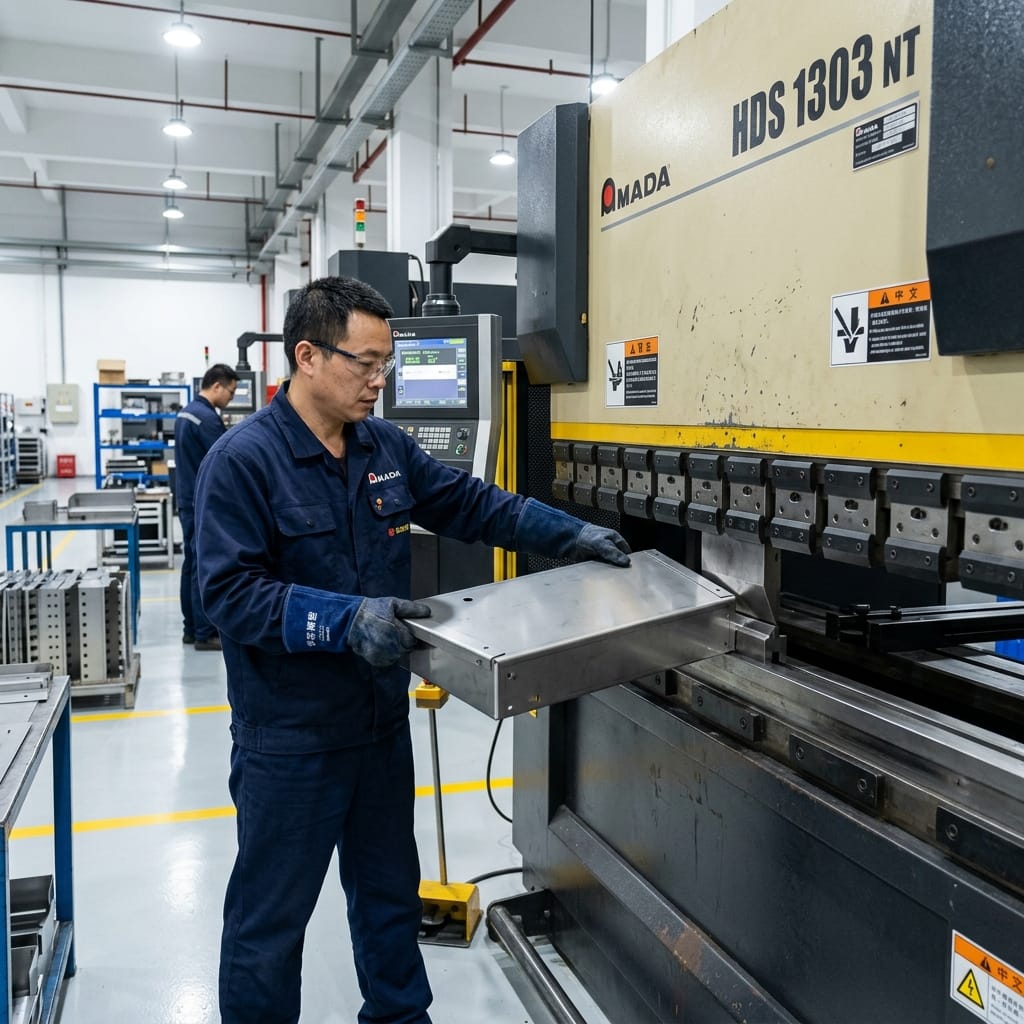
CNC press brake forming shapes the enclosure body, covers, side panels, and mounting flanges. Combining advanced sheet metal laser cutting and bending services optimizes forming precision. Bend angles and formed dimensions are checked against the agreed drawing and mating interfaces. Confirm the acceptance condition rather than assuming one tolerance fits every enclosure.
Welding
TIG or MIG welding is applied for reinforced joints, mounting brackets, hinge bases, and structural reinforcement. We offer high-quality welded sheet metal fabrication services and complete sheet metal welding and finishing services. Post-weld grinding and polishing restore surface continuity on visible faces.
Surface Finishing
Surface treatment options include powder coating (RAL color system), wet painting, brushed finish, mirror polishing, hot-dip galvanizing, and anodizing. Sourcing professional sheet metal fabrication with powder coating ensures that for industrial environments, the finish provides the best combination of durability, UV resistance, and color consistency.

Assembly and Hardware Installation
Mechanical assembly includes hinges, cam locks, captive screws, gasket strips, DIN rail mounting, internal mounting plates, cable glands, and labeling. We provide complete sheet metal fabrication and assembly services to ensure every hardware component is verified for fit and function before packaging.
Quality Control and Inspection
For industrial push button enclosures, dimensional accuracy and surface quality directly impact installation efficiency and end-user experience. Performing a detailed dfm for sheet metal fabrication review and following a strict sheet metal fabrication design guide ensures that parts are repeatable. MSTFAB applies systematic inspection at every fabrication stage.
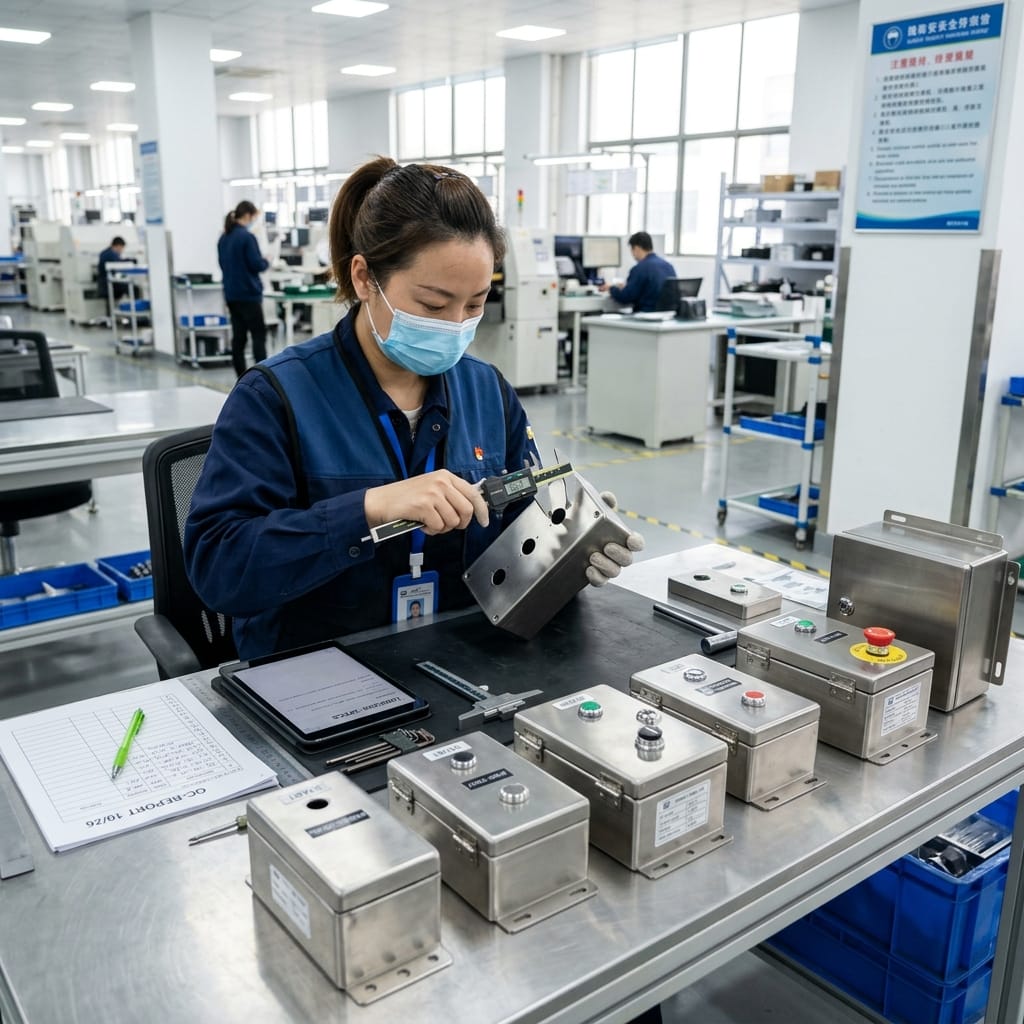
Quality checkpoints include:
- Incoming material certificate verification (mill certs)
- Laser cutting dimensional inspection (hole diameter, position, kerf quality)
- Bend-angle and formed-dimension checks to the agreed drawing
- Weld quality visual and dimensional inspection
- Surface finish thickness testing (coating gauge)
- Assembly fit verification (component insertion test)
- Final dimensional report with photos
- Packaging integrity check before shipment
When specified in the order, first-article inspection records the agreed dimensions and fit checks before batch approval. Define report content, sampling and approval responsibility in advance.
Custom Design Options
Push button enclosures can be engineered for virtually any industrial control application. Common customization parameters include:
- Single-button, multi-button, or custom operator panel layout
- Emergency stop (E-stop) mushroom button cutout with guard ring
- Selector switch and indicator light openings
- Cable gland plates with M20/M25/M32 knockouts
- DIN rail or internal mounting plate support
- Wall-mount, pole-mount, or machine-mount bracket design
- Hinged cover with 90° or 120° opening angle
- Quarter-turn cam lock or padlock hasp
- Continuous gasket groove for IP65/IP66 sealing
- Custom RAL color powder coating
- Laser engraving, silk-screen, or UV printing for labeling
Customers can provide 2D drawings (PDF/DWG/DXF), 3D STEP/STP files, physical samples, or reference photos for engineering review and quotation.
Export Packaging and Shipping
Push button enclosures require careful packaging to protect powder coating, hardware, and dimensional integrity during international transportation.

MSTFAB provides export-grade packaging including individual PE film wrapping, foam cushioning, corner guards, reinforced cartons, and wooden crates for heavy or oversized enclosures. Agree packing identification and any required certificates or inspection records before order placement.
Applications
Custom push button enclosures serve a wide range of industrial control and automation applications:
- Machine tool start/stop control stations
- Conveyor system operator panels
- Housings for OEM-defined emergency-stop stations; machine safety validation remains with the integrator
- Industrial automation HMI enclosures
- Electrical distribution control points
- Production line equipment interfaces
- Outdoor infrastructure control boxes
- Packaging machinery operator stations
Enclosures can function as standalone control boxes or integrate into larger custom sheet metal enclosures, electrical enclosures, or industrial equipment housings. We specialize in sheet metal fabrication for telecom cabinets and sheet metal fabrication for network cabinets, as well as sheet metal fabrication for machinery parts and sheet metal fabrication for industrial automation.
Why OEM Buyers Choose MSTFAB
MSTFAB — Guangzhou Maisituo Sheet Metal Manufacturing Co., Ltd. — specializes in custom sheet metal fabrication for industrial enclosures, equipment housings, electrical cabinets, and precision metal components. Sourcing from an established sheet metal fabrication manufacturer for OEM equipment ensures reliable production. MSTFAB coordinates cutting, bending, welding, mechanical assembly and the specified finishing route. Selected surface treatments may be completed by qualified long-term partners.
We support OEM customers with:
- Drawing-based manufacturing with DFM review
- Full-process integration: laser cutting → bending → welding → finishing → assembly
- Material flexibility: stainless steel, aluminum, galvanized steel, carbon steel
- Prototype, pilot batch, and volume production capability
- Export-oriented communication (English), documentation, and packaging
- Consistent repeat-order quality with fixture-controlled production
Request a Quote
To provide an accurate manufacturing quotation for your custom push button enclosure, please share:
- Drawings or reference photos (PDF/DWG/DXF/STEP preferred)
- Material requirement and thickness
- Order quantity (prototype or batch)
- Button hole sizes and layout
- Surface finish requirement (color, texture, protection level)
- Mounting method and installation environment
- Destination country for shipping
Request a Push Button Enclosure Quote →
Before requesting a quote: Confirm the operator part numbers and provide the mounting drawings together with the enclosure STEP/PDF package. This separates the metal-shell RFQ from electrical control-system design.
RFQ and Cutout Review Resources
Choose the next step based on the issue you need to resolve:
- Push button enclosure shell manufacturing scope for materials, mechanical interfaces and supplier review.
- Drawing files for a sheet metal RFQ for a revision-matched STEP/PDF package.
- Quality control and inspection planning for agreed dimensions, evidence and approval requirements.
FAQ: Custom Push Button Enclosure Fabrication
Can you manufacture push button enclosures according to our drawings?
Yes. We support custom fabrication based on PDF drawings, CAD files (DWG/DXF), 3D STEP files, physical samples, or reference photos. Our engineering team reviews every design for manufacturability before production.
What materials can be used for push button enclosures?
Common materials include SUS304 and SUS316 stainless steel, SPCC carbon steel, SECC galvanized steel, and AL5052 aluminum. Material selection depends on the deployment environment, corrosion exposure, weight requirements, and budget.
Can you customize button holes, cable entries, and mounting features?
Yes. Specify the selected operator mounting drawings for holes and anti-rotation details, plus cable-entry, mounting-plate and bracket requirements. The nominal operator size alone does not define the finished cutout.
What surface finishing options are available?
Review powder coating, painting, brushing, polishing, galvanizing or anodizing against the selected substrate and project requirements. Color availability, masking, partner processing and finish acceptance are confirmed in the quotation; not every finish suits every material.
Do you support first article inspection (FAI)?
First-article inspection and supporting records can be included when agreed in the quotation. Identify the critical features, sample quantity, report format and approval route before production.
What is the typical lead time?
The quotation confirms the schedule after review of the released drawings, material availability, quantity, finish and inspection requirements. Do not assume one prototype or batch lead time applies to every enclosure.
custom sheet metal enclosure fabrication
MSTFAB manufactures custom sheet metal enclosures, electrical cabinets, control boxes and industrial metal housings for OEM buyers.
 WeChat Contact
 WhatsApp Me Directly