
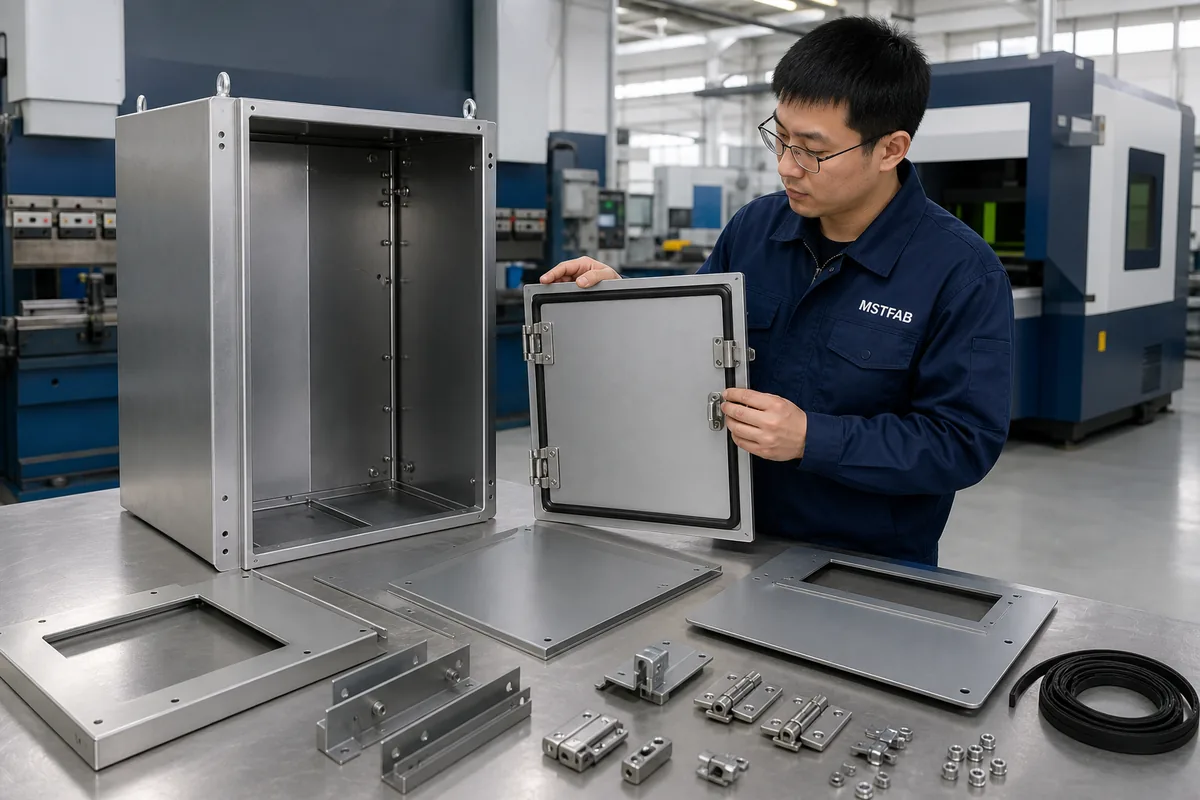
Quick answer: MSTFAB provides custom sheet metal enclosure fabrication and mechanical assembly for OEM buyers. That means laser cutting, punching, bending, welding, PEM hardware, hinges, locks, handles, gasket installation, surface finishing, final inspection and export packaging for empty metal cabinets, panels, doors, brackets and enclosure structures. It does not mean a finished electrical product.
Scope note before anyone buys the wrong thing: We do not supply finished electrical equipment, PCB assembly, wiring harnesses, batteries, charger internals, PLC systems, motors, software, or certification for complete machines. If your team needs a reliable sheet metal enclosure shell with the right holes, finish, hardware and packing, that is exactly the lane. If you need a ready-to-plug-in device, that is a different project and a different supplier list.
Buyers often ask for “fabrication and assembly” because they are tired of receiving beautiful loose panels and then spending a Friday afternoon discovering that the hinge screws are missing, the gasket groove is blocked by powder coat, and the lock cam rotates directly into a bracket. Good times for nobody. This guide explains what a clear enclosure assembly scope should include, what evidence you should request, and how to avoid paying for assembly twice: once at the factory and again during rework.
What this service includes
For MSTFAB, sheet metal fabrication and assembly is a drawing-based manufacturing service for metal enclosure parts and mechanical subassemblies. The useful phrase here is mechanical. We can fabricate the metal structure and install the hardware that belongs on that structure. We are not turning it into a complete electrical cabinet.
- Enclosure shells and cabinets: empty boxes, access doors, removable covers, control box housings, machine guards and welded frames.
- Panels and brackets: mounting plates, side panels, top covers, base plates, internal supports and reinforcement parts.
- Mechanical hardware: hinges, locks, handles, latches, rivet nuts, PEM nuts, studs, standoffs, screws and captive fasteners.
- Sealing parts: rubber gaskets, foam seals, gasket channels and door compression checks where the drawing defines them.
- Finishing coordination: powder coating, plating, brushing, masking of threads and finish inspection before hardware installation.
- Packing: foam protection, corner protection, hardware protection, carton or pallet packing for export shipment.
The boring part of that list is the valuable part. Anyone can say “full service.” The question is whether the quote says which fasteners, which finish sequence, which inspection points and which packing method. Silence in a quote is not simplicity. It is usually future email drama wearing a clean shirt.
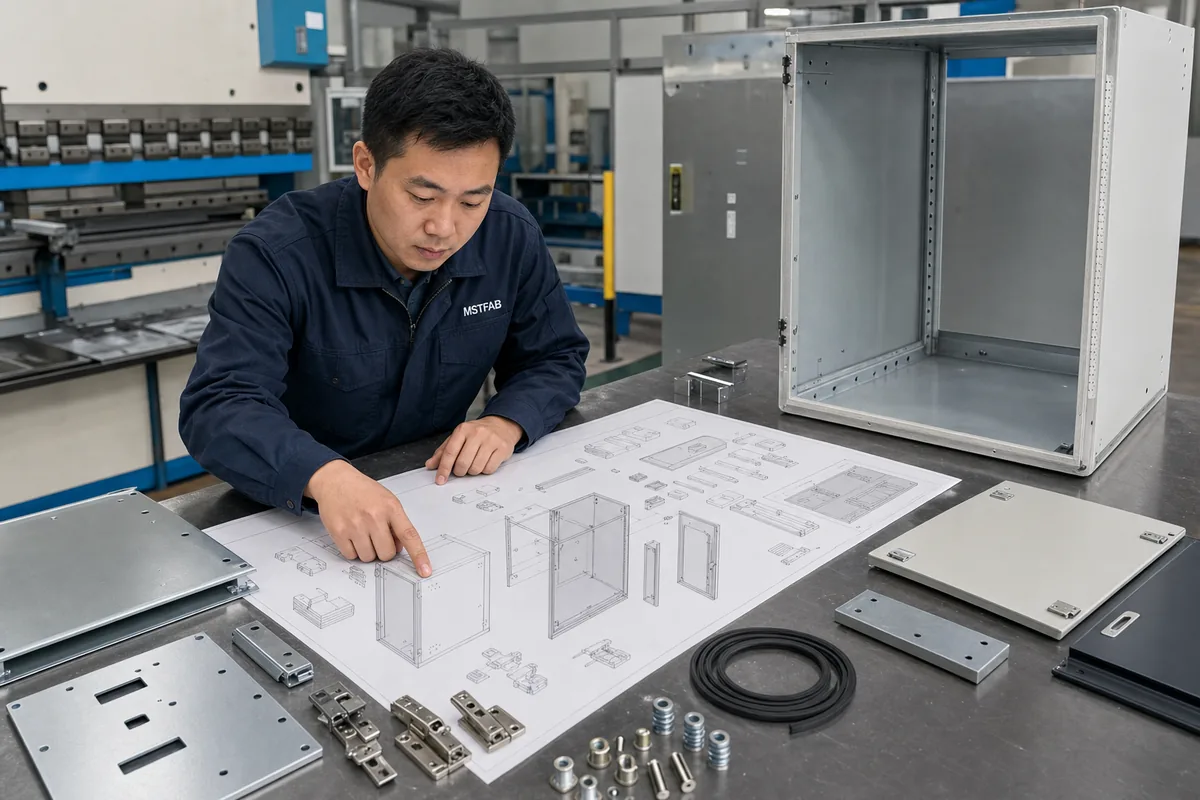
What this service does not include
This page is intentionally not a finished-product page. Keeping that boundary clear helps Google, but more importantly it helps buyers avoid a bad sourcing decision. MSTFAB’s role is the metal enclosure and its mechanical assembly. The electronics, functional system, field certification and final product responsibility remain with the OEM or system integrator.
| MSTFAB can support | Not included in this service |
|---|---|
| Custom sheet metal enclosure shells and cabinets | Finished EV chargers, PLC systems, batteries or powered devices |
| Laser cutting, punching, bending, welding and grinding | Electrical design, firmware, software or system integration |
| Hinges, locks, handles, PEM hardware, studs and gaskets | PCB assembly, wiring harnesses, cable routing or electrical testing |
| Powder coating, masking, mechanical fit checks and packing | End-product certification, UL listing for complete equipment or site commissioning |
That may sound less flashy than “we do everything.” Good. In industrial sourcing, “we do everything” often means “we will figure out the risky part after you pay the deposit.” A focused supplier is easier to audit, easier to quote accurately and easier to hold accountable.
Why OEM buyers use assembly instead of loose parts
Loose parts are fine when your own line is set up for assembly. They are not fine when your team becomes an emergency hardware department. Pre-installed mechanical assembly helps when the enclosure has moving doors, gasket compression, many threaded inserts, cosmetic surfaces or export packaging risk.
- Less incoming labor: the buyer receives enclosure subassemblies instead of a pile of panels and a bag of hardware.
- Fewer fit surprises: hinges, locks and gaskets are checked on the actual enclosure before shipping.
- Better finish control: threads can be masked before coating, and hardware can be installed after finish where needed.
- Cleaner repeat orders: photos, checklists and BOM control make the second batch less exciting, in the good way.
- Safer export packing: doors, corners and painted surfaces are protected before they spend weeks in transit.
The manufacturing route
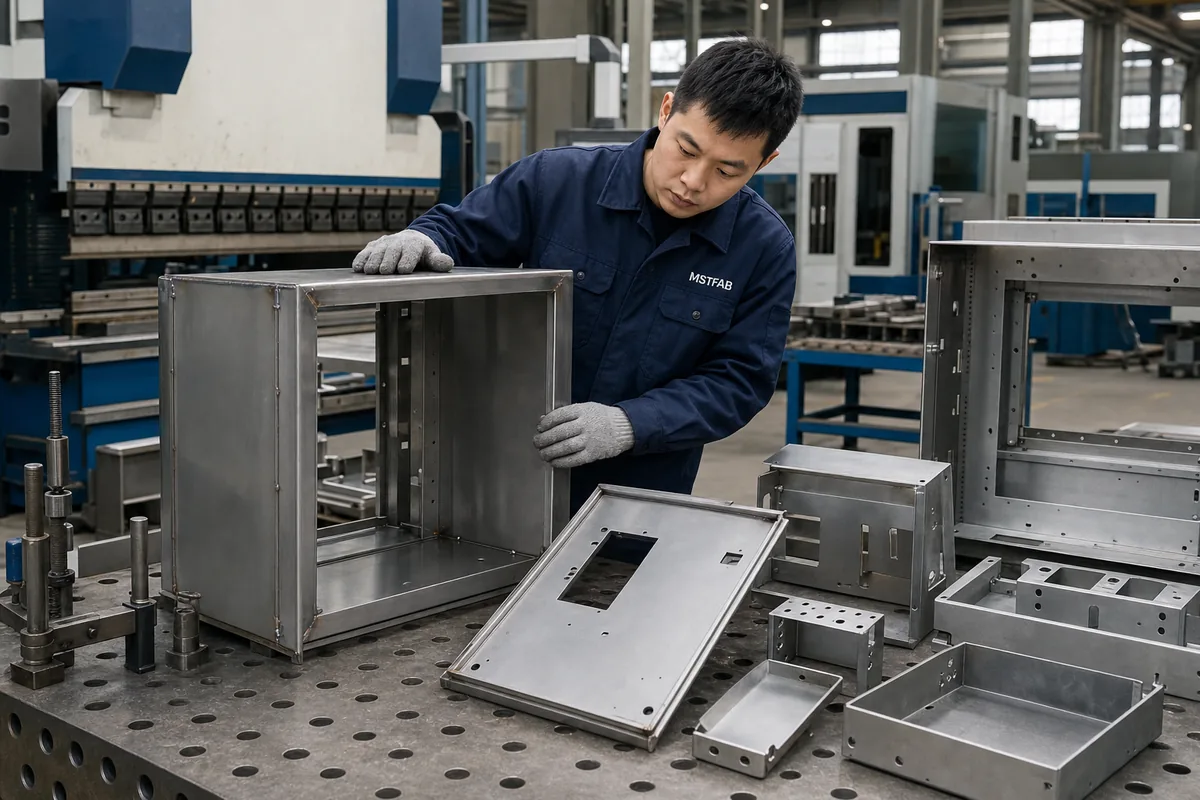
A reliable enclosure assembly job is not just “cut, bend, ship.” The route needs to protect the geometry first, then the finish, then the moving hardware. Skipping that sequence is how a clean drawing becomes a box that technically exists but refuses to close.
- RFQ review: drawings, STEP files, material, finish, quantity, tolerances, hardware list and packing expectations are checked before quoting.
- DFM review: bend radius, hole-to-bend distance, PEM hole sizes, weld locations, gasket paths and finish masking are reviewed. The earlier this happens, the cheaper the fix.
- Cutting and forming: laser cutting, punching and CNC bending create panels, doors, brackets and shell parts.
- Welding and grinding: welded cabinets and frames are controlled with fixtures where needed to reduce distortion.
- Surface finishing: powder coating or plating is planned around threads, grounding areas, gasket surfaces and cosmetic faces.
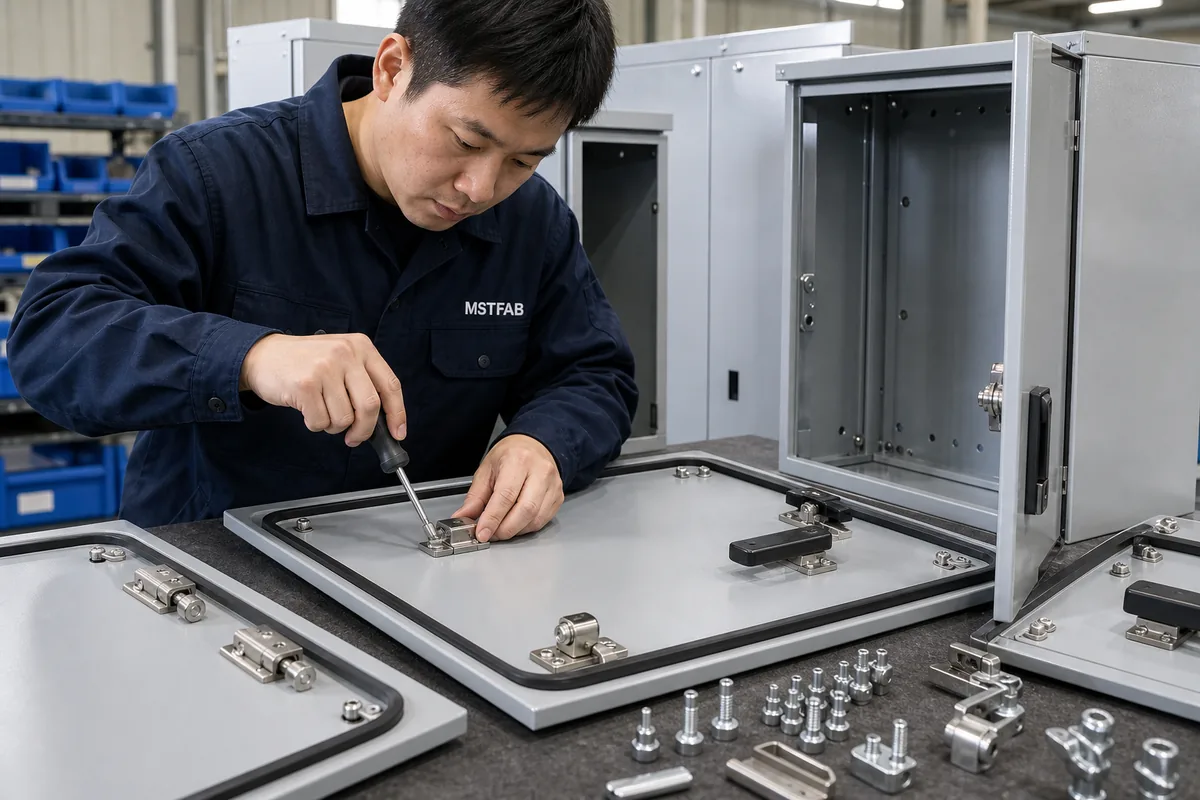
- Mechanical assembly: hinges, locks, handles, gaskets, PEM hardware and brackets are installed according to the drawing or approved sample.
- Final QC: door fit, hardware operation, coating condition, key dimensions and packing condition are checked.
- Export packing: surfaces, doors and corners are protected so the enclosure arrives as a part, not as a lesson.
If you are still developing the design, send the drawing early and ask for DFM feedback. We put a fuller checklist in DFM Design Rules for Sheet Metal Parts. It is much cheaper to move a hole in CAD than after powder coating. Obvious, yes. Forgotten surprisingly often, also yes.
Assembly scope checklist for your RFQ
A quote can only be accurate if the supplier knows what is being assembled. “Install all hardware” is not a specification; it is a request for future confusion. Use a simple assembly scope so every supplier prices the same work.
| RFQ item | What to define | Why buyers care |
|---|---|---|
| Hardware BOM | Part number, material, finish, supplier source and quantity per enclosure | Stops cheaper substitutes and missing fasteners |
| Assembly drawing | Exploded view, installation direction, torque note if needed, door swing direction | Prevents “looks right” assembly that fails in use |
| PEM and threaded features | Exact hole size, insert type, thread size and inspection requirement | Protects mating parts and field service work |
| Gasket/seal | Seal material, compression path, joint location and adhesive requirement | Prevents leaks, loose seals and doors that fight back |
| Finish sequence | Masking, coat thickness, color, texture, hardware installed before or after coating | Avoids painted threads and scratched cosmetic surfaces |
| Packing method | Individual bag, foam, carton, pallet, door protection and label requirement | Reduces transit damage and incoming inspection disputes |
For pricing, this is where hidden costs usually live. If you want a line-by-line way to compare supplier numbers, read How to Read a Sheet Metal Quote and Spot Hidden Costs. The short version: if the quote does not mention it, do not assume it is included.
Trust table: what serious buyers should verify
Trust is not built by a slogan. It is built by evidence. A good enclosure assembly supplier should make the risky parts visible before you issue a large PO.
| Buyer concern | What MSTFAB confirms | Evidence you can request |
|---|---|---|
| Will the parts fit after bending and welding? | Critical dimensions, fixture control and first-article checks for mating features | FAI report, inspection photos, dimension records |
| Will doors, hinges and locks operate properly? | Door swing, latch engagement, gasket compression and hardware operation | Assembly photos, short operation video, sample approval |
| Will coating block threads or damage fit? | Masking plan, finish thickness target and post-finish checks | Masking photos, coating thickness readings, finish sample |
| Will hardware match the BOM? | Fastener type, PEM spec, hinge/lock model and quantity control | Hardware list, supplier confirmation, packed BOM photos |
| Will the shipment survive export transit? | Surface protection, foam, carton/pallet method and moving-part protection | Packing photos before shipment, carton/pallet dimensions |
For a deeper look at inspection terms like FAI and CMM, see Sheet Metal Quality Control: FAI, CMM and SPC Explained. Not every bracket needs a CMM report, but critical fit features deserve a real inspection plan.
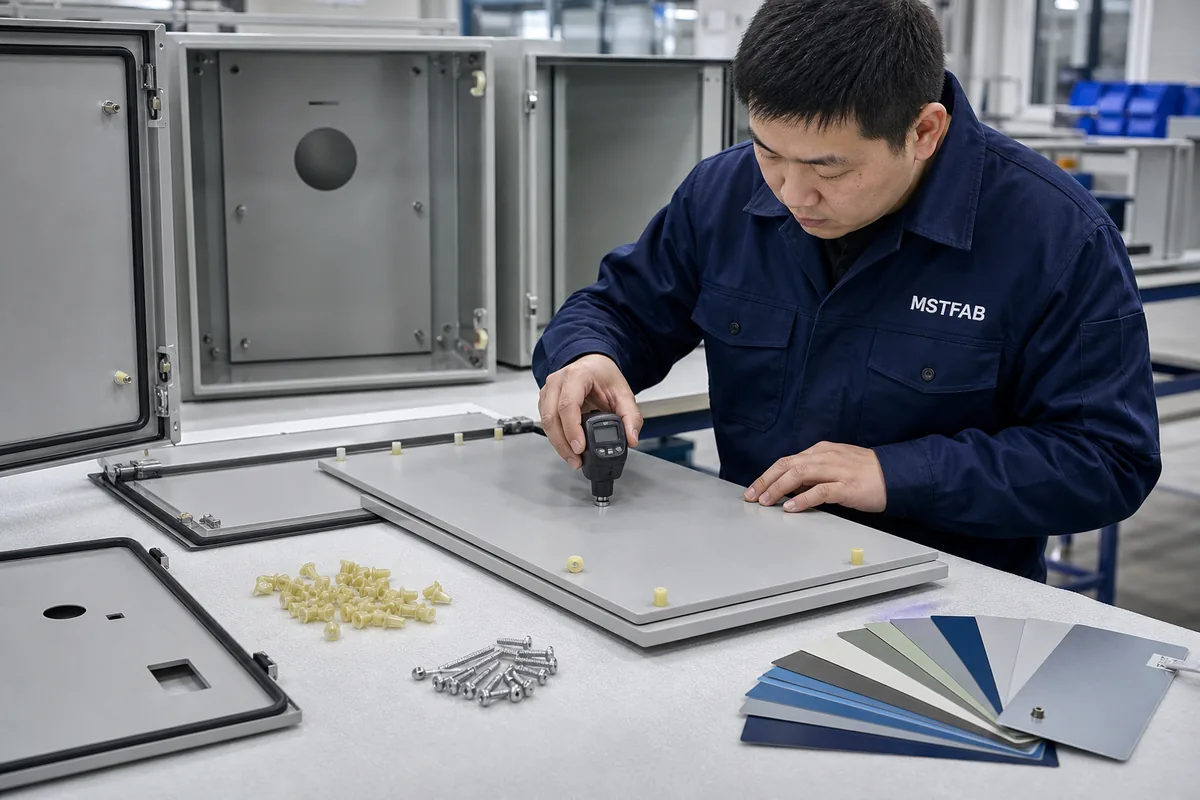
Finish and hardware sequence matters
Many enclosure problems are finish problems pretending to be assembly problems. Powder coat adds thickness. Threads disappear if they are not masked. A latch can scratch a door if installed too early. A gasket can lose adhesion if the surface is dirty. None of this is advanced engineering; it is simply sequencing.
- Mask threads and grounding points: tell the supplier exactly what must stay bare.
- Install visible hardware after finish: unless the design requires otherwise, this protects cosmetic surfaces.
- Check coating thickness: too thin can fail outdoors; too thick can ruin fit.
- Protect gasket surfaces: paint build-up, oil or dust can ruin sealing performance.
- Approve finish samples: color words like “gray” are not a specification. They are a conversation starter.
If the finish is still undecided, Sheet Metal Surface Finishing Guide explains powder coating, plating and other common options. Pick the finish by environment and function, not by which sample looked best under office lighting.
Ship assembled or flat-packed?
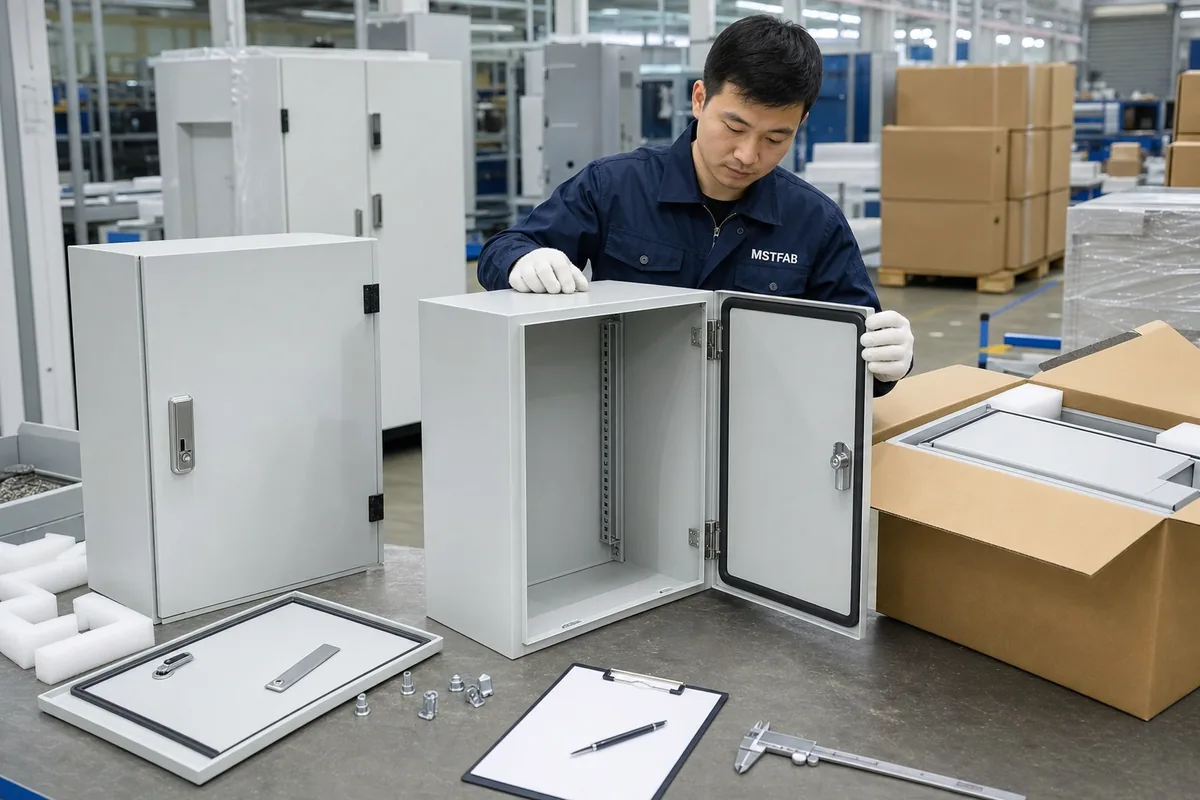
Not every enclosure should ship fully assembled. Sometimes flat-packing saves freight and reduces scratch risk. Sometimes pre-assembly saves your production line from a slow hardware puzzle. The right choice depends on size, surface finish, tolerance risk and incoming labor cost.
| Shipping option | Best for | Watch out for |
|---|---|---|
| Fully assembled enclosure | Doors, locks, gaskets and hardware that must be fit-tested before shipment | Higher volume, more packing protection and possible freight cost |
| Partly assembled subassemblies | Doors with gaskets, brackets with PEM hardware, welded frames with panels packed separately | Clear labels and assembly notes are needed at your line |
| Flat-packed loose parts | Large enclosures where freight cost is critical and buyer has assembly capacity | More incoming labor and more chance of missing hardware |
For repeat OEM programs, we often recommend a pilot batch with photos and assembly notes, then lock the method for production. The first batch is where you learn. The second batch should be where you stop learning the same lesson.
Common mistakes that create rework
- Calling it “assembly” without a BOM: the supplier guesses, and guessing is not a quality system.
- Ignoring coating thickness: a lovely door that will not close is still not a good door.
- Leaving gasket material vague: indoor foam, outdoor sealing and oil exposure are different jobs.
- Using a drawing without an exploded view: the shop sees parts, not your intended order of installation.
- Approving price before packing: export packaging is not decoration; it is part of the product arriving usable.
- Expecting the metal supplier to own the electronics: keep the enclosure supplier responsible for the enclosure, and the system integrator responsible for the system.
What to send MSTFAB for a useful quote
You do not need a perfect packet, but the more complete the RFQ, the fewer surprises in price and lead time.
- 2D drawings with dimensions, material grade, thickness and tolerance notes.
- STEP files for enclosure bodies, doors, panels and brackets.
- Hardware BOM: hinges, locks, handles, PEM inserts, screws, gaskets and any buyer-supplied parts.
- Finish requirements: powder coat color/code, texture, masking areas, plating or brushing notes.
- Assembly scope: what must be installed by MSTFAB and what your team will install later.
- QC requirements: first article inspection, key dimensions, photos, function checks, coating checks.
- Packing requirements: individual protection, cartons, pallets, labels and shipping method.
When those details are clear, the quote becomes a manufacturing plan instead of a hopeful number. To send drawings for review, use the MSTFAB contact page. Include the assembly scope in the first message; it saves everyone from playing detective.
Key takeaways
- MSTFAB supports sheet metal enclosure fabrication plus mechanical assembly, not finished electrical equipment.
- Good assembly scope means hardware BOM, drawings, finish sequence, QC checks and packing details.
- Hinges, locks, PEM hardware, gaskets and door fit should be checked before shipping when they affect function.
- Finish sequence matters: mask threads, protect cosmetic surfaces and inspect coating before hardware installation.
- Trust comes from evidence: sample photos, FAI notes, coating checks, assembly records and packing photos.
Frequently asked questions
Does MSTFAB provide finished electrical products?
No. MSTFAB fabricates sheet metal enclosures, panels, brackets and mechanical subassemblies. We do not provide finished electrical equipment, electronics, wiring, batteries, software or complete machine certification.
What does mechanical assembly include?
It can include hinges, locks, handles, latches, PEM nuts, studs, standoffs, screws, gaskets, welded subassemblies, finish checks and export packing. The exact scope should be listed in the RFQ and quote.
Can you install buyer-supplied hardware?
Yes, if the hardware is specified clearly and supplied with enough quantity for samples, production and possible replacements. Include part numbers, drawings and installation requirements.
Can the enclosures be shipped fully assembled?
Yes, when the size, finish and packing risk make sense. Some large enclosures are better shipped partly assembled or flat-packed to reduce freight and damage risk.
What inspection evidence can OEM buyers request?
Buyers can request first-article checks, key dimension records, coating thickness readings, assembly photos, door/lock operation checks and packing photos before shipment.
What files are needed for a quote?
Send 2D drawings, STEP files, material and thickness, finish notes, quantity, tolerance requirements, hardware BOM, assembly scope and packing expectations. A clear RFQ is the cheapest project management tool you own.
 WeChat Contact
 WhatsApp Me Directly