An IP54 enclosure is often used when buyers need practical dust protection and splash resistance, but do not require a fully sealed outdoor cabinet.
That sounds simple.
But in real OEM sourcing, many problems happen because buyers treat IP54 as “almost waterproof.”
It is not.
An IP54 enclosure is usually suitable for indoor industrial environments, semi-protected equipment areas, automation systems, control cabinets, electronic housings, and equipment installed where dust and light splashing may occur.
It is not the right choice for heavy rain, washdown cleaning, high-pressure water, coastal outdoor exposure, or fully exposed telecom infrastructure.
At MSTFab, we often see RFQs where buyers request an IP54 enclosure for:
- PLC control cabinets
- industrial automation enclosures
- electrical control boxes
- network equipment cabinets
- machine control panels
- power control enclosures
- indoor or semi-outdoor OEM equipment
The real procurement question is not only:
“Can you make an IP54 enclosure?”
The better question is:
“Is IP54 the correct protection level for this working environment?”
Because choosing the wrong IP level can create expensive field problems later.
A cabinet that works in a factory corner may not survive outdoor rain.
Metal boxes do not become waterproof just because the quotation says “industrial.”
Planning an RFQ? This guide focuses on IP54 enclosure design dust splash ventilation. For production capability, drawing review and quotation support, see MSTFAB’s custom sheet metal enclosure design and fabrication.
1. What Is an IP54 Enclosure?
An IP54 enclosure is designed to provide limited dust protection and protection against water splashing from different directions.
In practical purchasing terms, buyers usually choose IP54 when the enclosure needs protection against workshop dust, light splashing, general industrial contamination, accidental water exposure, equipment-area moisture, and controlled indoor environments.
Typical applications include industrial control cabinets, PLC enclosures, machine control boxes, electronic equipment housings, indoor network cabinets, automation equipment enclosures, and operator control panels.
For general custom enclosure capability, buyers can review: Custom Sheet Metal Enclosure Fabrication.
2. IP54 Is Not the Same as IP65
One of the most common buyer mistakes is confusing IP54 with IP65.
IP54 can be suitable for many indoor or semi-protected industrial applications.
But if the cabinet will face outdoor rain, hose water, heavy dust, or harsh weather, IP65 or higher may be more appropriate.
In procurement terms:
IP54 Enclosure
Better for indoor industrial areas, light dust environments, splash-prone equipment zones, protected automation systems, and machine-side control boxes.
Main concern: not suitable for strong water jets or fully exposed outdoor use.
IP65 Enclosure
Better for outdoor electrical cabinets, telecom equipment, EV charger enclosures, exposed power systems, and harsh industrial environments.
Main concern: more sealing, thermal, and condensation planning required.
For outdoor or harsher environments, buyers should compare:
Choosing IP54 to save cost is reasonable only when the environment matches IP54.
Choosing IP54 for the wrong environment is not cost saving.
It is just buying a future complaint at today’s price.
3. Dust Protection Depends on More Than the Door Gasket
Many buyers assume the gasket is the whole protection system.
It is not.
Dust can enter through door gaps, cable entries, ventilation openings, poorly sealed gland plates, hinge areas, removable panels, and warped doors.
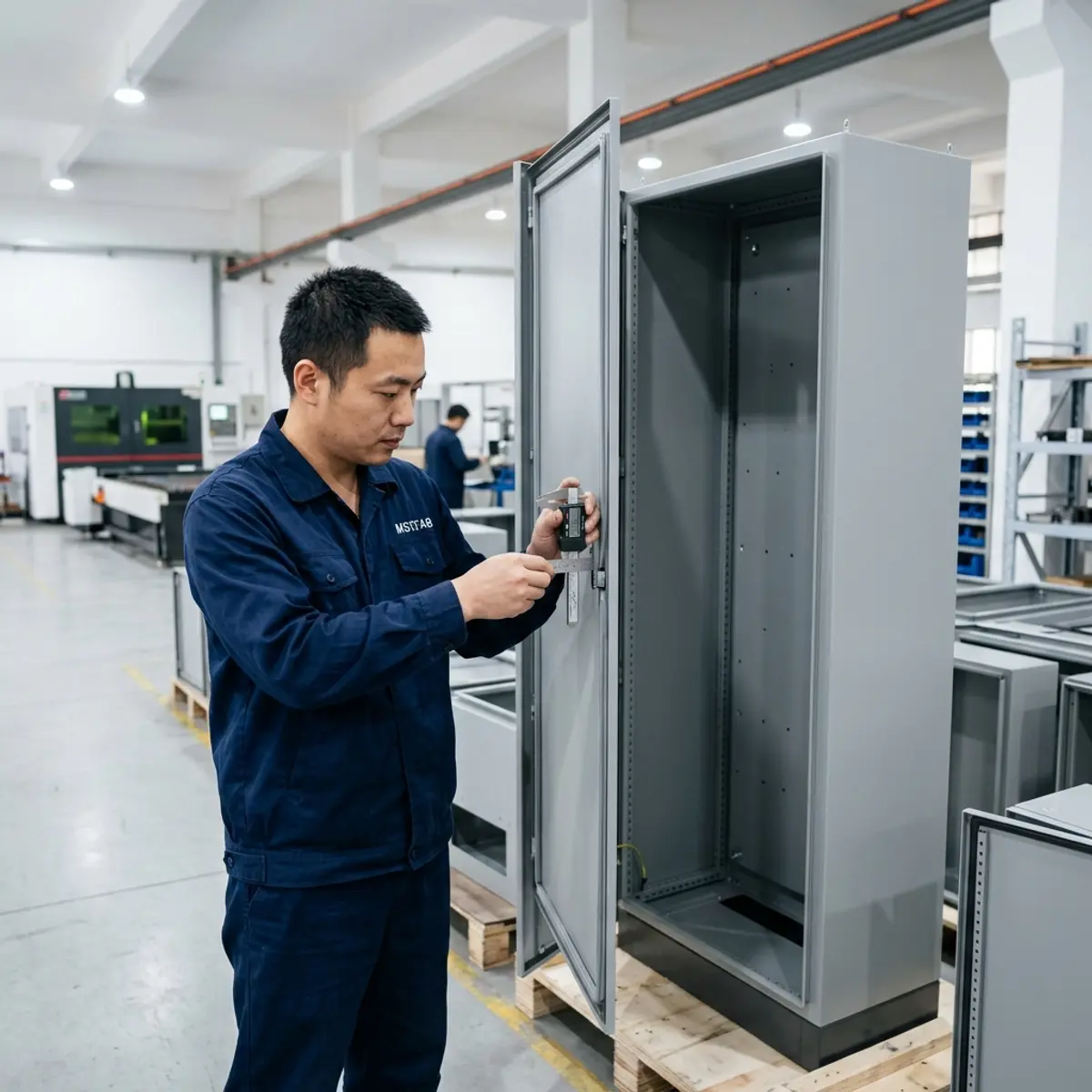
For IP54 sheet metal enclosure fabrication, buyers should check door fitment, gasket contact, frame flatness, cable gland sealing, ventilation filter design, panel gap consistency, and assembly inspection before shipment.
A good gasket cannot fix a twisted door.
A cabinet can look clean in photos and still allow dust through poor cable entry design.
Dust is small.
Procurement mistakes are usually bigger.
4. Splash Resistance Requires Practical Sealing Design
IP54 enclosures are commonly used where light splashing or occasional water exposure may happen.
But splash resistance depends on the whole enclosure structure.
Important design points include door overlap, gasket compression, latch pressure, top cover design, cable entry direction, drainage path, and ventilation opening protection.
Common problems include water entering through top gaps, splash reaching side vents, cable holes not sealed properly, gasket not compressed evenly, and coating buildup affecting door closure.
OEM buyers should ask whether the supplier checks door closing pressure and gasket contact after fabrication.
A cabinet does not need to be over-engineered.
But it must be sealed in the places where water actually tries to enter.
Water does not follow the drawing.
It follows gravity and gaps.
5. Ventilation Is Often the Real Challenge
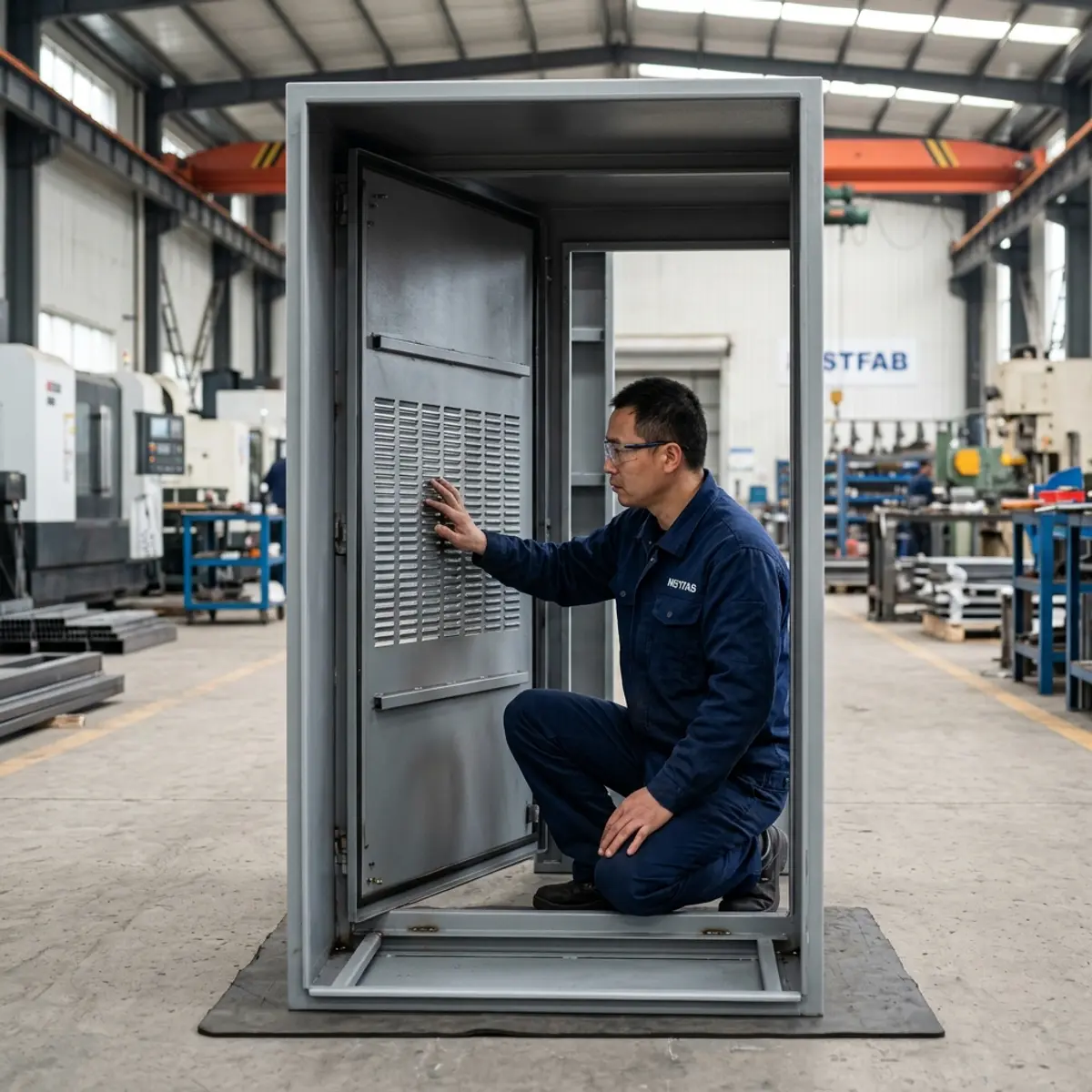
Many IP54 enclosures contain electrical or electronic components that generate heat.
Common heat sources include PLCs, relays, power supplies, VFDs, terminal blocks, communication modules, small transformers, and industrial PCs.
If the enclosure is too sealed, heat builds up.
If it is too open, dust and splash protection becomes weak.
That balance is where many projects fail.
OEM buyers should evaluate internal heat source layout, ventilation opening position, filter design, fan location, airflow path, maintenance access for filters, and whether IP54 is still realistic with ventilation.
For higher heat loads, buyers may need filtered ventilation or climate-controlled enclosure solutions.
Related page: Climate Controlled Enclosure Fabrication
A control cabinet should not protect electronics by slowly cooking them.
That is not protection.
That is meal prep.
6. Cable Entry Design Can Make or Break IP54 Performance
Cable entries are one of the most common failure points in IP54 electrical enclosures.
Even if the cabinet body is well made, poor cable entry design can allow dust, moisture, and insects to enter.
Buyers should check cable gland size, gland plate thickness, cable entry location, power and signal cable separation, bottom vs side entry, sealing around unused holes, and technician access for installation.
For industrial control systems, cable routing must also be practical.
If the cabinet is too compact, installers may struggle with cable bending radius, terminal access, wiring duct clearance, cable gland installation, and future maintenance.
Related pages:
- Custom Electrical Control Enclosure Fabrication
- Custom PLC Enclosure Fabrication
- Electrical Cabinet Manufacturing
A sealed cabinet with impossible wiring space is not a good cabinet.
It is just a small metal argument waiting for the installer.
7. Material Selection Should Match the Environment
IP54 enclosures can be made from different sheet metal materials depending on cost, corrosion risk, appearance, and installation environment.
Powder Coated Steel
Best for indoor industrial cabinets, control boxes, automation enclosures, and cost-effective OEM production.
Main concern: coating damage can expose steel and cause rust.
Related page: Powder Coated Steel Enclosure Fabrication
Galvanized Steel
Best for semi-protected electrical enclosures, industrial control cabinets, and better base corrosion resistance than SPCC.
Main concern: cut edges and weld areas still need protection.
Related page: Galvanized Steel Enclosure Fabrication
Stainless Steel
Best for food equipment, medical equipment, humid environments, clean industrial applications, and stronger corrosion resistance.
Related pages: 304 Stainless Steel Electrical Enclosure Manufacturer and 316 Stainless Steel NEMA Enclosure Fabrication
Aluminum
Best for lightweight electronic enclosures, heat-sensitive equipment, network devices, and portable industrial systems.
Related page: Aluminum Electronic Enclosure Fabrication
The right material depends on where the IP54 enclosure will actually work.
Indoor factory, humid workshop, food processing area, and semi-outdoor cabinet should not use the same material logic.
The environment always gets the final vote.
8. Powder Coating Quality Affects Protection and Assembly
Most IP54 steel enclosures use powder coating.
But powder coating is not just color.
It affects corrosion protection, assembly fit, edge durability, gasket sealing areas, grounding contact, visible appearance, and export protection.
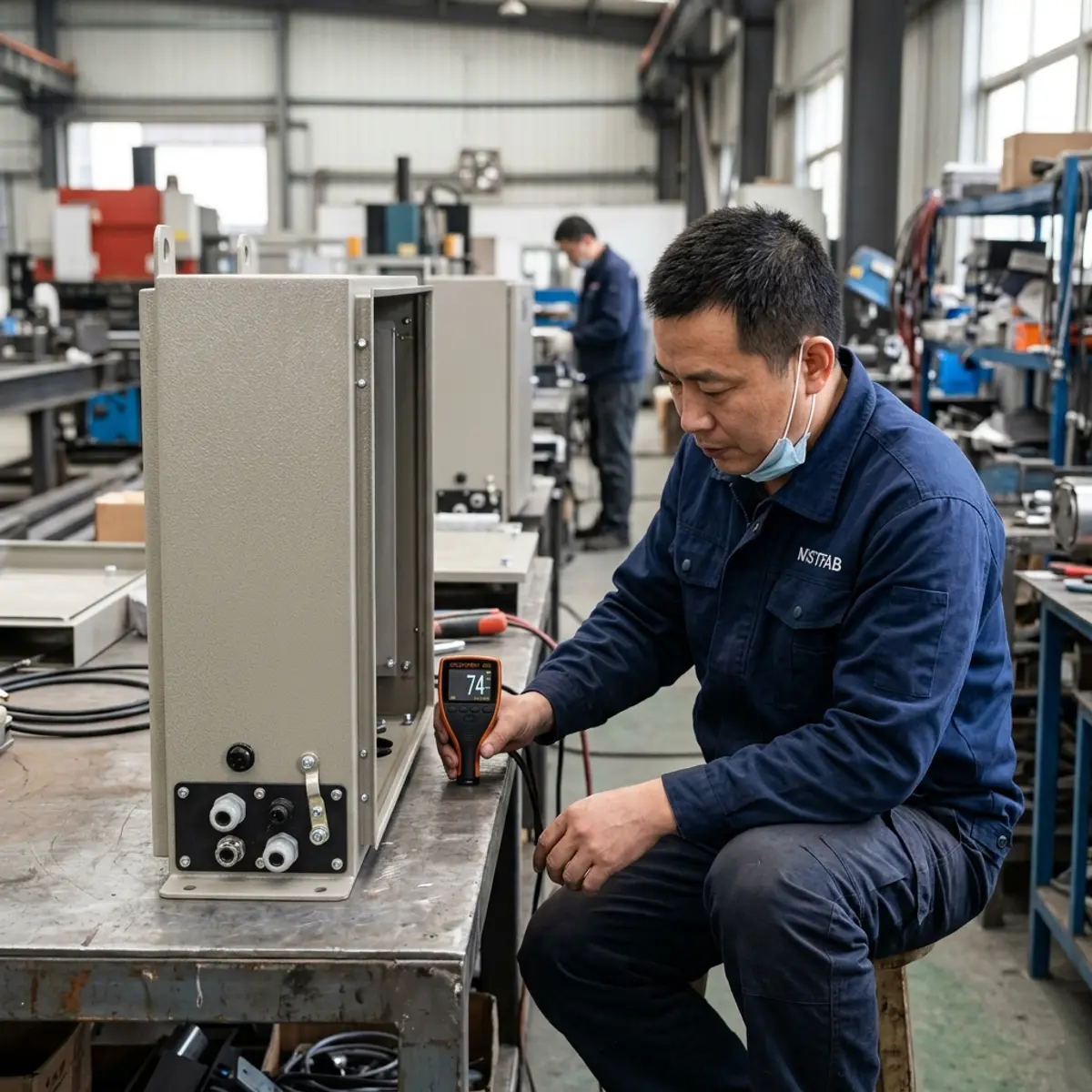
Common coating problems include rust around cable holes, peeling near welds, powder buildup around hinges, blocked threaded holes, poor adhesion on sharp edges, and scratches during shipment.
Buyers should specify RAL color, gloss level, texture requirement, coating thickness, masking areas, grounding contact points, and packaging protection.
Related page: Powder Coating Service
For IP54 enclosures, coating thickness around sealing surfaces and cable entries should be controlled carefully.
Too little protection causes corrosion.
Too much coating may affect assembly.
Manufacturing likes balance.
9. Grounding Should Be Planned Before Surface Treatment
Many IP54 enclosures are used for electrical control systems.
That means grounding matters.
Powder coating can block grounding contact if the design does not include masked areas or grounding hardware.
Buyers should define grounding stud locations, door bonding points, masked contact surfaces, mounting plate grounding, conductive hardware requirements, and internal bonding path.
A cabinet can look professionally powder coated and still have poor electrical continuity.
Beautiful finish. Bad grounding.
That is not a quality win.
10. CNC Bending and Welding Affect IP54 Fitment
IP54 performance depends on proper fitment.
Poor bending or welding may cause door gaps, twisted frames, uneven gasket compression, poor panel alignment, hinge misalignment, and latch pressure inconsistency.
Buyers should check whether the manufacturer controls CNC bending accuracy, bend sequence, material springback, frame squareness, welding distortion, and trial assembly.
Related process pages:
An enclosure can be made from the right material and still fail protection if the door does not sit correctly.
The gasket is not a miracle worker.
11. When IP54 Is a Good Choice
An IP54 enclosure is usually a practical choice when buyers need dust protection, splash resistance, indoor industrial protection, controlled cost, ventilation flexibility, easier maintenance than fully sealed cabinets, and custom sheet metal fabrication.
Typical applications include PLC control boxes, machine control cabinets, electrical control enclosures, indoor network cabinets, automation equipment housings, instrument enclosures, and operator control panels.
Related pages:
- Custom PLC Enclosure Fabrication
- Custom Instrument Enclosure Fabrication
- Network Cabinet Sourcing Guide
- Custom Control Station Enclosure Fabrication
IP54 is a smart choice when the environment is realistic.
Not every project needs IP65.
But every project needs the correct protection level.
12. When Buyers Should Avoid IP54
IP54 may not be suitable for fully exposed outdoor cabinets, heavy rain environments, washdown cleaning areas, high-pressure water exposure, coastal telecom sites, harsh chemical environments, outdoor EV charging systems, and battery storage cabinets exposed to weather.
In those cases, buyers should consider stronger enclosure protection, better sealing, stainless steel materials, climate control, or outdoor cabinet designs.
Related pages:
- Custom EV Charger Enclosure
- Battery Storage Cabinet Fabrication
- Outdoor Telecom Enclosure
- 316 Stainless Steel NEMA Enclosure Fabrication
Choosing a lower protection level is fine only when the environment supports it.
Otherwise, the field will correct the decision later.
Usually with water.
13. What Buyers Should Send for an Accurate IP54 Enclosure Quote
To get a reliable IP54 enclosure quotation, buyers should provide:
- STEP or 3D CAD files
- 2D PDF drawings
- cabinet dimensions
- material and thickness
- indoor or semi-outdoor application
- IP54 requirement
- ventilation requirement
- cable entry positions
- gasket requirement
- surface finish requirement
- grounding, lock and hinge requirements
- annual order quantity and packaging requirement
For electrical or control systems, buyers should also provide internal component layout, heat source information, cable routing plan, mounting plate details, maintenance access requirements, and critical tolerance notes.
If the RFQ only says “IP54 enclosure, please quote fast,” the supplier has to guess.
And guessing is not procurement.
It is just a faster way to create engineering revisions.
MSTFAB OEM Trust Table for IP54 Enclosures
IP54 means balancing ventilation with solid splash defense. Here is how MSTFab builds reliable semi-protected industrial enclosures:
| OEM Procurement Priority | MSTFAB Delivery Standard |
|---|---|
| Splash-Proof Sealing | Machine-poured continuous polyurethane (PU) gaskets ensure seamless, gap-free compression against precision-leveled door frames. |
| Airflow vs Dust Control | CNC-punched downward-facing louvers integrated with removable dust filter mats allow critical heat exhaust while rejecting falling dust and splashes. |
| Cabinet Rigidity | Sequence-controlled TIG welding and deep CNC return bends prevent frame twisting, ensuring doors close squarely without uneven gasket pressure. |
| Secure Cable Entries | Bottom gland plates are engineered with strict flatness tolerances and deburred edges to ensure IP54-rated cable glands seat and seal perfectly. |
| Electrical Continuity | All grounding studs are shielded with high-temperature silicone caps before powder coating, guaranteeing uninterrupted safety grounding for electronics. |
Final Thoughts
An IP54 enclosure is a practical solution for many industrial OEM projects.
But buyers should not treat IP54 as a generic waterproof label.
For OEM buyers, a reliable IP54 enclosure manufacturer should control material selection, dust protection, splash resistance, cable entry sealing, ventilation design, grounding, powder coating, CNC bending accuracy, welding distortion, gasket fitment, and export packaging.
At MSTFab, we support OEM customers with custom IP54 enclosure fabrication, CNC laser cutting, CNC bending, TIG/MIG welding, powder coating, gasket assembly, mounting plate fabrication, and DFM review for industrial electrical cabinets, automation systems, control enclosures, network devices, and custom sheet metal projects.
The best time to choose the right protection level is before production starts.
Not after the cabinet meets dust, water, heat, and a very unhappy field technician.
Related factory capability: For OEM buyers comparing a custom sheet metal enclosure factory, review how MSTFAB handles final assembly, protective packaging, export packing checks, and shipment-ready enclosure delivery.
custom sheet metal enclosure fabrication
MSTFAB manufactures custom sheet metal enclosures, electrical cabinets, control boxes and industrial metal housings for OEM buyers.
 WeChat Contact
 WhatsApp Me Directly