
Aluminum electronic enclosures are widely used for industrial electronics, telecom devices, control systems, monitoring equipment, network devices, power modules, and OEM electronic products.
Buyers choose aluminum because it is lightweight, corrosion-resistant, easy to machine, and better at heat dissipation than many steel enclosure options.
That sounds perfect.
Until the first prototype arrives with scratches, weak threads, poor grounding, blocked airflow, or a cover that does not fit after powder coating.
At MSTFab, we often see OEM buyers focus on enclosure size and appearance while overlooking the real manufacturing risks behind aluminum electronic enclosure fabrication:
- heat buildup inside compact electronic housings
- weak screw threads in thin aluminum sheet
- scratches on visible panels
- poor EMI grounding between panels
- coating thickness affecting assembly fit
- cracking during tight bending
- insufficient stiffness on large covers
An aluminum electronic enclosure is not just a lightweight box.
It is part of the product’s thermal system, protection system, assembly structure, and user-facing appearance.
And unfortunately, electronics do not care how nice the enclosure looks if they are slowly cooking inside it.

1. Why OEM Buyers Choose Aluminum Electronic Enclosures
Aluminum is a strong choice for electronic enclosure fabrication because it offers:
- lightweight structure
- good corrosion resistance
- better thermal conductivity than steel
- clean industrial appearance
- flexible surface finishing
- good machinability
- easier handling for compact equipment
It is commonly used for:
- industrial control devices
- network communication equipment (see Network Cabinets)
- telecom modules (see Telecommunications Enclosures)
- electronic monitoring systems
- power supply housings
- sensor enclosures
- automation electronics
- outdoor electronic boxes (see Outdoor Network Enclosure)
For broader aluminum enclosure manufacturing capability, buyers can review:
Aluminum Sheet Metal Enclosure Fabrication
2. Heat Dissipation Should Be Discussed Before Fabrication
One of the biggest mistakes in electronic enclosure procurement is treating the enclosure as only a protective shell.
For electronic products, the enclosure often becomes part of the thermal management system.
Heat sources may include:
- power modules
- PCBs
- transformers
- network switches
- industrial controllers
- communication devices
- battery backup components
If the internal layout is too compact, heat may accumulate around critical components.
This creates risks such as:
- shortened component lifespan
- unstable signal performance
- power module failure
- thermal shutdown
- customer warranty claims
Before production, buyers should confirm:
- internal heat source layout
- ventilation openings
- mounting plate position
- airflow direction
- heat sink connection area
- whether the enclosure needs fan cutouts
For outdoor or high-heat applications, buyers may also compare climate-controlled enclosure options:
Custom Climate Controlled Enclosures
A good aluminum electronic enclosure is not only easy to assemble.
It helps the electronics stay alive.
That is usually good for business.
3. 5052 vs 6061: Material Choice Matters
Many RFQs simply say:
“Aluminum enclosure.”
That is not enough for accurate manufacturing review.
For sheet metal electronic enclosures, two common aluminum options are 5052 and 6061.
5052 Aluminum
5052 is often preferred for bent aluminum sheet metal enclosures because it has good corrosion resistance and better forming performance.
It is suitable for:
- bent sheet metal covers
- electronic equipment enclosures
- telecom housings
- control boxes
- outdoor aluminum cabinets
- lightweight industrial panels
6061 Aluminum
6061 has higher strength and good machining performance, but it is less friendly for tight sheet metal bending.
It is better for:
- CNC machined parts
- thicker structural components
- heat sink structures
- machined enclosure frames
- precision mounting blocks
If a buyer chooses 6061 for a tight-bend sheet metal enclosure without proper bend radius review, cracking risk increases.
For enclosure fabrication, the correct question is not:
“Which aluminum is stronger?”
The better question is:
“Which aluminum works best for this manufacturing process?”
Metal has preferences. It just expresses them through cracks.
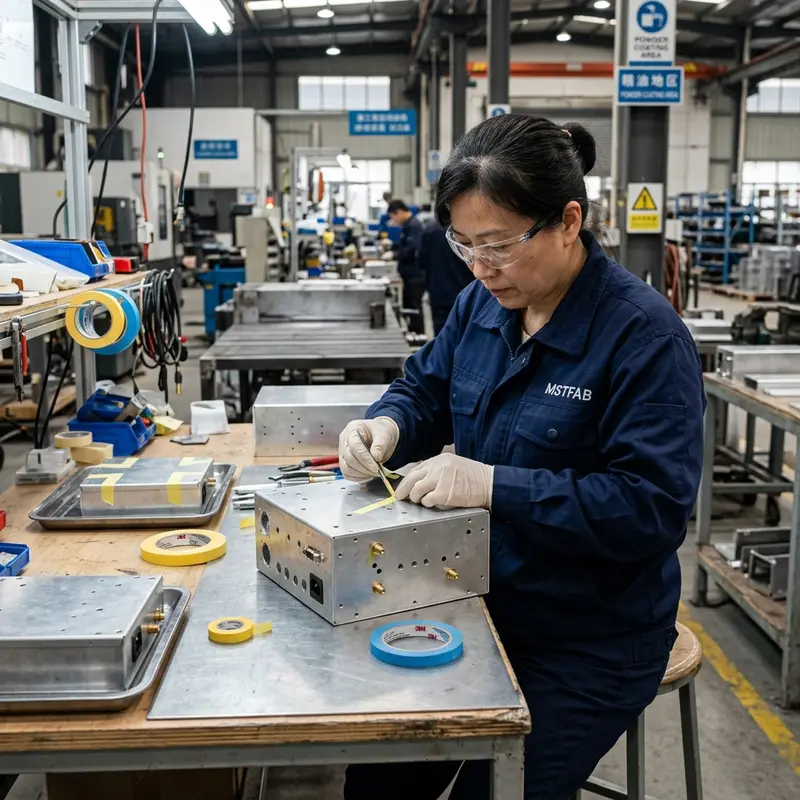
4. EMI Shielding and Grounding Need Early Planning
Electronic enclosures often need more than mechanical protection.
They may also need electromagnetic compatibility support.
For aluminum electronic enclosures, buyers should evaluate:
- grounding points
- panel-to-panel contact
- coating masking areas
- conductive gasket requirements
- screw connection reliability
- internal grounding studs
- coating thickness on electrical contact surfaces
Powder coating and anodizing can improve appearance and corrosion protection, but they may also reduce electrical conductivity at contact points if not controlled properly.
This is important for:
- telecom electronics
- industrial control equipment
- power electronics
- network devices
- monitoring systems
If grounding areas need metal-to-metal contact, they should be clearly marked before production.
Otherwise, the coating may look beautiful while quietly blocking the electrical path.
Beautiful is nice. Functional is better.

5. Thin Aluminum Threads Are a Common Failure Point
Many electronic enclosures require frequent assembly and maintenance.
That means screws may be installed and removed multiple times.
Thin aluminum sheet is not ideal for direct threading.
Common problems include:
- stripped threads
- loose cover screws
- weak mounting points
- vibration-related loosening
- poor long-term serviceability
For reliable fastening, buyers should consider:
- PEM inserts
- rivet nuts
- threaded bushings
- reinforced mounting plates
- CNC machined threaded blocks
This is especially important for:
- removable covers
- PCB mounting points
- wall mounting brackets
- terminal access panels
- field-serviceable enclosures
If an enclosure will be opened many times during maintenance, direct threading into thin aluminum is usually not the smartest choice.
The screw may forgive you once.
Maybe twice.
Then it starts making procurement problems.
6. Surface Finish Should Match the Product Positioning
Aluminum electronic enclosures may use different finishes:
- powder coating
- anodizing
- brushing
- sandblasting
- electrophoresis coating
- natural aluminum finish
Each finish has trade-offs.
Powder Coating
Good for: color customization, outdoor protection, industrial appearance, batch consistency.
Related page: Powder Coating Service
Anodizing
Good for: metallic appearance, improved surface hardness, electronic product aesthetics, lightweight premium housings.
But anodizing may reveal surface defects more clearly, so material handling and surface preparation must be controlled.
Brushed Aluminum
Good for: visible product panels, premium electronic housings, control interfaces, customer-facing devices.
For visible enclosures, buyers should define:
- visible surfaces
- scratch tolerance
- grain direction
- protective film requirement
- packaging standard
“Nice finish” is not a specification.
It is a polite way to create future arguments.
7. Aluminum Scratches Easily During Fabrication and Shipping
Aluminum is easier to scratch than many buyers expect.
Surface damage can happen during:
- cutting
- bending
- welding
- grinding
- assembly
- packing
- ocean shipment
For electronic enclosures, appearance often matters because the enclosure may be part of the final product.
Buyers should clarify:
- whether visible surfaces need protective film
- acceptable scratch standard
- packaging separation method
- whether parts can contact each other during shipping
- whether final cleaning is required
For export projects, packaging is part of quality control.
An aluminum enclosure that leaves the factory clean and arrives scratched is not a finished product.
It is a customer complaint with a tracking number.
8. Aluminum Electronic Enclosure vs Steel Enclosure
OEM buyers often compare aluminum with steel options.
Aluminum Electronic Enclosure
Best for: lightweight products, electronic equipment, telecom devices, better heat dissipation, clean product appearance, corrosion resistance.
Main concern: lower stiffness than steel, easier surface scratching, fastening strength requires planning.
Powder Coated Steel Enclosure
Best for: cost-effective industrial cabinets, stronger structure, large electrical enclosures, power distribution cabinets, indoor control systems.
Related page: Powder Coated Steel Enclosure Fabrication
Stainless Steel Enclosure
Best for: food equipment, medical devices, washdown environments, harsh corrosion conditions, premium industrial cabinets.
Related page: Stainless Steel Sheet Metal Enclosure Fabrication
The right material depends on weight, heat, corrosion, appearance, cost, and installation environment.
There is no universal “best metal.”
There is only the best metal for the job.
9. What Buyers Should Send for an Accurate Quote
To get a reliable aluminum electronic enclosure quote, buyers should provide:
- STEP or 3D CAD files
- 2D PDF drawings
- aluminum grade requirement
- material thickness
- surface finish requirement
- visible surface standard
- heat source layout
- ventilation requirement
- grounding requirement
- fastening method
- assembly requirements
- annual volume estimate
- packaging requirement
For electronic projects, buyers should also provide:
- PCB mounting locations
- connector cutouts
- cable entry positions
- heat dissipation expectations
- EMI shielding requirements
The more complete the RFQ package, the fewer quotation revisions and production surprises.
And in sourcing, fewer surprises usually means fewer emergency video calls.
MSTFAB OEM Trust Table for Aluminum Electronic Enclosures
Making a metal box is easy. Making an electronic enclosure that protects the PCB, dissipates heat, and assembles flawlessly is a manufacturing discipline. Here is how MSTFab delivers confidence:
| OEM Procurement Priority | MSTFAB Delivery Standard |
|---|---|
| Thermal Management Validation | Precise CNC punching and laser cutting for complex ventilation patterns without compromising structural integrity. |
| Fastening Reliability | Mandatory use of correctly torqued PEM inserts and rivet nuts instead of tapping directly into thin 5052 sheet aluminum. |
| EMI Grounding Integrity | Meticulous masking applied prior to powder coating or anodizing to guarantee bare-metal contact at critical grounding studs. |
| Material Handling & Bending | Strict bend-radius control to prevent cracking in 6061-T6, with protective film intact during fabrication to eliminate scratches. |
| Tolerance & Fitment Check | Trial assembly of PCB mounting plates and external covers before shipment to guarantee exact alignment. |
Final Thoughts
Aluminum electronic enclosure fabrication is not only about making a lightweight housing.
For OEM buyers, the real value comes from controlling:
- aluminum alloy selection
- heat dissipation
- EMI grounding
- bending feasibility
- fastening strength
- surface protection
- assembly accuracy
- export packaging
At MSTFab, we support OEM customers with aluminum electronic enclosure fabrication, CNC laser cutting, CNC bending, welding, powder coating, assembly, and DFM review for telecom, industrial electronics, network devices, control systems, and custom OEM equipment.
For an overview of our broader sheet metal capabilities, visit Custom Sheet Metal Enclosure Fabrication.
The best time to solve electronic enclosure problems is before the first sheet is cut.
Not after the PCB overheats inside a very good-looking box.
Related engineering resource: If your project involves EV charging infrastructure, review our custom EV charger enclosure fabrication capabilities for outdoor sheet metal cabinet design, powder coating, and export-ready manufacturing.
custom sheet metal enclosure fabrication
MSTFAB manufactures custom sheet metal enclosures, electrical cabinets, control boxes and industrial metal housings for OEM buyers.
 WeChat Contact
 WhatsApp Me Directly