
OEM buyer guide / empty outdoor cabinet metalwork
Quick answer: Before ordering an outdoor network enclosure shell, review four fabrication risks: water-shedding geometry, door and gasket fit, material and finish, and repeat-order control. Define the relevant drawings and acceptance records. These checks support the mechanical procurement decision; they do not establish network performance or a completed enclosure rating.
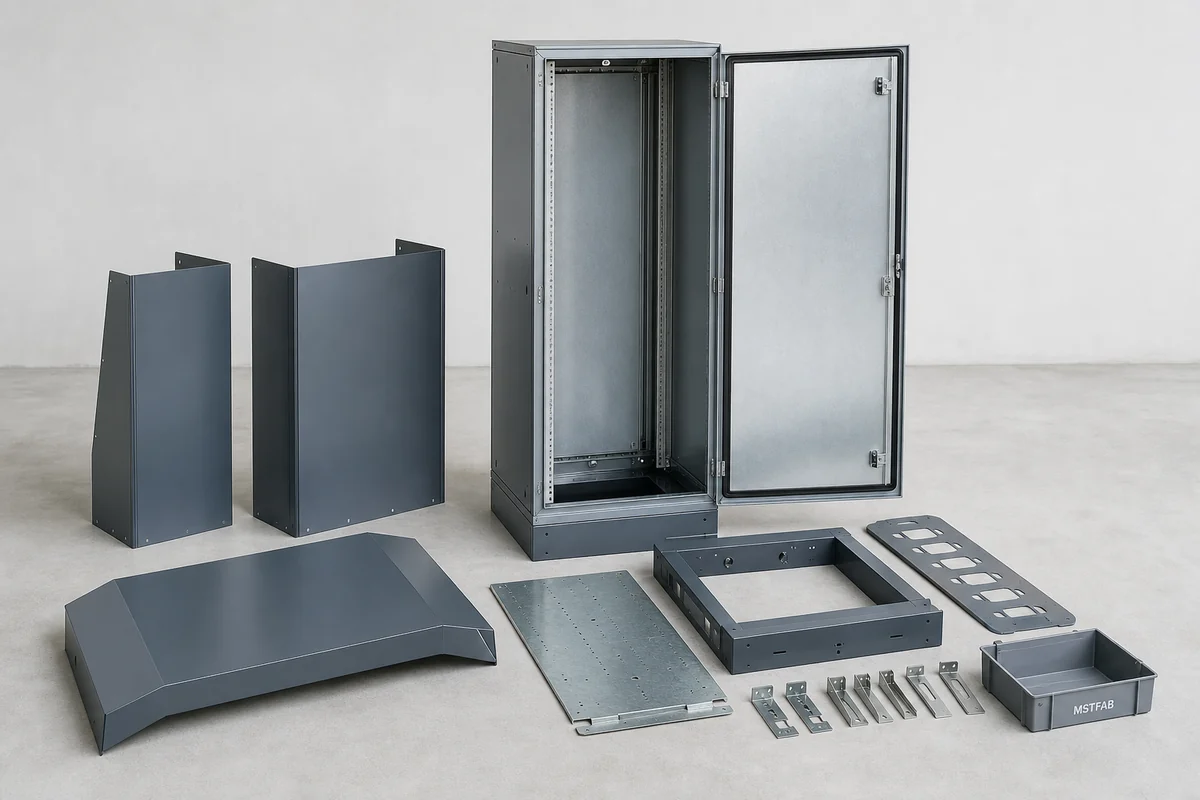
First, define the product boundary before the RFQ grows legs
MSTFAB manufactures empty outdoor network enclosure sheet metal shells and mechanical parts from buyer-controlled drawings. Typical scope includes doors, panels, welded frames, rain hoods, mounting plates, plinths, brackets, louvers, cable-entry plates, studs, hinges and specified mechanical hardware.
- Laser cutting, CNC bending and welding
- Powder coating and specified surface treatment
- Mechanical hardware installation and shell trial fit
- Dimensional inspection and export protection by agreement
- Routers, switches, servers and communication devices
- Wiring, power distribution and electronic integration
- Thermal-system design and environmental testing
- Final IP/NEMA claim, system certification and field validation
This boundary is not a footnote. It prevents an empty metal cabinet quote from quietly becoming a complete network-system promise. Those are different products, different risks and, unsurprisingly, different invoices.

Rain-shedding geometry is vague or disconnected from the drawing
Outdoor protection starts with the path water can take across the metal shell. The drawing should define rain hood projection, drip edge, door return, overlap, slope, seam location, cable-entry plate position and drain strategy. Simply writing “outdoor” near a rectangle is not a design specification.
During DFM review, the fabricator should check whether the hood can be formed with available tooling, whether welded seams distort the opening and whether bends create low points where water can sit. The buyer remains responsible for final ingress-protection validation, but the shell geometry must be built consistently enough to make that validation meaningful.
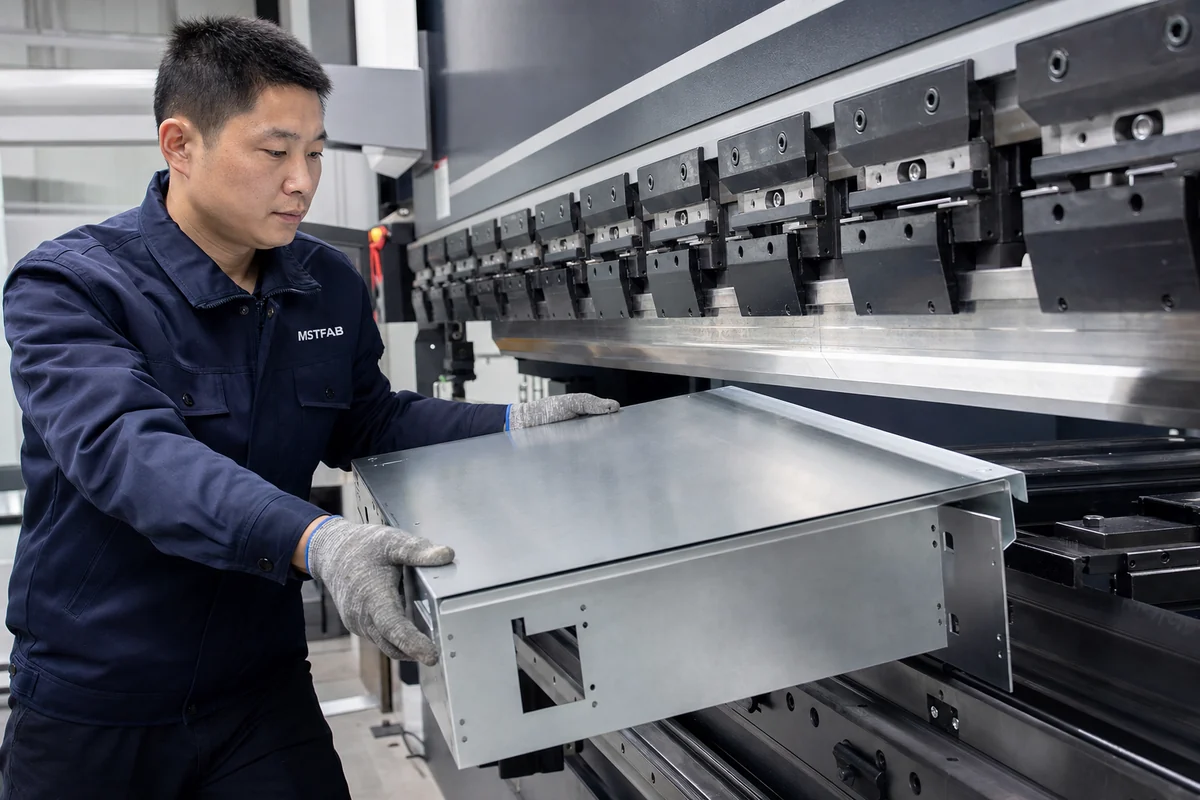
Door gap and gasket geometry move after bending, welding or coating
A door can look square on screen and still fight the frame in production. Multiple bends, long welds, hinge position, latch compression and coating buildup all influence the closing interface. The risk is highest when door gap, flatness and gasket channel dimensions are not tied to clear datums.
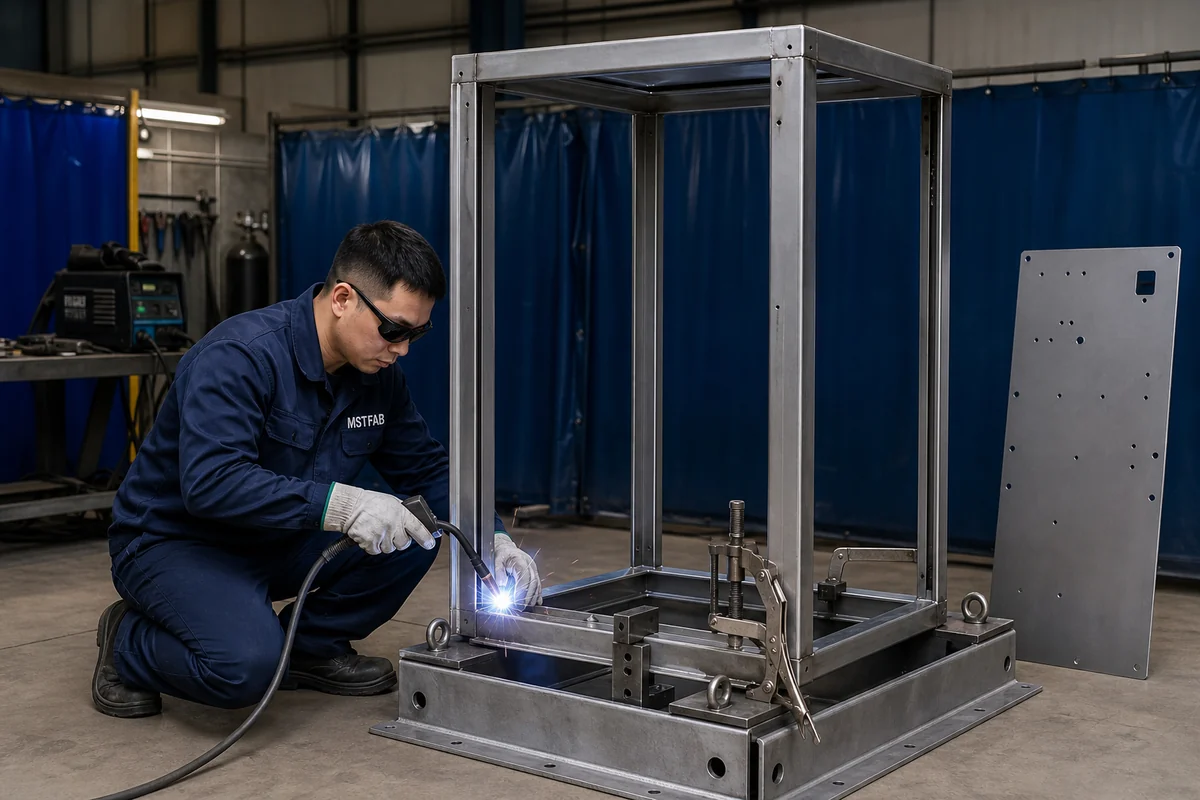
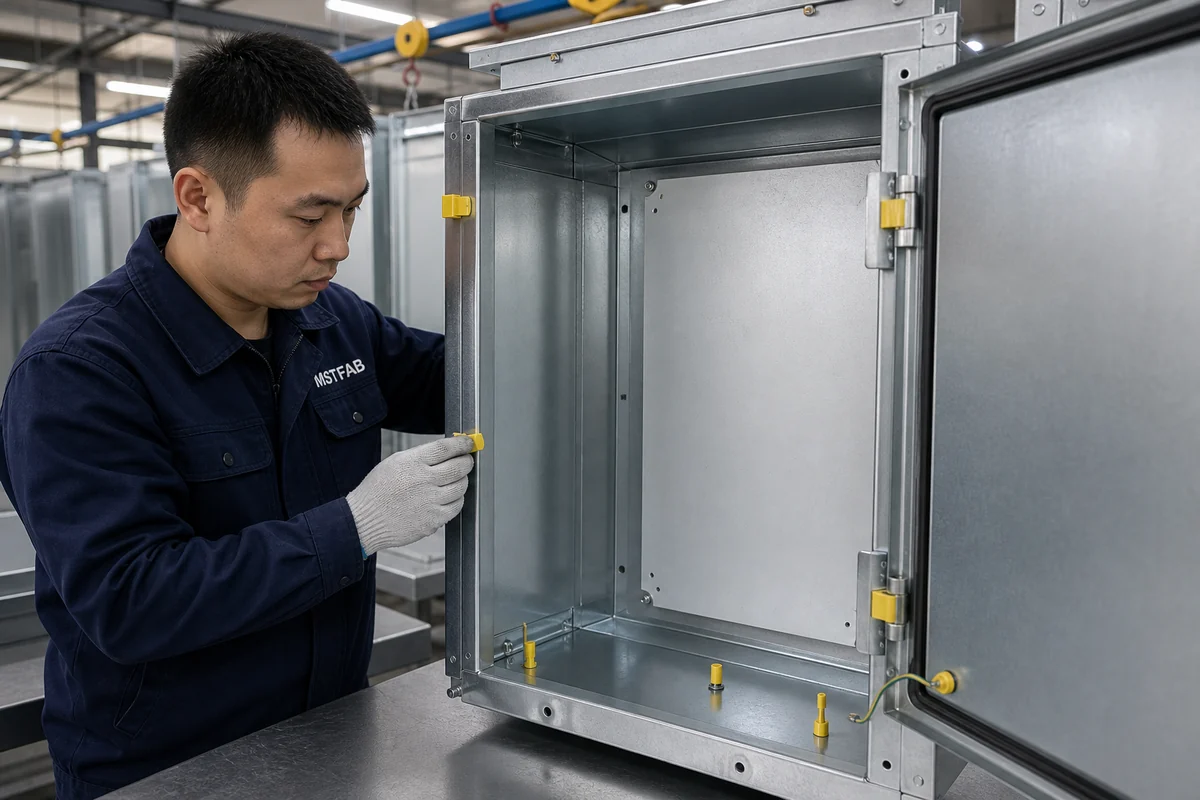
Fixture-controlled welding helps hold the frame. Mechanical trial fit then checks the empty shell with its doors, hinges, locks, studs and blank mounting plates. This is not electrical assembly. It is a practical way to find interference before coated parts arrive at the buyer and introduce themselves with a metallic clunk.
Finish requirements ignore cut edges, welds, masking and mating surfaces
Corrosion protection is a system: substrate, pretreatment, weld cleanup, coating specification, edge coverage, hardware compatibility and handling all matter. Buyers should specify material grade, finish, color, gloss or texture, coating thickness and visible-surface acceptance criteria. Coastal or high-humidity projects may require a different material and validation plan from an indoor control room.
Masking deserves its own drawing notes. Grounding contact areas, threaded studs, hinge interfaces, gasket faces and tight fits cannot be left to workshop interpretation. An attractive coating is not helpful if the door no longer closes or the buyer has to clean paint from every thread.
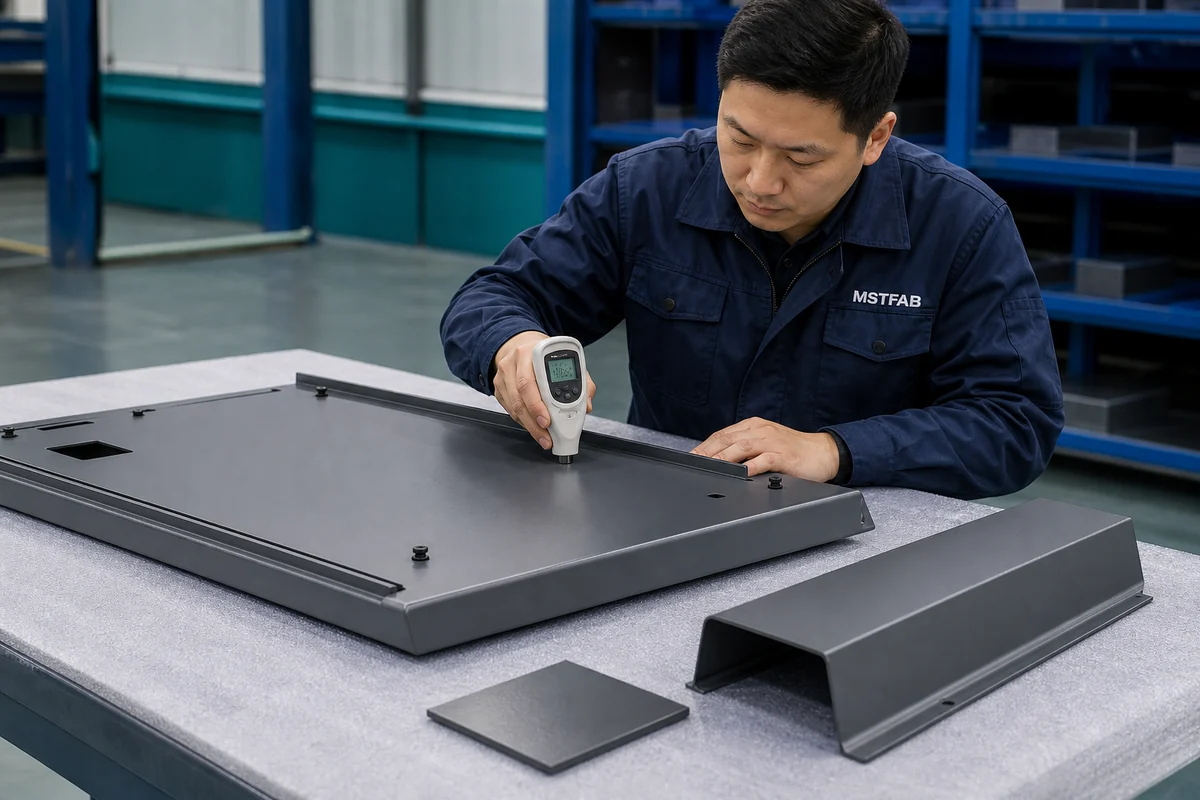
Use MSTFAB’s surface treatment services page to compare practical finish routes, then agree the inspection evidence needed for the project.
The first sample fits, but the next batch does not repeat it
One good sample proves that one sample can be good. Repeat supply needs revision control, material identification, controlled programs and tooling, approved finish samples, defined inspection points and batch status. Critical enclosure dimensions usually include overall squareness, door opening, mounting pattern, base geometry, panel interchangeability and agreed hardware locations.
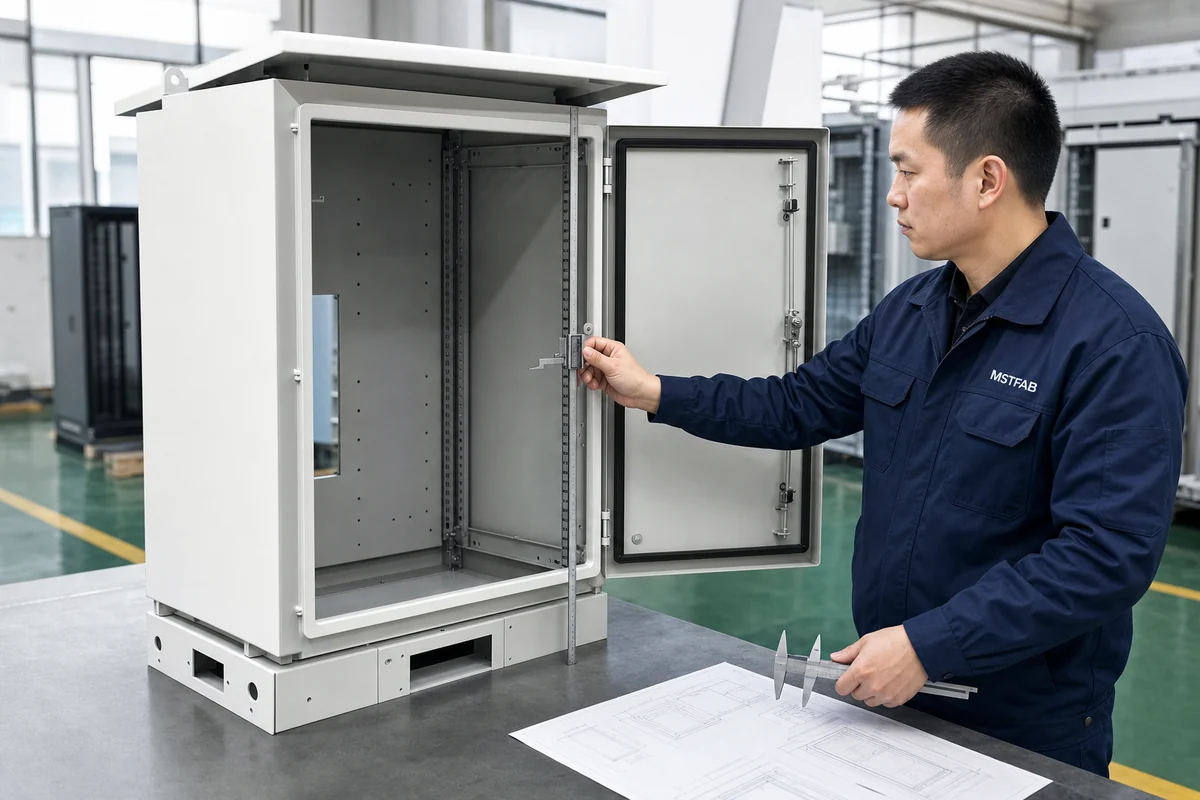
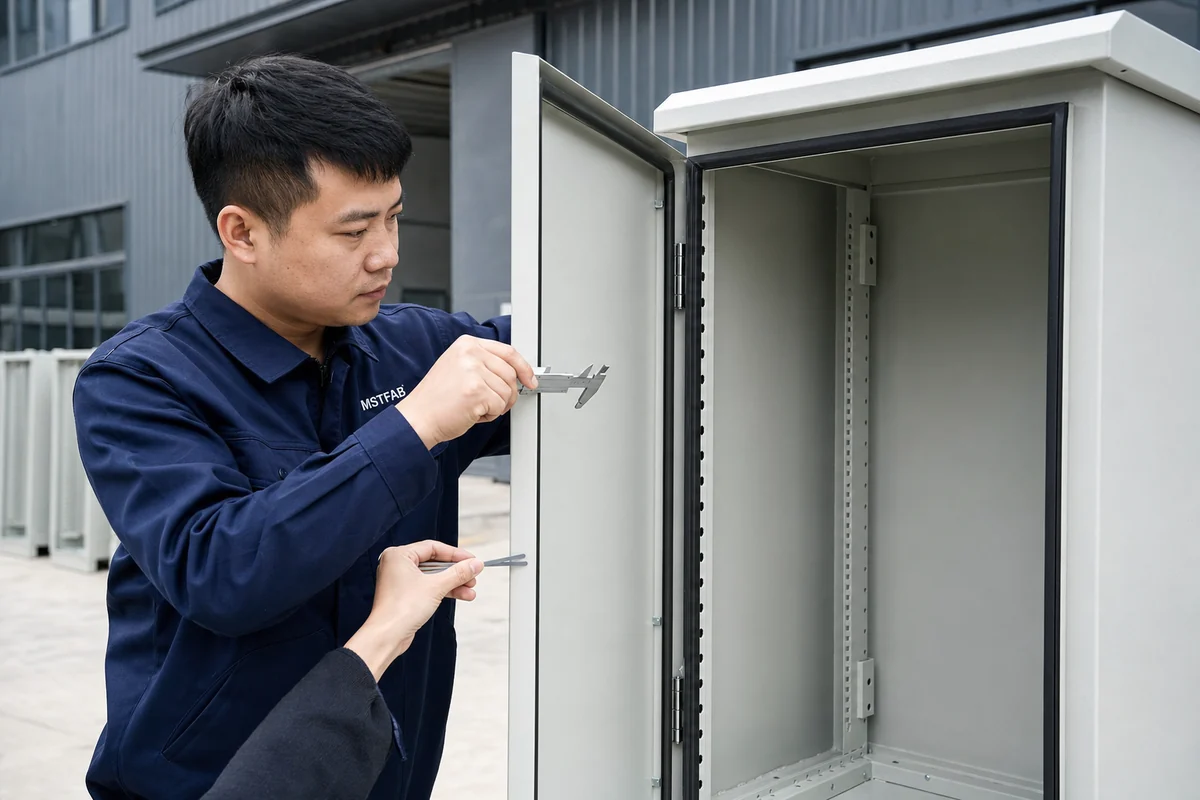
Ask what will be measured, how values will be recorded and how drawing changes move into work instructions. For high-risk interfaces, a dimensional inspection report or first-article inspection can provide useful evidence.

Procurement evidence matrix
What to ask the enclosure shell fabricator to prove
| Risk area | Drawing input | Useful supplier evidence | Owner of final validation |
|---|---|---|---|
| Water shedding | Hood, drip edge, seams, cable plate and drains | DFM notes, formed-part photos and first-article geometry | Buyer or integrator |
| Door and gasket interface | Gap, flatness, hinge, latch and gasket channel | Fixture plan, trial-fit photos and recorded dimensions | Shared mechanical review |
| Corrosion protection | Material, pretreatment, coating, masking and cosmetic class | Approved sample, coating checks and batch record | Requirements by buyer; process evidence by fabricator |
| Repeat production | Critical dimensions, datums, revision and quantity | First article, inspection report and batch traceability | Shared acceptance plan |
| System performance | Electronics, thermal loads, wiring and compliance plan | Not part of empty shell fabrication | Buyer or system integrator |
RFQ checklist
Send these details for a quotation that buyers can compare
| RFQ item | Why it matters | Recommended format |
|---|---|---|
| 2D drawing and revision | Controls dimensions, tolerances, notes and acceptance | PDF or DWG |
| 3D geometry | Clarifies assembly and supports programming | STEP or STP |
| Material and thickness | Changes bending, welding, corrosion route and cost | Grade and standard |
| Outdoor interfaces | Defines rain hood, gasket, cable plate, drain and mounting risks | Marked drawing |
| Finish and masking | Protects appearance, threads, grounding and fit | Drawing notes plus sample if needed |
| Quantity and forecast | Sets tooling, inspection and packing assumptions | Prototype, batch and annual estimate |
| Evidence required | Prevents inspection documents becoming a late surprise | FAI, critical report, photos or samples |
Export protection
Field failure can begin inside a crate
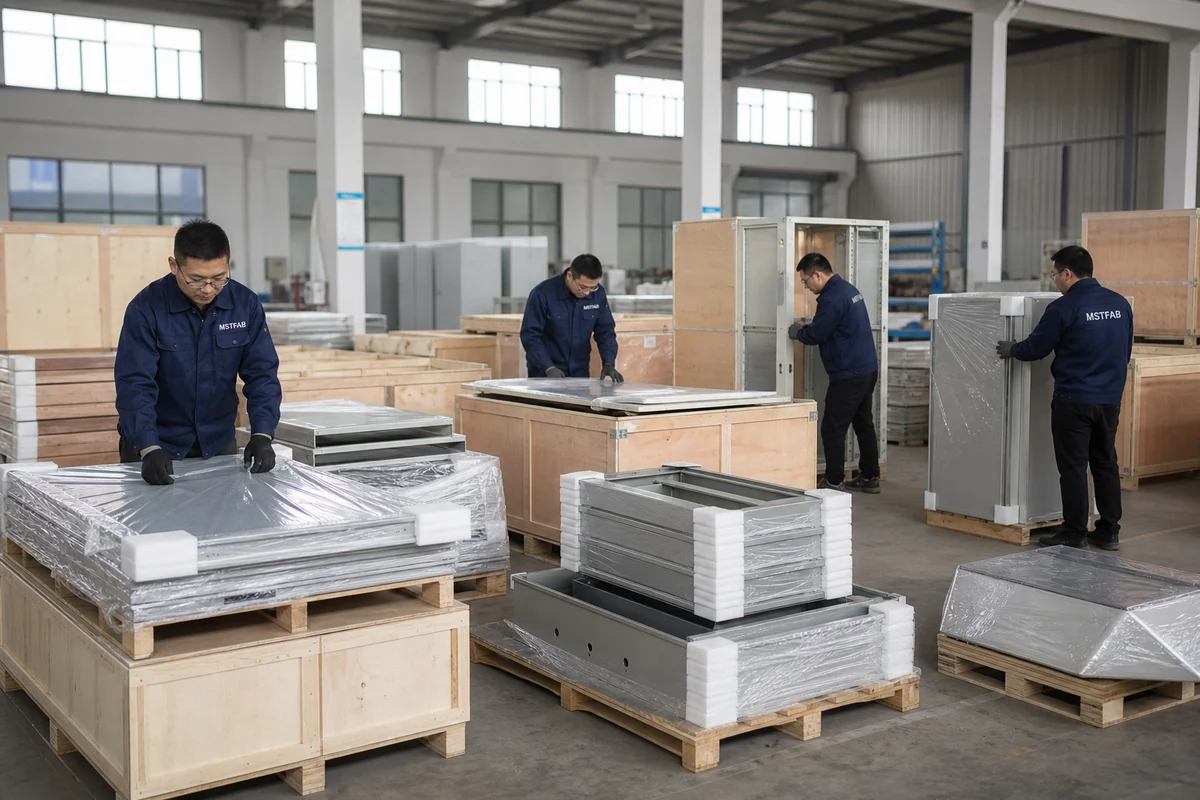
Thin doors can twist, rain hoods can dent and coated panels can rub during transport. A packing plan should separate sensitive surfaces, block heavy frames, protect corners and identify parts by assembly or drawing revision. Review MSTFAB’s assembly and export packaging capability for fabricated metalwork.
Match Each Claim to the Right Evidence
A workshop photograph can show a process or part, but its origin and relevance must be verified. Generated or illustrative images are not evidence of a completed customer order. A dimensional report should identify the actual part, revision, measured characteristics and inspection condition.
A fit check can confirm agreed mechanical interfaces when the specified mating parts or approved gauges are used. If those items were unavailable, record the limitation. An environmental or structural performance claim needs the separately agreed validation, not just a picture of a gasket or weld.
For any proposed material, hardware, seam or coating substitution, identify the affected drawing and obtain approval before use. Keep the approved change connected to the first article and repeat-order baseline. Do not treat “similar appearance” as proof of equivalent performance.
Trust evidence
Verify manufacturing evidence, not only brochure adjectives
FAQ
Outdoor network enclosure shell procurement questions
Does MSTFAB supply a complete outdoor network cabinet?
No. MSTFAB fabricates the empty sheet metal shell and mechanical parts to controlled drawings. Network equipment, wiring, power components, thermal hardware, software, energized testing and final system certification remain with the buyer or integrator.
Can MSTFAB guarantee an IP or NEMA rating?
MSTFAB can fabricate drawing-defined rain hoods, door returns, gasket interfaces, seams and cable-entry plates. The buyer owns the final enclosure design, gasket selection, assembly method and certified environmental testing unless a separate written validation scope is agreed.
Which materials suit outdoor network enclosure shells?
Common choices include galvanized steel with a suitable coating, aluminum and stainless steel. Environment, corrosion exposure, weight, welds, cosmetic requirements and cost should be reviewed together rather than choosing by material name alone.
What should be checked on the first article?
Check overall squareness, door opening, gap and flatness, mounting pattern, base, rain hood, cable plate, hardware, coating, masking and any drawing-defined critical interfaces.
What files help MSTFAB quote quickly?
Send a controlled 2D drawing, STEP model where available, material grade, thickness, quantity, finish, masking notes, critical dimensions, expected evidence and packing requirements.
Can empty shells be shipped as separate panels or welded cabinets?
Yes, when the drawing and logistics permit. The packing plan should match the chosen construction, surface sensitivity, shipment mode and buyer assembly method.
Drawing-based quotation
Send the shell drawing before the field finds the weak detail
MSTFAB will review the fabrication route, weather-exposed geometry, door interfaces, finish, inspection and export protection for empty outdoor network enclosure metalwork.
 WeChat Contact
 WhatsApp Me Directly