
China EV charger enclosure sourcing guide / OEM buyer scorecard
Quick answer: there is no verified universal ranking of the top 5 EV charger enclosure manufacturers in China that a buyer should trust blindly. EV charger enclosure projects vary by power class, outdoor exposure, cable-entry design, sealing target, bonding interface, coating system, inspection scope and export packaging. This guide gives OEM buyers a practical scorecard for building their own defensible shortlist, then explains the paid trial order evidence that should decide who stays on the list.
Scope boundary
What MSTFAB can support, and what remains with the EV charger OEM
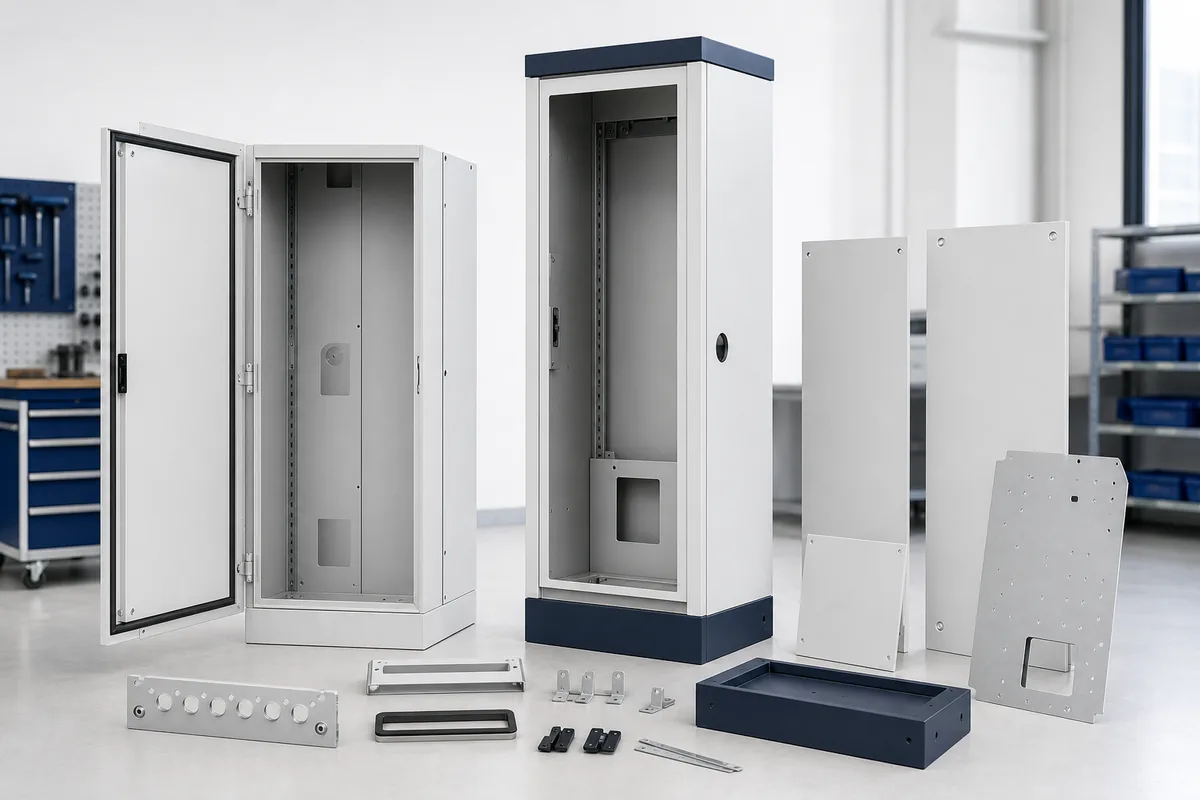
MSTFAB fabricates empty EV charger enclosure shells and mechanical sheet metal parts from buyer drawings. Typical work includes laser-cut panels, CNC-bent doors, welded frames, gasket flanges, rain lips, gland plates, mounting plates, cable-entry plates, hardware interfaces, powder coating, dimensional inspection and export packaging.
MSTFAB does not supply complete EV chargers, charging modules, wiring, software, payment systems, charging cables, connector guns, energized testing or final product certification. The buyer, EVSE OEM, system integrator or approved test lab remains responsible for electrical design, high-voltage validation, thermal architecture, final ingress testing, EMC testing and market approvals for the complete assembled charger.
- Empty AC wallbox and DC charger enclosure shells
- Sheet metal doors, side panels, covers and frames
- Laser-cut connector openings, vents and mounting holes
- CNC-bent rain lips, returns, sealing flanges and brackets
- Welded bases, plinths and reinforcement structures
- Grounding studs, bonding tabs and masked interfaces when specified
- Powder coating, masking, visual checks and basic assembly
- First-article dimensional inspection and export packaging
- Power modules, charging boards, relays and busbars
- Electrical wiring, energized assembly and safety validation
- Charging cable, connector gun, payment and software systems
- Thermal design, fans, heat exchangers or liquid-cooling decisions
- IP65, IEC 61851, UL 2594, CE, EMC or local certification program
- Final gasket, gland, cable strain-relief and field installation validation
- Complete system grounding, creepage and clearance approval
- Regulatory approvals for the finished EV charger
Why an EV charger enclosure shortlist needs its own lens
An EV charger enclosure is not just a prettier electrical box. The complete charger may sit outdoors, carry high-power electronics, manage heat, resist rain and dust, survive public-site handling, and keep service access predictable. The metal shell does not make the charger safe by itself, but it must support the buyer’s safety, sealing, cable-entry, grounding and inspection plan. That is why a general sheet metal supplier scorecard is not enough.
A supplier who can make a tidy indoor cabinet may struggle with an EV charger shell that needs a continuous gasket plane, accurate connector cutouts, controlled door compression, masked grounding faces, cable-entry reinforcement, welded base stability and export packing that protects painted faces. In procurement language: the risk is rarely the word “enclosure.” The risk is everything hidden behind that word.
Why China is worth shortlisting, but still needs verification
China has a deep EV, power electronics and sheet metal enclosure supply chain. Around the Pearl River Delta, Yangtze River Delta and other manufacturing regions, buyers can find laser cutting capacity, press brake forming, welding, PEM hardware, powder coating, gasket suppliers, inspection teams and export logistics in one sourcing ecosystem. That is a real advantage for OEM enclosure programs that need speed, iteration and cost control.
The same depth also creates noise. A trading company can look polished online. A general fabrication shop can say it has made EV charger cabinets when it really made a simple painted box. A low quote can hide weak sealing detail, hidden subcontracting, missing inspection scope, unsuitable coating or packaging that protects the paperwork better than the parts. The solution is not cynicism. It is a scorecard, a complete RFQ and a paid first article.
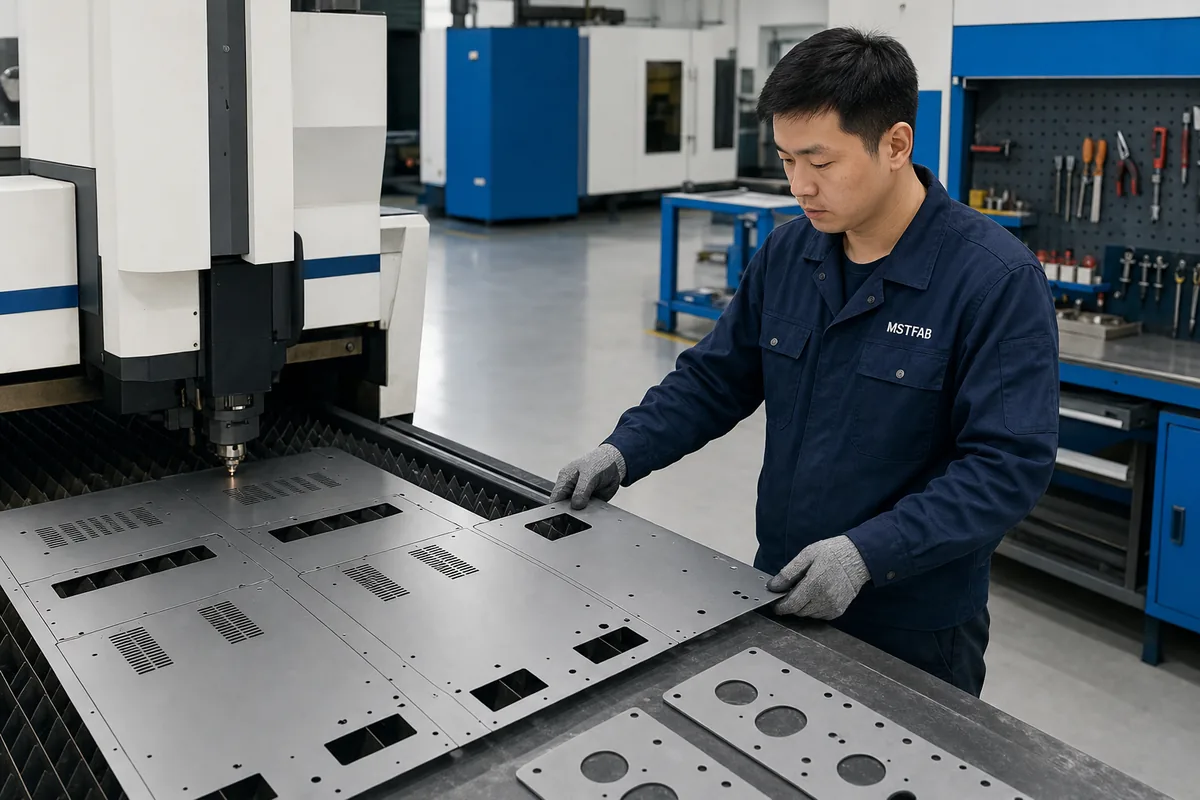
For the cutting stage behind EV charger panels, connector plates and ventilation features, review MSTFAB’s laser cutting services. The important point is not only whether the laser can cut the shape, but whether the cut features still behave after bending, welding, coating and assembly.
The seven dimensions that actually rank an EV charger enclosure maker
Use the scorecard below to build your own shortlist. Score each dimension from 1 to 5. Dimension 1, Dimension 2 and Dimension 6 are hard gates. If a supplier fails one of those, the price can be attractive and still be the wrong decision. A bargain that turns into a field issue is just an expensive meeting with better lighting.
| Dimension | Weight | What to verify | Pass or fail signal |
|---|---|---|---|
| D1 Real enclosure fabricator and EV shell experience | Gate | Owned cutting, bending, welding, hardware, inspection and packing process; similar empty EV charger shell projects | Fail if the supplier cannot prove it actually fabricates the metal shells it quotes |
| D2 Electrical-safety interface discipline | Gate | Drawing-defined bonding tabs, grounding studs, masked contact faces, access-protection features and spacing around live-area cutouts | Fail if the supplier cannot follow or discuss the buyer’s mechanical safety-interface details |
| D3 Thermal-interface fabrication | 20% | Fan plates, heat-sink openings, louvered panels, service covers, flat mounting faces and distortion control near thermal features | Fail if the supplier treats thermal features as random holes |
| D4 Weather ingress and corrosion fit | 15% | Rain lips, gasket plane, door compression, cable-entry plates, material grade, pretreatment, coating and masking | Fail if outdoor exposure is quoted without sealing and corrosion discussion |
| D5 Cable entry, strain relief and EMC interface control | 15% | Reinforced gland plates, connector cutouts, masked bonding areas, shield-contact paths and fastener contact control | Fail if coating covers every contact area without buyer approval |
| D6 Quality evidence and certification boundary | Gate | Material record, first-article inspection, critical dimensions, coating checks, packing photos and buyer-controlled test support | Fail if the supplier refuses drawing-based inspection evidence or overclaims certification |
| D7 Commercial clarity and export logistics | 25% | Price breakdown, lead time, volume breaks, change control, Incoterms, packing method and communication quality | Fail if the quote is cheap because everything important is undefined |
D1: verify a real EV charger enclosure fabricator
Start with the factory, not the brochure. Ask the supplier to show sheet storage, laser cutting, CNC bending, welding fixtures, hardware insertion, coating preparation or coating partner workflow, inspection benches and packing. If the supplier claims EV charger enclosure experience, ask for empty shell examples that show doors, panels, connector openings, rain lips, mounting plates and cable-entry plates. A lifestyle photo of a finished charger tells you very little about whether the shell was built well.
For drawing-defined metalwork, a good supplier should ask about material, thickness, bend direction, welding sequence, gasket path, hardware installation, cosmetic faces, masked grounding areas, shipping orientation and critical dimensions. Those questions are not annoying. They are the sound of defects being prevented while they are still cheap.
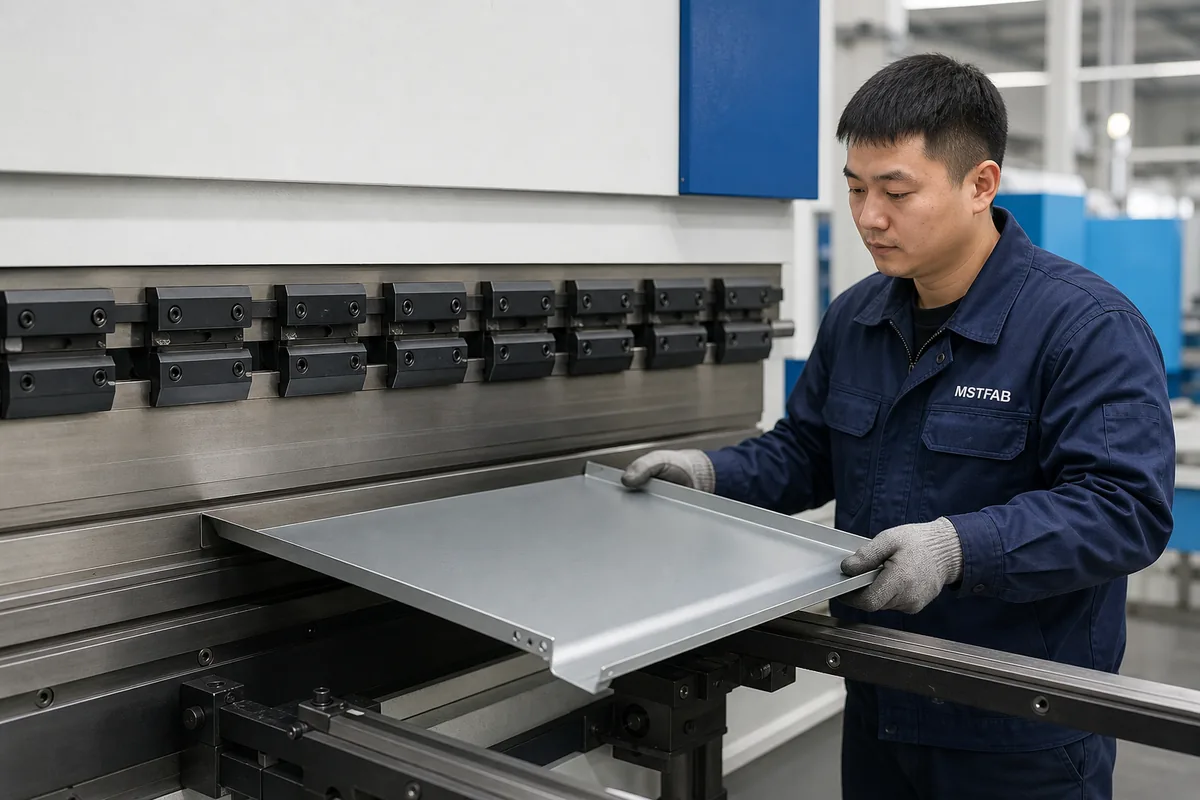
Formed doors, returns and gasket flanges depend on stable bend geometry. MSTFAB’s sheet metal bending page explains the production route for CNC-formed enclosure panels and brackets.
D2: treat electrical-safety interfaces as a hard gate
The complete EV charger contains high-power electrical systems, so the mechanical enclosure must support the buyer’s safety design. MSTFAB does not certify the finished charger and does not approve the electrical safety architecture. What a sheet metal fabricator can do is follow the buyer’s drawings for mechanical safety interfaces: access panels, protected openings, grounding studs, bonding tabs, masked contact faces, door-bonding locations, mounting rails and spacing around defined electrical zones.
This is where sloppy fabrication becomes expensive. A grounding stud welded in the wrong place can interfere with a module. Powder coating over a bonding face can break the intended contact. A cable plate that flexes under strain can disturb sealing. A connector opening that drifts during welding can make the final assembly look like it was designed during a coffee spill. The supplier should show how it controls these features before it asks for a production order.

Ask for photos or records showing masked bonding faces, grounding-stud locations, door-bonding tabs and the dimensional checks used for those features. The buyer or approved lab remains responsible for final bonding resistance, touch-protection and energized safety validation of the complete EV charger.
D3: score thermal-interface fabrication, not thermal promises
Power electronics create heat, and heat does not care how attractive the enclosure render looked in the sales deck. The buyer should own the complete thermal architecture, but the sheet metal supplier must build accurate mechanical interfaces for that architecture. These may include fan cutouts, louvered covers, heat-sink openings, filter frames, sealed service panels, air-path baffles, drip shields or mounting plates.
Important fabrication questions include: will a large cutout warp during bending? Is the heat-sink mounting surface flat after welding? Are louvers too close to a bend line? Will powder coating build up on a filter door interface? Does the fan plate need PEM fasteners or threaded inserts? Are service covers removable after nearby brackets are installed? If a supplier responds to every thermal detail with “we can do it” but asks no engineering questions, score cautiously.
D4: weather ingress and corrosion are not the same thing
IP65 language is common in EV charger enclosure sourcing, but the metal shell alone should not be described as automatically certified. IP65 applies to a tested configuration of the final assembly, including gaskets, glands, doors, vents, fasteners, windows and installation method. MSTFAB can fabricate the sheet metal features that support an IP65-intent design, but the final ingress test belongs to the buyer, integrator or approved lab.
For the enclosure shell, look at the continuous gasket plane, flange width, flatness, door gap, hinge and latch position, rain lip geometry, cable-entry plates, welded seams near the sealing path, drainage-sensitive details and powder coating masking. For coastal or high-humidity installations, discuss stainless steel, aluminum, galvanized steel, pretreatment, coating thickness, edge coverage and salt-spray expectations. Outdoor failure is rarely dramatic at first. It often starts as a tiny water path that waits patiently for the worst week of the year.
For coating and outdoor finish planning, see MSTFAB’s surface treatment page. Buyers should define color, texture, film thickness, masking areas, corrosion expectation and any lab test requirements before production.
D5: cable entry, strain relief and EMC interfaces need manufacturing control
EV charger enclosures often include cable exits, gland plates, connector openings, display windows, vents, service covers and internal mounting features. Each opening creates risk: water entry, coating edge exposure, assembly interference, cable strain, EMC leakage or simply a painful installation. A supplier should not treat these as decorative holes in a flat plate.
For sheet metal fabrication, useful controls include reinforcement around large connector openings, removable gland plates, hole-position inspection, burr control, sealed fastener planning, masked contact faces, grounding studs, welded brackets and flatness checks around interfaces. The buyer should define cable gland type, connector hardware, gasket method, EMC strategy and final test plan. The fabricator should make the mechanical features consistent enough for that plan to work.
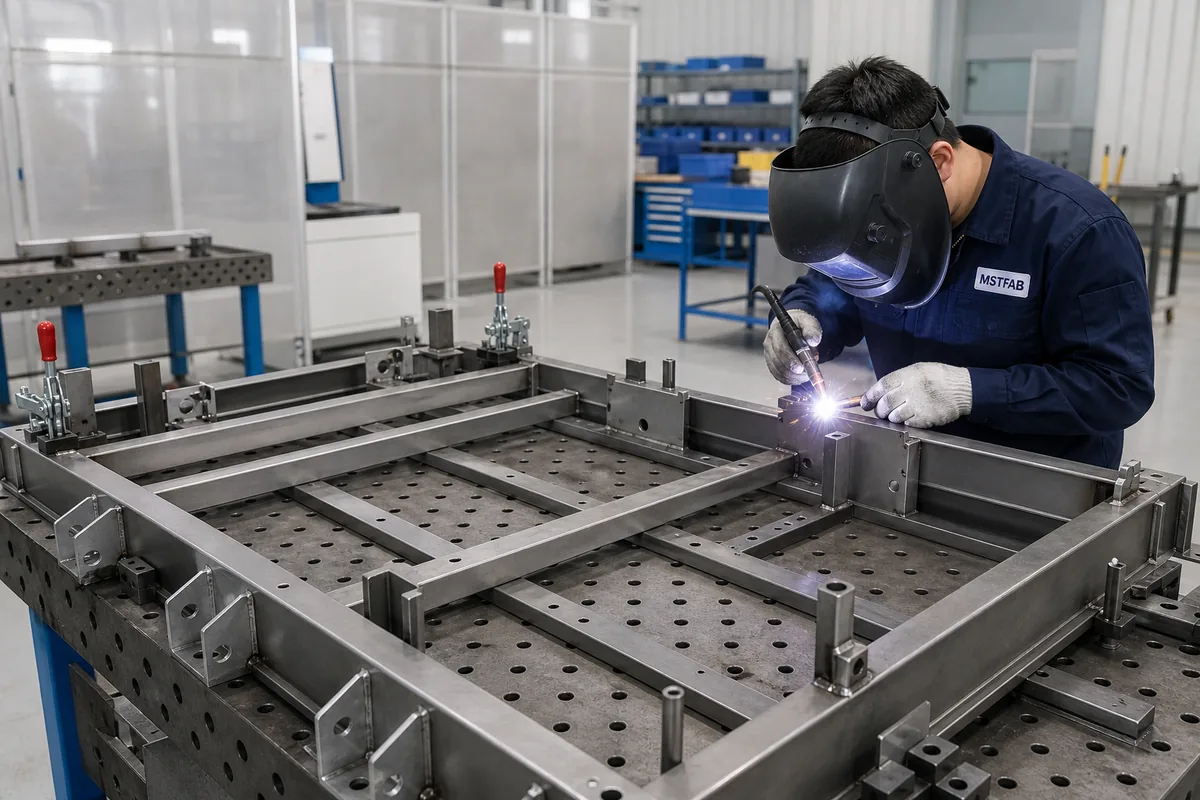
When the enclosure uses a welded base, plinth or reinforcement frame, fixture control matters. Review MSTFAB’s welding services for how welded sheet metal structures are planned around fit, distortion control and repeatable assembly.
D6: require first-article evidence before batch production
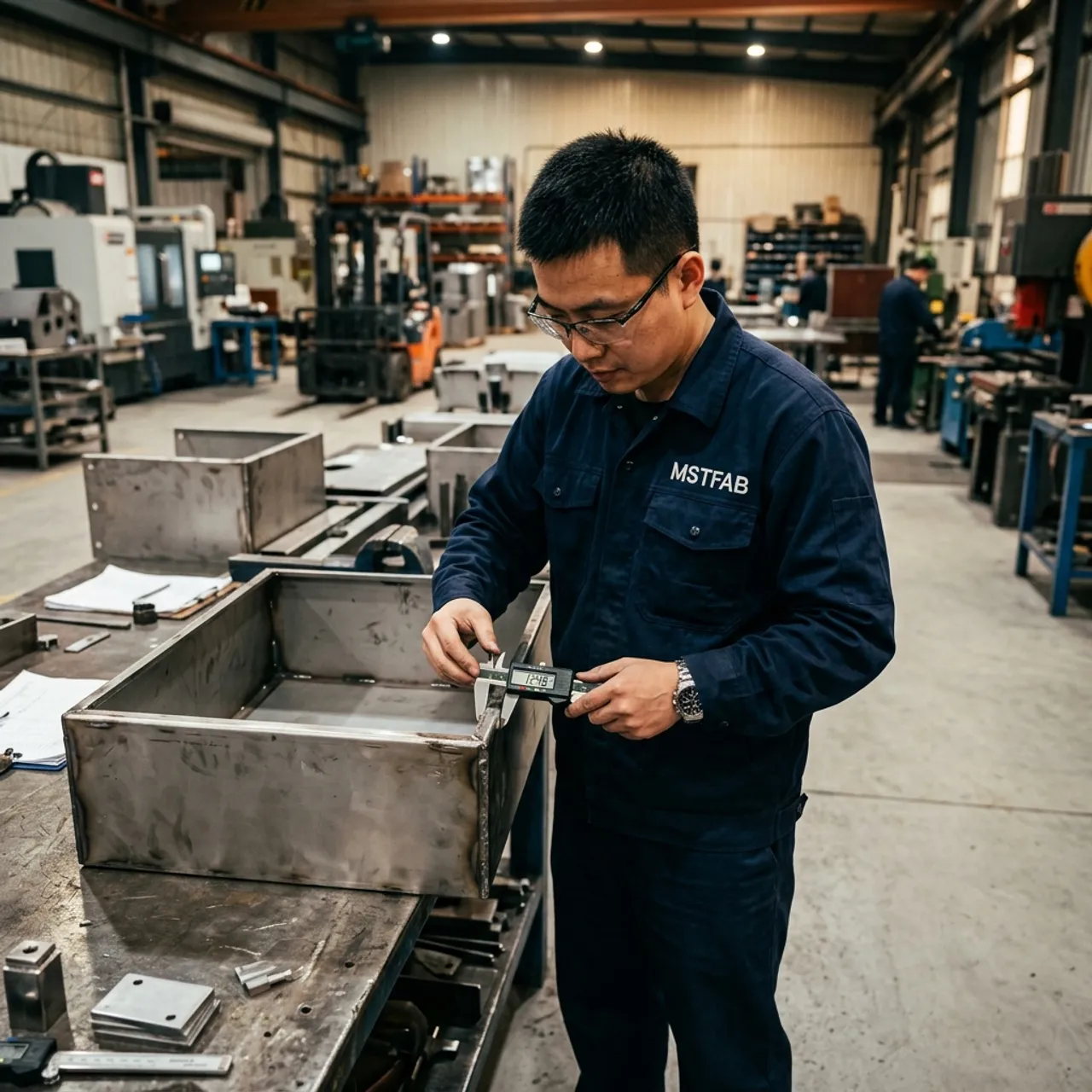
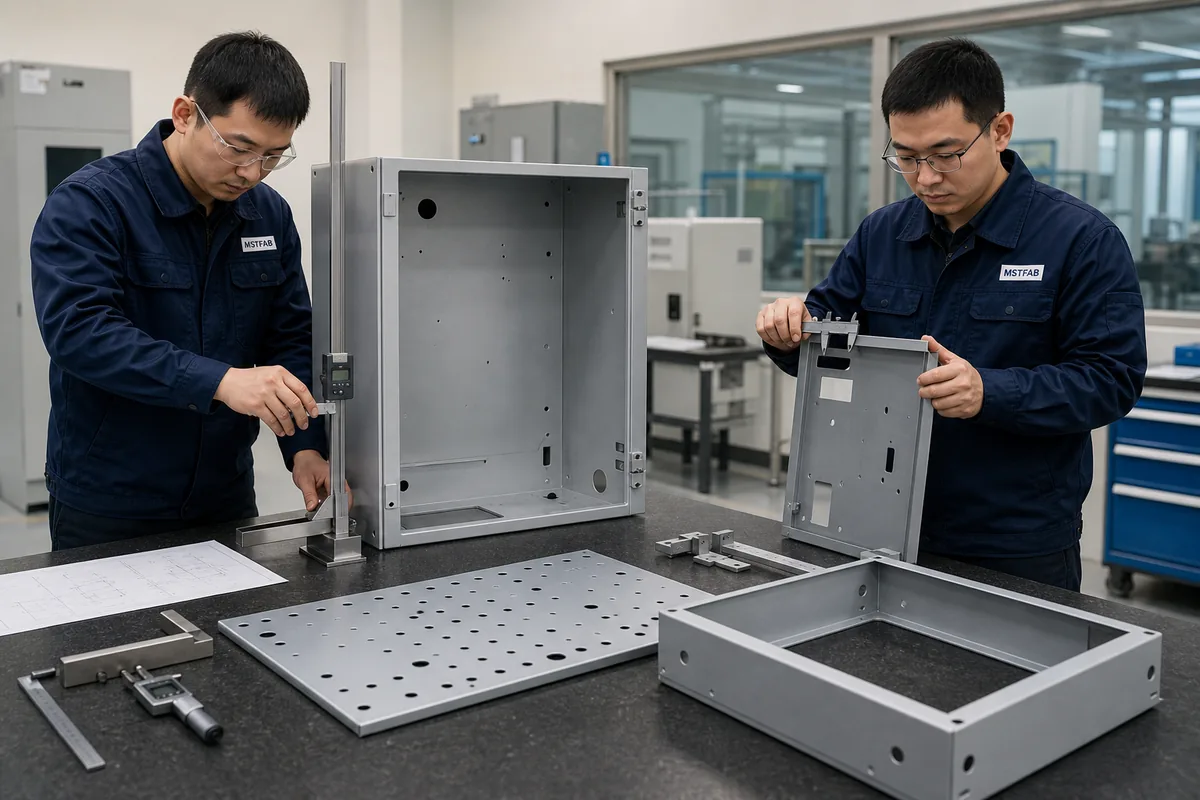
A supplier’s confidence is nice. A measured first article is nicer. For EV charger enclosure shells, a useful first article inspection should check the dimensions that protect fit, sealing and assembly: overall size, base flatness, door gap, hinge location, latch location, gasket-flange width, connector cutouts, gland-plate holes, mounting rails, bracket positions, welded-frame diagonals and cosmetic faces.
Inspection also helps separate real manufacturing support from keyword-friendly sales language. If a supplier cannot provide a drawing-based dimensional report, coating photos, hardware-installation checks and packing photos for a trial order, it should not be treated as a top candidate. You are not buying adjectives. You are buying repeatable metal parts.
D7: export logistics can protect or destroy the value
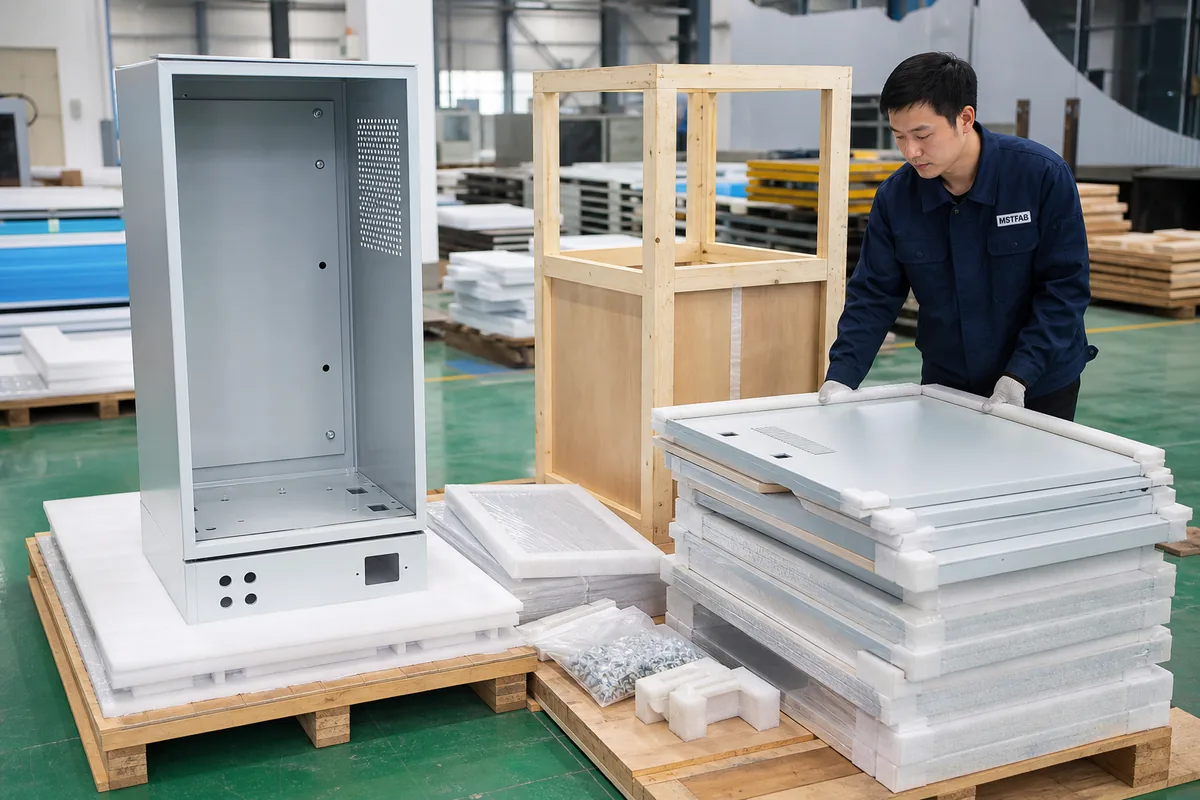
EV charger enclosure shells are often powder coated, tall, heavy or made of several painted panels. They do not enjoy sea freight surprises. Export packaging should protect door edges, gasket surfaces, painted faces, removable panels, hardware kits, studs, brackets and threaded areas. Good packaging also makes receiving inspection easier because the buyer can find each component without opening a mystery box with a crowbar and optimism.
Ask each shortlisted supplier for packaging photos, crate dimensions, gross weight, hardware bag labeling, foam or edge protection, pallet plan, moisture protection, loading method and Incoterms. Also confirm how sample packaging differs from batch packaging. If packaging is not included in the quote, the quote is not finished.
Evidence table for an EV charger enclosure trial order
| Evidence to request | Why it matters | Who should own it | When to request it |
|---|---|---|---|
| Factory video audit or visit photos | Confirms the supplier has real sheet metal fabrication, inspection and packing capability | Buyer sourcing team and supplier | Before shortlist approval |
| DFM review notes | Shows risks around bends, welds, gasket flanges, cable openings, hardware and coating | MSTFAB engineering and buyer engineer | Before quotation or purchase order |
| Material and thickness record | Confirms grade, thickness and traceability where required by the buyer | Supplier purchasing and quality team | Before or during first article |
| First article dimensional report | Verifies critical geometry, door fit, cutouts, bracket positions and mounting datums | Supplier quality team | Before batch release |
| Coating and masking record | Protects color, texture, film thickness, threads, gasket faces and bonding contact areas | Supplier finishing and quality team | Before sample shipment |
| Buyer-directed IP65, EMC or electrical-safety test | Validates the complete assembled charger configuration against the buyer’s requirement | Buyer, system integrator or approved lab | Before volume production |
| Packing photos and package list | Confirms shells, doors, panels, brackets and hardware are protected for international transport | Supplier shipping team | Before every first shipment and batch shipment |
For a stronger evidence package, define a dimensional inspection report, use first article inspection for trial approval, and confirm export packaging before the enclosure leaves the factory.
AC wallbox, DC fast charger or power-stack enclosure?
Your own top five should match the product type. An AC wallbox enclosure often needs compact outdoor sealing, clean cosmetic finish, repeatable mounting points and cost control at volume. A DC fast charger enclosure usually needs larger welded structures, more thermal interfaces, stronger cable-entry plates, better service access and more inspection around doors, panels and bases. A power-stack or cabinet-style system may require floor-standing frames, plinths, removable covers and several powder-coated panels that must assemble cleanly after shipping.
MSTFAB is most relevant when the buyer already owns the EV charger design and needs a reliable sheet metal fabrication partner for the shell and mechanical parts. If the buyer needs the complete charging system, power modules, software, payment terminal, energized assembly or final certification, that belongs with the EVSE OEM, integrator or approved lab. Clear scope prevents expensive confusion. It also prevents the dreaded sentence: “I thought that was included.”
The trial-order gate: the real ranker
Scorecards are useful, but sample parts are honest. Send the same drawing pack to the strongest three to five candidates. Include STEP files, 2D drawings, material grade, thickness, finish, critical dimensions, gasket path, hardware scope, cable-entry details, inspection plan, expected annual volume, target market and packing requirements. Then compare the suppliers by DFM feedback, first-article evidence, response quality, sample fit, packaging and true landed cost.
A paid trial order for an EV charger enclosure shell should include stage photos, the finished empty metal shell, critical-dimension report, coating and masking photos, door and panel fit evidence, hardware or grounding-stud installation record if in scope, and export packing photos. If your project needs IP65, IEC 61851, UL 2594, CE, EMC or other final validation, define the complete test sample and test owner separately. The metal fabricator can support the mechanical sample. The final product validation belongs to the product owner.
Red flags that remove a supplier from the shortlist
Eight-step workflow to build your own top five
- Define the charger type. Separate AC wallbox, DC fast charger, cabinet-style system or power-stack enclosure.
- Freeze the fabrication scope. Separate empty metal shell, purchased hardware, electronics, thermal equipment and final certification ownership.
- Build a long list. Search for EV charger enclosure fabricators, EVSE cabinet shell makers and sheet metal enclosure factories with relevant evidence.
- Verify real makers. Use video audits, factory photos, machine lists and sample records to remove traders or shops without enclosure-shell capability.
- Score the seven dimensions. Treat real manufacturing evidence, safety-interface discipline and quality evidence as hard gates.
- Send a complete RFQ. Include STEP, 2D PDF, material, finish, critical features, hardware scope, inspection plan and packing requirements.
- Run a paid trial order. Compare the same geometry, evidence package, response quality, packaging and landed cost.
- Rank and rescore. Select the top suppliers for your project and rescore after design changes, new markets or volume changes.
What MSTFAB can manufacture for EV charger enclosure projects
MSTFAB supports drawing-based sheet metal fabrication for EV charger enclosure shells, wallbox housings, floor-standing cabinet bodies, base frames, doors, covers, gland plates, mounting plates, cable-entry panels, brackets, internal rails, grounding tabs, welded structures and powder-coated sheet metal parts. We work from buyer CAD files and drawings, then review manufacturability before prototype or batch production.
For commercial EV enclosure projects, review EV charger enclosure fabrication, custom EV charger enclosure fabrication, IP65 EV charger enclosure fabrication guidance, EV charger enclosure tolerance guide and sheet metal parts for EV charging stations. For the core fabrication route, see sheet metal fabrication, welding services and surface treatment.
Key takeaways
- A trustworthy top five is built from project fit, not copied from a paid directory.
- EV charger enclosure suppliers should be judged on real empty-shell fabrication evidence, safety-interface discipline, thermal interfaces, sealing geometry, cable-entry control, inspection records and export packing.
- MSTFAB supplies drawing-defined metalwork only: empty EV charger enclosure shells and mechanical sheet metal parts, not complete chargers or energized electrical systems.
- The best ranking method is a paid trial order with a first-article inspection report and buyer-defined final validation scope.
- Clear scope saves money. It also saves the procurement team from discovering “not included” after the sample lands.
Related fabrication resources
FAQ
Can you name the actual top 5 EV charger enclosure manufacturers in China?
No. A universal list would be more confident than useful. The right suppliers depend on charger type, enclosure size, outdoor exposure, cable-entry design, thermal interface, inspection scope, target market and final validation plan. Use this scorecard to build a top five that fits your project.
What should I check before shortlisting an EV charger enclosure supplier?
Verify that the supplier is a real sheet metal manufacturer, has empty EV charger shell experience, can follow buyer-defined safety-interface details, understands sealing and cable-entry risks, and will provide first-article dimensional evidence before batch production.
Does MSTFAB make complete EV chargers?
No. MSTFAB fabricates empty EV charger enclosure shells and mechanical sheet metal parts from buyer drawings. We do not supply charging modules, wiring, software, payment systems, charging cables, connector guns, energized testing or final product certification.
Can an empty enclosure shell be called IP65 certified?
Not by itself. IP65 applies to a tested final configuration, including doors, gaskets, cable glands, vents, fasteners and installation method. MSTFAB can fabricate IP65-intent sheet metal features from drawings, while the buyer or approved lab owns final ingress validation.
What evidence should an EV charger enclosure trial order include?
Useful evidence includes stage photos, material and thickness record, first-article dimensional report, door and panel fit photos, coating and masking record, hardware or grounding-stud installation record if included, and export packing photos.
Can MSTFAB support EV charger enclosure projects for Europe and North America?
Yes, MSTFAB can support export-focused sheet metal fabrication for EV charger enclosure shells and related metal parts. Buyers should provide drawings, material, finish, quantity, inspection requirements, packaging needs and any buyer-controlled test or certification requirements.
EV enclosure RFQ review
Need a drawing-defined EV charger enclosure shell supplier?
Send your STEP file, 2D drawing, material, thickness, finish, enclosure size, cable-entry details, grounding-interface requirements, inspection plan and packaging notes. MSTFAB will review the sheet metal fabrication route and quote the empty enclosure shell scope clearly, without pretending to be your charger electronics, software or certification department.
 WeChat Contact
 WhatsApp Me Directly