
OEM component procurement guide / drawing-defined EV charging station metalwork
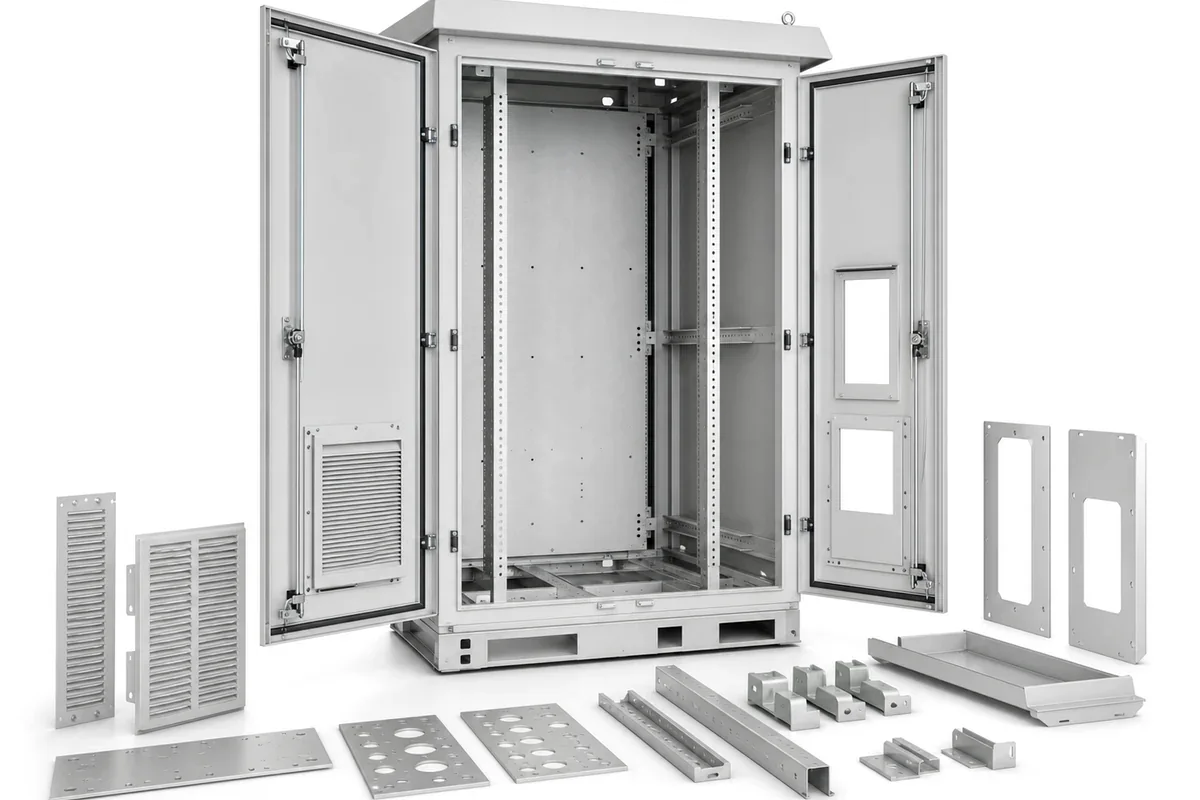
Short answer: Sheet metal parts for EV charging stations are not one anonymous pile of grey metal. Cabinet shells protect the assembly, mounting plates locate equipment, brackets hold interfaces, panels manage access, cable-entry plates control field routing and base frames carry the structure. A good RFQ gives each part a function, datum, material, finish and inspection method before anyone reaches for the laser.
Scope boundary
We fabricate the metalwork; the OEM builds and validates the charger
MSTFAB supplies drawing-defined, non-energized sheet metal parts for EV charging stations. The fabrication scope can include empty cabinet bodies, doors, removable panels, mounting plates, cable-entry plates, brackets, rails, plinths, welded base frames and buyer-specified mechanical hardware.
- Laser-cut cabinet panels and flat parts
- CNC-bent doors, covers, channels and brackets
- Fixture-welded bases, frames and reinforcements
- PEM hardware, studs, rivet nuts and mechanical trial fit when specified
- Powder coating, masking and appearance inspection
- Dimensional reports, first-article records and export packing
- Charging modules, controllers, contactors and busbars
- Cables, connectors, wiring and energized testing
- Payment systems, communications and software
- Complete thermal, electrical and functional validation
- Final selection of glands, vents, windows and seals
- IP, UL, CE and market-specific certification of the assembled product
Important responsibility line: We do not supply a finished charging station, charging modules, wiring, software or payment systems. MSTFAB manufactures the released mechanical parts; the EV charging OEM controls the complete product design, integration, testing and certification.
What this guide covers and how it differs from an enclosure service page
This is a technical procurement guide about the family of fabricated parts inside and around an EV charging station cabinet. It explains how those parts relate, where tolerance and revision problems appear and what evidence a buyer can request. It is not a replacement for a production quotation page and it is not an electrical charger design manual.
Buyers ready to quote an empty cabinet program can visit our EV charger enclosure fabrication service. This article stays focused on part classification, drawing control, interfaces and repeatable delivery so the service page can do its actual job: collect a useful RFQ.
Project workflow
Five steps from a mixed CAD package to controlled fabricated parts
Start with a bill of materials that assigns a part number, revision, material, thickness, finish and quantity to every cabinet, bracket, panel and frame. Then identify which dimensions connect one part to another. A folder named FINAL_v8_really_final is not a revision-control system, even when everyone agrees to type it confidently.
During DFM review, the supplier checks cutting, bend access, tooling, weld sequence, hardware installation, coating and inspection. The first article is then measured and trial-fitted before repeat production. For file preparation and quotation scope, use our sheet metal RFQ checklist.
Build an RFQ that a fabricator can price without guessing
| RFQ item | Buyer should define | Manufacturing reason |
|---|---|---|
| Part list | Part number, revision, description, quantity and assembly level | Separates individual brackets from welded or fitted subassemblies |
| CAD package | STEP model plus controlled 2D PDF for every released item | Combines geometry with tolerances, notes and inspection datums |
| Material | Grade, thickness, temper or condition and approved substitutions | Changes strength, springback, welding, corrosion and cost |
| Interfaces | Critical hole patterns, mating faces, door gaps, rail spacing and base mounting | Directs inspection toward dimensions that affect assembly |
| Hardware | PEM type, stud length, rivet nut, hinge, lock and supply responsibility | Prevents wrong threads, poor access and coating interference |
| Finish | Pretreatment, powder, color, texture, gloss, masking and cosmetic zones | Protects outdoor metalwork and controls visible brand surfaces |
| Quality evidence | FAI format, critical dimensions, material records and sample plan | Makes approval requirements quotable before production starts |
| Packaging | Protective film, separators, loose-part labels, pallet or crate and shipping route | Stops panels and brackets from damaging one another in transit |
The part family: six groups a buyer should keep separate
These groups may share the same material and powder color, but they do not share the same risk. A cosmetic door needs surface control. A mounting plate needs hole-location control. A base frame needs weld and flatness control. Applying one generic tolerance note to all three is tidy on paper and surprisingly untidy on the assembly floor.
Laser-cut panels: hole count is only half the story
Laser cutting creates door windows, service openings, ventilation patterns, gland-plate apertures, mounting holes, slots and identification features. The drawing should show which cutouts are cosmetic, which locate purchased hardware and which must align with another sheet metal part after bending or welding.
DFM review checks minimum web width, feature-to-edge distance, feature-to-bend distance, corner radii, pierce density and distortion risk. A panel with hundreds of ventilation holes can remain flat when the pattern, cutting sequence and support strategy are considered. A large window near a narrow flange may need a different bend sequence or temporary tabs. The laser is precise; the surrounding sheet is still allowed to behave like metal.
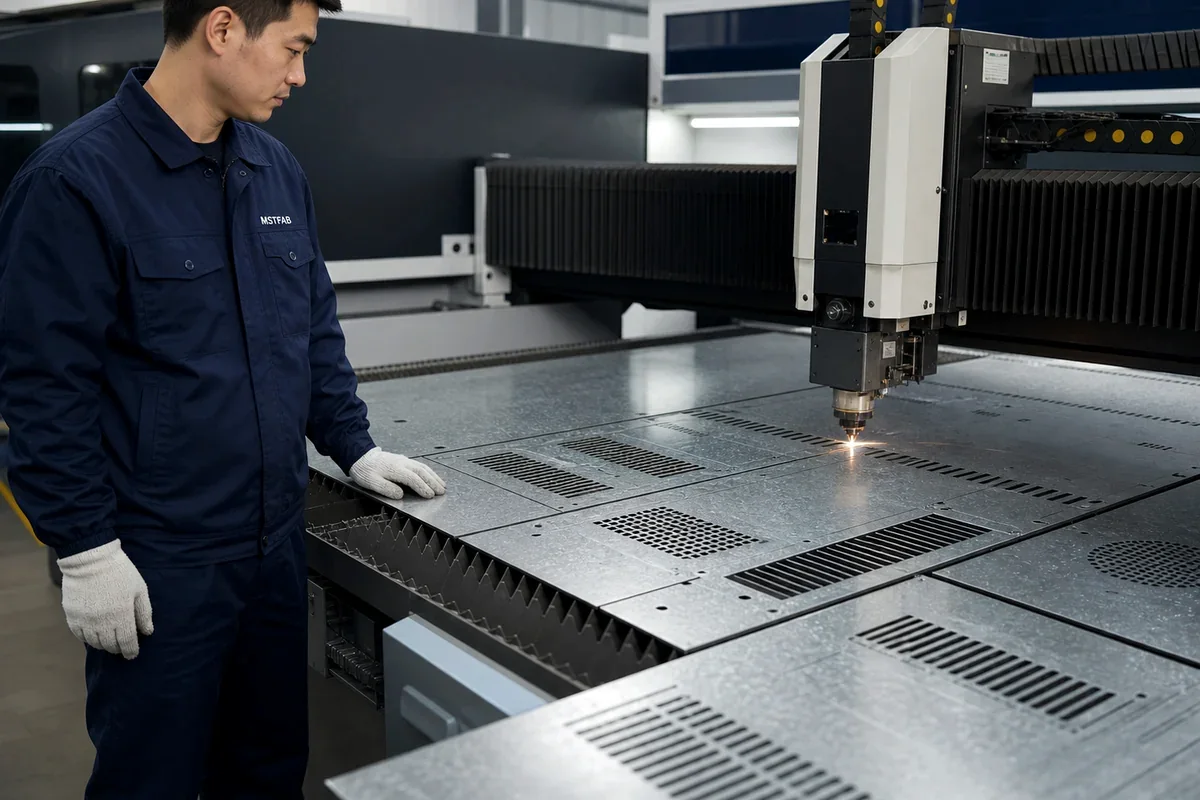
Our laser cutting services page covers the production capability, while this guide explains how cut features affect the wider cabinet assembly.
Mounting brackets: small parts with large assembly consequences
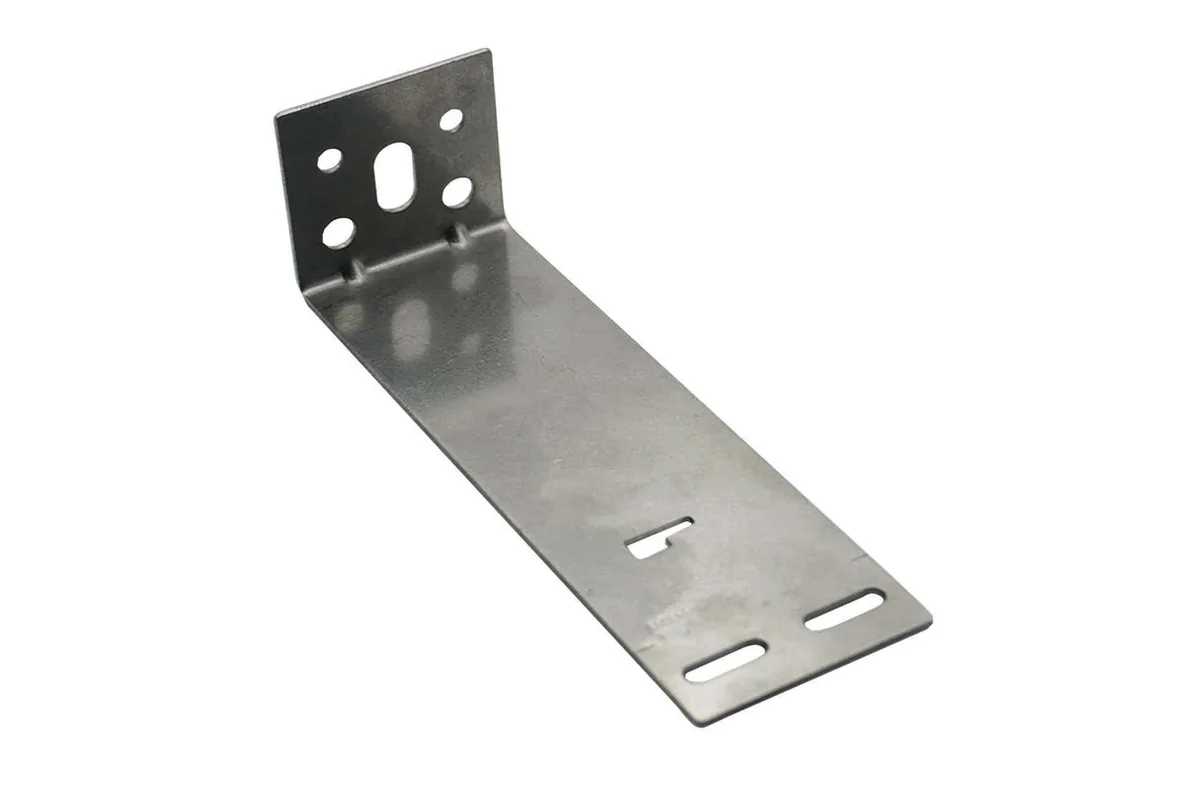
Brackets support cable trays, control modules, door stays, fans, covers and structural members. Their unit value may be modest, but a wrong slot direction or reversed bend can stop a much more expensive assembly. Drawings should define the functional faces, slot orientation, bend direction, thread or hardware requirement and any keep-out zone around tools and fasteners.
Use standard bend radii and practical flange lengths where possible. Keep holes far enough from bend lines to avoid distortion, and dimension related holes from one datum instead of stacking several local dimensions. If a bracket is mirrored, give each hand a separate part number. “Operator will understand” is a manufacturing instruction that tends to age badly.
For general fabrication routes and material options, see our sheet metal fabrication capability.
Mounting plates: control the pattern the OEM actually assembles
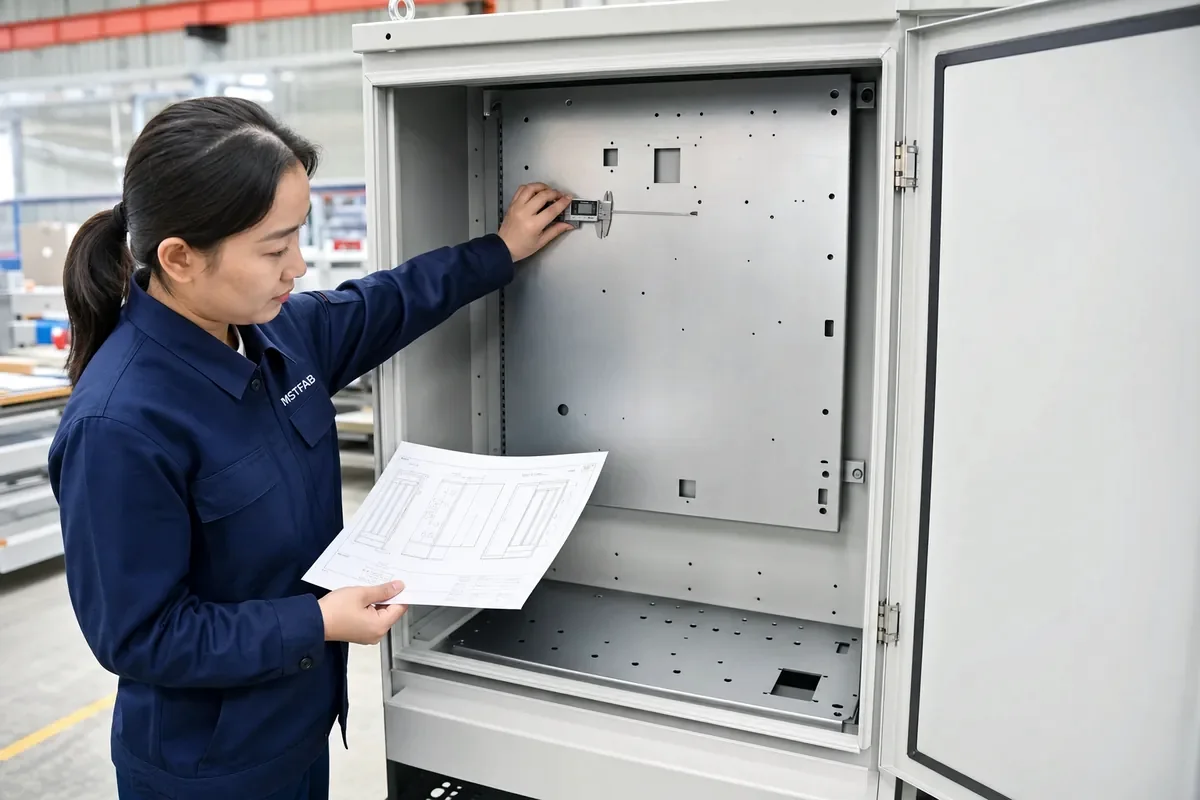
A mounting plate often carries rails, power electronics, cable management and buyer-installed components. Hole patterns may look simple until several suppliers deliver parts that must share the same datum. Define the primary mounting face, edge datums, hole position tolerances, thread form, stud projection and flatness where it affects installation.
Do not apply an unnecessarily tight tolerance to every hole. Separate locating holes from clearance holes and inspection-critical features from ordinary access features. This keeps the quality plan focused and avoids charging precision-machining expectations to a formed sheet metal plate.
CNC bending: flat-pattern accuracy must survive forming
Cabinet sides, doors, covers, channels and brackets change dimension when formed. Bend radius, K-factor, grain direction, tooling, material lot and springback influence the result. A mature drawing identifies the dimensions that matter after bending and allows realistic tolerance for non-functional edges.
Consistent bend radii reduce tool changes and setup time. Adequate flange length gives the press brake a stable surface. Reliefs protect corners where bends meet, and thoughtful feature placement prevents holes from stretching into small ovals. For large panels, the handling plan matters too: a dimension can be correct at the brake and damaged during an improvised journey across the shop.
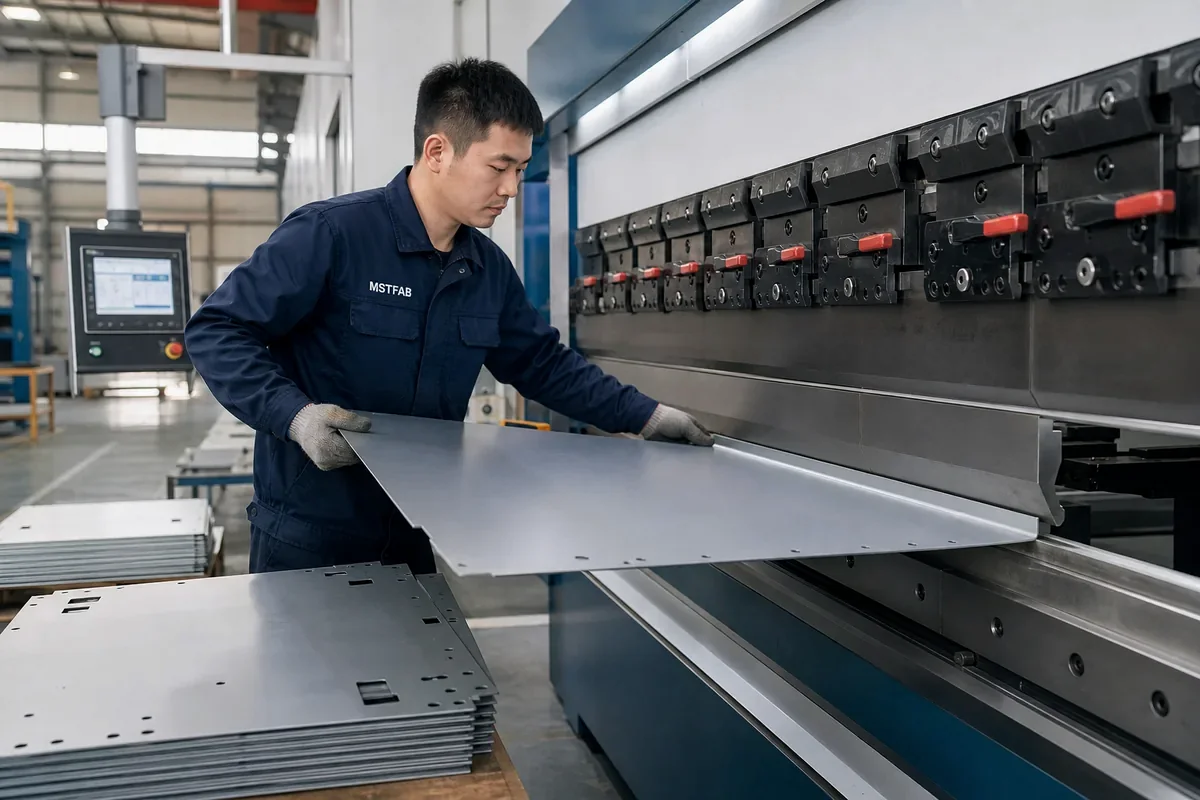
Detailed forming information is available on our CNC sheet metal bending page.
Base frames and welded structures: protect the datums from heat
A base frame carries cabinet weight, anchoring loads and handling forces. Its top mounting face, anchor holes, lifting features and diagonals should be tied to an inspection scheme. Welding sequence and fixture strategy must protect those features while joints are added and the structure cools.
Weld symbols should identify joint type, size, length and location. Continuous welds, stitch welds and cosmetic ground seams have different cost and distortion effects. More weld is not automatically more strength, especially when it moves the hole pattern that everything above it needs. The design owner should define structural requirements; the fabricator can then propose a controllable process.
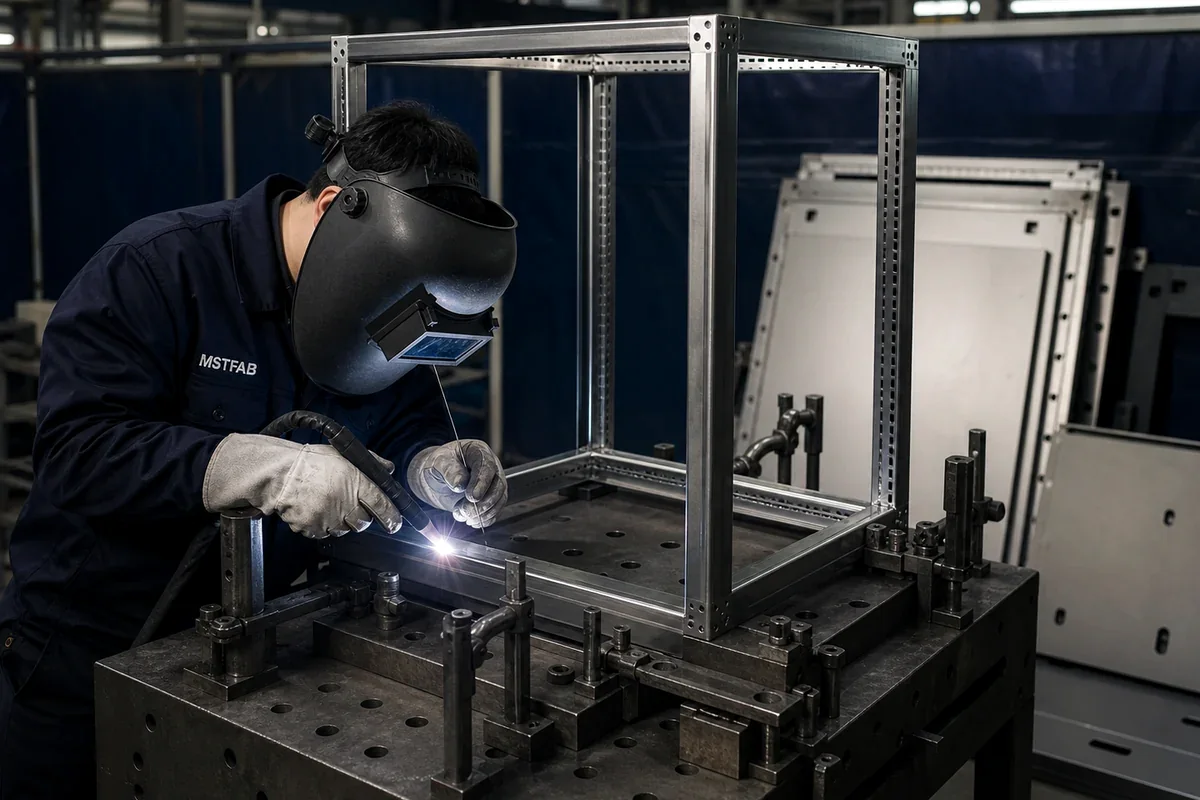
See our sheet metal welding services for fixture, TIG and MIG process scope.
Doors, removable panels and cable-entry plates need clear interfaces
Doors combine appearance, stiffness, hinge geometry, latch pull, gasket contact and service access. Removable panels add fastener access and repeat installation. Cable-entry plates add a boundary between factory fabrication and field routing. Each part needs a defined relationship to the cabinet rather than an isolated drawing that merely looks plausible.
For cable-entry plates, specify material, thickness, gasket or sealant if required, screw pattern, opening ownership and whether blank plates or pre-cut gland holes are supplied. Leave enough cable bend space and tool access. When an installer cannot reach a gland or route a power cable, the elegant CAD model often meets a drill. The drill rarely reads the ingress test report first.
For outdoor cabinet sealing and drainage decisions, use the companion IP65 EV charger enclosure fabrication guide. It separates metalwork prerequisites from final assembled-product validation.
Hardware insertion and grounding features should be designed before coating
PEM nuts, studs, standoffs, weld studs, rivet nuts, hinges and locks affect both fabrication order and inspection. The drawing should include manufacturer or standard, thread, length, orientation, installation side and pull or torque requirement where relevant. Hardware too close to a bend or return flange may block tooling; hardware installed after coating may damage a cosmetic face.
Grounding studs and bonding interfaces need buyer-defined electrical requirements. MSTFAB can fabricate and install the mechanical feature to the released drawing, but the OEM validates electrical continuity and the complete grounding system. Masking, bare-metal contact zones and corrosion protection must be reconciled rather than assigned to separate notes that quietly disagree.
Material selection: choose for function, process and environment
Material choice does not replace product validation. Stainless steel is not a weatherproofing method, and powder-coated steel is not automatically unsuitable outdoors. The design has to combine substrate, geometry, joining, pretreatment, coating and maintenance for the actual installation environment. Our sheet metal material selection guide provides a broader comparison.
Powder coating: appearance and interfaces need separate acceptance rules
Specify pretreatment, coating type, color reference, texture, gloss, film-thickness range, masking and cosmetic zones. Visible doors may need approved color and texture samples. Internal brackets may need functional coverage without premium cosmetic grading. Threads, grounding contacts, hinge interfaces and close-clearance features often need masking or coating allowance.
Inspection can include appearance under agreed lighting, color sample comparison, film-thickness readings and checks for blocked threads, sharp-edge exposure, runs, pinholes and transport damage. A subjective note such as “nice finish” is friendly but difficult to put on an inspection form.

Our surface treatment capability explains powder coating and other finish routes for fabricated metal parts.
Tolerances and datums: inspect the assembly relationship, not decorative decimals
Sheet metal parts pass through cutting, bending, welding, hardware insertion and coating. Each process introduces predictable variation. Define tighter tolerances only where they protect fit, function or safety. Use a stable datum scheme so the supplier and buyer measure the same geometry from the same references.
First-article inspection should connect the BOM to the physical kit
A useful first-article package confirms part numbers, revisions, quantities, material, finish, hardware and critical dimensions. For a cabinet kit, it can include door trial fit, mounting-plate fit, bracket orientation, rail spacing, base-frame geometry and photographs of marked parts. The objective is to approve a repeatable physical configuration, not to create a thick report that avoids the difficult dimensions.
Agree the report format before quotation. Mark critical characteristics on the drawing, define gauges or measurement methods where needed and identify buyer-supplied trial-fit items. When the assembly is large, a coordinated datum plan is more valuable than measuring every edge independently.
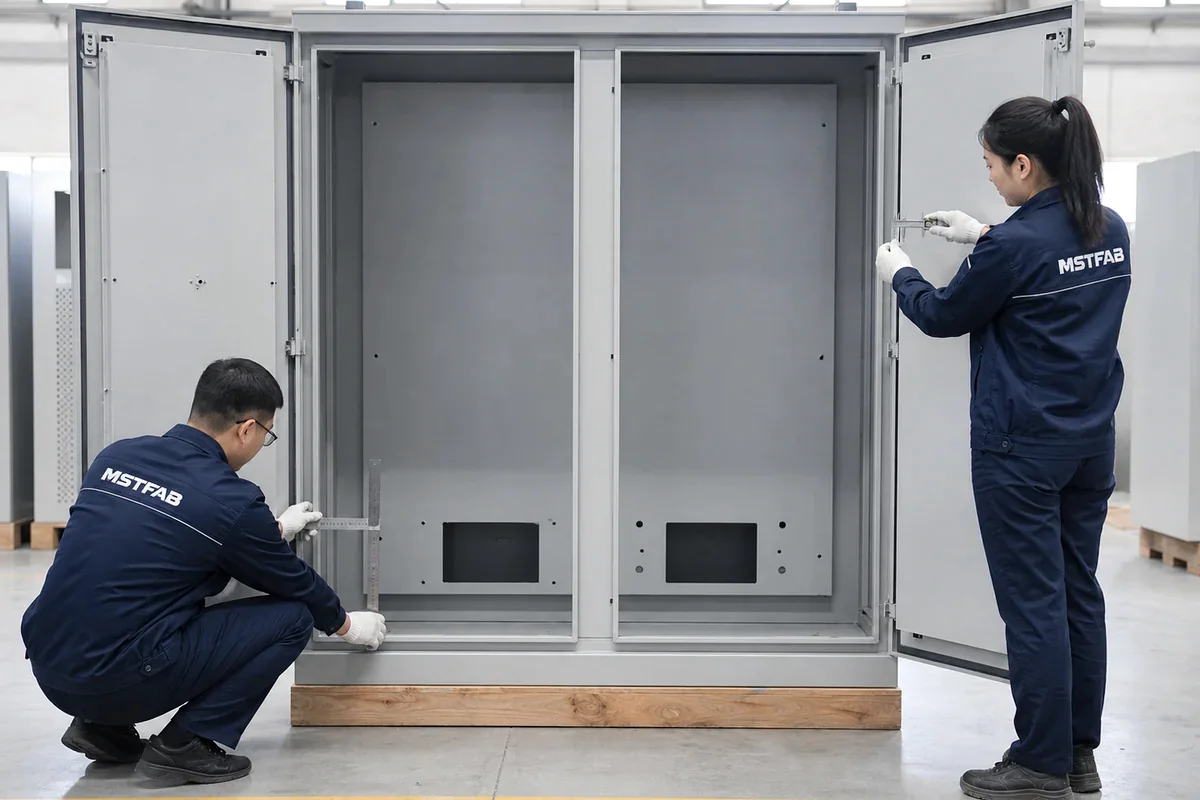
Evidence buyers can request before repeat production
| Evidence | What it confirms | Typical owner | Best approval point |
|---|---|---|---|
| Released BOM and drawing register | Part numbers, revisions and quantities match the purchase scope | Buyer and MSTFAB project teams | Purchase-order review |
| DFM clarification record | Cutting, bend, weld, hardware and inspection questions were resolved | MSTFAB engineering and buyer | Before first-article fabrication |
| Material and hardware records | Specified metal and installed mechanical hardware match requirements | MSTFAB purchasing and quality | Receiving and production release |
| First-article dimensional report | Critical interfaces follow the released drawing and datum scheme | MSTFAB quality team | Before repeat production |
| Mechanical trial-fit photos | Doors, panels, plates, brackets and frames assemble in the approved relationship | MSTFAB and buyer | FAI review |
| Coating inspection record | Appearance, film thickness and masking match the approved finish scope | MSTFAB finishing and quality | Before sample shipment |
| Revision and change log | Approved drawing changes are visible and obsolete files are removed | Buyer document owner and MSTFAB | Every engineering change |
| Packing photographs and labels | Part identity and protection are maintained through export transport | MSTFAB shipping team | Before first shipment |
Buyers can specify a dimensional inspection report, a first-article inspection plan and export packaging for fabricated sheet metal parts.
Packaging a mixed cabinet kit without creating a metal puzzle
Doors and painted panels need separators and surface protection. Long rails and base members need restraint. Small brackets and hardware need labeled bags or cartons tied to the BOM. Mounting plates should be protected from bending and rubbing against rough welded frames. The package should make receiving and kitting easier, not ask the buyer to identify sixteen nearly identical brackets by optimism.
Define whether items ship loose, mechanically assembled or as welded subassemblies. Agree pallet size, crate requirements, moisture protection, stacking limits and label format for the actual shipping route. Our assembly and packaging capability describes the supported mechanical scope.
Cost control that does not move problems to the assembly line
Cost reduction is not simply removing metal or loosening every tolerance. It is eliminating requirements that do not protect the product while preserving the datums, loads, interfaces and finishes that do. Early DFM usually saves more than negotiating after drawings, hardware and test samples are already frozen.
Common procurement failures and the practical alternative
Most expensive surprises are not dramatic. A row of holes is 2 mm off, a bracket is reversed or powder fills the threads. The fix is rarely a heroic new machine. It is usually a clearer drawing, a better datum and a first article approved before volume production.
Related fabrication resources
These pages support an EV charging station sheet metal parts program from drawing review through protected export delivery:
Frequently asked questions
Does MSTFAB supply complete EV charging stations?
No. MSTFAB fabricates drawing-defined empty cabinet shells and non-energized mechanical sheet metal parts. The buyer or system integrator supplies charging modules, wiring, controls, software and complete product validation.
Which files are best for quoting a family of EV charging station parts?
Send a controlled BOM, STEP files and dimensioned 2D PDFs. Include part numbers, revisions, material, thickness, finish, hardware, quantities, critical datums, inspection requirements and assembly-level definitions.
Can cabinets, brackets, panels and frames be quoted together?
Yes. Keep each item as a controlled part number and identify whether it ships loose, mechanically fitted or welded into a subassembly. This lets setup, finishing, inspection and packaging be priced correctly.
Can MSTFAB install PEM hardware, hinges and locks?
Yes, when the exact parts, installation side, process and acceptance criteria are included in the purchase scope. Electrical devices and energized assembly remain outside the metal fabrication scope.
How should critical tolerances be selected?
Apply tighter tolerances to mounting patterns, mating faces, door and frame relationships and other functional interfaces. Use practical general tolerances for non-critical edges so cost and inspection effort remain proportional to risk.
What should be approved before repeat production?
Approve the released BOM and drawings, DFM clarifications, material and hardware scope, first-article dimensional report, mechanical trial fit, finish sample where required and packaging method.
Drawing review
Have an EV charging station cabinet and parts package ready?
Send the BOM, STEP files, 2D drawings, material, finish, hardware, quantities and critical inspection points. MSTFAB will review the laser cutting, bending, welding, finishing and mechanical-delivery scope while your team retains control of the complete charger system.
 WeChat Contact
 WhatsApp Me Directly