
OEM procurement guide / empty outdoor charger cabinet metalwork
Short answer: IP65 EV charger enclosure fabrication depends on a controlled sealing plane, repeatable door geometry, sensible cable entry, managed weld distortion, specified gasket compression and a buyer-approved validation plan. Calling a cabinet “weatherproof” is quick. Making every opening behave when water arrives sideways takes a little more paperwork and considerably better metalwork.

Scope boundary
What MSTFAB fabricates and what remains with the EV charger OEM
MSTFAB supplies drawing-defined empty IP65-intent EV charger enclosure shells and mechanical parts. Typical fabricated items include cabinet bodies, doors, sealing flanges, rain hoods, bases, mounting plates, cable-entry plates, internal brackets, hinge and latch interfaces, welded frames and buyer-specified mechanical hardware.
- Laser-cut and formed cabinet panels
- Door returns, gutters and rain lips
- Welded bases, frames and reinforcement
- Removable gland plates and mechanical cutouts
- Hinges, locks, studs and PEM hardware when specified
- Powder coating and drawing-defined masking
- Dimensional inspection and mechanical trial fit
- Buyer-directed sample preparation and export packing
- Charging modules, cables, connectors and busbars
- Electrical design, wiring and energized testing
- Payment systems, communications and software
- Thermal architecture and complete airflow validation
- Selection of glands, vents, windows and sealing components
- Final IEC 60529 test plan and acceptance criteria
- CE, UL, NEMA or market-specific product approvals
- Certification of the assembled EV charger
Important responsibility line: MSTFAB fabricates the empty metal enclosure to the released drawing and inspection plan. We do not supply a finished EV charger and do not automatically certify an empty shell as IP65. The final ingress rating belongs to the assembled product with its gasket, locks, glands, windows, cooling devices and every other opening installed.
What IP65 means for an enclosure procurement team
IEC 60529 uses two digits to describe ingress protection. The first digit in IP65 indicates protection against dust ingress at the tested product level. The second digit indicates protection against water jets under the defined test conditions. Those two digits are useful, but they are not a universal promise about corrosion, salt spray, ultraviolet exposure, flooding, condensation, impact resistance or ten years beside a coastal road.
For a fabricated shell, the practical lesson is simple: the metal body is only one part of the ingress path. A beautiful door flange cannot rescue an unsealed display window. A premium gasket cannot compensate for a cable gland installed in the wrong hole. Water is very patient and has no respect for the purchase order.
Project workflow
Five steps from enclosure drawing to an IP65 validation sample
A robust project moves through drawing review, quotation, DFM clarification, first-article fabrication, gasket and hardware trial fit, dimensional evidence, buyer-directed ingress testing and then batch release. Shipping a hundred cabinets before confirming the door seal is an efficient way to manufacture a hundred identical questions.

What should an IP65 EV enclosure RFQ include?
Send a STEP model for assembly geometry, a controlled 2D PDF for materials, tolerances and sealing notes, DXF files when the buyer owns flat patterns, and a bill of materials that separates fabricated metal from purchased gasket and hardware. Identify the test configuration and show every opening. The forgotten 20 mm hole is often the most enthusiastic leak path.
| RFQ input | What it controls | Buyer clarification |
|---|---|---|
| STEP or native 3D model | Cabinet geometry, doors, internal parts and interfaces | Revision, units and whether formed geometry is authoritative |
| Dimensioned 2D PDF | Material, thickness, tolerances and sealing notes | Mark critical flange, door-gap and opening dimensions |
| Ingress target and test plan | Intended IP65 product configuration | Applicable standard edition, laboratory, sample state and acceptance owner |
| Gasket specification | Material, profile, joint, adhesive and compression range | Buyer-specified part or approved equivalent and installation method |
| Door and latch arrangement | Compression distribution around the sealing perimeter | Hinge position, latch quantity, adjustment and opening direction |
| Cable-entry strategy | Bottom plate, glands, connectors and field access | Hole sizes, gland ownership, blanking plugs and installation responsibility |
| Windows, vents and cooling | Non-metal interfaces that can change ingress performance | Supplier, sealing detail, cutout tolerance and final assembly owner |
| Finish specification | Pretreatment, coating, masking and corrosion-sensitive details | Color, gloss, film thickness, appearance zones and approved sample |
| Quantity and release plan | Nesting, fixtures, inspection effort and batch price | Prototype quantity, test samples, batch size and annual demand |
| Inspection and packing | Approval records and shipment protection | Critical report, photos, labels, edge protection and loose-part control |
Use the laser cutting RFQ checklist for file, quantity and finish preparation. For the broader empty-shell production route, see the EV charger cabinet shell procurement checklist and our sheet metal fabrication capability.
Start with one continuous sealing plane
The door opening should provide a continuous, stable surface for the gasket to compress against. Corners, welds, hinge cutouts and latch reinforcements must not create abrupt steps beneath the seal. A gasket can accommodate controlled variation; it cannot negotiate a small mountain range around the door.
Useful drawing controls include flange width, flange flatness, corner radius, weld dressing, door-to-body gap, hinge datum and latch position. The dimensions should be linked to the functional sealing path rather than scattered across convenient outside edges.
Laser cutting: every opening needs an owner and a sealing method
Laser cutting establishes display cutouts, gland-plate openings, mounting holes, lock openings, hinge interfaces and internal mounting features. During DFM review, we check feature-to-bend distance, corner radii, small webs, distortion risk and whether later hardware or coating will change the usable opening.
For IP65-intent work, the RFQ should identify who supplies and installs every non-metal component. If the buyer supplies a display window, cable gland or pressure vent, the drawing should define the cutout, fasteners, gasket or sealant, mounting side and acceptance method. A hole with no owner is not an interface; it is an invitation.
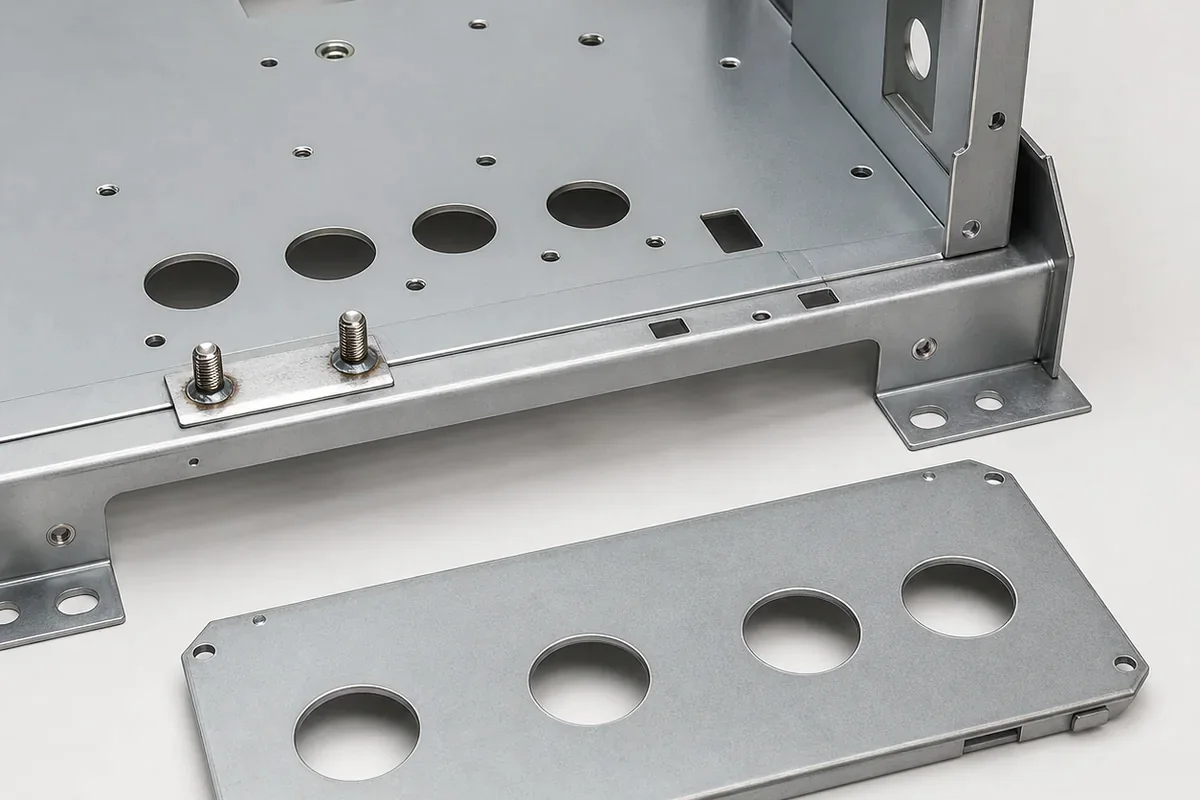
Production cutting is supported through our laser cutting services page.
CNC bending: door returns, gutters and rain lips must repeat
Bend radius, tooling access, material springback and bend sequence affect the sealing surface. Long narrow flanges may bow; nearby holes may distort; multiple return bends can accumulate error across the door opening. These are manufacturing effects, not signs that the gasket should be thicker.
Use consistent bend radii where the design allows, keep critical cutouts away from forming zones and dimension the sealing flange from stable datums. Rain lips and drip edges should guide water away from the opening without blocking door movement, hardware or service access.

See our sheet metal bending capability for press-brake process information.
Fixture welding: stop heat from rewriting the door opening
Welding can pull a cabinet out of square, twist a base, wave a sealing flange or move hinge and latch interfaces. We review joint access, weld size, sequence, clamping, fixture datums and post-weld dressing before production. The objective is not simply a strong joint; it is a strong joint that leaves the sealing geometry where the drawing put it.
Continuous welds may be necessary on selected exposure boundaries, while stitch welds may be suitable elsewhere. The buyer’s design must identify which seams form part of the ingress boundary. More weld is not automatically more waterproof. Sometimes it is simply more heat.

Process details are available on our sheet metal welding services page.
Gasket compression depends on the door, hinges and latches together
A gasket specification should include material, profile, hardness or density, joint method, adhesive if used and the acceptable compression range. The door and hardware must distribute that compression around the perimeter. Too little compression can leave a leak path; too much can permanently deform the gasket, overload the latch or bow the door.
Hinge position controls how the door approaches the seal. Latch count and adjustment control local compression. Door stiffness controls whether the force reaches the far corners. These features should be evaluated as one mechanical system, even when the gasket and lock arrive from separate suppliers.

Drainage and cable entry: keep water outside the primary boundary
Good outdoor enclosure design does not rely on a single line of defense. A roof overhang, drip edge or gutter can reduce direct exposure before water reaches the gasket. Sloped or detailed horizontal surfaces avoid standing water. Bottom entry can reduce exposure, but only when gland plates, cable glands and installation orientation are controlled.
A removable gland plate is useful for field service, yet its perimeter becomes another sealing interface. Define plate thickness, fastening pattern, gasket, opening sizes, blanking method and replacement procedure. Large power cables also need bend space and strain relief. If the installer cannot route the cable, the cabinet may receive an unscheduled field modification involving a drill. That is rarely part of the original IP strategy.
Material and finish selection should follow the operating environment
IP65 and corrosion resistance are different requirements. A cabinet can pass an ingress test and still have an unsuitable finish for its installation environment. Specify pretreatment, coating chemistry, film-thickness range, masking, edge expectations, repair limits and any salt-spray or material evidence separately.
Coating can change hinge movement, latch engagement, thread fit, gasket contact and close-clearance slots. Mark functional masking and appearance zones on the drawing. Our surface treatment capability explains the finishing route.

First-article inspection should follow the possible leak path
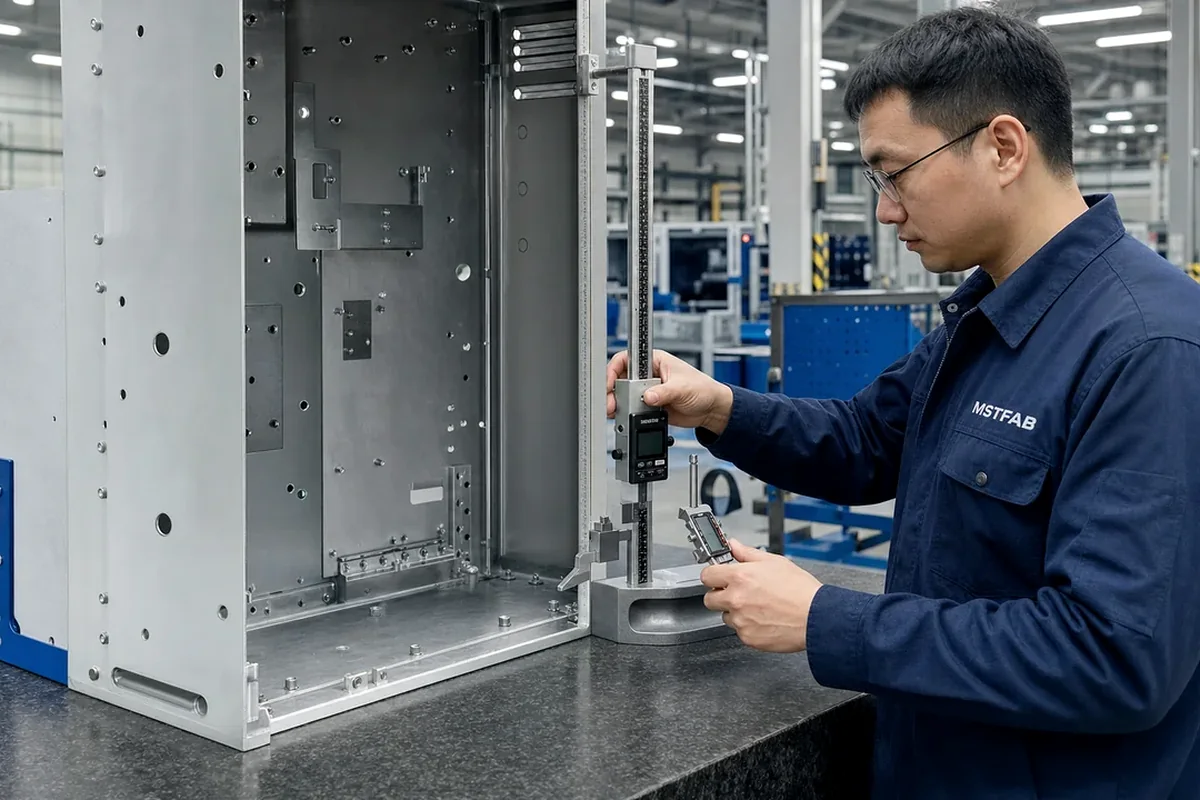
An inspection report is most useful when it measures the geometry that affects sealing and buyer assembly. Typical checks include cabinet diagonals, door flatness, flange width, door gap, hinge and latch position, gasket channel, cable-entry plate, window cutout, lock opening, mounting datums and coating on functional interfaces.
Overall height and width are necessary, but they do not prove that the door compresses evenly. Agree the datum scheme, critical dimensions, gauges, sample quantity, photographs and report format before quotation. This makes inspection part of the manufacturing plan rather than an emergency document created after a failed test.
Evidence a buyer can request before production release
| Evidence | What it demonstrates | Typical owner | Best time to agree |
|---|---|---|---|
| DFM review record | Sealing, bend, weld, hardware and inspection risks were reviewed | MSTFAB and buyer | Before quotation or first article |
| Material certificate | Metal grade and thickness match the purchase requirement | MSTFAB supply chain | At purchase-order review |
| Gasket and hardware record | Installed mechanical parts match the approved bill of materials | Specified purchasing and assembly owner | Before validation sample assembly |
| First-article dimensional report | Critical sealing and mounting interfaces match the released drawing | MSTFAB quality team | Before ingress testing |
| Door and latch trial-fit photos | Door movement, gap and hardware relationship were checked mechanically | MSTFAB and buyer | During first-article approval |
| Coating and masking record | Finish thickness and protected functional areas were inspected | MSTFAB finishing and quality teams | Before sample shipment |
| Ingress test report | The agreed assembled configuration passed the specified test | Buyer-approved laboratory or responsible test owner | Before batch release |
| Packing photographs | Sealing flanges, doors, finished faces and loose parts are protected | MSTFAB shipping team | Before the first shipment |
Buyers can define a dimensional inspection report, a first-article inspection plan and export packaging for fabricated enclosures before production.
How to define IP65 test responsibility without creating a paperwork fog
The purchase order should state who builds the test sample, who supplies gasket and hardware, who installs cable glands and windows, which unused openings are blanked, which standard and edition apply, where testing occurs, who receives the report and what happens if the sample fails.
MSTFAB can support buyer-directed sample fabrication, dimensional evidence and agreed mechanical corrections. The buyer or appointed laboratory should control the final test configuration and certification decision. This distinction protects both sides: the supplier controls metalwork, while the OEM controls the complete product that enters the market.
- Released drawing and revision
- Material and finish records
- Critical-dimension report
- Door, hinge and latch trial fit
- Gasket or hardware installation record when in scope
- Photographs before shipment
- Approved assembled test configuration
- IEC 60529 procedure and acceptance criteria
- Laboratory or responsible test-owner report
- Electrical and thermal validation
- Market-specific product approvals
- Change-control decision after any design revision
Common IP65 enclosure failures and the quieter alternative
A failed water test is not always solved by applying more sealant. Sealant can hide the symptom while making service difficult and variation harder to control. The better response is to identify the leak path, confirm the responsible interface, correct the drawing or process and repeat the agreed validation.
Prototype and batch controls for repeatable enclosure sealing
A first article proves the released design can be fabricated and assembled once. Batch control must prove the process can repeat the dimensions that matter. For long doors and tall floor-standing cabinets, fixture wear, weld sequence, bend tooling, hinge adjustment and coating buildup can shift performance over time.
Agree a practical control plan for incoming material, laser-cut features, formed flange dimensions, welded-frame geometry, hardware installation, coating and final inspection. Not every dimension needs to appear on every report. The critical sealing and assembly characteristics do.
When the OEM changes a display, gland plate, cooling interface, gasket, lock or door construction, review whether the tested configuration has changed. “Almost the same” is useful in conversation and less useful in certification files.
Related fabrication resources
These pages support an empty IP65-intent EV charger enclosure program from drawing review through first-article approval:
Frequently asked questions
Does MSTFAB certify an empty EV charger enclosure as IP65?
No automatic certification is claimed. MSTFAB fabricates the empty enclosure and can provide agreed manufacturing evidence. The final IP65 result applies to the tested assembled configuration, and the buyer or appointed laboratory controls the test and product certification decision.
What files help MSTFAB quote an IP65 EV charger enclosure shell?
A STEP model and controlled 2D PDF are best. Include material, thickness, sealing geometry, gasket, hardware, openings, finish, test-sample quantity, critical tolerances, inspection evidence and packing requirements.
Can MSTFAB install gaskets, hinges and locks?
Yes, when the exact parts, installation method and acceptance criteria are included in the purchase scope. The buyer should confirm whether the same installed configuration will be used for ingress testing and production.
Can an IP65 enclosure have vents or cooling equipment?
Only when the selected vent, heat exchanger or cooling interface supports the buyer’s target ingress design and test configuration. MSTFAB fabricates the drawing-defined cutout and mounting interface; the OEM validates the complete thermal and ingress system.
Which material is best for an outdoor EV charger enclosure?
The answer depends on corrosion exposure, weight, cost, appearance and fabrication needs. Powder-coated steel, galvanized steel, stainless steel and aluminum can all be appropriate when the grade, pretreatment, finish and joining process match the environment.
What should be inspected before the IP65 test sample is released?
Prioritize door opening geometry, sealing flange, gasket channel, door gap, hinge and latch alignment, cable-entry plate, window and gland cutouts, seam condition, coating and the installed hardware configuration defined by the test plan.
Drawing review
Have an IP65 EV charger enclosure drawing ready for fabrication?
Send the STEP file, 2D drawing, material, finish, gasket and hardware scope, test-sample quantity and critical inspection points. MSTFAB will review the metal fabrication route while your team retains control of the electrical system and final product validation.
 WeChat Contact
 WhatsApp Me Directly