
The Short Answer
An effective online laser cutting quotation service requires synchronized 3D STEP assemblies, 1:1 clean 2D DXF flat patterns, and a fully toleranced 2D PDF drawing rather than isolated profile outlines. While instant pricing algorithms often guess K-factors, overlook countersinks, and price parts assuming zero downstream forming or welding constraints, an engineer-verified RFQ review catches bend relief conflicts, oxide-edge powder adhesion risks, and datum stack-ups before steel is cut.
Explore this guide
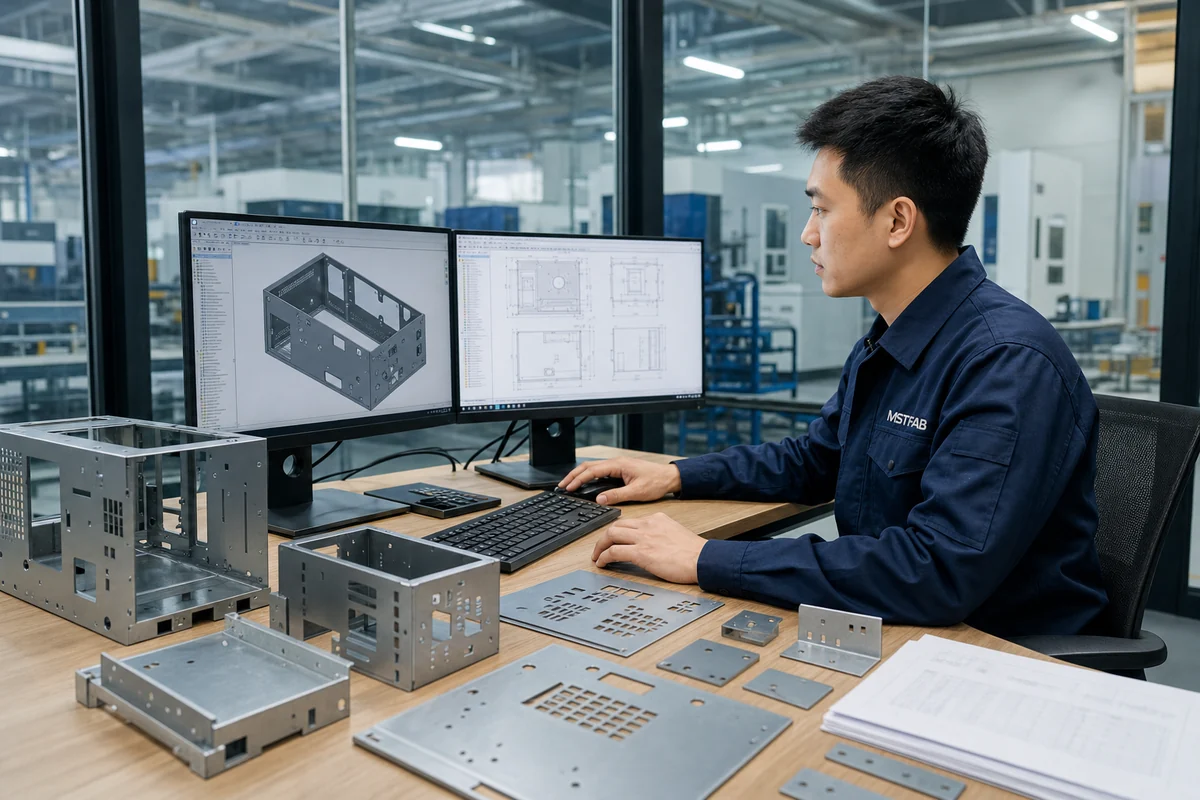
01 / Engineering File Package
Pair 3D STEP models with clean 2D DXF profiles and PDF tolerance drawings.
Automated web quoting engines frequently misinterpret title blocks, dimension leaders, or bend tangent lines embedded in a 2D file as cut paths, inflating machine runtime estimates or producing scrap blanks. When you submit an RFQ through our upload drawing laser cutting quote workflow, our manufacturing engineers cross-validate all three file formats before locking nesting layouts and press-brake tooling.
Whether you are sourcing flat mounting plates through our laser cutting services or multi-bend subassemblies from a custom laser cutting services manufacturer, each file type plays a distinct role in eliminating quoting ambiguity.
3D STEP (.stp / .step) model
Defines true 3D folded geometry, flange orientation, countersink side direction, and mating clearance in multi-part assemblies.
Clean 1:1 2D DXF (.dxf) profile
Provides closed-loop outer contours and inner cutouts on Layer 0 with no title blocks, spline gaps, or duplicate overlapping entities.
2D PDF (.pdf) engineering drawing
Establishes the contractual inspection baseline: material grade, critical-to-quality (CTQ) hole tolerances, tapped threads, and surface finish.
Flat pattern rule: If your part requires CNC bending, always provide the 3D STEP model alongside the 2D PDF so our engineers can calculate the exact flat pattern using our actual press brake punch and V-die radii rather than generic CAD K-factors.
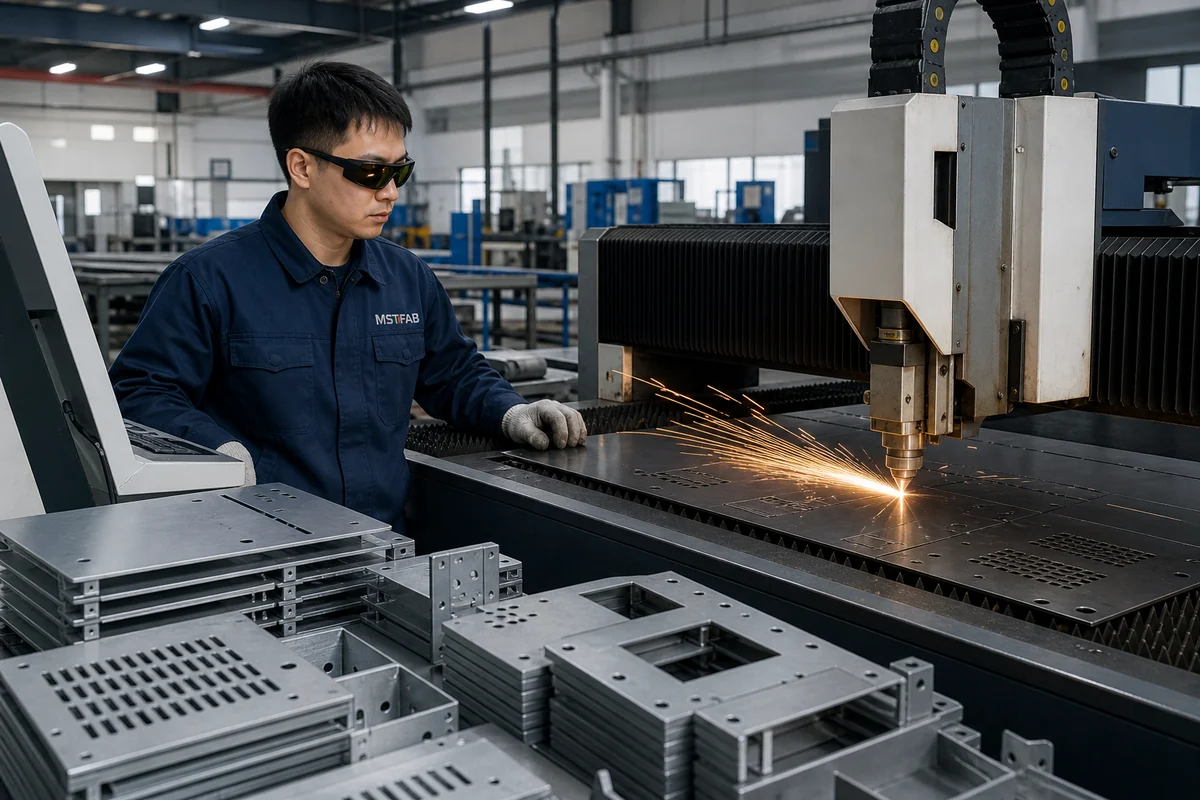
02 / Fiber Laser Physics and Edge Condition
Specify assist gas, grain direction, and deburring expectations at the quote stage.
Not all laser-cut edges perform equally in downstream welding or powder coating. High-power fiber lasers use different assist gases depending on material chemistry, plate thickness, and whether cut edges will be welded or painted.
- Nitrogen vs. oxygen assist gas: Oxygen-cut carbon steel above 3 mm leaves a thin dark oxide scale along the kerf edge that can cause powder coating delamination under salt-spray exposure unless mechanically descaled or switched to high-pressure nitrogen cutting.
- Minimum hole diameter to thickness ratio: Keep laser-pierced round holes at or above 1.0x material thickness (1.2x on thicker stainless plate) to prevent pierce blowback, taper distortion, and nozzle spatter.
- Micro-tabs and rotary brush deburring: Specify whether parts require manual tab grinding, wide-belt slag removal, and uniform R0.2 mm edge rounding for safe cable routing and uniform coating film build.
Our stainless steel sheet metal fabrication service and aluminum sheet metal fabrication service utilize high-purity nitrogen cutting with protective PVC laser film handling to prevent slat back-splatter and surface scratches on cosmetic panels.
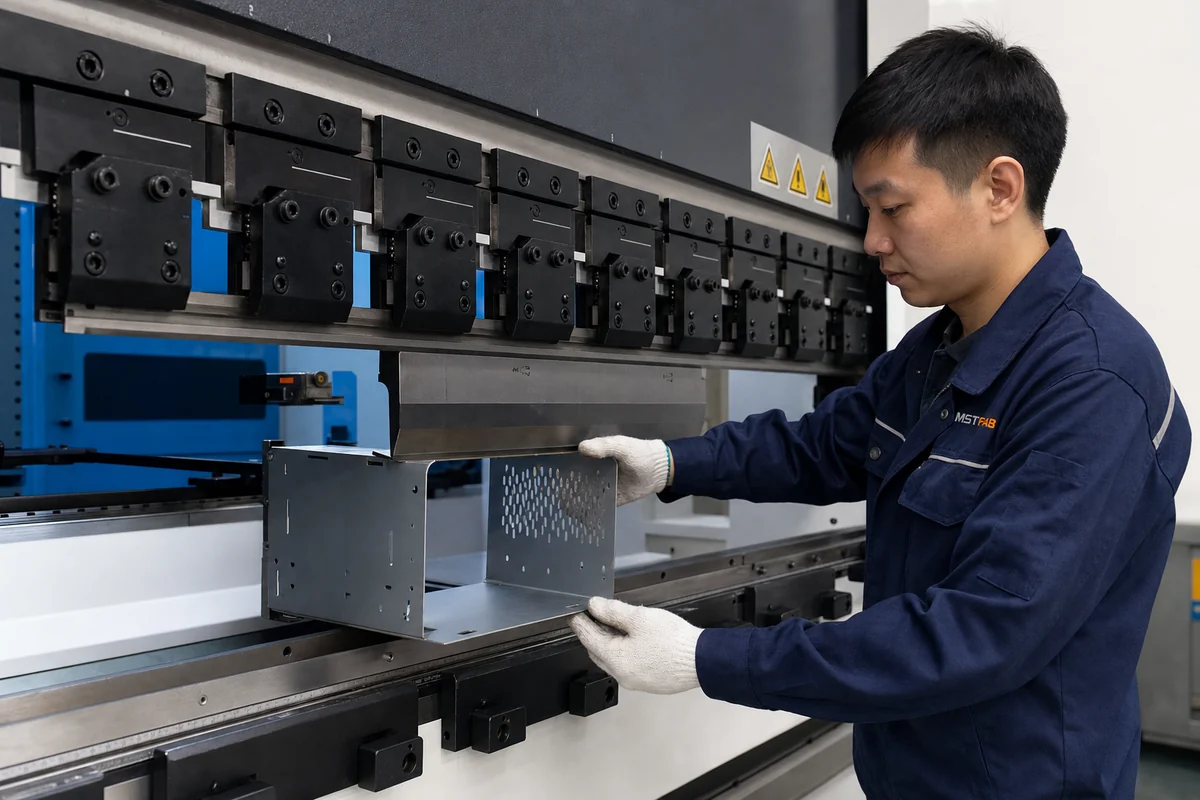
03 / Forming Allowance and Flat Pattern Control
Prevent assembly mismatch where laser-cut blanks transition to CNC press brakes.
A common sourcing failure occurs when a buyer orders laser-cut flat blanks from one shop using a default 0.44 K-factor in CAD, only to discover the flanges grow by 1.2 mm per bend when formed in an air-bending V-die. Integrated quoting aligns the laser flat development directly with our shop-floor tooling library.
- Verify laser-cut bend relief slots have a width >= material thickness and depth extending past the inside bend radius plus thickness to prevent corner tearing.
- Check hole-to-bend distances against minimum V-die shoulder span (typically >= 2.5t + inside radius) so round laser cutouts do not pull into oval shapes during forming.
- Confirm whether laser-etched bend lines or edge notches are permitted on internal non-cosmetic faces to speed up operator orientation on asymmetrical brackets.
By combining laser blanking and forming under one roof, we adjust flat blank compensation prior to cutting so final flange-to-flange outside dimensions match your 2D PDF without trial-and-error scrap.
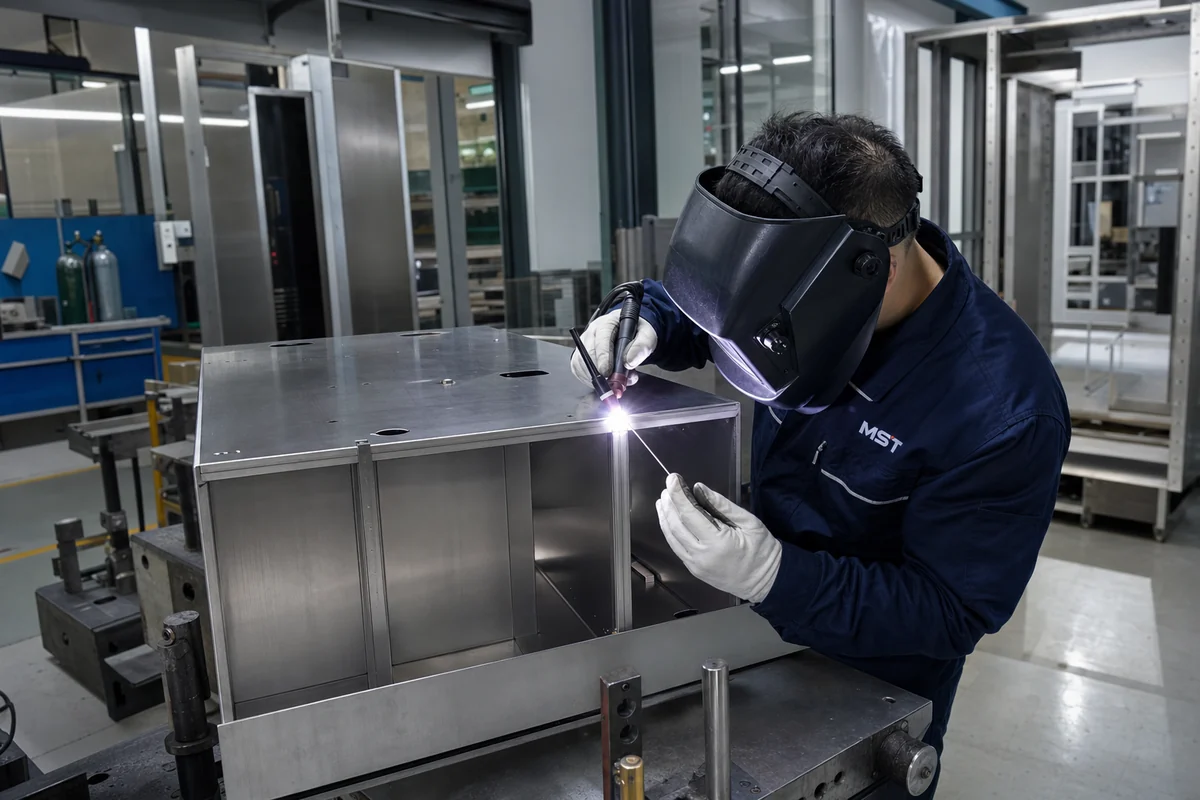
04 / Secondary Operations and Surface Finishing
Scope hardware insertion, welding, and powder coating inside a single RFQ.
Most industrial sheet metal projects require more than raw laser-cut plates. Quoting secondary operations together eliminates inter-vendor freight, finger-pointing over hole sizes for self-clinching fasteners, and unmasked ground studs after painting.
- Self-clinching hardware sizing: PEM nuts, standoffs, and studs require precise pre-coating laser hole diameters (often held within -0.00/+0.08 mm) and controlled press tonnage before powder coating.
- Tab-and-slot welding preparation: Adding self-fixturing laser tabs and slots into enclosure panels speeds up sheet metal welding service fit-up and holds frame squareness without custom hard tooling.
- Coating code and masking zones: Call out exact RAL or Pantone color codes, gloss levels, texture (smooth vs. fine sand), and silicone plug/tape masking for threaded holes and EMI grounding pads when ordering powder coated sheet metal parts.
Our integrated line supports outdoor EV charger enclosure fabrication, heavy-duty agricultural sheet metal parts, precision custom instrument enclosure fabrication, and rack-mount custom sheet metal chassis manufacturer builds.
05 / Buyer Quotation Control Matrix
Confirm five commercial and technical baselines before approving a laser cutting quote.
Use this verification matrix when comparing online sheet metal quotations to ensure every supplier is pricing the same material condition, edge prep, and inspection deliverables.
06 / Drawing Review and Quality Verification
Verify first-article geometry before releasing full nested sheet runs.
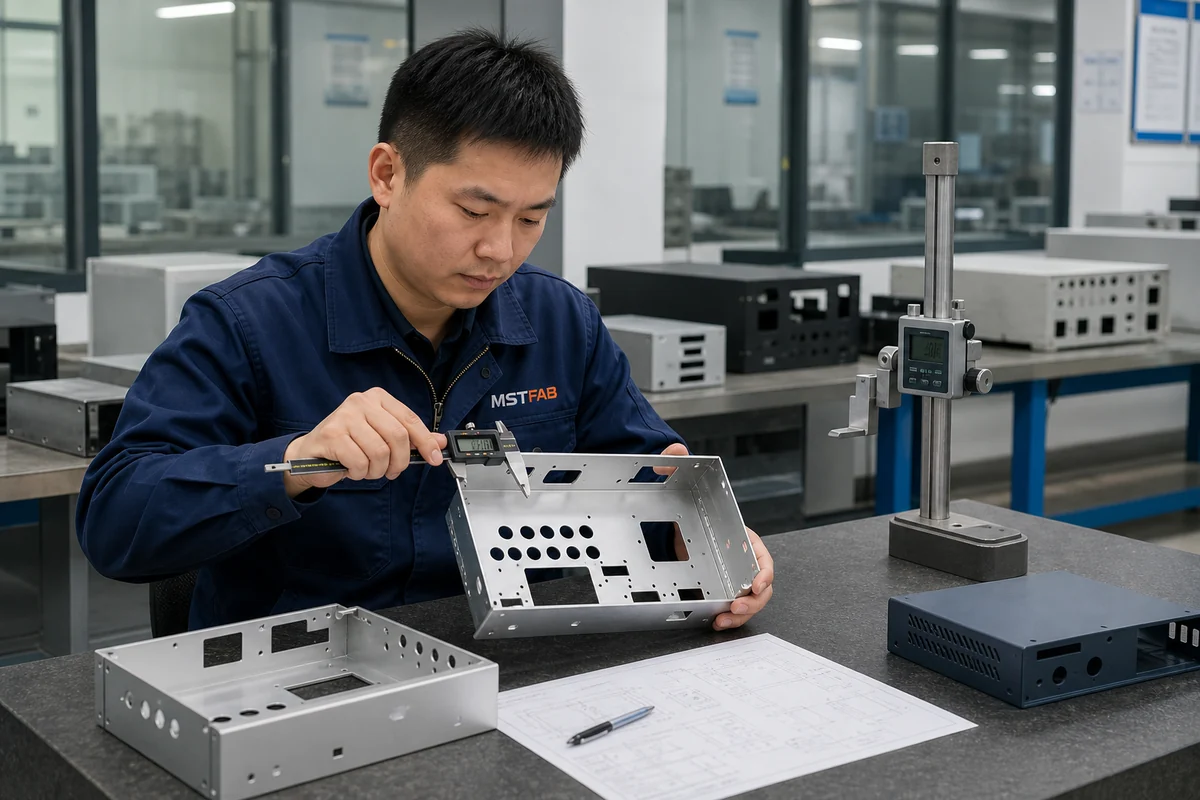
Quoting quickly is only valuable if the delivered parts assemble on your production floor without re-drilling holes or grinding flanges. Every order at MSTFAB begins with an engineering DFM review that checks kerf compensation, pierce points, and datum chains against your 2D PDF.
Before cutting full production sheet nests, our quality team inspects the first laser-cut blank on optical 2D vision testers or calibrated digital calipers, followed by first-off bend angle and flange-to-hole checks after press brake setup.
For complex OEM sheet metal parts for industrial equipment components, we supply a documented dimensional inspection report tied directly to ballooned drawing coordinates.
Review our sheet metal fabrication with first article inspection workflow →
07 / Export Packaging and Scope Clarity
Protect flat laser blanks and coated enclosure shells during international transit.
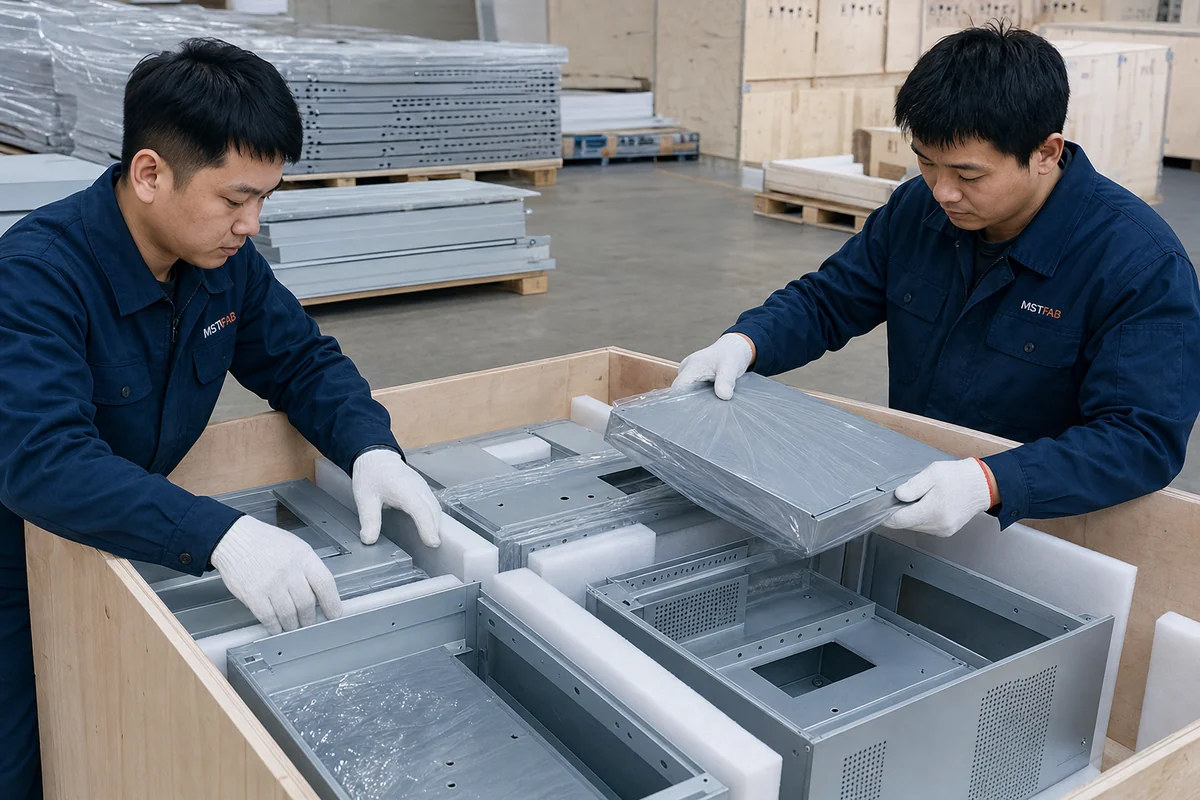
Flat laser-cut blanks can warp if strapped unevenly on narrow skids, while powder-coated panels and welded shells suffer rub marks if packed without foam separation. We package flat parts stacked flat on reinforced fumigation-free plywood pallets with anti-rust VCI paper or PE film interleaving, edge protectors, and steel/PET strapping.
Whether shipping heavy brackets for Agricultural Machinery or cosmetic stainless panels, every pallet is labeled by part number, drawing revision, and PO line item so your receiving warehouse can stage kits immediately.
Manufacturing scope: MSTFAB operates under an ISO 9001 quality management system and manufactures custom drawing-based laser-cut blanks, formed brackets, and empty sheet metal enclosure shells. Internal power electronics, wiring harnesses, and final powered system certifications remain the responsibility of the OEM.
08 / Ready-to-Quote Checklist
Include eight engineering details in your online laser cutting RFQ package.
- 3D STEP (.stp) and 2D DXF (.dxf) filesProvide 3D models for bent/welded parts and clean 1:1 closed-contour DXFs for flat profiles.
- 2D PDF drawing with tolerancesCall out critical hole diameters, datum surfaces, tapped threads, and countersink dimensions.
- Exact material grade and thicknessSpecify alloy, temper, and metric thickness (e.g., 2.0 mm 304L stainless or 3.0 mm 5052-H32 aluminum).
- Edge and deburring conditionNote if oxide-free nitrogen cutting, slag removal, or R0.2 mm brushed edge rounding is required.
- Grain direction and cosmetic faceMark mandatory brush grain orientation and designate the A-side cosmetic surface to keep free of die marks.
- Hardware and secondary operationsList PEM fasteners, tapped holes, CNC bending, or TIG/MIG welding callouts.
- Surface treatment and maskingProvide RAL powder coat color, anodizing class, passivation standard, and grounding stud masking zones.
- Order quantity tiers and IncotermsState prototype sample quantity, recurring batch volume, and delivery terms (EXW, FOB, DAP, or DDP).
Sending a complete drawing package with material, finish, and quantity tiers allows our engineering desk to return an accurate, itemized quotation within 24 hours without back-and-forth clarification delays.
Frequently asked questions about online laser cutting quotations
Which CAD file formats should I upload for the fastest laser cutting quote?
For flat laser-cut parts, upload a 1:1 scale 2D DXF or DWG file alongside a 2D PDF showing material grade, thickness, tapped holes, and critical tolerances. For bent, welded, or multi-part assemblies, always include a 3D STEP (.stp / .step) file together with your 2D PDF drawings.
Why does MSTFAB combine engineer review with online RFQ submissions instead of pure instant pricing?
Pure algorithmic pricing often misses countersink directions, tight hole-to-bend proximity, weld distortion allowances, and masking requirements—leading to price hikes after ordering or parts that fail assembly. Our engineering DFM check validates manufacturability up front and delivers a firm quote within 24 hours.
Can you quote CNC bending, welding, PEM insertion, and powder coating in the same RFQ?
Yes. We provide complete turnkey quotations covering fiber laser cutting, CNC press brake forming, self-clinching hardware installation, TIG/MIG/laser welding, surface treatment (powder coating, anodizing, passivation, plating), and export crating.
What tolerances can your fiber laser cutting and CNC bending processes hold?
Our fiber laser cutting typically holds +/-0.10 mm on profile and hole features depending on material thickness, while CNC press brake forming typically holds +/-0.25 mm to +/-0.50 mm on single bend flanges and +/-0.5 degrees on bend angles per ISO 2768-m/f.
Is there a minimum order quantity (MOQ) for custom laser-cut sheet metal parts?
We have no strict MOQ. We regularly quote 1 to 10 prototype validation pieces alongside low-to-medium volume production runs of 50 to 5,000+ units, providing tiered unit pricing so you can compare batch economics.
What quality documentation can be supplied with our laser-cut parts?
Upon request in your RFQ, we provide EN 10204 3.1 material mill test certificates, first article inspection (FAI) dimensional reports, coating thickness readings, and pre-shipment packaging photos under our ISO 9001 quality system.
Technical references
These international manufacturing standards govern thermally cut edge quality, general sheet metal geometrical tolerances, and corrosion-resistant steel specifications.
- ISO 9013 — Thermal Cutting: Classification of Thermal Cuts, Geometrical Product Specification and Quality Tolerances
- ISO 2768-1 — General Tolerances for Linear and Angular Dimensions Without Individual Tolerance Indications
- ASTM A240 / A240M — Standard Specification for Chromium and Chromium-Nickel Stainless Steel Plate, Sheet, and Strip
Upload your STEP, DXF, and PDF drawings for an engineer-verified laser cutting quote.
Send your drawing package, material specification, finish code, and batch quantities. Our engineering team will review DFM details and respond within 24 hours.
Request Your Laser Cutting Quote →
Have a question first? caroline@mstfab.com
 WeChat Contact
 WhatsApp Me Directly