
⚡ Direct Answer: What Is Custom EV Charger Enclosure Fabrication?
Custom EV charger enclosure fabrication is the drawing-defined precision sheet metal manufacturing process of producing rugged, weather-sealed mechanical housings for commercial AC Level 2 pedestals and high-power DC fast-charging stations (50kW–480kW). The fabrication workflow combines high-accuracy fiber laser cutting for touchscreen and connector openings, multi-axis CNC press brake forming, continuous TIG/MIG seam welding, Formed-in-Place Foam Gasket (FIPFG) sealing (IP54/IP65/NEMA 3R/4), and architectural-grade outdoor powder coating tested to 1,000+ hours ASTM B117 salt spray resistance.
Engineering Overview: Why EV Charger Cabinets Demand Custom Sheet Metal Fabrication
An electric vehicle supply equipment (EVSE) enclosure is far more than a standard electrical utility box. It operates continuously in harsh public environments, serving as the structural armor for high-voltage power converters, display monitors, payment terminals, RFID scanners, liquid cooling loops, high-amperage cable retractors, and sub-distribution circuit breakers.
Off-the-shelf catalog enclosures fail in commercial EV charging deployments for three decisive reasons:
- Sub-optimal Thermal Dissipation: High-power DC fast chargers generate substantial internal heat. Standard boxes lack specialized labyrinth ventilation channels and sealed blower louvers needed to expel heat without compromising ingress protection.
- Vandalism and Impact Vulnerability: Public charging pedestals must withstand high-impact physical loads (IK10 impact resistance), heavy cable drop torque, and unauthorized tampering attempts.
- Display and Cable Alignment Mismatch: Custom touchscreens, LED indicator bezels, emergency stop pushbuttons, and heavy-gauge CCS1/CCS2/NACS cable holsters require sub-millimeter cutouts that cannot be retrofitted post-coating without destroying corrosion protection.
MSTFAB manufactures custom EV charger enclosures strictly to customer STEP files, DXF drawings, and specification sheets. We integrate DFM (Design for Manufacturability) analysis to eliminate structural distortion, optimize bend radii, ensure IP54/IP65 sealing integrity, and guarantee repeatable fit during high-volume assembly lines.
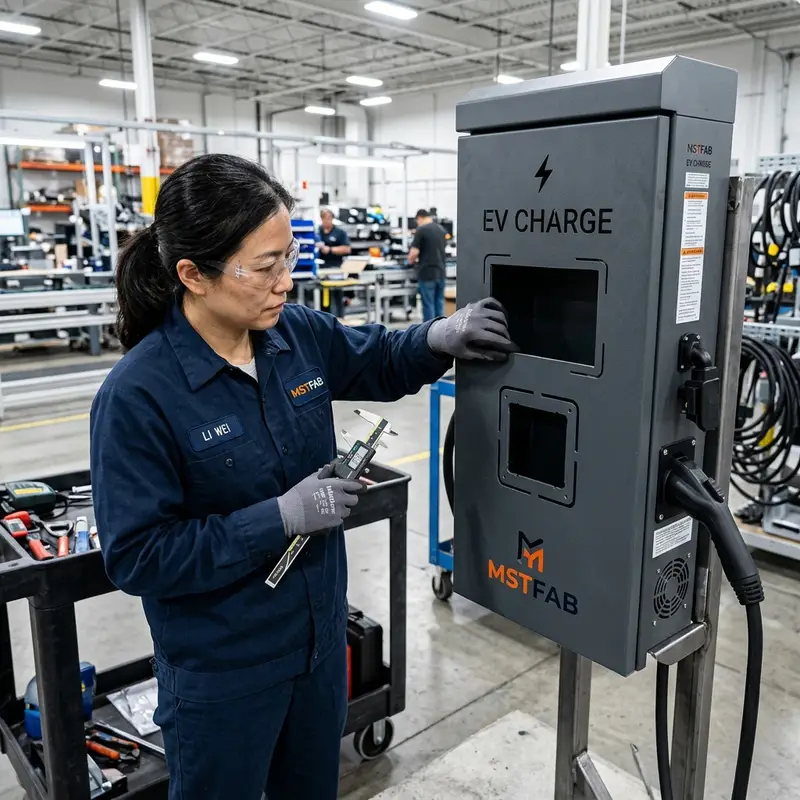
Material Selection Matrix for Outdoor EV Charging Enclosures
Selecting the optimal sheet metal substrate determines corrosion life, total weight, impact durability, and overall unit cost. MSTFAB provides material test certificates (MTR) with heat number traceability for every production run:
| Material Substrate | Typical Thickness | Corrosion Resistance | Thermal & Structural Benefits | Recommended EVSE Application |
|---|---|---|---|---|
| Hot-Dip Galvanized / Galvannealed Steel (SGCC / Q235B) | 2.0 mm – 3.0 mm | High (Dual zinc-barrier + outdoor epoxy/polyester powder coat) | Superior rigidity, cost-effective structural strength, high yield strength against vehicular bump impact. | Commercial DC Fast Charger Cabinets, Heavy Floor Pedestals, Utility Power Distribution Enclosures. |
| Marine-Grade Aluminum 5052-H32 | 2.5 mm – 4.0 mm | Exceptional natural oxidation resistance; 1,500+ hrs salt spray with chromate-free conversion coating. | 60% lighter than steel; 4x higher thermal conductivity for passive heat sinking across power module plates. | Wall-Mounted Residential/Fleet EVSE, Destination Chargers, Rooftop Parking Installations. |
| Austenitic Stainless Steel 304 / 316L | 1.5 mm – 2.5 mm | Maximum chemical and chloride resistance; NEMA 4X / C5-M marine rating. | Premium brushed aesthetic finish (No. 4 finish), zero paint chipping risk, lifetime corrosion protection. | Coastal EV Charging Plazas, Marine Port Chargers, Chemical Facility Fleet Stations. |
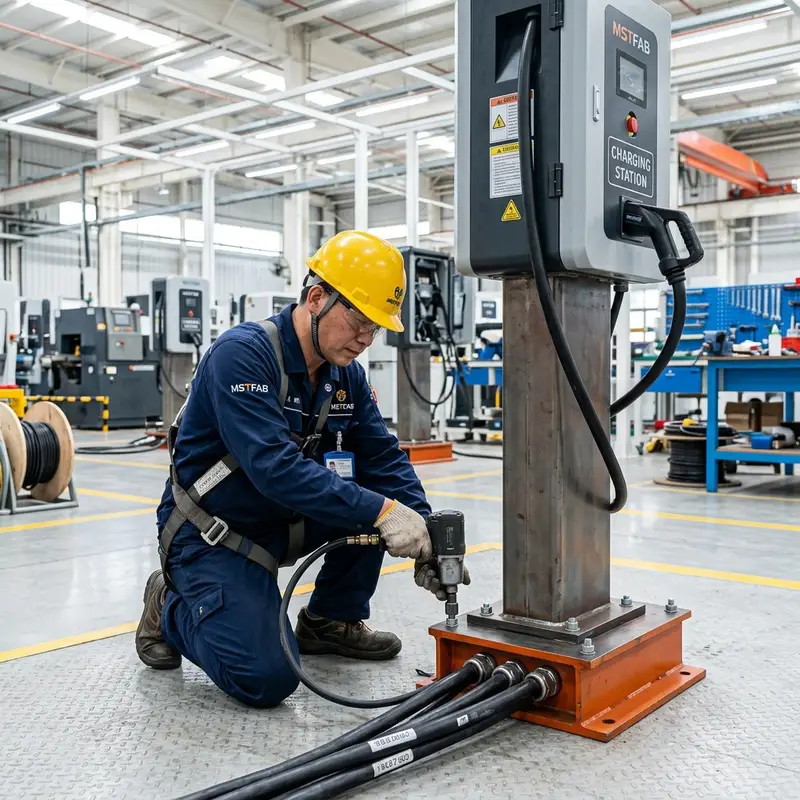
6 Critical DFM & Fabrication Details in Custom EV Charger Enclosures
Reliable performance in the field comes down to micro-level fabrication execution. Here is how MSTFAB engineers and fabricates core subassemblies:
1. Precision Cutouts for HMI, RFID & Payment Systems
Modern EV chargers integrate interactive capacitive touch displays, credit card POS readers, emergency stop knobs, and LED halo status lights. Using high-precision fiber laser cutting (optical beam accuracy within ±0.1 mm), all bezel cutouts maintain clean, burr-free edges. Internal mounting studs (PEM flush-head studs) are pneumatically installed on the reverse face with zero surface marks on the exterior cosmetic skin.
2. Labyrinth Rain Louvers and Thermal Air Management
Internal power rectification modules (AC to DC) generate significant heat dissipation demands. MSTFAB fabricates double-baffle labyrinth louvers featuring interior washable stainless steel mesh. This engineered path allows forced airflow while redirecting driving rain, snow, and airborne dust, meeting IP54 / IP55 requirements without active air conditioning.
3. IP54 / IP65 Continuous Gasket Sealing Geometry
Water ingress around maintenance doors is the leading cause of field controller failure. MSTFAB incorporates formed 3D return water channels (gutter lips) around door perimeters. Doors are fitted with continuous Formed-in-Place Foam Gaskets (FIPFG) or closed-cell EPDM hollow-core seals compressed uniformly by multi-point cam latches to ensure zero water ingress under wind-driven downpours.
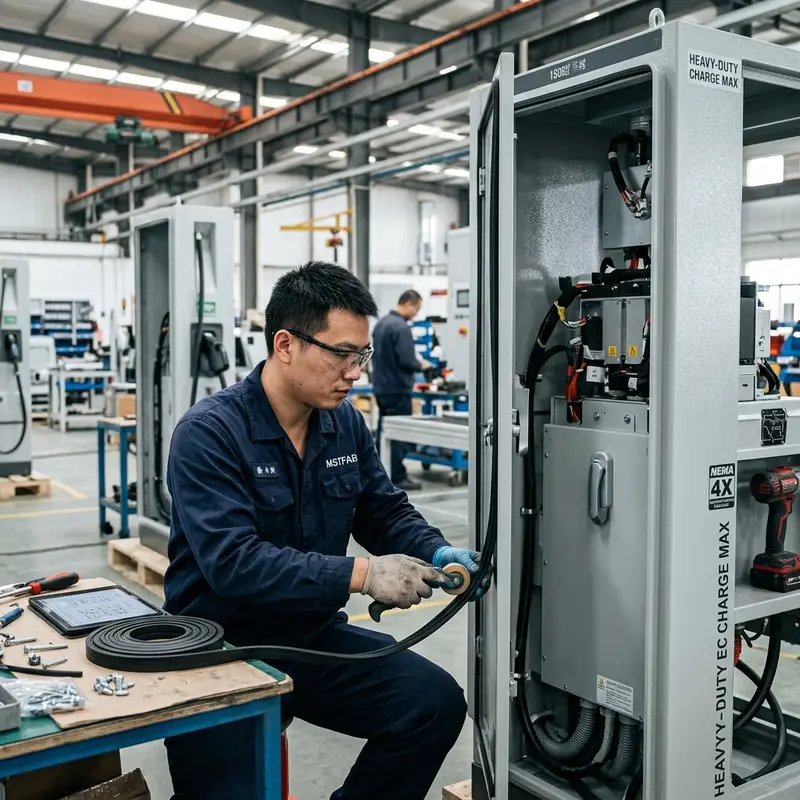
4. Heavy-Duty Cable Holster Brackets and Strain Relief
Heavy liquid-cooled high-amperage charging cables exert severe cantilever torque whenever drivers pull or drop the charging gun. We fabricate reinforced 3.0mm bracket mounting plates internally gusseted to the main chassis frame, preventing front panel deformation over tens of thousands of charging cycles.
5. Grounding, EMC Shielding & Electrical Safety
Electrical safety is paramount. All enclosure components feature dedicated M6/M8 copper-plated or stainless steel grounding studs with unpainted conductive contact pads. Front doors and removable panels are bonded to the main chassis via flexible tinned copper grounding braids to eliminate static accumulation and comply with IEC 61851-1 / UL 2202 grounding requirements.
6. Anti-Corrosion Outdoor Surface Finishing
Outdoor cabinets undergo a rigorous multi-stage pre-treatment process: automated alkaline degreasing, iron phosphate or zirconium nano-conversion coating, pure water deionized rinsing, and electrostatic polyester powder coating cured at 200°C. Total dry film thickness (DFT) is controlled at 80–120 microns, verified with cross-hatch adhesion (ASTM D3359 Class 5B) and impact resistance checks.

Common Enclosure Configurations Fabricated at MSTFAB
- Wall-Mounted EV Charger Enclosures: Compact sheet aluminum or stainless steel housings designed for residential garages, hotel parking bays, and multi-tenant fleet hubs. Includes keylock access, cable wrap brackets, and recessed display panels.
- Pedestal-Mounted Dual-Port AC Chargers: Standalone floor-standing architectural pillars with internal wiring raceways, vandal-resistant access panels, and bottom conduit knockout plates.
- High-Power DC Fast Charger Cabinets (60kW – 360kW): Large-footprint industrial enclosures engineered for modular power stack sub-racks, heat exchanger mounting, rear service doors, and heavy copper busbar support.
- Battery Energy Storage (BESS) Companion Cabinets: Heavy-duty NEMA 3R/4 outdoor cabinets housing battery modules, DC-DC converters, and BMS controllers for off-grid or peak-shaving EV charging plazas.
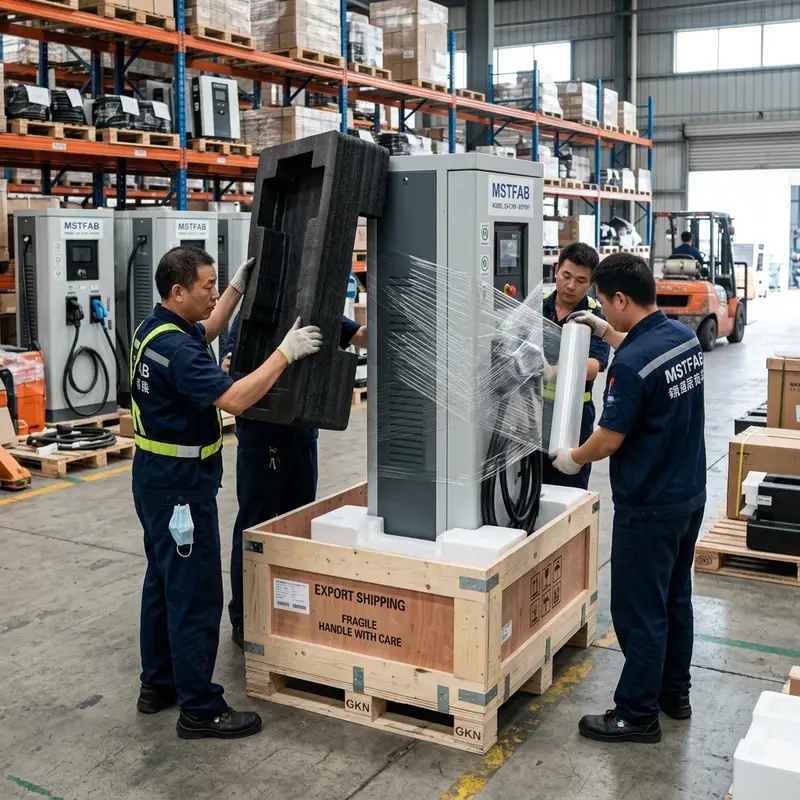
Accelerate Your EV Charger Enclosure Production
Send your 3D STEP/IGS models or 2D DXF/PDF drawings to MSTFAB. Our engineering team will conduct a comprehensive DFM review on cutouts, bend radii, sealing paths, and powder coat specifications within 24 hours.
Frequently Asked Questions About EV Charger Enclosure Fabrication
What engineering file formats are required for an EV charger enclosure quote?
We recommend providing 3D CAD models in STEP (.step, .stp) format along with 2D drawings in PDF or DWG format. The 2D drawings must clearly annotate critical tolerances, tapped thread specifications, surface finish colors (RAL code), and designated gasket sealing faces.
Can MSTFAB fabricate enclosures to achieve IP65 or NEMA 4 ratings?
Yes. We design and fabricate custom mechanical shells conforming to IP54, IP55, IP65, NEMA 3R, and NEMA 4 specifications using continuous seam welding, formed perimeter water gutters, and automated continuous polyurethane foam gaskets (FIPFG). Final certified testing is verified on customer assembled prototypes.
How do you protect laser-cut edges from rusting on outdoor steel chargers?
Laser cutting in mild steel generates micro-burrs and oxide edges. At MSTFAB, all cut blanks undergo mechanical edge rounding (R0.5 to R1.0mm) before powder coating. Rounded edges ensure uniform paint thickness across sharp contours, preventing early edge-corrosion failures.
What is the typical lead time for prototype and batch production?
Custom EV charger enclosure prototypes are typically fabricated, coated, and inspected within 7 to 10 working days. Production batches (50 to 1,000+ units) typically ship within 3 to 4 weeks depending on stamping tooling and enclosure complexity.
 WeChat Contact
 WhatsApp Me Directly