On a drawing, a chip chute looks like the simplest part on the machine: a bent metal channel pointing downhill. In service it gets bombarded with hot steel chips, soaked in coolant, ambushed by aluminum swarf that would happily knit itself into a sweater, and ignored until it blocks. Getting it right starts with what you put in the RFQ.
Quick answer: Custom sheet metal chip chutes are fabricated metal components that guide machining chips from a CNC machine, chip conveyor or collection point toward a designated discharge location. They may need laser-cut profiles, CNC-bent panels, welded joints, reinforced mounting flanges and removable sections for maintenance, typically in carbon steel, stainless steel or another metal chosen for the chip type, wear, coolant exposure and equipment requirements. The key purchasing question isn’t whether a supplier can bend a metal channel. It’s whether the finished chute fits the approved machine interface, provides the intended discharge path, and allows safe access for cleaning and maintenance.
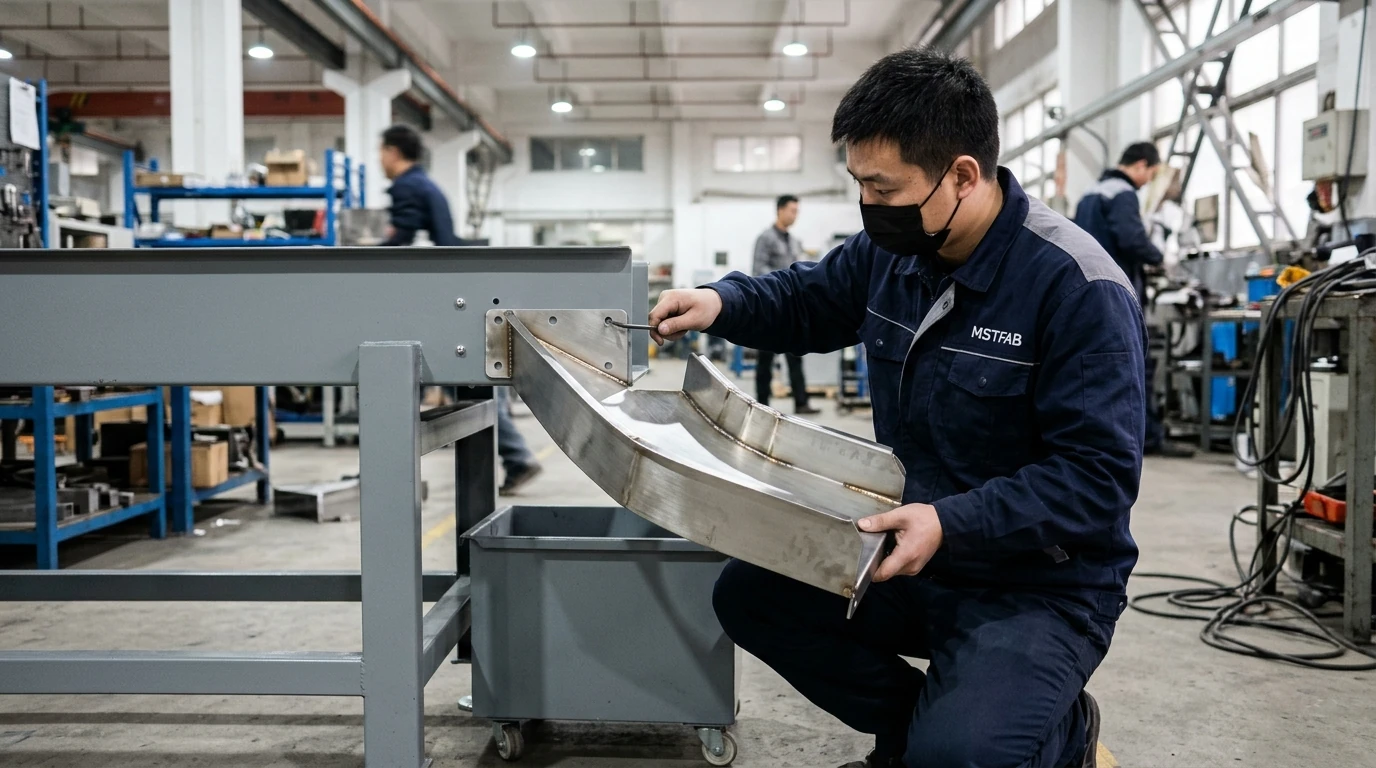
A custom sheet metal fabrication supplier can manufacture the drawing-defined metal components, while the CNC equipment manufacturer remains responsible for validating the complete chip-removal system. This guide explains what OEM buyers should specify when sourcing custom sheet metal chip chutes and related mechanical parts.
What Is a Custom Sheet Metal Chip Chute?
A sheet metal chip chute is a formed or welded metal component that directs machining chips between equipment discharge points. It may sit inside a CNC machining center, beneath a cutting area, at the discharge of a chip conveyor or above a collection container. Its geometry follows the machine layout and the material-handling path approved by the equipment manufacturer.
Typical chip chute components
| Component | Main Function |
|---|---|
| Inlet section | Receives machining chips from the equipment |
| Formed chute body | Guides chips toward the discharge location |
| Side walls | Help contain material within the chute |
| Mounting flanges | Connect the chute to the machine structure |
| Reinforcement brackets | Support the chute where required |
| Discharge outlet | Directs material into the collection area |
| Drain openings | Support coolant drainage when specified |
| Removable access section | Allows inspection and cleaning |
Not every application needs all of these. A simple gravity-fed chute may be a single CNC-bent steel channel with mounting flanges; a larger one may need several formed panels, welded transitions, internal supports and access features. The construction follows the customer-approved design.
What Types of Chip Chutes Can Be Made From Sheet Metal?
If your project is a guard rather than a chute, see our industrial machine guard RFQ guide; for grain and bulk-material chutes on farm equipment, our hoppers, chutes and bins guide covers that different world.
How Does Chip Type Affect Sheet Metal Chute Design?
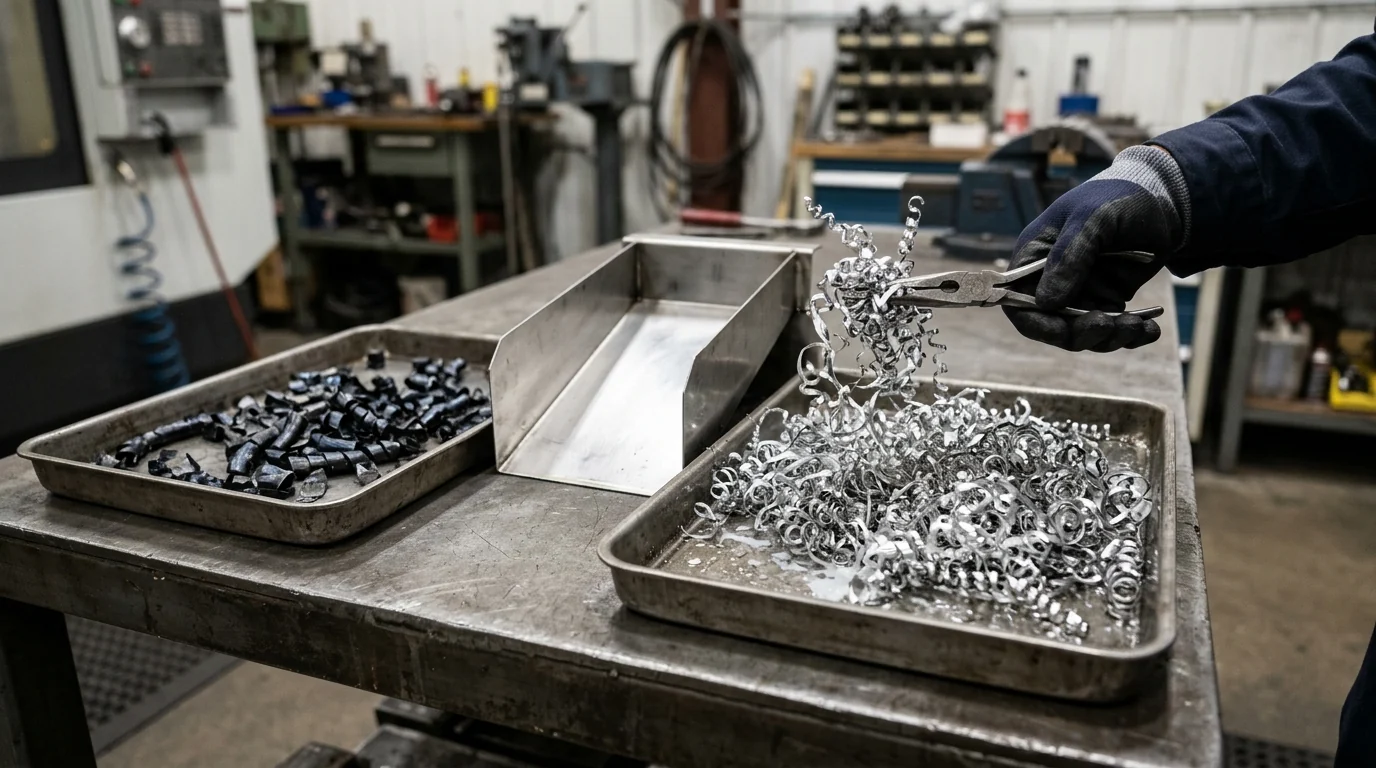
Different machining operations produce very different chips. A chute that works well with short, broken steel chips may behave quite differently with long, curled aluminum chips. Consider the chip type before finalizing the metal geometry.
| Chip Type | Potential Concern | OEM Design Consideration |
|---|---|---|
| Short steel chips | Abrasive contact and accumulation | Wear areas and discharge geometry |
| Long curled chips | Bridging or entanglement | Clearances and possible blockage locations |
| Aluminum chips | Different shapes, flow and handling behavior | Surface condition and discharge layout |
| Fine metal particles | Accumulation and contamination | Cleaning and collection requirements |
| Coolant-covered chips | Fluid carryout and retained liquid | Drainage and fluid compatibility |
| Mixed machining chips | Variable flow and wear behavior | Application-specific validation |
A fabrication supplier should not pick a chute slope based only on the material name. The OEM should provide chip geometry, expected loading, coolant exposure and the discharge arrangement. Chip-handling equipment makers such as Haas Automation and Hennig offer different conveyor and discharge configurations for different machining applications, which is a useful reminder that the sheet metal chute is one component inside a larger system.
How Should OEM Buyers Specify Chute Geometry?
Geometry is one of the most important requirements. Every individual part can meet its dimensions and the completed chute can still guide material badly if the approved geometry doesn’t reflect real operating conditions.
- Inlet geometry: the inlet must align with the approved discharge source. Define the opening, location, mounting arrangement and relevant clearances.
- Outlet geometry: the outlet must deliver chips to the intended receiving area, whether that’s a chip bin, hopper, conveyor intake or another defined location. Check it against the actual machine and collection equipment.
- Chute angle: the slope influences how material moves in a gravity-fed chute. There is no universal chute angle for all chip types; chip shape, moisture, surface condition, obstructions and operating conditions all play a part. The equipment manufacturer should validate the selected geometry.
- Internal transitions: abrupt steps and protruding features create places where chips collect. Smooth transitions or carefully positioned welds can reduce interference. The supplier can review whether the drawn transitions are manufacturable with its cutting, forming and welding processes.
What Materials Are Suitable for Custom Metal Chip Chutes?
| Material | Potential Application | Main Consideration |
|---|---|---|
| Carbon steel | Industrial chip channels and fabricated structures | Wear and corrosion protection |
| 304 stainless steel | Applications needing more corrosion resistance | Coolant compatibility and fabrication |
| 316 stainless steel | Certain demanding chemical environments | Actual chemical exposure and cost |
| Galvanized steel | Selected sheet metal components | Coating damage, wear and edge protection |
| Aluminum 5052 | Lightweight components where appropriate | Mechanical loads, wear and suitability |
Material choice should account for chip impact, abrasion, coolant chemistry, temperature, geometry and expected service conditions. Our guides to 304 vs. 316 stainless steel and sheet metal material selection go deeper.
Powder coating is not a wear liner. A powder-coated surface may suit some exterior areas, but it shouldn’t automatically be specified as a long-life surface for continuous abrasive chip contact. Steel chips are very patient sandpaper. Where severe wear is expected, the OEM may need a different material, a thicker section or a separately approved replaceable wear component, approved by the responsible engineering team before manufacturing.
How Are Sheet Metal Chip Chutes Manufactured?
- Engineering drawing review.The manufacturer reviews the STEP/STP model, dimensioned PDFs, material, quantity and approved assembly configuration, paying attention to mounting interfaces, chute dimensions, welded seams, service openings and drainage features.
- Laser cutting.Laser cutting produces the profiles, openings and mounting features. Parts of different thickness or grade may need separate programs. Cut edges should meet the agreed requirements before further processing.
- CNC bending.Blanks are formed into channels, side walls and flanges. Bend sequence, tooling access, springback and corner relief affect manufacturability; for complex chutes the supplier should review the formed model, not just the flat pattern. See our bend radius and flange checklist and CNC sheet metal bending services.
- Welding and mechanical joining.Multi-part chutes may need welded connections, brackets or fastened joints per the approved requirements, with weld access, distortion, surface preparation and installation in mind. If liquid containment is required, specify the leak performance and verification procedure separately.
- Inspection and surface finishing.The supplier checks the agreed requirements, such as inlet and outlet geometry, mounting holes, chute dimensions, formed profiles and welded assembly fit, then finishes the part to the approved specification.

Why Are Welded Joints Important in Chip Chutes?
A chute may be several joined panels, and joint design affects manufacturing, assembly, maintenance and potentially chip flow. A welded transition joining two channels of different widths is a good example: if the finished joint leaves an unintended lip on the inside, it becomes a very effective chip collector. The supplier should review where welded seams sit and whether they’re accessible.
| Manufacturing Issue | Why It Matters |
|---|---|
| Joint location | May affect the internal flow path |
| Weld access | Determines whether the specified joint can be produced |
| Heat distortion | Can change the finished chute geometry |
| Internal weld profile | May affect local chip accumulation |
| Welded brackets | Must align with machine mounting interfaces |
| Inspection access | Allows verification of specified joints |
| Fluid-containment seams | May need additional sealing or leak checks |

A continuous weld is not, by itself, proof that the assembly is leak-tight. Any required leak testing must be defined and agreed separately. For more on welded parts, see welded sheet metal assemblies: buyer checks and our TIG and MIG welding services.
How Should Coolant Drainage Be Handled?
Many CNC processes use coolant or cutting fluid, and chips carry some of it into the collection system. A sheet metal chute can include customer-designed drain holes, collection features or interfaces to a separate coolant-management system, but the right solution depends on the complete machine design.
Questions for OEM buyers
- What liquid is present? Identify the coolant or cutting fluid and operating conditions.
- Where should the liquid go? The approved design should define the drainage route.
- Will the chute hold liquid? If containment is required, specify the relevant welded joints and inspection requirements.
- Can drain openings become blocked? The equipment designer should evaluate chip build-up and maintenance needs.
- Does the chute need removable access? Cleaning requirements may shape the construction.
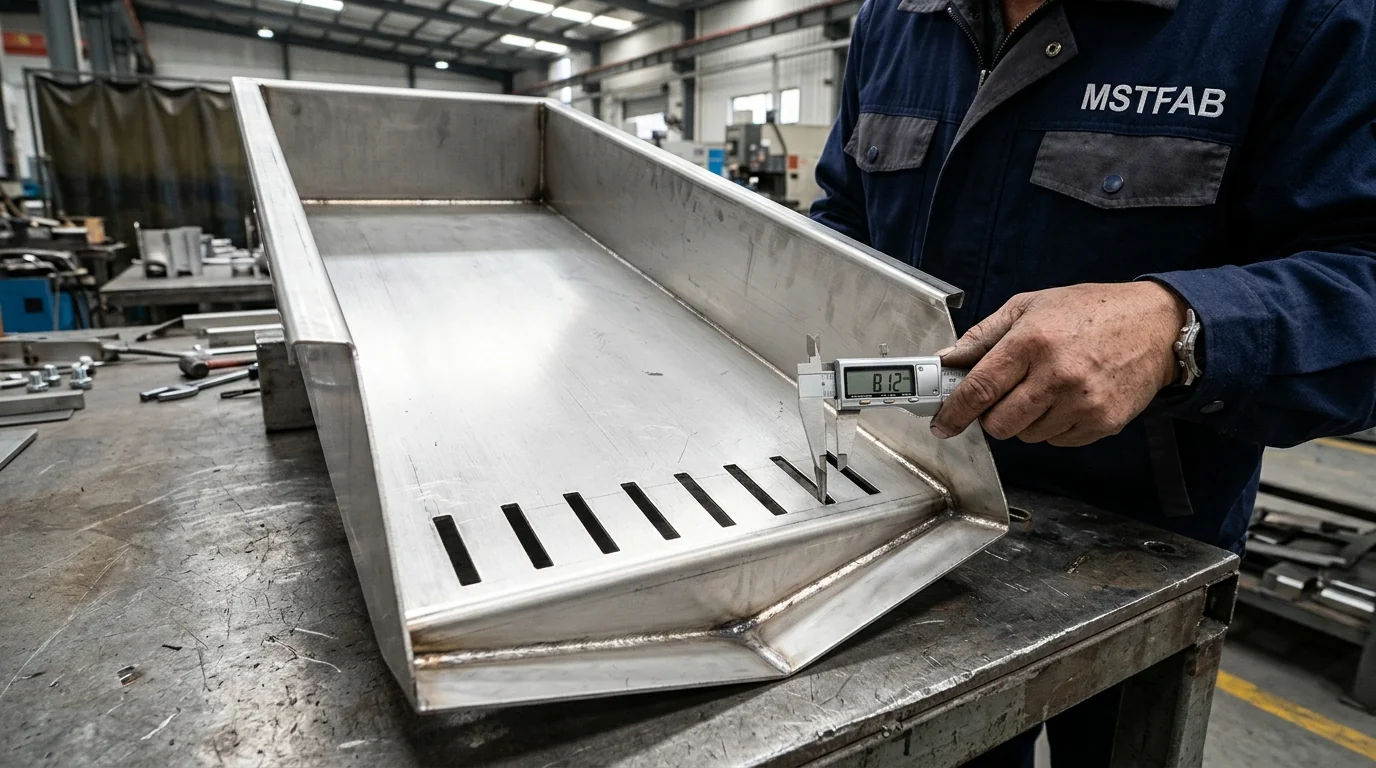
MSTFAB can evaluate the manufacture of the metal chute body and its specified drainage features. The complete coolant filtration, pumping, separation and fluid-management system remains the responsibility of the equipment OEM or a specialist supplier.
How Can a Chip Chute Be Designed for Maintenance?
If chips build up inside a chute, someone has to inspect or clean it. The metal design should support the customer-approved maintenance procedure. Common features include:
- Removable metal access covers
- Bolted mounting flanges
- Accessible fastening locations (see fastener access and tool clearance)
- Smooth, cleanable internal transitions where specified
- Replaceable sections where approved
- Clearance for the intended removal path

Removable designs simplify some maintenance but add joints, fasteners and alignment requirements. They must not compromise the machine’s required guarding or safety provisions. The OEM remains responsible for defining safe access, lockout procedures, operational hazards and applicable machine safety requirements.
How Should OEM Buyers Compare Manufacturing Costs?
Chip chute pricing depends on geometry and the operations involved. A simple bent chute needs fewer steps than a multi-section welded assembly, but material, thickness, finishing, quantity and inspection all move the price.
| Cost Factor | Purchasing Consideration |
|---|---|
| Material grade | Carbon steel, stainless steel or other specified metal |
| Sheet thickness | Material consumption and forming requirements |
| Chute geometry | Number and complexity of fabricated components |
| Laser cutting | Cut length, openings and nesting |
| CNC bending | Bend count and tooling requirements |
| Welding | Joint type, length and fabrication access |
| Reinforcement | Additional brackets and support components |
| Surface finishing | Approved protective or cosmetic treatment |
| Inspection | Required dimensional and joining checks |
| Packaging | Shape, weight and transport protection |
Sometimes a formed design reduces the number of welded parts; sometimes several smaller sections are easier to make or assemble. Neither is automatically cheaper. The supplier should quote the complete scope from the approved drawings. Awkward 3D chute shapes also ship like awkward 3D shapes, so it’s worth thinking about packaging early.
Example RFQ: Custom CNC Chip Discharge Chute
A hypothetical CNC machinery OEM has finished the mechanical design of a fabricated discharge chute and needs a supplier for prototypes and repeat manufacturing.
| Requirement | Example |
|---|---|
| Project | CNC machine chip discharge chute |
| Material | 304 stainless steel |
| Thickness | 2.0 mm |
| Manufacturing | Laser cutting, CNC bending, specified welding |
| Construction | Formed chute body with mounting flanges |
| Surface condition | Deburred, finish per drawing |
| Mounting | Customer-defined mounting-hole pattern |
| Drainage | As specified in approved drawings |
| Inspection | Inlet, outlet and mounting dimensions |
| Quantities | 10, 50 and 100 pcs |
| Technical files | STEP/STP and dimensioned PDF |
Illustrative specifications only; not an actual customer project.
The RFQ should ask for a manufacturing feasibility review, material confirmation, fabrication price, lead time, inspection scope and packaging. If you need a special wear material, removable liner, coolant-containment weld or leak test, list it separately so the supplier can say whether it’s in-house or needs additional processes and arrangements.
Chip Chute Supplier Trust Table
A few questions that separate a fabricator who understands your chute from one who just sees a bent channel.
| Question to Ask | A Reliable Answer Sounds Like | Red Flag |
|---|---|---|
| What chute angle should we use? | “That’s your design decision based on chip type; we’ll build and check the angle you approve.” | Confidently quotes one angle for every chip. |
| Will the welds make it leak-proof? | “Only if leak performance and a test method are specified and agreed.” | “Full weld means no leaks.” |
| Can we powder coat the inside? | “Yes, but it won’t act as a wear surface against steel chips.” | “Powder coat lasts forever.” |
| Any issues with the transitions? | Points out internal lips, weld access or bend-tooling problems before cutting. | Discovers them at the welding table. |
| Can you supply the conveyor too? | “We make the metal parts; powered conveyors and controls are outside our scope.” | Says yes to everything. |
| What will you inspect? | Inlet, outlet, mounting pattern, formed profile and welded fit, as agreed. | “We check it looks right.” |
How Can MSTFAB Support Custom Chip Chute Fabrication?
Guangzhou Maisituo Sheet Metal Manufacturing Co., Ltd. (MSTFAB) provides drawing-based custom sheet metal fabrication for international OEM equipment manufacturers. Our core processes include sheet metal laser cutting, CNC bending, TIG and MIG welding, grinding and deburring, custom metal panels and channels, mechanical mounting brackets, welded sheet metal components, project-specific dimensional inspection and export packaging. We work with carbon steel, 304/316 stainless steel, 5052/6061 aluminum and galvanized steel, subject to drawing requirements and manufacturability review.
For chip chute projects, our engineers can review geometry and processing requirements for components such as CNC-bent discharge channels, formed side panels, laser-cut mounting flanges, welded transition sections, metal deflector panels, reinforcement brackets and removable mechanical covers. More on our custom sheet metal fabrication services.
Scope, plainly: Our standard scope is fabrication of customer-designed metal components, not design or supply of a complete powered chip-removal system. Chip conveyors, augers, motors, sensors, coolant pumps, filtration systems, controls, chip-flow validation and final machine safety compliance are outside standard sheet metal fabrication scope. Specialized abrasion testing, leak testing or performance validation must be agreed separately if required.
What Should Buyers Include in a Chip Chute RFQ?
| Required Information | Purpose |
|---|---|
| STEP/STP model | Defines the finished 3D geometry |
| Dimensioned PDF | Establishes fabrication specifications |
| Material grade | Confirms approved metal |
| Sheet thickness | Defines raw material and forming requirements |
| Inlet and outlet dimensions | Controls interface geometry |
| Mounting-hole pattern | Ensures mechanical installation |
| Weld requirements | Defines the required joining scope |
| Chip type and application | Provides manufacturing context |
| Coolant exposure | Supports material and finishing review |
| Surface finish | Defines agreed post-fabrication treatment |
| Order quantities | Supports production pricing |
| Inspection requirements | Establishes acceptance evidence |
| Shipping destination | Supports packaging and logistics planning |
If the design has several metal components, include a complete bill of materials so the manufacturer can tell individually fabricated parts from complete chute assemblies. Our guide to quoting with STEP, PDF and DXF files covers file preparation, and buyers sourcing a wider range of machine parts may find our machinery covers, guards and frames guide useful.
Key Takeaways
- A chip chute is a functional machine component, not just a bent channel.
- Tell the supplier the chip type, coolant and discharge arrangement; slope can’t be chosen from a material name.
- Define inlet, outlet, mounting pattern and transitions clearly; the OEM validates the geometry.
- Watch internal weld profiles and lips; they become chip traps.
- Powder coating isn’t a wear surface. Specify wear materials or replaceable liners separately.
- “Fully welded” isn’t “leak-tight” unless a leak test is specified.
- Design the removal path for cleaning without compromising guarding or safety.
- Fabricators make the metal parts; the complete chip-removal system stays with the OEM.
Frequently Asked Questions
Can sheet metal fabrication be used for CNC chip chutes?
Yes. Suitable chute components can be made with laser cutting, CNC bending, welding and mechanical fabrication according to the approved design.
Is stainless steel better than carbon steel for chip chutes?
Not universally. It depends on chip abrasion, coolant exposure, mechanical loading, expected service life and cost. The OEM should approve the material.
Can a chip chute be manufactured without welding?
Some designs can be produced with CNC bending and mechanical fastening; others need welded joints or multi-part assemblies. Feasibility depends on the drawing.
Can a sheet metal factory manufacture removable chip chutes?
Yes, where the approved design includes removable sections and suitable fastening interfaces. Assembly and maintenance requirements are defined by the machine manufacturer.
Does powder coating prevent chip chute wear?
Not necessarily. Powder coating protects surfaces in suitable applications, but abrasive chip contact can damage it. Evaluate wear-resistant requirements separately.
Can a custom chip chute include coolant drain holes?
Yes. Laser-cut or otherwise manufactured drainage features can be included per the approved drawings. The complete fluid-management function must be validated by the equipment designer.
Can MSTFAB manufacture a complete chip conveyor?
MSTFAB specializes in fabricated metal parts. Complete powered conveyors, drives, controls and coolant-handling systems are outside its standard manufacturing scope.
What files should I send for a custom chip chute quotation?
STEP/STP models, dimensioned PDF drawings, material grade, thickness, quantity, joining requirements, surface finish and relevant machine interface details.
Source the Chute as a Functional OEM Metal Component
A custom chip chute may look like a straightforward bent metal channel, but its performance depends on the machine interface, chip characteristics, material, geometry, joining method and installation. For CNC equipment manufacturers, good procurement starts with an approved design and a clearly defined fabrication scope.
A qualified sheet metal supplier should be able to review cutting, bending, welding, mechanical interfaces and the agreed inspection. The complete chip-handling function stays with the equipment designer. The right chip chute is one that can be made consistently, installed correctly and used within the OEM’s validated machine design.
Request a Custom Sheet Metal Chip Chute Quote
Need custom metal chutes, deflector panels, mounting brackets or welded sheet metal components for a CNC machinery project? Send your STEP/STP models, dimensioned PDF drawings, material specifications, order quantities and required processes. Our team will review the fabrication scope and provide a project-specific quotation.
Request a Custom Fabrication Quote
Explore Custom Sheet Metal Fabrication
View CNC Bending Services
 WeChat Contact
 WhatsApp Me Directly