Quick Answer: Sourcing Custom Sheet Metal for Machinery OEMs
Machinery OEMs need sheet metal components that fit their equipment, support the approved design and remain consistent across production orders. A custom sheet metal fabrication supplier can manufacture machine covers, protective guards, welded frames, equipment panels, brackets and mechanical subassemblies from buyer-approved drawings.
MSTFAB focuses specifically on manufacturing these high-precision physical metal components—not complete functional machinery, electric motors, control systems, or turnkey finished equipment. For OEM equipment builders in industrial automation, agricultural machinery, packaging systems, and material-handling equipment, the critical procurement question is not merely whether a fabricator can cut and bend plate.
It is whether the complete fabricated component aligns seamlessly with mating machine datums, maintains dimensional repeatability across repeat batches, and arrives at your assembly floor properly packaged and ready for immediate line integration.
1. Different Machinery Parts Need Different Quality Checks
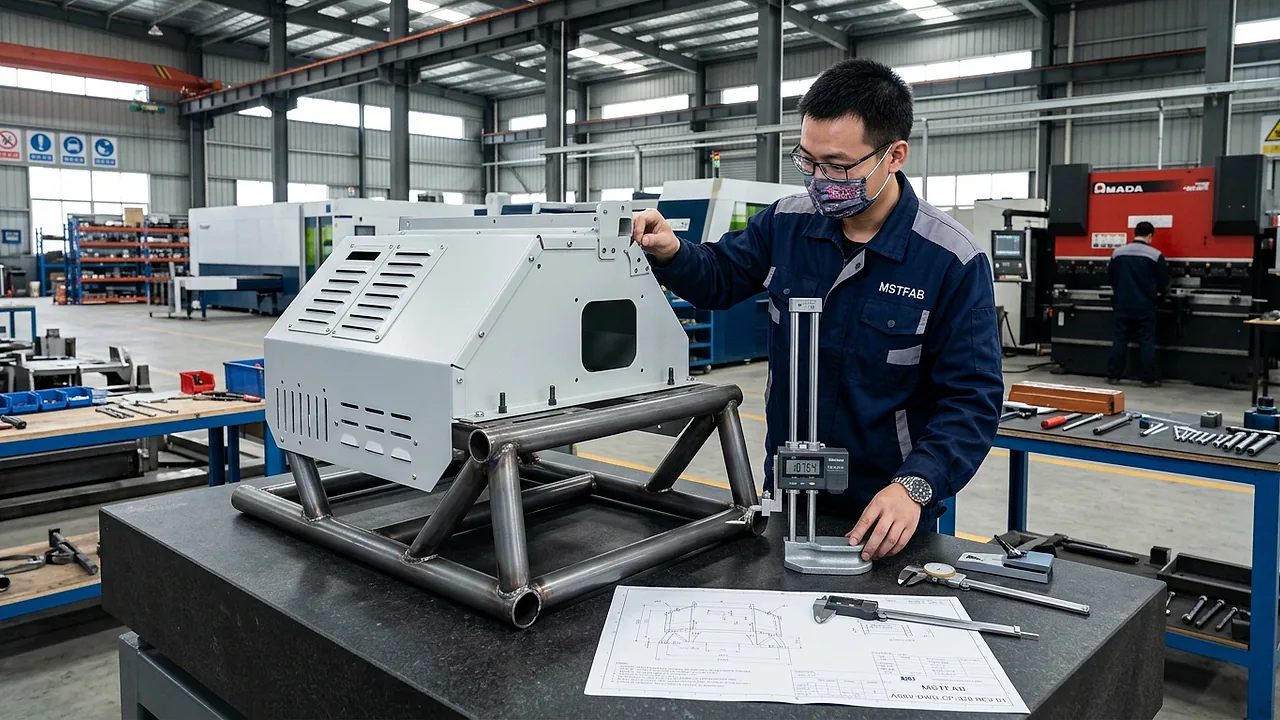
In machinery design, custom sheet metal components perform radically different functions. A cosmetic exterior cover requires flawless powder-coat texture and smooth edge blending; an internal welded subframe demands rigid squareness and co-planar mounting pads; a protective machine guard prioritizes safety compliance, finger-trap elimination, and secure interlock mounting.
Applying the exact same generic inspection routine to all components creates avoidable waste. Instead, OEM procurement and quality teams should align quality checks to the component’s functional role:
| Custom OEM Component | Primary Machinery Function | Critical Quality & Fit Checks | Inspection Evidence |
|---|---|---|---|
| Machine Covers & Hoods | Internal mechanism protection, noise attenuation, aesthetic brand identity | Flange co-planarity, hinge alignment, quick-release latch fit, cosmetic powder coat finish | Dimensional FAI & Gloss Check |
| Protective Safety Guards | Personnel shielding around rotating drives, pinch points, and cutter belts | Ventilation slot opening dimensions, 100% deburred radius edges, interlock bracket position | Pin Gauge & Edge Touch Audit |
| Welded Support Frames | Structural mounting base for motors, linear guides, and conveyor rollers | Overall diagonal squareness (≤ 1.0 mm), weld penetration, mounting pad flatness, tap pitch | Granite Square & Thread Go/No-Go |
| Equipment Control Panels | Housing for HMIs, pushbuttons, emergency stops, cable glands, and cooling fans | Laser cutout positions, PEM stud torque/push-out retention, sealing gasket channel flatness | Optical CMM & Torque Test |
| Heavy Mounting Brackets | Sensor positioning, gearbox mounting, hydraulic manifold anchoring | Hole-to-bend center distance, sheet thickness tolerance, bend radius relief without cracking | Digital Caliper & Visual Bead Check |
| Mechanical Subassemblies | Pre-assembled modules (door + hinges + latches + bracket + gas spring) | BOM completion, smooth hinge swing, latch engagement, transit restraint packaging | Functional Assembly Checklist |
The Golden Principle: A painted machine cover that looks pristine in a catalog photo but cannot be easily unlatched for routine field maintenance is an engineering failure. Component inspection must reflect actual equipment assembly and operational conditions.
2. Start With the Machine Assembly, Not Just the Individual Part
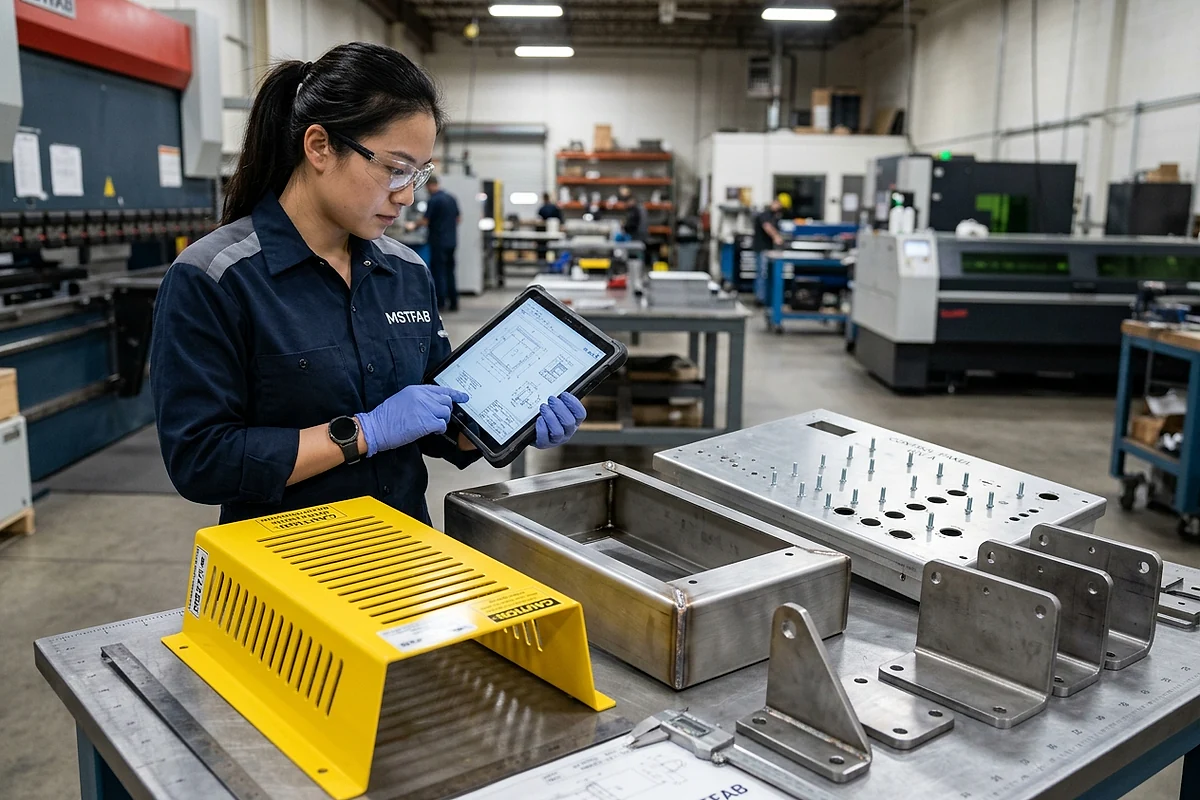
Machinery sheet metal components rarely exist in isolation. A guard bolts directly onto a welded tubular chassis. An HMI panel must align precisely with an internal aluminum sub-chassis. A sensor bracket must place an optical eye within 1.0 mm of a moving conveyor belt.
When sourcing custom machinery sheet metal parts, providing a lone 2D drawing of an isolated bracket often conceals critical assembly interfaces. To ensure flawless integration on your assembly floor, your RFQ package should communicate the broader machine assembly context:
- Native 3D CAD Geometry & 2D Controlled Prints: Provide 3D STEP/STP models alongside 2D PDF drawings. 3D models clarify spatial orientation, flange clearance, and bend reliefs; 2D prints define critical datums, GD&T limits, and surface finish notes.
- Assembly BOM & Mating Datums: Identify which flanges, hole patterns, or milled pads serve as the primary locating datums (Datums A, B, C) during equipment assembly. This allows the supplier to design press brake tooling and welding fixtures referencing the exact same datums.
- Specified Hardware & Inserts: Clearly detail clinch nut/stud specifications (e.g., PEM part numbers, thread class 6H/2B, stainless vs zinc-plated steel) and installation torque requirements.
- Collaborative DFM Review: If our engineering team identifies an interference, tight bend radius prone to cracking, or an inaccessible weld seam, any proposed drawing change is submitted with marked-up CAD screenshots for OEM engineering approval before metal is cut.
3. Keep Machinery Safety Responsibilities Clear
Machinery fabricators frequently produce protective belt guards, safety fence panels, electrical interlock enclosures, and operator shields. However, a crucial legal and engineering boundary must remain crystal clear before issuing a purchase order:
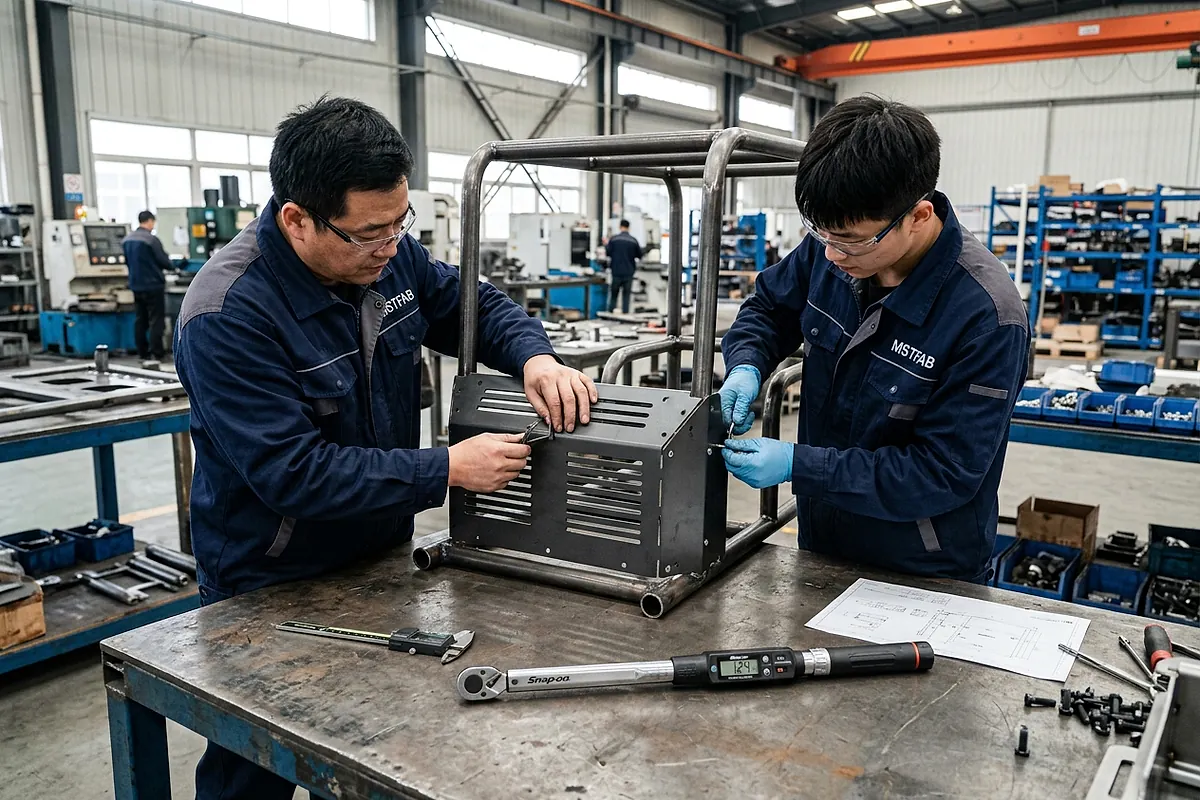
MSTFAB’s Responsibility: Manufacture the physical metal parts strictly according to the buyer-approved drawings, ensure structural weld integrity, eliminate sharp burrs and laser dross, maintain specified slot opening dimensions, and install agreed hardware.
OEM’s Responsibility: Determine machine hazard zones, calculate safety distances according to international standards (e.g., ISO 13857, ISO 14120, OSHA 1910), specify interlock switch integration, perform machine risk assessments, and certify total equipment CE/UL compliance.
Fabrication suppliers manufacture mechanical components; the equipment OEM owns the system design and functional safety validation. Clarifying this division prevents unrealistic contractual assumptions while ensuring every guard is fabricated with uncompromising physical precision.
4. Compare Complete Manufacturing Scope (No Hidden Costs)
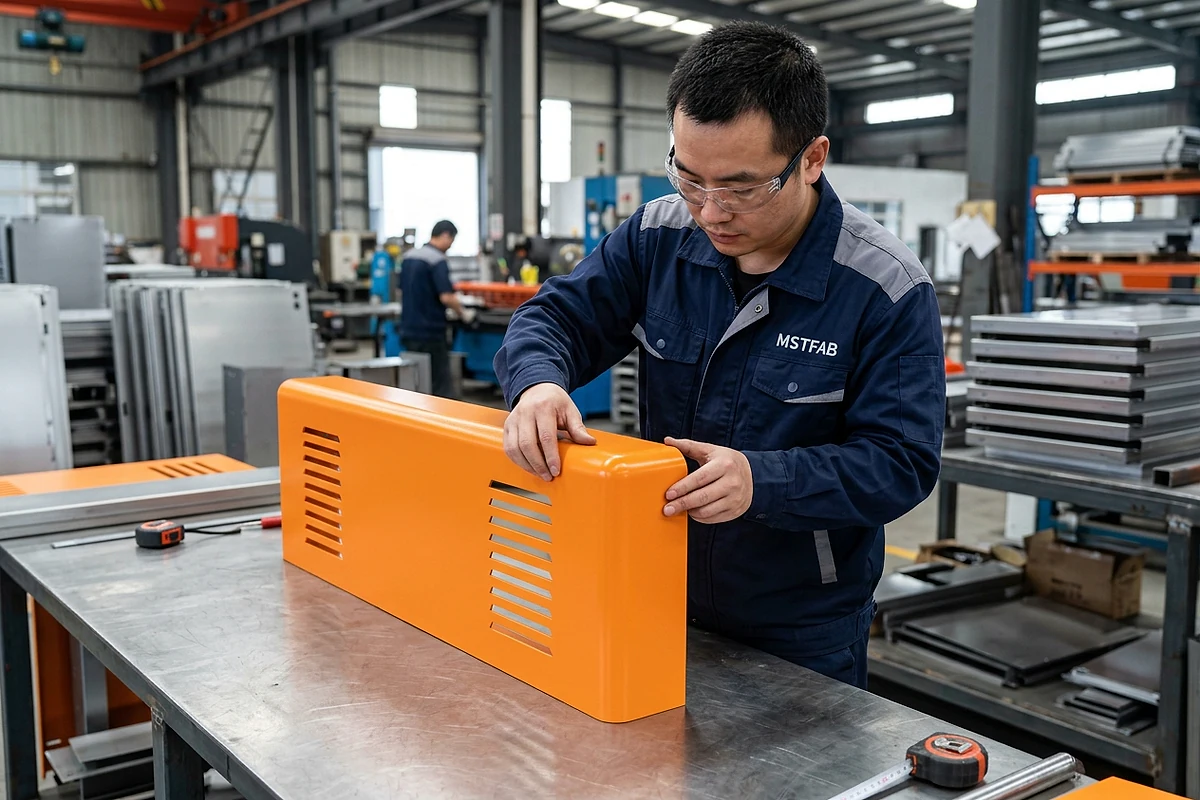
In overseas sheet metal procurement, comparing supplier quotations based strictly on bare metal unit prices frequently results in unpleasant surprises. Sourcing assembly-ready machinery components requires an integrated manufacturing sequence:
- Fiber Laser Cutting: High-speed, burr-free cutting of carbon steel, stainless steel, and aluminum sheet up to 25 mm thickness, including precision louvers and ventilation patterns.
- CNC Press Brake Bending: Multi-axis CNC bending with segmented tooling, radius punches, and dynamic crowning to ensure consistent bend angles across varying steel coil heats.
- Precision Welding & Dressing: Certified TIG/MIG welding for tubular frames and chassis corners, followed by seamless weld grinding and blending where cosmetic appearance is required.
- Hardware Installation: Dedicated pneumatic insertion presses installing threaded PEM studs, standoffs, flush nuts, and captive panel screws with verified push-out resistance.
- Coordinated Surface Finishing: Project-specific surface treatments—including polyester/epoxy powder coating (RAL color matched), anodizing, zinc electroplating, and chemical blackening—coordinated through established, long-term finishing partners under strict MSTFAB quality oversight.
- Metrology Inspection & Export Packaging: Final dimensional verification, moisture-barrier VCI polybagging, custom foam cushioning, and certified ISPM-15 export crating.
- “ISO certification guarantees every single part is in tolerance”: An ISO 9001 quality management system establishes procedural discipline, but it does not replace physical inspection. Conformance must be proven through project-specific First Article Inspection (FAI) and lot measurement data.
- “All critical hole positions can achieve ±0.1 mm everywhere”: While laser cutting can achieve tight hole pitches on flat blanks, subsequent press brake bending and heat-induced weld shrinkage alter spatial relationships. Realistic tolerances must be evaluated based on material thickness, formed geometry, and functional datums.
- “Sheet metal parts guarantee IP54 / IP65 / IP66 ratings”: Fabricated sheet metal shells and panels provide the mechanical enclosure, but ingress protection ratings depend on the OEM’s final sealing gasket compression, cable gland sealing, and total system assembly.

5. Control Production and Repeat Orders (From Prototype to Series)
Machinery manufacturing typically follows an evolutionary trajectory: an initial prototype batch of 1 to 5 units for R&D assembly testing, followed by serial production runs of 50 to 500 units per quarter. Maintaining consistency throughout this transition requires robust configuration control:
- First Article Inspection (FAI) Baseline: The initial prototype or first production batch establishes the authorized manufacturing baseline. Critical to Quality (CTQ) dimensions, bend clearances, and hardware installations are formally documented on an agreed FAI report.
- Digital Work Order Travelers: Digital routing travelers tie the approved CAD revision directly to CNC laser cutting and press brake programming, eliminating obsolete revision risks on the factory floor.
- Preserving Repeat Batch Interchangeability: Repeat orders must match the authorized drawing baseline without silent supplier changes. If material heats or tooling wear introduce variations, our metrology team verifies CTQs before shipment release.

6. What MSTFAB Does and Does NOT Manufacture
To avoid misaligned expectations and streamline procurement evaluation, MSTFAB maintains clear, transparent boundaries regarding our manufacturing capabilities:
✓ What MSTFAB Manufactures
- Drawing-based machine covers, hoods, and access doors
- Protective safety guards with laser ventilation louvers
- Welded structural base frames and sub-chassis
- HMI, electrical, and pneumatic mounting panels
- Heavy-duty structural mounting brackets and motor plates
- Empty sheet metal enclosure shells and card cages
- Mechanical subassemblies (sheet metal + hinges + latches + PEM hardware)
✗ What MSTFAB Does NOT Supply
- Complete, functional turnkey machinery
- Electric motors, gearboxes, or drive transmissions
- PLC programming, electrical wiring, or automation controls
- Hydraulic pumps, valves, or pneumatic cylinders
- Machine-level CE / UL / OSHA functional safety certification
7. Sample Machinery Sheet Metal Procurement Specification (RFQ Clause)
To streamline RFQ discussions and eliminate contractual ambiguity, OEM buyers can adapt the following clause for purchase orders or supplier quality agreements:
Machinery Sheet Metal Procurement & Assembly Fit Clause
1. Manufacturing Baseline: Supplier shall manufacture all machine covers, guards, welded frames, and panels strictly in accordance with buyer-approved 2D PDF drawings, 3D CAD models, material standards, and GD&T limits stated in the purchase order.
2. Interface & Datum Integrity: Critical mounting hole patterns, welded frame squareness, and mating flanges shall be verified against drawing datums prior to shipment. Where specified, supplier shall perform pre-assembly fit trials on mating subassemblies.
3. Hardware & Finishing Verification: Specified PEM clinch hardware shall be installed with verified push-out retention. Surface finishing (powder coating/plating) coordinated through approved partners shall meet agreed color, gloss, and adhesion criteria without coating buildup in threaded holes.
4. Safety Edge Treatment: All exposed operator-accessible edges, ventilation slots, and cutouts on machine covers and guards shall be 100% deburred and radius-dressed to prevent snagging and personnel injury.
5. Export Protection: Components shall be packaged in accordance with approved export protection specifications—incorporating non-abrasive interleaving, edge protectors, and ISPM-15 wooden crates where applicable—to minimize transit damage risks.
8. Frequently Asked Questions (FAQ)
Can MSTFAB manufacture machine covers, protective guards, and welded frames?
Yes. MSTFAB specializes in custom, drawing-based sheet metal fabrication for overseas machinery OEMs. Our core manufacturing capabilities include fiber laser cutting, precision CNC press brake bending, certified TIG/MIG welding, mechanical hardware insertion, coordinated powder coating, and full metrology inspection.
Do you manufacture complete, running industrial machines?
No. MSTFAB is a precision sheet metal and mechanical components fabricator. We supply fabricated structural frames, machine covers, guard assemblies, brackets, and empty enclosure shells. We do not provide electric motors, gearboxes, internal PLC automation wiring, hydraulic systems, or turnkey machine commissioning.
Can MSTFAB install hinges, latches, gas springs, and threaded hardware?
Yes. We routinely deliver value-added mechanical subassemblies. When specified on customer drawings and BOMs, we install captive fasteners, PEM clinch nuts/studs, industrial lift-off hinges, quarter-turn latches, rubber edge trims, and gas struts, delivering modular assemblies ready for direct equipment installation.
Can we request prototype batches before committing to volume production?
Absolutely. We encourage prototype runs (typically 1 to 5 sets) to validate physical assembly fit, ergonomics, latch engagement, and cosmetic finishes. Once your engineering team signs off on the First Article Inspection (FAI) report, we lock in the manufacturing routing for repeat production runs.
What information should a machinery OEM provide for an accurate quotation?
For a fast, comprehensive quote, provide 3D CAD models (STEP/STP), fully dimensioned 2D PDF prints with tolerance callouts, material specifications (grade, thickness, temper), surface finish requirements (RAL color, texture, masking areas), required hardware BOM, annual and batch volume estimates, and destination port/address.
Request a Machinery Sheet Metal Fabrication Quote
Looking for an experienced, export-oriented sheet metal fabrication partner for your machinery program? Partner with MSTFAB for precision covers, guards, welded frames, and equipment panels built to your exact engineering specifications.
Send your STEP/PDF drawings and project requirements to our engineering team for a detailed DFM review and competitive quotation.
Email: [email protected]
WhatsApp: +86 173 2831 6456
Website: https://mstfab.com/
Learn more about our core capabilities on our custom sheet metal fabrication services page.
 WeChat Contact
 WhatsApp Me Directly