A crate can look magnificent on the loading dock: thick timber, neat straps, “FRAGILE” in large letters. None of that tells you whether the powder-coated cabinet inside will still be scratch-free after four weeks, two ports and one forklift driver having a bad day. Packaging validation is how you find out before the whole order is on the water.
Quick answer: Packaging validation for custom sheet metal parts is the process of checking whether an approved packaging design can protect finished metal components through the intended shipping and handling conditions. For OEM buyers importing metal enclosures, CNC-bent panels, stainless steel covers or welded assemblies, it may include a trial pack, movement and clearance checks, impact or vibration testing, load assessment, and receiving inspection after a representative shipment. The goal is to find packaging failures before they affect an entire production order. How much validation you need depends on part value, geometry, surface finish, weight, transport route and your quality requirements.
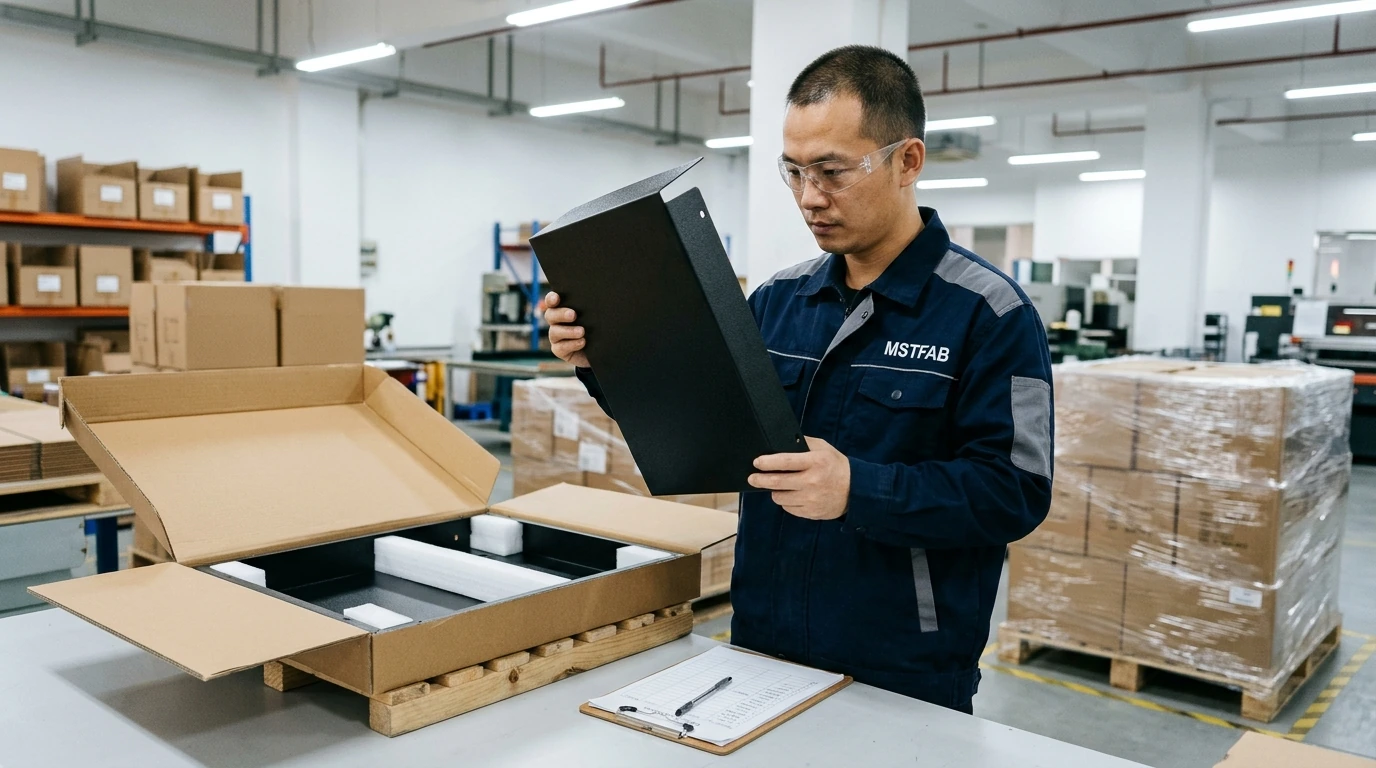
Unlike a routine packaging checklist, validation is about evidence: proof that the selected materials, internal supports, package structure and shipping configuration actually suit this product. This guide explains how OEM purchasing and engineering teams can set up a practical validation process when sourcing custom sheet metal fabrication from an overseas supplier. (If you’re looking for which packaging materials to use, such as film, foam, corner guards and so on, our guide to packaging quality requirements for sheet metal suppliers covers that. This article is about proving the result works.)
What Is Packaging Validation in Sheet Metal Manufacturing?
Packaging validation evaluates whether a proposed packaging arrangement meets the agreed protection requirements for a particular metal part or assembly. A supplier may propose a carton, foam separators, protective film, a pallet or a wooden crate. But the presence of those materials doesn’t prove the packed product can survive the real distribution environment.
- A heavy enclosure can still move inside a wooden crate.
- A thin panel can deform if pressure lands on an unsupported area.
- A powder-coated part can pick up rub marks when its separator shifts in transit.
Validation addresses these risks with structured evaluation instead of optimism.
Packaging inspection vs. packaging validation
| Factor | Routine Packaging Inspection | Packaging Validation |
|---|---|---|
| Main question | Was the approved packing method followed? | Can the packing method provide the required protection? |
| Typical stage | Before each shipment | Before production release or after significant changes |
| Focus | Materials, quantities, labels, packing condition | Product protection under expected transport conditions |
| Evidence | Packing photos, packing list, inspection records | Trial-pack results, measurements, test reports or shipment evaluation |
| Main purpose | Verify packing execution | Establish suitability of the packaging design |
Both are useful; they just answer different questions. Once a method has been validated and approved, routine shipment inspections confirm it keeps being used. Our export packaging approval checklist and export packaging, QC and delivery checks cover the routine side.
1. Why Do Custom Sheet Metal Parts Need Packaging Validation?
Custom sheet metal parts are built to precise mechanical and cosmetic requirements. They may have thin flanges, welded frames, mounting holes, installed studs, decorative panels or delicate finishes. A part can pass final inspection at the factory and still arrive unusable.
Common transport-related risks
| Component Type | Potential Risk | Validation Objective |
|---|---|---|
| Large CNC-bent panel | Flange deformation | Verify mechanical support |
| Powder-coated enclosure | Surface rubbing | Verify separation and movement control |
| Brushed stainless steel cover | Cosmetic marks | Confirm surface protection |
| Welded cabinet frame | Movement or impact damage | Evaluate internal restraint |
| Thin aluminum panel | Bending or denting | Check load distribution |
| Parts with studs | Hardware impact or thread damage | Verify local clearance and protection |
| Multi-part mechanical kit | Components shifting inside the package | Confirm secure positioning |
The test plan should target the risks of the actual product. A small aluminum bracket may need a fairly simple evaluation; a large, high-value industrial cabinet shipped internationally may justify much more. Match the validation level to the consequences of damage, rather than applying the same test to every order.
2. Start With the Actual Shipping Configuration
Before picking a test method, understand how the parts will travel. A single boxed sample sent through a parcel network is handled very differently from a heavy cabinet strapped to a pallet in a container.
Shipping information buyers should define
- Transport mode: parcel, air freight, road freight or ocean freight
- Product dimensions and net weight
- Quantity per package
- Individual cartons or a unitized pallet
- Loading and unloading method
- Expected handling and storage conditions
- Whether the shipment will be broken down into smaller packages
- Applicable destination packaging requirements
This tells you which hazards are relevant. The International Safe Transit Association (ISTA) publishes test procedures for different distribution situations, and ASTM D4169 provides a framework for laboratory performance testing of shipping containers and systems. Neither should be chosen just because it’s familiar. The procedure must match the actual shipping unit and route. Shipping terms matter too: who arranges and carries the freight risk affects who should validate what (see EXW vs. FOB sheet metal quotes).
3. What Should Be Checked During a Trial Pack?
A trial pack is the practical first step before any formal testing. The supplier packs representative production parts using the proposed materials, and the buyer or responsible engineer checks that the product sits in the package as intended.
| Check | What to Verify |
|---|---|
| Product orientation | Components are positioned as approved |
| Internal clearance | Critical areas have sufficient separation |
| Support locations | Loads pass through appropriate surfaces |
| Surface protection | Visible finishes are not exposed to damaging contact |
| Corner protection | Vulnerable edges and formed corners are supported |
| Fastener protection | Studs, hinges and other hardware cannot strike adjacent parts |
| Internal movement | Components are adequately restrained |
| Package closure | Cartons or crates close without harmful pressure |
| Handling access | Lifting or moving the package doesn’t require unsafe contact with parts |
Use representative production parts and packaging. A prototype enclosure and the production version may differ in hardware, finish or weight; if those differences affect protection, the packaging needs another look.
Why trial packing matters
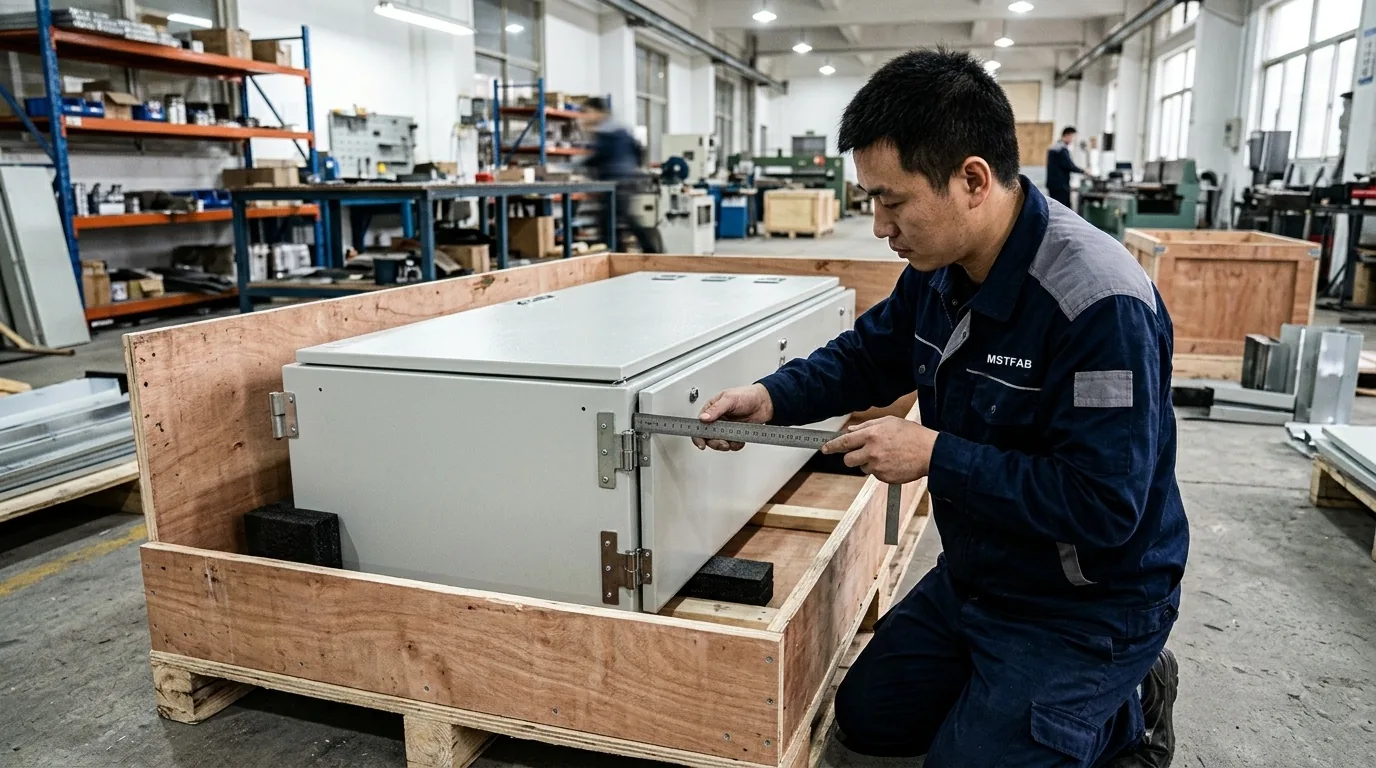
Packaging designed only from overall dimensions can fail because of features that don’t show up in a simple rectangle. An enclosure may have hinges sticking out beyond the main body. If the crate supports the enclosure directly on those hinges, transport loads go straight through them. A trial pack catches that before it’s repeated across an entire shipment.
4. How Should Vibration Risk Be Evaluated?
Transport means repeated movement and vibration. The resulting damage depends on the product’s mass and geometry, how well the packaging restrains it, and the transport environment. A heavy metal assembly that can move relative to its supports will eventually find something to rub against. Picture a powder-coated cabinet in a wooden crate with weak restraint: over thousands of small movements, contact with the internal supports wears through the coating or deforms exposed features.
What a vibration evaluation should check
- Movement between the part and its packaging supports
- Loosening of internal restraints
- Repeated contact with adjacent components
- Abrasion or cosmetic damage
- Packaging deformation
- Movement of separately packed accessories
- Changes in structural or mounting alignment

Formal vibration testing should follow an appropriate, agreed protocol. A supplier should not claim a package “passes ISTA” or “passes ASTM” because someone shook a carton and nothing rattled. For OEM purchasing the relevant questions are: which test method was used, what conditions were applied, and did the product meet the agreed acceptance criteria afterwards?
5. Should OEM Buyers Request Impact or Drop Testing?
Impact testing can be relevant when packages may be shocked during handling, but the right test depends heavily on package size, mass, configuration and transport method. A small parcel of brackets and a large welded enclosure secured to a pallet have very different risk profiles.
Potential impact-related problems
- Bent corners: thin sheet metal corners can deform when impact passes through a poorly supported package.
- Damaged mounting features: threaded studs, brackets or protruding hardware are vulnerable to concentrated forces.
- Panel distortion: large flat panels bend if the package transfers impact into an unsupported area.
- Broken internal restraints: the box can look perfect outside while the support system inside has failed.
Choose the test procedure based on the shipment configuration. Testing should never expose people to uncontrolled hazards from dropping heavy metal assemblies. For oversized industrial equipment, an approved professional laboratory or packaging specialist may be required. “Let’s just drop it off the forklift and see” is not a test method.
6. Why Compression and Stacking Loads Matter
Packages of metal parts may end up under other freight or stacked in a warehouse. That’s a different risk from vibration or impact. If several cartons of formed panels are stacked on a pallet and the packaging can’t carry the load, the weight of the upper cartons passes into the parts below: bent panels, damaged flanges, crushed separators.
| Question for Stackable Packaging | Why It Matters |
|---|---|
| Is the packaging intended to be stacked? | Determines whether stacking load must be evaluated |
| How is the load transferred? | Prevents concentrated force on the metal part |
| Does the pallet support the bottom package? | Reduces local package deformation |
| Are the internal supports load-bearing? | Separates cushioning from structural support |
| Does humidity affect the packaging? | Moisture can weaken some packaging materials |
| Are stacking limits marked? | Communicates approved handling requirements |

A foam separator that’s excellent at preventing scratches may be useless as a load-bearing support. Choose packaging materials for the job they actually have to do.
7. When Should OEM Buyers Consider ISTA or ASTM Testing?
Not every sheet metal shipment needs formal third-party testing. For standard low-risk parts, a documented trial pack and appropriate shipment inspection may be enough under your requirements. Formal laboratory testing makes more sense when the product is high-value, easily damaged, shipped through demanding conditions, or covered by a contractual packaging qualification requirement.
| Framework | General Purpose | Buyer Consideration |
|---|---|---|
| ISTA screening procedures | Initial package integrity evaluation | Useful for appropriate development-stage testing |
| ISTA distribution simulation procedures | Simulate selected shipping hazards | Choose the procedure matching the shipment type |
| ASTM D4169 | Performance evaluation of shipping units | Define a suitable distribution cycle and test conditions |
| Customer-specific protocol | Meet an OEM’s defined shipping requirements | Confirm test method and acceptance criteria |
Select the specific test designation using the current applicable procedure and the real distribution conditions. The plan should state the purpose, sample configuration, standard, acceptance requirements and testing organization. If the supplier doesn’t have the right test equipment, qualified external testing can be evaluated and quoted separately.
Important: Passing a laboratory test does not guarantee zero damage on every real shipment. It provides evidence of performance under the tested conditions. Anyone promising “zero damage, guaranteed” is selling confidence, not packaging.
8. What Should Be Measured After Packaging Testing?
The package isn’t the only thing to inspect. A box can come through a test looking pristine while the parts inside are damaged. Post-test inspection should cover the product’s important characteristics.
| Inspection Item | Acceptance Objective |
|---|---|
| Surface appearance | No damage beyond the approved cosmetic criteria |
| Panel flatness | Meets specified dimensional requirements |
| Flange geometry | No unacceptable deformation |
| Mounting holes | Still suitable for intended assembly |
| Hardware condition | No damage or loosening outside approved limits |
| Welded structure | Meets agreed structural and dimensional checks |
| Protective materials | No failure that compromises required protection |
| Package identification | Labels and identification remain usable |
| Component quantity | No loss of required components |

If the package went through formal testing, record the results against the acceptance criteria. For high-risk interfaces, you may want a representative assembly fit check after testing; agree that scope in advance. A visual check alone may miss transport-related dimensional damage. If the receiving inspection and the supplier’s numbers disagree, our guide to resolving supplier vs. buyer measurement differences helps; if parts do arrive damaged, see cosmetic rework vs. remake.
9. Example: Validating Packaging for Industrial Enclosure Panels
A hypothetical overseas OEM order: 200 powder-coated carbon steel enclosure panels, each about 600 × 400 mm with formed edges and mounting holes, shipping internationally. The buyer’s main worries are scratched surfaces and bent corners.
Example packaging plan
Component: Powder-coated steel enclosure panel
Material: SPCC carbon steel
Thickness: 1.5 mm
Surface finish: Black powder coating, RAL 9005
Order quantity: 200 pcs
Proposed packaging: Individual protective separation, reinforced outer cartons and palletized shipment, subject to design review
- Inspect representative panels before packing.Record their condition so “after” has a “before” to compare against.
- Prepare the proposed production packaging.Real materials, real quantities per carton.
- Verify support, separation and closure.The trial-pack checks above.
- Evaluate the applicable handling and transport risks.Based on the actual route and shipping unit.
- Perform the agreed testing or representative shipment trial.Lab test, trial shipment or both, as agreed.
- Unpack and inspect the selected panels.Against the agreed acceptance criteria.
- Record any scratches, deformation or packing failures.With photos and locations, not just “some damage”.
- Approve, revise or retest.Then freeze the approved configuration.
If the first round shows damage, find the cause before reaching for more foam. The fix might be moving a support location rather than piling on cushioning. After modifying the packaging, repeat the affected validation steps as appropriate.
Illustrative purchasing example only, not an actual MSTFAB packaging test result.
10. How Do Packaging Changes Affect Validation?
Once a configuration is approved, the supplier shouldn’t change anything that could affect protection without evaluating it first. Typical changes include:
- A different carton grade
- Replacing foam with another protective material
- More parts per carton
- Removing internal separators
- Different pallet dimensions
- Moved restraint locations
- A different wooden crate design
- A changed transport configuration
- Changes to the enclosure’s dimensions or weight
Not every change needs a full new laboratory qualification. Changing an external label barely affects package strength; doubling the number of heavy parts in the same carton changes the loading considerably. A practical change-control process records the reason for the change and any revalidation needed.
11. What Should Be Included in a Packaging Validation Report?
A useful report explains what was tested and what the results show. A photo of a closed crate is a nice photo, not evidence of performance.
| Report Field | Purpose |
|---|---|
| Customer and project | Identify the purchasing program |
| Part number and revision | Identify the tested metal part |
| Product quantity and weight | Establish the test configuration |
| Packaging description | Identify materials and construction |
| Packaging configuration revision | Control changes to the packaging |
| Test method | Describe the agreed validation activity |
| Testing organization | Identify who performed the evaluation |
| Test conditions | Document relevant applied conditions |
| Pre-test inspection | Record original part condition |
| Post-test inspection | Record resulting part condition |
| Deviations or failures | Identify nonconforming results |
| Approval status | Document the authorized conclusion |
Ask for records proportionate to the project’s risk. Routine brackets don’t need the same file as expensive industrial enclosures. The aim is useful evidence, not a heavier binder.
12. How Do Export Wooden Crates Affect Packaging Requirements?
Heavy sheet metal assemblies often ship in wooden crates, on skids or on pallets. For international trade, regulated solid wood packaging may need to comply with ISPM 15, which covers phytosanitary treatment and marking of wood packaging material (for US imports, see the USDA APHIS wood packaging requirements). ISPM 15 does not establish that a crate is structurally suitable for your product. Treat these as two separate requirements:
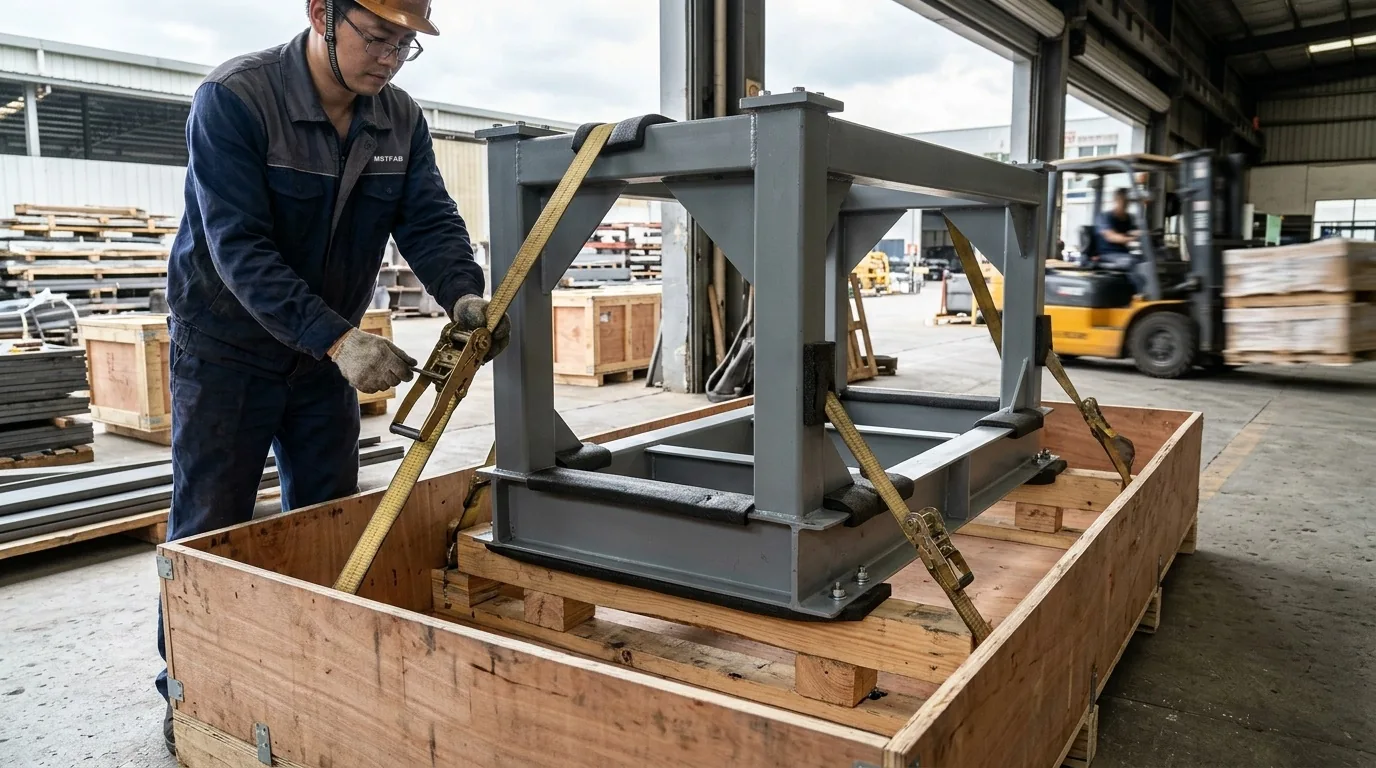
A correctly marked ISPM 15 crate can still be unsuitable if it doesn’t restrain a heavy enclosure. And a mechanically excellent crate can still cause import problems if it doesn’t meet wood packaging rules. For overseas procurement, address both where relevant. Large welded frames in particular deserve a restraint plan based on their real dimensions and lifting points.
13. How Can Packaging Validation Reduce Total Procurement Cost?
Validation adds planning and possibly testing cost. Packaging failure adds its own list:
- Replacement fabrication
- Cosmetic refinishing
- Additional inspection
- Expedited freight
- Delayed OEM assembly
- Warehousing and sorting costs
- Supplier–buyer disputes
- Customer service interruptions
For expensive fabricated parts, these can easily exceed the cost of evaluating the packaging before a large shipment. A simplified model:
The expected damage cost depends on project-specific evidence and assumptions. Don’t assume formal testing delivers a particular percentage saving. Instead, match the validation scope to the financial and operational consequences of damage. For repeat orders, an approved packaging configuration also removes a lot of uncertainty the next time the same part ships.
14. What Should OEM Buyers Ask Before Approving a Packaging Plan?
- Is the packaging based on the final production part?Confirm it accounts for the actual finish, installed hardware, weight and geometry.
- Which hazards is it meant to address?Separate surface rubbing, impact, stacking pressure, vibration, corrosion exposure and handling risks.
- Has the proposed package been evaluated?Ask whether a trial pack, lab test or representative shipment assessment exists or is required.
- Who approves the packaging design?Name the buyer or engineering representative authorized to accept it.
- What happens when the packaging changes?Agree which changes need notification, review or additional validation.
- Is validation included in the quotation?Special testing, external lab fees, samples and extra packaging engineering should be quoted where applicable.
Packaging Validation Supplier Trust Table
How to tell a supplier who validates packaging from one who just has nice crates.
| Question to Ask | A Reliable Answer Sounds Like | Red Flag |
|---|---|---|
| Has this packaging been tested? | States exactly what was done: trial pack, lab procedure or trial shipment, and with what result. | “It’s export standard packaging.” |
| Does it pass ISTA? | Names the procedure, the lab and the acceptance criteria, or says clearly it hasn’t been formally tested. | “Yes” with no procedure, lab or report. |
| Do you have your own ISTA lab? | An honest yes with evidence, or “we arrange qualified external testing when required.” | Vague claims of certification nobody can verify. |
| Where does the load go in this crate? | Points to the support and restraint locations and explains why. | “The crate is very strong.” |
| Can you change the carton supplier? | “We’ll tell you first and agree whether it needs revalidation.” | Changes it quietly to save cost. |
| Can you guarantee zero damage? | “No one can. We can show evidence for the tested conditions.” | “100% guaranteed.” |
15. How MSTFAB Supports Packaging Review for Custom Sheet Metal Parts
Guangzhou Maisituo Sheet Metal Manufacturing Co., Ltd. (MSTFAB) manufactures custom metal enclosure shells, panels, mounting brackets, frames and mechanical components for international OEM equipment manufacturers. Our core capabilities include laser cutting, CNC sheet metal bending, TIG/MIG welding, grinding and deburring, custom industrial enclosure fabrication, mechanical assembly within the agreed scope, dimensional inspection and export packaging coordination. We work with carbon steel, 304/316 stainless steel, 5052/6061 aluminum and galvanized steel.
Our team can review packaging requirements for customer-defined parts and discuss suitable protective arrangements. Powder-coated panels may need surface separation and reinforced packaging; a large welded frame may need support and restraint based on its real dimensions and handling. Buyers can specify whether they want packaging photographs, an initial trial pack or additional packaging evaluation before shipment.
To be clear about scope: Formal vibration, impact, compression or ISTA/ASTM laboratory testing is not automatically included in MSTFAB’s standard fabrication scope. If a project needs specialized testing, its feasibility, testing provider, cost, acceptance criteria and schedule are agreed separately. MSTFAB focuses on drawing-based metal fabrication and mechanical components, and does not supply electronics, wiring or finished electronic system integration.
16. What Should Buyers Include in a Packaging Validation RFQ?
Discuss packaging requirements before the production quotation is finalized. See also what to send for a sheet metal quote.
Example RFQ: custom metal enclosures with packaging review
Project: Custom industrial equipment enclosure shell
Material: SPCC cold-rolled steel
Thickness: 1.5 mm
Surface finish: Black powder coating, RAL 9005
Order quantities: 10, 50, 100 and 300 units
Manufacturing requirements: Laser cutting; CNC bending; specified welding; surface finishing; dimensional inspection; export packaging.
Packaging requirements:
- Appropriate surface and edge protection
- Suitable internal restraint
- Protection for protruding mechanical features
- Approved carton, pallet or crate configuration
- Pre-shipment packaging photographs
- Packaging trial or validation scope to be agreed separately
Quotation request: Please review the supplied STEP and PDF drawings and advise on suitable packaging options for international shipment. Provide separate pricing for the fabrication scope and any additional packaging or validation services, and identify whether specialized packaging testing would require an external provider.
This lets you compare manufacturing and packaging scope without assuming every optional validation activity is hiding inside the unit price. For new parts, a pilot run is a natural point to run the trial pack and a representative shipment.
Key Takeaways
- Packaging materials are not proof. Validation is about evidence that this package protects this part.
- Start from the real shipping configuration: mode, weight, unit load, handling and route.
- A trial pack with production parts catches most problems, like hinges carrying the load.
- Vibration, impact and stacking are different hazards; test the ones that matter.
- ISTA and ASTM D4169 are tools, not badges. Ask for the procedure, lab and acceptance criteria.
- Inspect the parts after testing, not just the box.
- ISPM 15 compliance and mechanical protection are separate requirements.
- Control packaging changes after approval, and quote validation separately.
Frequently Asked Questions
What is packaging validation for custom sheet metal parts?
It evaluates whether a proposed packaging configuration provides the required protection for metal components under defined handling and transport conditions.
Does every sheet metal shipment require ISTA testing?
No. Formal testing depends on contractual requirements, shipping conditions, product value, packaging risk and buyer specifications.
What is the difference between packaging testing and packaging inspection?
Testing evaluates performance under specified conditions. Inspection checks whether a package was prepared according to the approved requirements.
Can a wooden crate prevent every type of shipping damage?
No. A crate can provide strong external protection, but its internal supports, restraints, load distribution and construction must suit the product inside.
Can vibration damage powder-coated sheet metal parts?
Yes. Repeated relative movement between parts or packaging materials can cause rubbing, coating damage or other mechanical problems.
Should packaging be revalidated after changes?
Changes that could affect protection should be evaluated. How much revalidation is needed depends on the nature and risk of the change.
Can packaging validation be performed by an external laboratory?
Yes. Qualified external testing organizations can perform applicable evaluations using agreed procedures and acceptance criteria.
Can MSTFAB arrange specialized packaging testing?
MSTFAB can review project-specific packaging and validation requirements. Any specialized testing must be confirmed before quotation approval and should not be assumed to be included automatically.
Packaging Approval Should Be Based on Evidence
Custom sheet metal parts can be made accurately and still be damaged in transit, and packaging materials alone don’t prove a shipment will arrive in acceptable condition. For overseas OEM buyers, packaging validation is a structured way to check that the chosen design suits the product and its journey.
Start with the final part dimensions, weight, finish and shipment configuration. Then agree a trial pack, the right validation activities, inspection criteria and who approves what. Not every order needs extensive lab testing, but the important risks should be evaluated before a large production shipment. The goal is to protect accepted parts through the real supply chain, not to build a package that merely looks secure on the dock.
Request a Custom Sheet Metal Fabrication Quote
Looking for a manufacturer of custom sheet metal enclosure shells, industrial panels, mounting brackets or welded mechanical structures? Send your STEP/STP models, dimensioned PDF drawings, material requirements, expected quantities and any special packaging specifications. Our team will review the manufacturing and agreed shipment-preparation scope.
Request a Custom Fabrication Quote
Explore Custom Sheet Metal Fabrication
Packaging Requirements for Metal Parts
 WeChat Contact
 WhatsApp Me Directly