
⚡ Direct Answer: How to Conduct a Sheet Metal Pilot Production Run?
A Sheet Metal Pilot Production Run is the formal manufacturing qualification gate that transitions a custom design from prototype stage to full-scale mass production. Unlike rapid prototypes (which are often hand-tweaked by master technicians), a pilot run tests the repeatability of serial production tooling, automated CNC programs, and standard operators under real factory line speeds. Successfully passing a pilot run requires 4 mandatory quality milestones: 1) Freezing the Controlled Manufacturing Routing Specification (Rev Lock); 2) Executing a 100% Dimensional First Article Inspection (FAI) with ballooned CAD drawings and CMM data across 30 consecutive parts; 3) Establishing In-Process Statistical Process Control (SPC) Baselines confirming Process Capability Index Ppk ≥ 1.67 and Cpk ≥ 1.33 on Critical-to-Quality (CTQ) dimensions; and 4) Formally Signing Off on Tooling & Fixture Acceptance before releasing volume purchase orders.
A classic procurement mistake is jumping directly from 2 hand-crafted engineering prototypes to a 2,000-unit mass production order. When those 2,000 units arrive, assembly line technicians discover that mounting holes drift by 0.5mm across coils, press brake bend angles vary by 1.2°, or powder coat thickness prevents grounding studs from making electrical contact. A structured pilot run intercepts every serial defect before high-volume capital is committed.
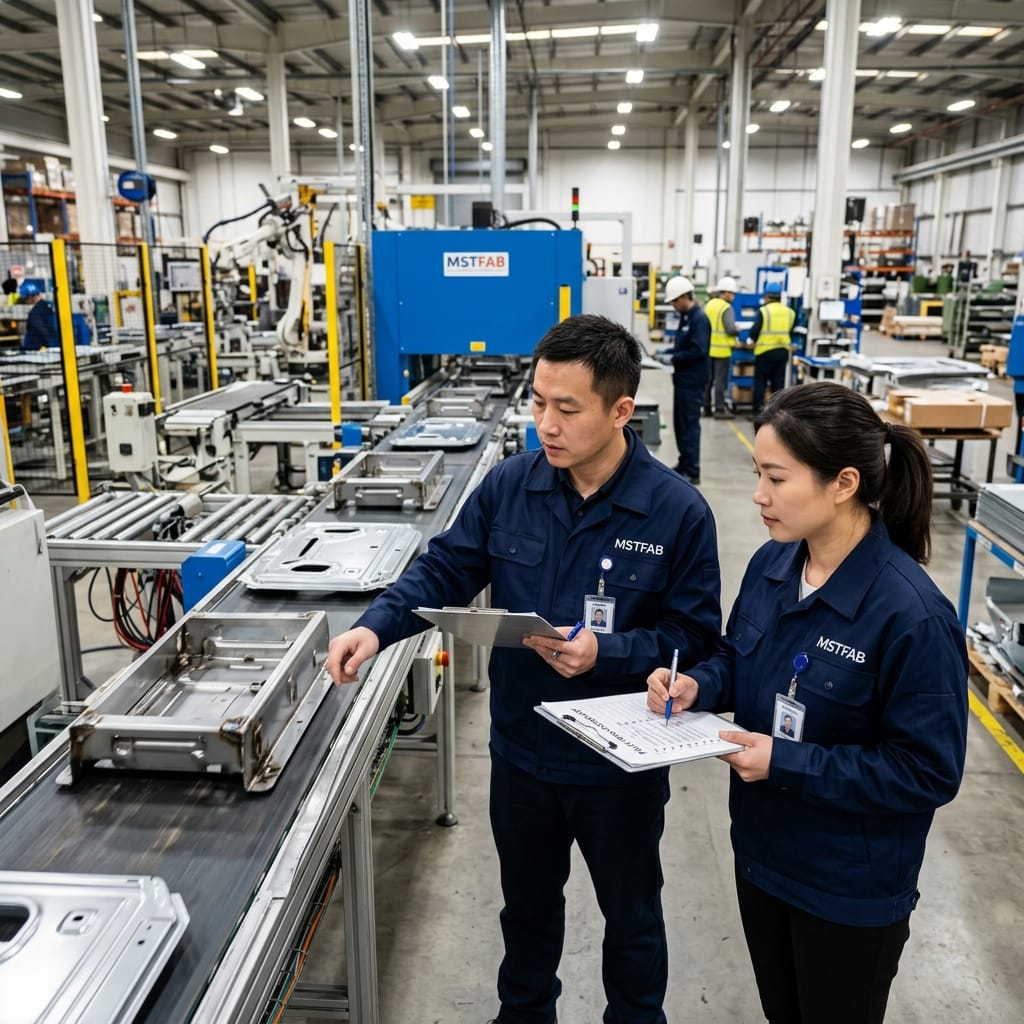
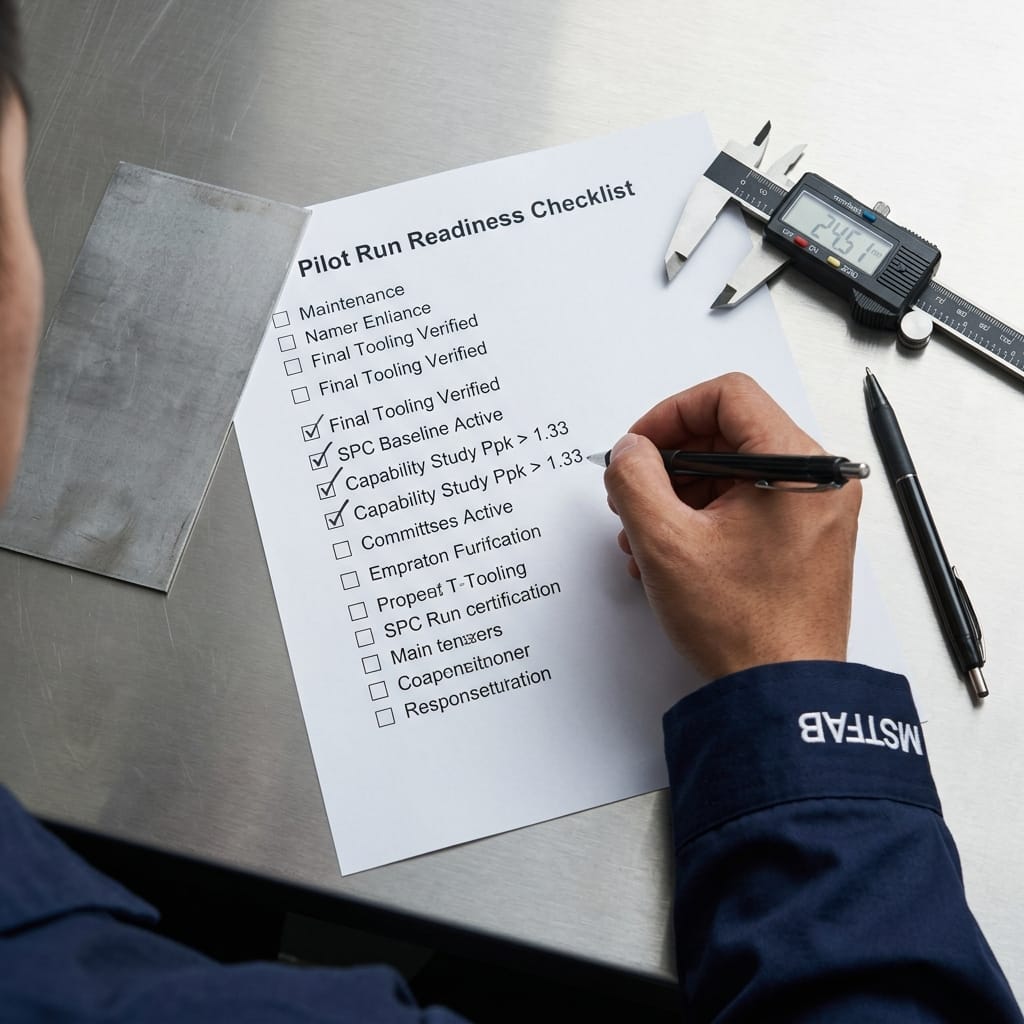
The 4-Stage Sheet Metal Pilot Run Production Checklist
Audit your manufacturing partner against these four disciplined pilot qualification gates:
| Qualification Gate | Required Engineering Deliverable | Acceptance Criteria | Failure Consequence If Skipped |
|---|---|---|---|
| Gate 1: Pre-Pilot Tooling Freeze | Approved CAM laser cutting nest, press brake tooling setup, weld jig sign-off | 100% hard tooling in place; zero manual hand-forming or off-line rework permitted | Production parts fail to match prototypes because prototypes were hand-adjusted. |
| Gate 2: FAI Balloon Inspection | Complete First Article Inspection report ballooning 100% of blueprint dimensions | 100% of dimensions within drawing tolerance (ISO 2768-m or custom callout) | Hidden tolerance stack-ups cause field assembly failure during customer deployment. |
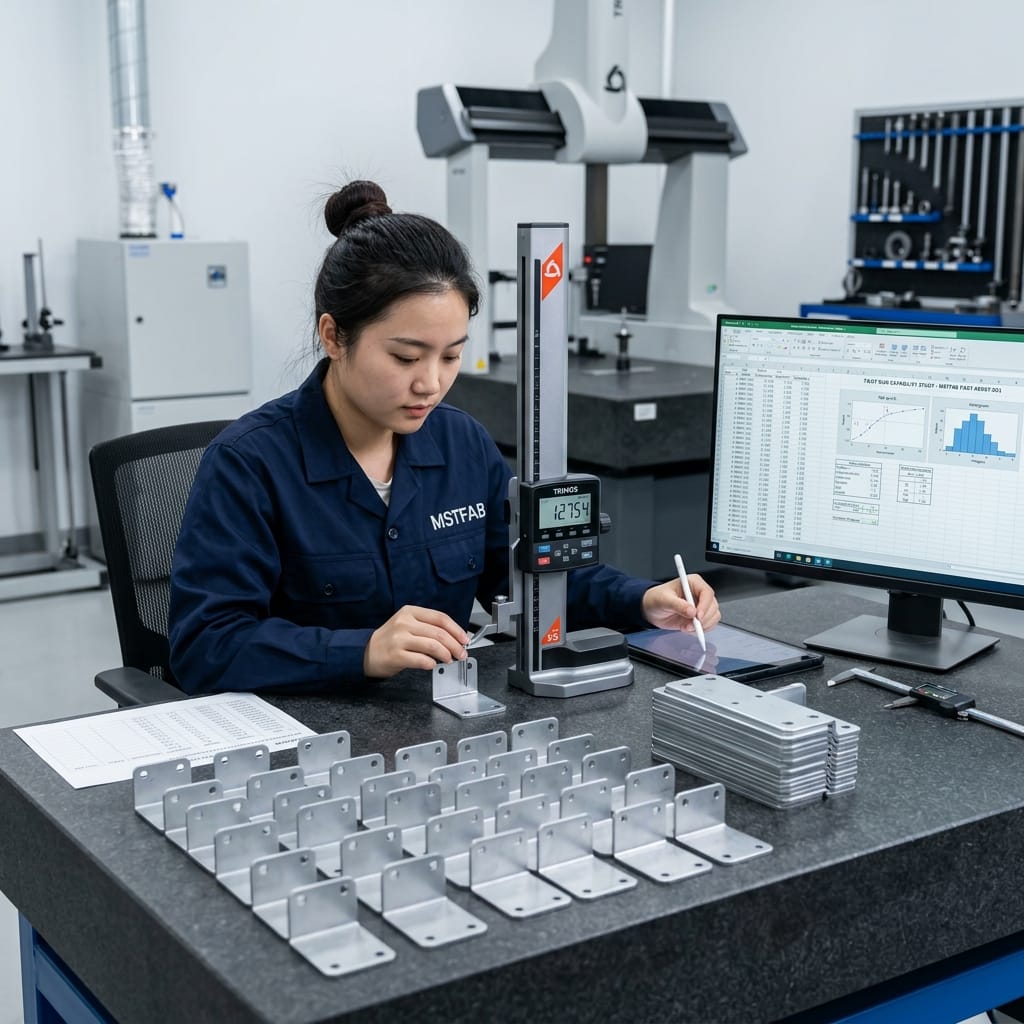
| Gate 3: Statistical Capability (Cpk) | 30-piece capability study measuring all Critical-to-Quality (CTQ) dimensions | Ppk ≥ 1.67 (short-term pilot) and predicted Cpk ≥ 1.33 (long-term mass run) | High scrap rates (>5%) and random batch-to-batch hole misalignment. |
| Gate 4: Surface & Packaging Sign-off | Powder coat dry film thickness (DFT), cross-hatch adhesion, export packaging drop test | Cross-hatch ASTM D3359 Class 4B/5B; zero packaging scuffing after drop test | Transit cosmetic scratch claims and paint flaking around tight sheet metal bend radii. |

How to Calculate Process Capability (Cpk and Ppk) for Sheet Metal
A pilot run must prove statistically that the fabricator’s machines can produce parts within tolerance over thousands of cycles. The Process Capability Index (Cpk) evaluates process centering and spread relative to drawing tolerance limits:
- USL / LSL: Upper and Lower Specification Limits from the engineering drawing (e.g., 100.00 ±0.20 mm).
- μm: Arithmetic mean of 30 sequentially measured pilot parts.
- σ: Process standard deviation across the sample batch.
- Acceptance Threshold: A Cpk ≥ 1.33 guarantees a theoretical defect rate of ≤63 parts per million (PPM), while Cpk ≥ 1.67 achieves Six Sigma quality (≤0.57 PPM).


Achieve Flawless Validated Pilot Production Consistency With MSTFAB
MSTFAB enforces ISO 9001 certified quality gates, CMM automated metrology, locked CNC bend sequences, and tamper-proof golden sample governance. Guarantee batch-to-batch repeatability from pilot run to mass production.
Frequently Asked Questions (FAQ)
What is the ideal batch size for a custom sheet metal pilot run?
Typically between 30 and 50 units. Statistically, a minimum sample size of n=30 is required to calculate meaningful standard deviation (σ) and process capability (Cpk) indices. Fabricating 30 to 50 units also provides sufficient assembled chassis to run through your own electromechanical factory line for functional integration testing.
What happens if a CTQ dimension achieves Cpk < 1.33 during the pilot run?
Mass production release is halted. MSTFAB’s engineering team conducts root cause analysis: 1) Checking sheet thickness variance across the coil; 2) Adjusting press brake V-die opening ratios; 3) Re-machining weld fixture locator pins; or 4) Re-nesting laser cut relief notches. A corrective 30-piece run is executed until Cpk ≥ 1.33 is confirmed.
Who signs off on the final pilot run approval?
Pilot run release requires dual sign-off: MSTFAB’s Quality Assurance Director certifies that all dimensional, coating, and capability criteria are met, and the OEM buyer’s Lead Mechanical Engineer executes the formal Part Submission Warrant (PSW) or FAI approval form.
 WeChat Contact
 WhatsApp Me Directly