
Quick Answer: What Packaging Standards Protect Custom Sheet Metal?
Packaging quality requirements for custom sheet metal parts should define protection for cosmetic surfaces and vulnerable geometry, separation of part numbers and revisions, package labeling, quantity checks and shipment inspection evidence. OEM buyers should approve the packaging scope before quotation and production.
In international manufacturing, a dimensionally perfect bracket or enclosure panel provides zero value if it arrives at your assembly plant scratched, bent, or mislabeled. International ocean freight, air transport, and multi-tier intermodal trucking expose fabricated sheet metal to extreme mechanical vibrations, drops, container condensation, and rough forklift handling.
The goal of an effective packaging specification is not to demand exorbitant wooden crates for every non-critical internal clip. It is to match protective materials and verification procedures to the actual mechanical vulnerability, cosmetic sensitivity, and assembly risks of the part.
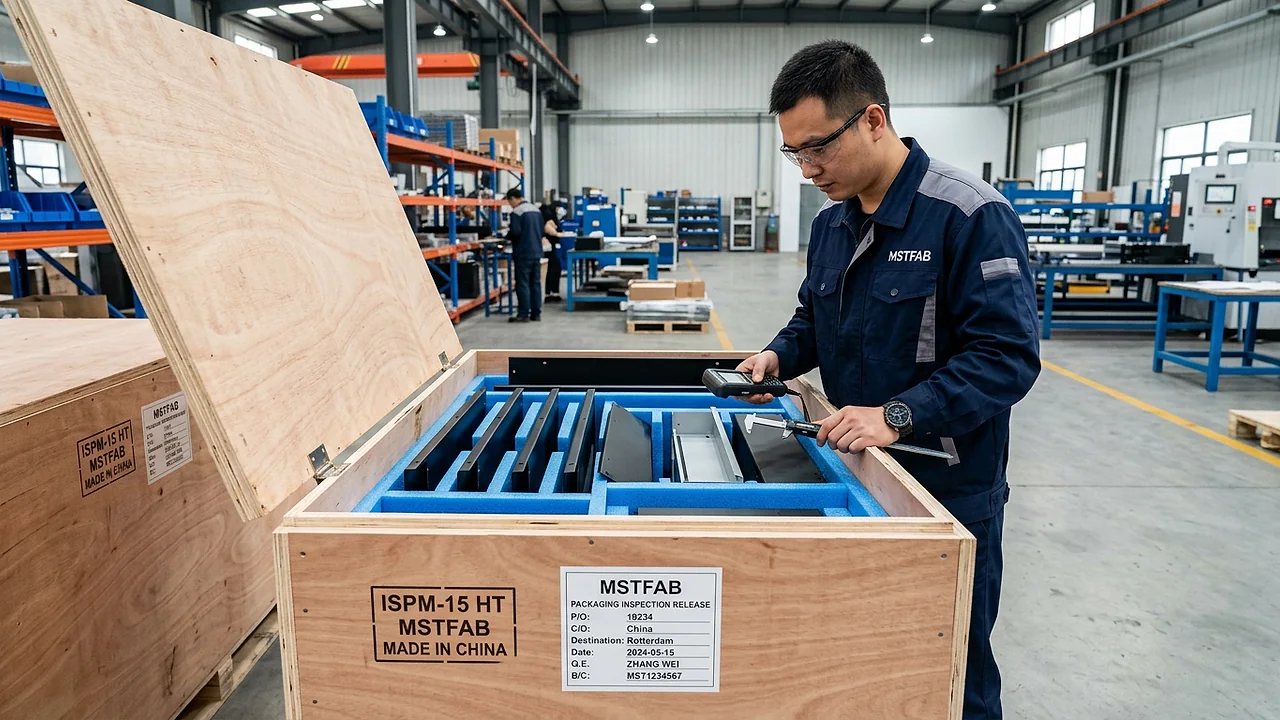
1. Define Packaging Requirements by Part Risk
Different sheet metal components face radically different hazards during overseas transit. A heavy 3 mm welded stainless steel base frame requires structural tie-down restraints, while a 0.8 mm powder-coated front cover requires scratch-free surface separation and corner reinforcement.
OEM buyers should evaluate fabricated parts against a structured packaging risk matrix before issuing a Request for Quotation (RFQ):
| OEM Component | Primary Packaging Risk | Required Protective Method | Governing Packaging Standard |
|---|---|---|---|
| Powder-Coated Cover Panels | Surface abrasions, chipped edges, finish rubbing | EPE foam interleaving, PE protective film, edge protectors | Cosmetic Surface Class A Spec |
| Thin Aluminum Chassis (≤ 1.2 mm) | Bent corner flanges, oil-canning, stack crushing | Rigid molded corner guards, slotted foam nests, max stack limits | Structural Load Limit Spec |
| Brushed 304/316 Stainless Steel | Friction grain scratches, fingerprint oil staining | Low-tack laser protective film + moisture-barrier VCI wrap | Corrosion & Finish Spec |
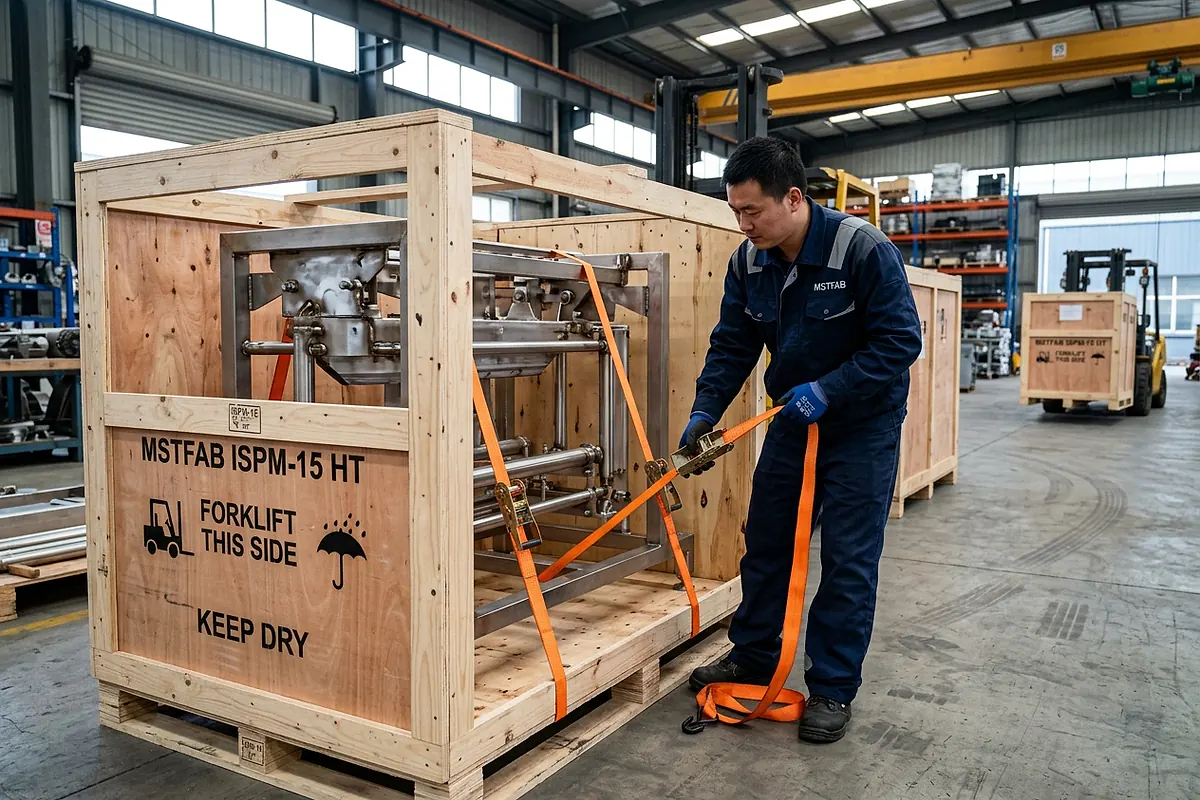
| Welded Equipment Frames | Diagonal racking, twisting, heavy impact damage | ISPM-15 wooden crates, timber blocking, ratchet tie-downs | Export Heavy Crate Spec |
| Small Stamped/Formed Brackets | Mixed part numbers, tangled hooks, count errors | Separated polybags, count verification, barcode labels | Warehouse Traceability Spec |
| Fastener / Accessory Kits | Lost screws, mismatched PEM hardware, assembly delays | Pre-kitted heat-sealed bags tied to main assembly cartons | Kitting & Assembly Spec |
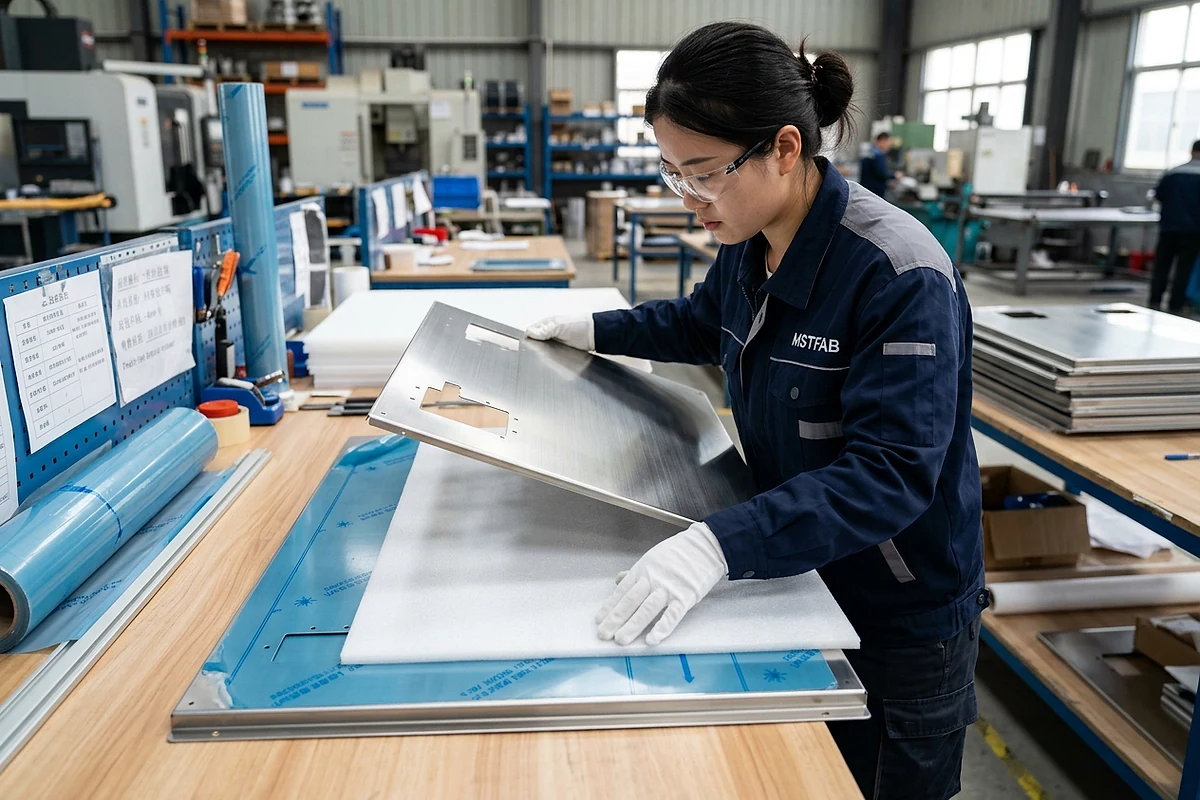
2. Define Scratch Acceptance and Surface Separation Before Shipping
Vague purchase order notes such as “pack carefully” or “supplier guarantees 100% usable condition” provide no actionable criteria on the shop floor. In international logistics, metal components rubbing against each other during ocean vibration will inevitably cause finish burnishing or abrasion if not isolated.
Professional sheet metal packaging specifications establish concrete physical separation rules:
- Prohibit Metal-to-Metal Contact: For all cosmetic Class A and Class B surfaces, zero bare metal-to-metal contact is permitted. Every individual panel must be separated by protective interleaving.
- Select Compatible Interleaving Materials:
- Closed-Cell EPE Foam Sheets (1–3 mm): Absorbs micro-vibrations and prevents scuff marks without leaving residue.
- Low-Tack PE Surface Protection Film: Applied to smooth sheet metal before forming or after powder coating. The adhesive must be formulated for clean peel-off without leaving tacky residue after 30–60 days in transit.
- Acid-Free Kraft Interleaving Paper: Ideal for galvanized and cold-rolled steel sheets where moisture trapping could cause white rust.
- Pre-Packing Cosmetic Inspection: Parts must be inspected and confirmed defect-free before entering the packaging line. A packaging barrier cannot fix a pre-existing paint scratch or handling gouge.
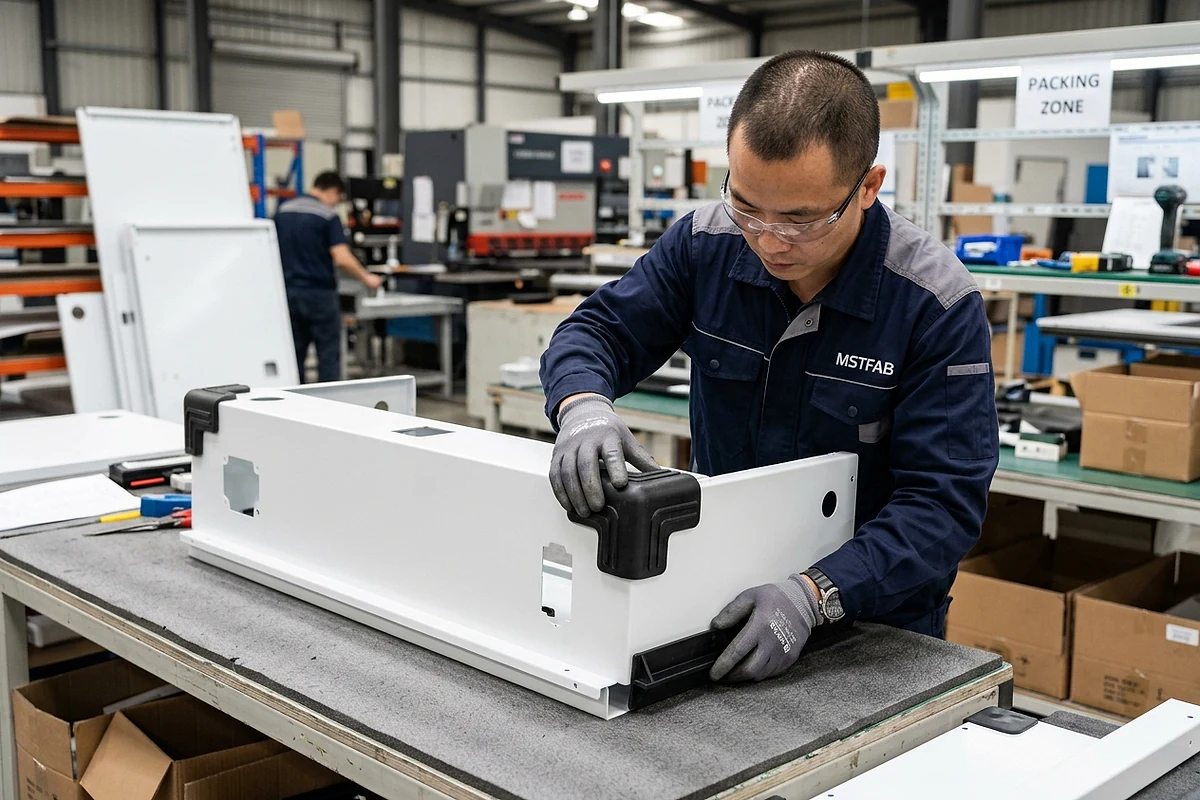
3. Prevent Bent Corners and Distorted Flanges
Formed sheet metal flanges—particularly thin 90-degree bends on 0.8 mm to 1.5 mm aluminum or steel—are vulnerable to impact drops and stacking loads. When heavy master cartons are stacked four-high in a sea container, the bottom layers can bear substantial downward pressure.
A larger wooden crate or carton does not automatically guarantee safety. If fabricated parts have room to shift and slide internally, transit momentum causes components to strike the packaging walls. Components must be securely restrained to reduce movement and impact risk.
To eliminate bent flanges and distorted sheet metal frames:
- Reinforced Molded Corner Protectors: Install heavy-duty plastic or multi-layer paperboard corner protectors on all external corners of flat and folded panels.
- Slotted Foam Nests: For high-mix chassis components, custom CNC-milled or waterjet-cut EPE foam trays position parts vertically or horizontally with dedicated cushion channels.
- Pallet Perimeter Protection: When cartoned sheet metal parts are palletized, vertical paper angle boards must reinforce all four pallet corners, topped with a rigid corrugated deck cap and tensioned polyester strapping.
- Restraint of Heavy Welded Frames: For welded structures over 50 kg, the assembly must be bolted or wedged with timber cleats directly to the pallet skid base, complemented by industrial ratchet straps to prevent shifting during container handling.
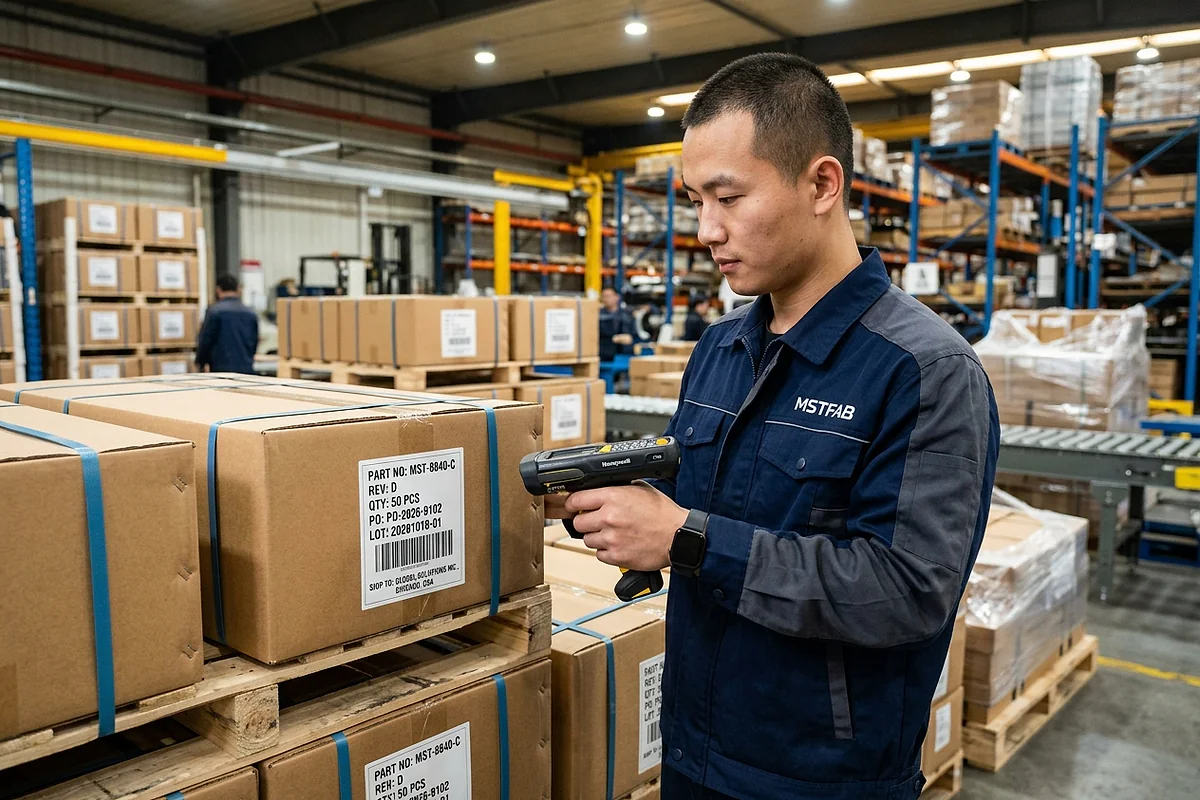
4. Prevent Mixed Part Numbers and Revisions (Warehouse Identification)
In high-mix, low-volume (HMLV) sheet metal manufacturing, a common receiving nightmare is opening a carton to find two visually identical brackets with slightly different mounting hole patterns mixed together, or receiving an obsolete Revision B part labeled as Revision C.
Clear shipment identification supports customs documentation and receiving verification. MSTFAB enforces strict labeling standards on every package:
| Label Element | Standard Format | Receiving & Inventory Purpose |
|---|---|---|
| Customer Part Number | e.g., MST-8840-C (Human-readable & Code 128 / QR) | Immediate ERP scan-in and automated bin allocation |
| Drawing Revision Level | e.g., REV: D (Must match approved PO) | Prevents accidental mixing of superseded engineering revisions |
| Exact Quantity | e.g., QTY: 50 PCS | Allows rapid warehouse piece-count auditing without unpacking |
| Customer PO Number | e.g., PO-2026-9102 | Ties commercial invoice directly to customer purchasing ledger |
| Production Lot Number | e.g., LOT: 20261018-01 | Enables full material heat and fabrication traveler traceability |
Separation Rule: Different part numbers and different revision levels must never be commingled within the same internal sub-pack or carton without explicit written authorization from the buyer.
5. Agree on Packaging Inspection Evidence Before Shipment
For cross-border sheet metal manufacturing, disputes over transit damage frequently devolve into finger-pointing between the fabrication supplier, freight forwarder, and customer receiving team. The only way to eliminate uncertainty is establishing a verified pre-shipment packaging inspection gate.
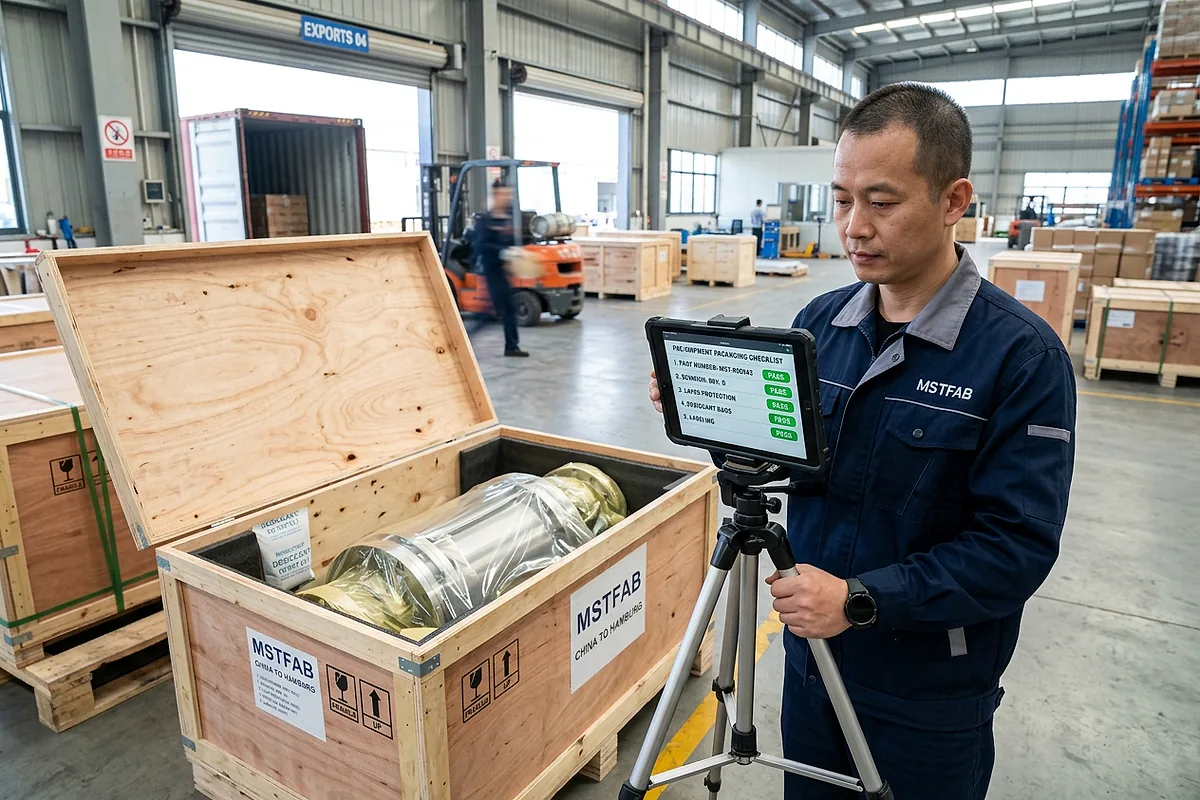
At MSTFAB, every export consignment undergoes a structured 6-step packaging release verification:
- Correct Part Verification: Physical part matches approved CAD drawing geometry and drawing title block.
- Correct Revision Audit: Drawing revision on work order traveler matches customer PO.
- Quantity & Count Validation: Digital piece-counting scales verify small brackets; physical tallies verify large panels.
- Approved Cushioning & Interleaving: Confirmation that specified foam thickness, protective films, and corner buffers are installed.
- Desiccant & Moisture Sealing: Insertion of active silica gel or calcium chloride desiccant pouches inside sealed VCI polybags to prevent marine container sweat.
- Photographic Record Release: High-resolution photographs captured of the open internal layer, closed waterproof barrier, external carton/crate labels, and final strapped pallet.
Note: A pre-shipment photo record proves the parts were properly packed and undamaged when leaving the factory floor, providing vital evidence if carrier mishandling occurs during ocean transit.
6. Validate Packaging Where Risk Justifies It
Not every sheet metal order requires formal laboratory transit testing. For standard brackets packed in double-wall corrugated cartons, proven packaging methods backed by historical shipping data are sufficient.
However, for high-value Class A cosmetic enclosure panels, fragile medical equipment chassis, or recurring shipments experiencing carrier damage, buyers and suppliers should agree on standardized packaging validation:
- ISTA 3A / ASTM D4169 Testing: Standardized laboratory simulation including random vibration, rotary vibration, compression load tests, and drop testing from heights of 76 cm to 100 cm.
- Trial Shipment Protocol: For new high-volume OEM programs, dispatching a single pilot pallet under standard commercial shipping terms. Upon arrival at the buyer’s facility, the receiving SQE inspects both external packaging condition and internal part tolerances.
- Protection Method Tailoring: Protection methods are selected according to finish sensitivity and handling risks—rigid foam dividers are deployed where cosmetic fragility warrants them, while high-efficiency bulk nesting with corrugated dividers is utilized for industrial internal brackets.
7. Include Packaging Scope in the Supplier Quote & Purchase Order
A frequent commercial pitfall in overseas sheet metal procurement is comparing supplier quotes based solely on bare metal fabrication cost. If Supplier A quotes 45.00/unit with flimsy cartons and Supplier B quotes48.50/unit including custom CNC foam inserts and ISPM-15 crating, Supplier A may ultimately cost double once freight damage and scrap rates are tallied.
When requesting quotes, ensure the packaging scope is explicitly itemized:
- Packaging Material Specification: Type of corrugated carton (e.g., 5-ply double-wall BC flute vs 7-ply heavy-duty), custom foam inserts, or ISPM-15 plywood crates.
- Palletization & Forklift Access: Standard pallet dimensions (e.g., 1200×1000 mm Euro/US spec) with 4-way forklift entry and skid runners.
- Incoterms & Freight Responsibility: Clarify whether the quote is EXW, FOB, CIF, or DDP. An EXW price excludes export crating and container loading unless negotiated.
Sample Packaging Quality Requirement for an OEM Purchase Order
1. Packaging Specification Compliance: Supplier shall package all custom sheet metal parts strictly in accordance with the buyer-approved packaging specification, drawing notes, and agreed RFQ scope.
2. Surface & Feature Protection: Packaging shall provide approved non-abrasive interleaving to eliminate bare metal-to-metal contact on all cosmetic and coated surfaces. Formed flanges, projecting tabs, corners, and press-fit hardware shall be shielded with approved edge protectors or cushion nests.
3. Separation & Identification: Different part numbers and drawing revision levels shall be packaged in separate, clearly marked containers. Commingling of multiple part numbers or revisions within a single package without prior written authorization is strictly prohibited.
4. Exterior Carton & Crate Labeling: Each package shall bear a durable, legible label displaying the customer part number, authorized drawing revision, exact piece count, customer purchase order number, production lot reference, and package sequence ID.
5. Pre-Shipment Verification: Supplier shall execute a formal packaging inspection verifying correct part, revision, count, and protective arrangement before release, maintaining photographic records for export shipments.
8. How MSTFAB Delivers Drawing-Based Sheet Metal with Engineered Export Packaging
MSTFAB provides full-service custom sheet metal fabrication services for international OEM equipment builders across North America, Europe, and worldwide. Our manufacturing scope encompasses precision brackets, cosmetic front covers, welded structural frames, and empty sheet metal equipment enclosures.
We treat packaging as an integral engineering discipline rather than an afterthought. To ensure parts arrive at your receiving dock in factory-fresh condition, MSTFAB provides:
- Custom Engineered Foam Nests: Precision CNC-routed or waterjet-cut EPE foam trays tailored to complex formed geometries and delicate powder-coated covers.
- Certified ISPM-15 Heat-Treated Crates: Heavy-duty, fumigation-free engineered plywood crates built with internal timber blocking and forklift runners for ocean and air freight.
- Corrosion Barrier Protection: Active VCI film wrap and industrial desiccants shielding carbon steel, galvanized steel, and aluminum parts against maritime humidity and container condensation.
- Digital Shipment Traceability: Standardized barcode carton labeling, packing lists, and pre-shipment photographic inspection documentation shared before dispatch.
Frequently Asked Questions (FAQ)
Does every custom sheet metal part require individual packaging?
No. Individual polybagging or single-part boxing is necessary for Class A cosmetic panels, delicate aluminum covers, or hardware kits prone to transit damage. For unpainted internal structural brackets or heavy formed clips, bulk packing with corrugated layer dividers and perimeter pallet strapping provides excellent protection at significantly lower cost.
Can different sheet metal part numbers share one carton?
Yes, provided the arrangement is reviewed and approved by the buyer in advance. When multiple part numbers share a master carton, each part number must be individually bagged or compartmentalized with distinct internal labels. Unsegregated bulk mixing of similar part numbers creates severe sorting delays and line stoppage risks at receiving.
What documents and records should an OEM buyer request before shipment?
Buyers should request the formalized Commercial Invoice, detailed Packing List (cross-referencing carton IDs to part numbers and gross/net weights), Certificate of Conformance (CoC), dimensional inspection report for critical features, and pre-shipment packaging verification photographs showing open internal cushioning and exterior pallet labeling.
Does export packaging guarantee 100% zero transit damage?
No reputable manufacturer can guarantee 100% zero transit damage under all possible logistical conditions. Unforeseen ocean container drops, severe maritime storms, customs inspection unpacking, or improper forklift handling at transit hubs can introduce extreme forces exceeding commercial standards. However, an engineered packaging specification reduces risk to near-zero under all normal and anticipated handling conditions.
Can MSTFAB build custom packaging for overseas OEM equipment projects?
Yes. MSTFAB routinely designs and builds custom packaging solutions—including CNC foam inserts, returnable plastic totes, heavy-duty ISPM-15 plywood crates, and specialized pallet skids. We review packaging requirements during initial quotation to ensure complete cost and protective alignment before production.
Request a Custom Sheet Metal Fabrication Quote
Need custom sheet metal parts fabricated with precision tolerances and protected by professional, export-ready packaging? Partner with MSTFAB for reliable delivery from factory floor to receiving dock.
Send your STEP/PDF drawings, material specifications, order quantities, and cosmetic or packaging requirements to our engineering team for a comprehensive manufacturing review and competitive quote.
Email: [email protected]
WhatsApp: +86 173 2831 6456
Website: https://mstfab.com/
 WeChat Contact
 WhatsApp Me Directly