A scratch on a powder-coated panel triggers a very human reflex: grab the touch-up pen and make it go away. Sometimes that is exactly right. Sometimes it is like covering a dent with a nice hat: the dent is still there, and now there is also a hat. This guide is about telling those two situations apart before the parts ship.
Quick answer: When custom sheet metal parts fail cosmetic inspection, the buyer has four basic choices: accept the defect under an approved concession, authorize a controlled repair, require full refinishing, or have the parts remanufactured. Minor localized defects may be repairable, but not every scratch or discoloration should be touched up. The right call depends on material, finishing system, defect location, service environment, function and the approved appearance standard. The supplier should identify the defect, propose a technically sound disposition and get the required buyer approval before releasing the parts.
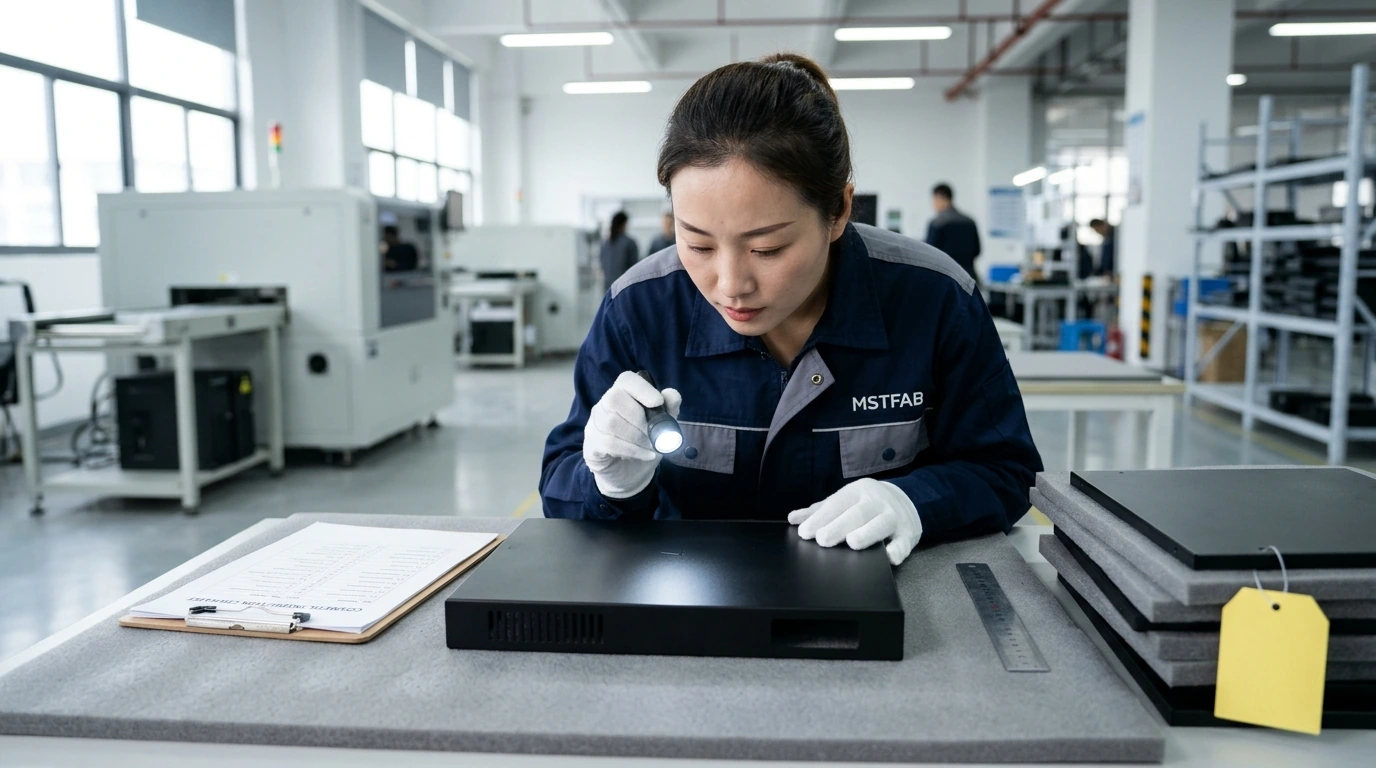
A small coating scratch on a hidden indoor bracket and a deep scratch on a customer-facing outdoor panel are not the same problem, even if they look similar in a photo. This guide covers the commercial and engineering decisions behind cosmetic rework, recoating and remanufacturing of custom OEM sheet metal parts.
1. What Is Cosmetic Rework in Sheet Metal Fabrication?
Cosmetic rework means extra manufacturing or finishing operations that bring a nonconforming part back into line with its original approved specification. Defects can appear at any stage: laser cutting, bending, welding, grinding, finishing, assembly or final inspection.
Typical examples:
- Scratches on visible stainless steel panels
- Localized powder-coating damage
- Uneven brushed surface appearance
- Weld grinding marks on enclosure covers
- Surface contamination or discoloration
- Coating damage during assembly
- Minor handling damage before export packing
Some can be corrected with an approved process. Others need complete refinishing or a new part.
Don’t mix up rework and concession. Rework restores the part to its original specification. A concession accepts a specific nonconformity under documented authorization. They are different decisions with different approvers, and a supplier should never treat them as interchangeable. For the wider nonconformance process, see how to handle nonconforming sheet metal parts.
2. Repair, Recoat or Remake: What’s the Difference?
Think of it as a ladder. Each step up costs more and takes longer, but fixes deeper problems.
| Disposition | Description | Purchasing Consideration |
|---|---|---|
| Use as-is under concession | Buyer accepts a documented nonconformity | Requires authorized approval |
| Local touch-up | A small area receives an approved repair | Color match and durability must be evaluated |
| Surface rework | Grinding, blending, brushing or other corrective finishing | Original geometry and finish must stay acceptable |
| Full recoating | Coating reapplied with a validated process | Film thickness, adhesion and curing must be controlled |
| Strip and refinish | Old coating removed, new finish applied | Substrate condition and dimensional effects need review |
| Remake | New part replaces the rejected one | Extra material, fabrication time and scheduling |
The right step depends on why the part was rejected. More powder will not fix a panel that is dented or distorted. Polishing a deep scratch out of stainless can change the surface geometry or the brushing direction. Diagnose first, then prescribe.
3. When Is Local Touch-Up Acceptable?
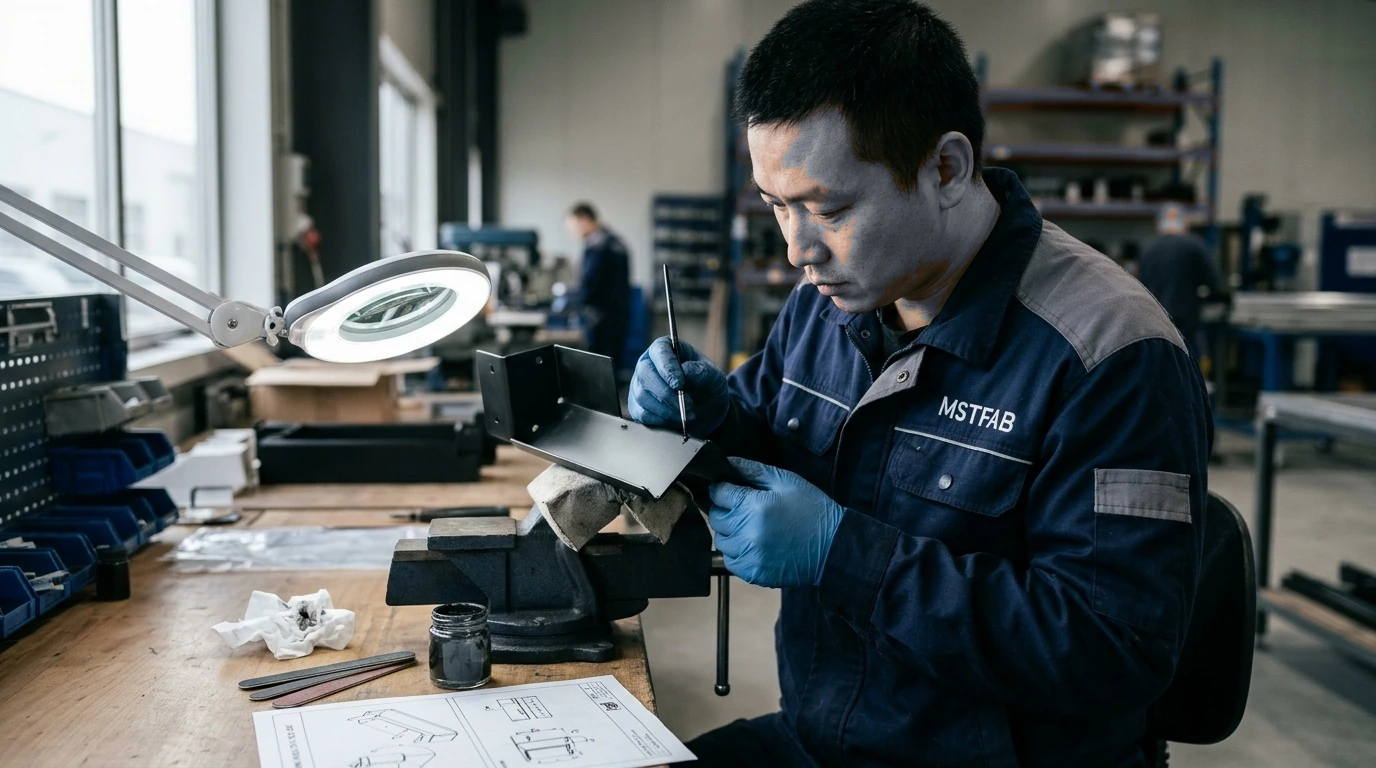
Local touch-up can suit small handling marks, localized coating chips or limited non-critical damage, provided the repair system is compatible with the original finish and the customer approves the result.
The catch: a repaired spot may not perform or age like the factory coating. Liquid touch-up on a powder-coated part can differ in gloss, texture, adhesion and long-term weathering. Indoors that may never matter. On outdoor equipment, it might show up next summer. Touch-up paint is concealer, not surgery.
Check these before approving touch-up
- Defect location: will the operator or end customer see it?
- Coating condition: is the damage only in the finish, or is bare or damaged metal exposed?
- Service environment: indoors, outdoors, or corrosive?
- Repair compatibility: does the coating supplier recommend a suitable repair system?
- Appearance requirements: will the repair meet the approved appearance criteria?
- Functional surfaces: could it affect grounding contacts, threads, gasket lands or mechanical interfaces?
Approve a local repair only when the result meets the applicable specification. For highly visible panels or demanding corrosion requirements, touch-up may simply not be good enough. The visible-surface classes and scratch limits themselves belong in your cosmetic acceptance standard, and a boundary sample helps everyone agree what “acceptable repair” looks like.
4. When Should Powder-Coated Parts Be Recoated?
Recoating makes sense when defects are too widespread for local repair but the fabricated metal underneath is still fine. A steel panel with poor coating appearance across a large area, but correct dimensions and features, may be cheaper to recoat than to remake.
But “just add another layer” is not automatically a process. The risks:
| Risk | Why It Matters |
|---|---|
| Excessive coating thickness | Can affect panel gaps, holes and assembly clearances |
| Intercoat adhesion | The new layer may not bond properly to the old one |
| Surface contamination | Oil, dust or residue can be sealed under the new finish |
| Appearance mismatch | Gloss, texture and color may differ |
| Additional heat exposure | Another cure cycle may affect components or installed accessories |
| Masking failure | Threads and contact areas may get coated |
| Original defect remains | Recoating can conceal rather than correct a substrate problem |
The Powder Coating Institute and major powder manufacturers point out that coating chemistry and surface preparation decide whether recoating is suitable. In procurement terms: the finishing supplier should verify the route, not just promise another coat.
Buyer recommendation: before approving a full recoat, ask for the repair route, coating compatibility, expected finished thickness, affected mechanical features, inspection method and schedule. If recoating is not technically justified, strip-and-refinish or remanufacture may be the honest answer.

5. When Is Remanufacturing the Better Option?
Sometimes the most reliable fix is a new part, especially when cosmetic damage comes with functional or dimensional problems.
- Deep scratches into the substrate: grinding them out can thin the material locally or change the surface geometry.
- Visible panel deformation: a dented door or warped cover will not return to approved geometry through finishing alone. Powder coating is many things; a panel beater is not one of them.
- Severe welding or grinding damage: too much material removed, or the required profile damaged.
- Unacceptable corrosion or contamination: some defects need more than concealment, particularly where corrosion performance matters.
- Irreversible finish damage: some anodized or specialty finishes do not allow a simple local repair.
- Repeated repair failure: if a part has been reworked and still fails, another round may no longer be technically or commercially reasonable.
For critical applications, replacing one part can cost less than the risk of an uncertain repair. Judge remanufacturing against the part’s actual performance requirements, not as automatically the cheapest or the most expensive option.

6. Rework Options by Material and Finish
A repair that works on powder-coated carbon steel may be exactly wrong for brushed stainless or anodized aluminum.
| Material / Finish | Potential Corrective Route | Main Risk |
|---|---|---|
| Powder-coated carbon steel | Approved touch-up, recoat or refinish | Adhesion, corrosion and coating thickness |
| Brushed 304 stainless | Controlled brushing or surface refinishing | Grain mismatch and material removal |
| Polished stainless | Controlled repolishing | Distorted reflective appearance |
| Anodized aluminum | Specialist refinishing evaluation or replacement | Local repair may not reproduce the anodized finish |
| Unfinished aluminum | Approved deburring or blending where feasible | Altered dimensions and appearance |
| Galvanized steel | Approved corrosion-protection repair | Loss of protective coating at damaged areas |
Brushed stainless steel
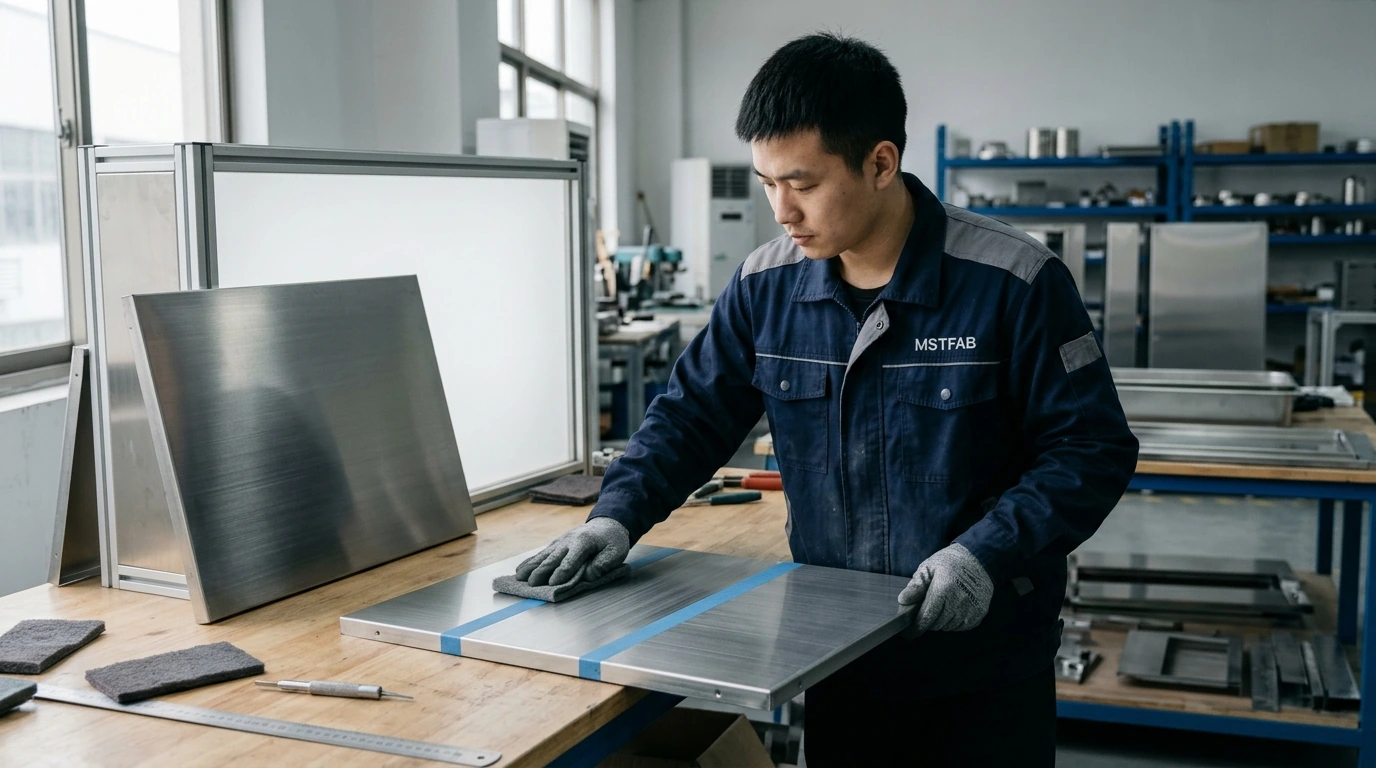
Brushing direction matters. A local repair can create a patch that reflects light differently from everything around it, invisible from one angle and glaring from another. On some projects, refinishing the whole visible face gives a more consistent result than treating only the scratch.
Anodized aluminum
Anodizing creates an oxide layer on the aluminum surface. Paint on top does not recreate that structure. Where appearance and performance are strict, specialist refinishing or replacement may be the only route.
Powder-coated carbon steel
Carbon steel needs its corrosion protection. Where a defect exposes bare steel, the repair must address substrate preparation and the specified protection system. A perfect color match proves the color matches. It does not prove corrosion resistance. For background on choosing finishes in the first place, see our surface finishing guide.
7. How Should OEM Buyers Approve Cosmetic Rework?
A supplier should not quietly repair rejected parts without considering the buyer’s approval rules, especially where appearance carries the customer’s brand.
| Stage | Required Action | Typical Responsibility |
|---|---|---|
| 1. Identify | Record the defect, part number and affected quantity | Supplier QC |
| 2. Contain | Separate affected parts from accepted stock | Supplier production / QC |
| 3. Investigate | Decide whether the defect is cosmetic, functional or both | Manufacturing / Quality |
| 4. Propose | Recommend touch-up, recoat, refinish, concession or remake | Supplier engineering |
| 5. Approve | Authorize the disposition where required | Buyer SQE / Engineering |
| 6. Execute | Perform the approved corrective operation | Supplier / finishing partner |
| 7. Reinspect | Verify the original requirements after rework | Supplier QC |
| 8. Release | Document acceptance and shipment authorization | Authorized quality team |
Repaired parts should be traceable to the approval that covered them. For larger batches, the buyer can ask for one approved repair sample before authorizing the rest, which stops a small cosmetic problem from growing into a large rework dispute. If rework is threatening your assembly schedule, our guide to managing supplier rework without delaying your line covers the logistics side.
8. Can Repaired Parts Ship Without Buyer Approval?
It depends on the purchase specification, the supplier quality agreement and applicable product requirements.
- Usually OK without separate approval: routine rework under a previously approved process, when the parts fully meet the original specification and the agreement allows it.
- Usually needs explicit written authorization: a concession, use-as-is decision, unapproved finish substitution, or any repair that changes a controlled product characteristic.
Set these rules before production. And one rule needs no agreement at all: a supplier must never hide a known nonconformity under a cosmetic finish. When approval is required, the buyer should get enough evidence to understand the proposal and any remaining risk.
9. What Does Cosmetic Rework Actually Cost?
The finishing operation is often the smallest part of the bill. A rejected panel may need to come out of an assembly, travel to a finishing partner, be cleaned, refinished, inspected and repacked. If the customer is waiting, delay costs join the party.
| Cost Factor | Local Touch-Up | Recoat / Refinish | Remake |
|---|---|---|---|
| Additional material | Usually limited | Coating and preparation materials | New sheet metal and finishing materials |
| Labor | Localized repair | Surface prep and full finishing | Complete fabrication route |
| Inspection | Repaired area and affected features | Finished surface and affected interfaces | Full new-part inspection |
| Scheduling | Depends on approved repair process | Depends on finishing availability | Depends on fabrication capacity |
| Technical risk | Color or performance mismatch | Adhesion, thickness, appearance | New manufacturing variation |
| Delivery impact | Project-specific | Project-specific | Project-specific |
Touch-up usually has the lowest direct cost, but not necessarily the lowest risk. On a customer-facing panel, a visible repair can trigger a receiving rejection and a replacement shipment anyway, which is the most expensive way to save money. Include the probability and consequence of failure in the comparison.
Also agree which party pays for what under the purchase order and quality agreement, ideally before anyone needs to know.
10. Example: A Powder-Coated Enclosure Batch Fails Cosmetic Inspection
A hypothetical OEM order: 100 powder-coated industrial enclosure shells, with a consistent visible finish required on the front panel and exterior. Final inspection flags 12 units.
| Defect | Units | Initial Disposition for Review |
|---|---|---|
| Minor localized marks on hidden internal areas | 5 | Assess against approved requirements |
| Visible scratches on front panels | 4 | Evaluate refinishing or replacement |
| Extensive coating defects on exterior surfaces | 2 | Evaluate recoating or replacement |
| Dented enclosure body | 1 | Evaluate structural conformity and possible remake |
| Total affected | 12 |
The tempting move is one fix for all 12. Don’t. The internal marks may already meet the approved specification. The front-panel scratches may need full-face refinishing or replacement. The extensive coating defects justify a specialist recoat review. The dented body may need remaking if its dimensional and functional requirements cannot be restored. Four defect types, four decisions.
Illustrative example, not a report of an actual MSTFAB production incident.
11. What Evidence Should Buyers Request After Rework?
A repaired part should be verified against the requirements that originally applied. Depending on the repair and risk, records may include:
- Part number, drawing revision and affected quantity
- Nonconformance identification and defect photographs
- Authorized repair instructions
- Coating system or finishing method used
- Before-and-after photographs where appropriate
- Dimensional checks of affected features
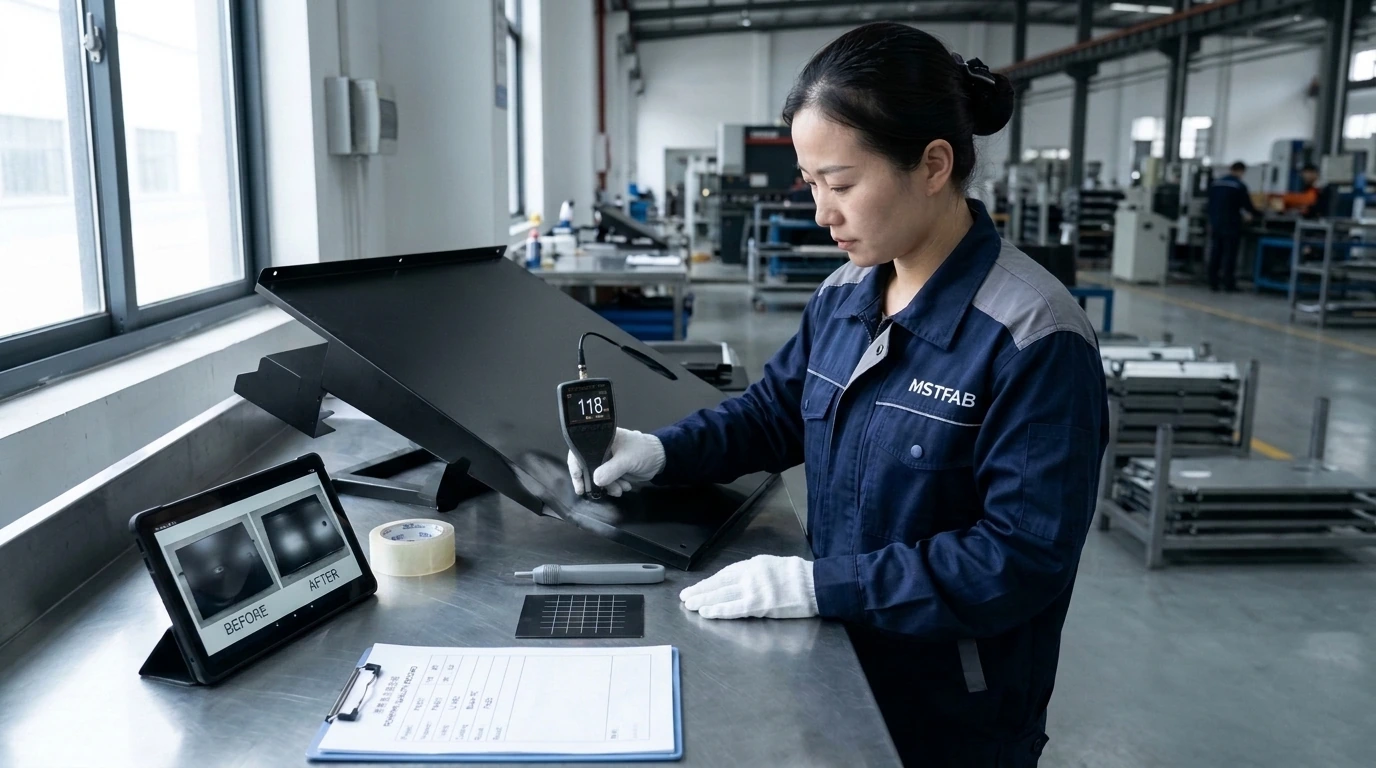
- Coating thickness or adhesion verification if required
- Functional assembly checks where relevant
- Final inspection status and approval reference
A nice photo does not prove the coating performs, and a dimensional report does not prove the finish looks right. Match the evidence to the risk the repair created.
12. How to Reduce Cosmetic Rework in Repeat Orders
The cheapest rework is the rework that never happens. On repeat production, that means holding the approved process steady and guarding the risky steps.
- Laser cutting and bending: protective film, clean handling and suitable forming tooling on visible surfaces, compatible with the actual cutting and bending processes.
- Welding and grinding: define weld locations and grinding profiles up front, and whether each weld stays visible, gets finished or ends up hidden.
- Surface finishing: tie requirements to the approved material, coating system and specification; where outside finishers are used, the fabricator coordinates quality requirements and inspection responsibilities.
- Mechanical assembly: suitable work surfaces, part separation and assembly sequence so finished panels survive fastening and handling.
- Before shipment: packaging that stops finished parts rubbing together, chosen for material, finish, size, weight and transport conditions.
None of this eliminates every defect, but it removes the avoidable ones and keeps batches consistent.
Cosmetic Rework Supplier Trust Table
How a supplier answers these tells you whether a cosmetic problem will be handled or hidden.
| Question to Ask | A Reliable Answer Sounds Like | Red Flag |
|---|---|---|
| What happens when you find a cosmetic defect? | Records, contains and classifies it, then proposes a disposition. | “We fix it, don’t worry.” |
| Which repairs need my approval? | Explains the line between approved routine rework and concessions. | Repairs everything without telling you. |
| Can you touch up powder coating? | “Depends on location, environment and the coating system; here’s what we’d verify.” | “Yes, always” with a spray can in hand. |
| How do you recoat? | Describes preparation, compatibility, thickness control, masking and cure. | “Just spray another layer.” |
| When would you remake instead? | Dents, distortion, substrate damage or repeated repair failure. | Never; everything is “repairable.” |
| What evidence comes with reworked parts? | Photos, method, affected-feature checks and approval reference. | Nothing; parts simply look fine. |
13. How MSTFAB Supports Rework and Replacement Decisions
Guangzhou Maisituo Sheet Metal Manufacturing Co., Ltd. (MSTFAB) provides custom fabrication for international OEM equipment manufacturers: laser cutting, CNC bending, TIG and MIG welding, grinding and deburring, custom metal enclosures, equipment panels, brackets and chassis, mechanical assembly within the agreed scope, dimensional inspection and export packaging. We work in carbon steel, galvanized steel, 304/316 stainless and 5052/6061 aluminum. The full process route is on our custom sheet metal fabrication services page.
Powder coating, anodizing and other finishes are coordinated through established finishing partners; see our surface treatment capabilities. For cosmetic-sensitive projects, buyers can specify the approved finish, inspection expectations and disposition rules during quotation review. Where parts need repair or replacement, the technical and commercial response follows the approved requirements, manufacturing feasibility and customer authorization.
Our scope, plainly: empty metal enclosure shells and mechanical components, not complete electronic equipment or system assembly.
14. What to Put in a Cosmetic Rework Agreement
A practical agreement names the controlling drawing revision, the acceptance standard and who can approve deviations. It can also say when local repair is allowed, when full refinishing is required and when remanufacturing should be considered.
Example supplier quality requirement
Project: Custom powder-coated industrial enclosure shells
Material: SPCC cold-rolled steel
Finish: Black powder coating, RAL 9005
Order quantity: 100 units
Cosmetic rework requirement: Any identified cosmetic nonconformity shall be recorded and evaluated against the approved product specification. Repairs that change controlled finish requirements, introduce a different coating system, or require acceptance of a remaining deviation must receive written authorization from the customer before shipment. Reworked components shall be reinspected against the applicable original requirements. Where a technically acceptable repair cannot be achieved, the supplier shall propose replacement or another disposition for customer review.
Adapt this example to your project’s actual contractual and quality requirements.
Key Takeaways
- Rework restores the original spec; a concession accepts a deviation. Keep them separate.
- Diagnose why the part failed before choosing touch-up, recoat, refinish or remake.
- Touch-up is fine for small, hidden, indoor defects, rarely for visible or outdoor panels.
- Recoating needs a verified route: prep, compatibility, thickness, masking, cure.
- Dents, distortion and substrate damage usually mean remake.
- Compare total disposition cost, including the cost of the repair failing.
- Agree approval rules and evidence before production, not after rejection.
Frequently Asked Questions
Can scratched powder-coated sheet metal be repaired?
Some localized scratches can be repaired with a compatible coating system. The repair must still meet the specified appearance, corrosion protection and other performance requirements.
Is recoating cheaper than remaking a metal enclosure?
It can be, when the fabricated part is still acceptable and the finishing system supports recoating. Stripping, preparation, inspection, extra curing and scheduling may reduce the savings.
Can a scratched stainless steel panel be refinished?
Some scratches can be addressed by controlled brushing or polishing. The supplier must confirm that grain direction, appearance, material condition and dimensions remain acceptable.
Can anodized aluminum be touched up?
A local paint repair does not recreate the anodized oxide layer. Depending on requirements, the part may need specialist refinishing or replacement.
Should OEM buyers accept repaired cosmetic parts?
Only when the repaired part meets the original requirements or the buyer has authorized a documented concession, considering function, appearance, service environment and product requirements.
Does a cosmetic defect always require replacing the part?
No. Some defects can be accepted or repaired; others need full refinishing or replacement. Decide based on the approved specification and technical feasibility.
Can MSTFAB provide replacement sheet metal parts for an OEM project?
Yes. We can review replacement-part fabrication using approved customer drawings, material specifications, quantities and the relevant manufacturing scope.
Choose the Right Disposition, Not Just the Cheapest Repair
Cosmetic defects can affect appearance, corrosion protection, schedules and the quality of your finished equipment, but they do not all deserve the same fix. A small localized coating defect may suit an approved repair. A larger coating problem may need refinishing. A damaged or dimensionally nonconforming part may need to be remade. Identify the defect, weigh the technical options, document the approval and verify the result before shipment.
The goal is not to repair every rejected part. It is to deliver conforming metal parts through a process that is technically justified and commercially sensible.
Want a Supplier Who Tells You About the Scratch?
Send your STEP/STP models, dimensioned PDF drawings, material specifications, finishing requirements, quantities and inspection expectations. MSTFAB’s engineers will review the fabrication and finishing scope, including cosmetic acceptance and disposition rules, before we quote.
Request a Custom Fabrication Quote
Explore Fabrication Services
 WeChat Contact
 WhatsApp Me Directly