
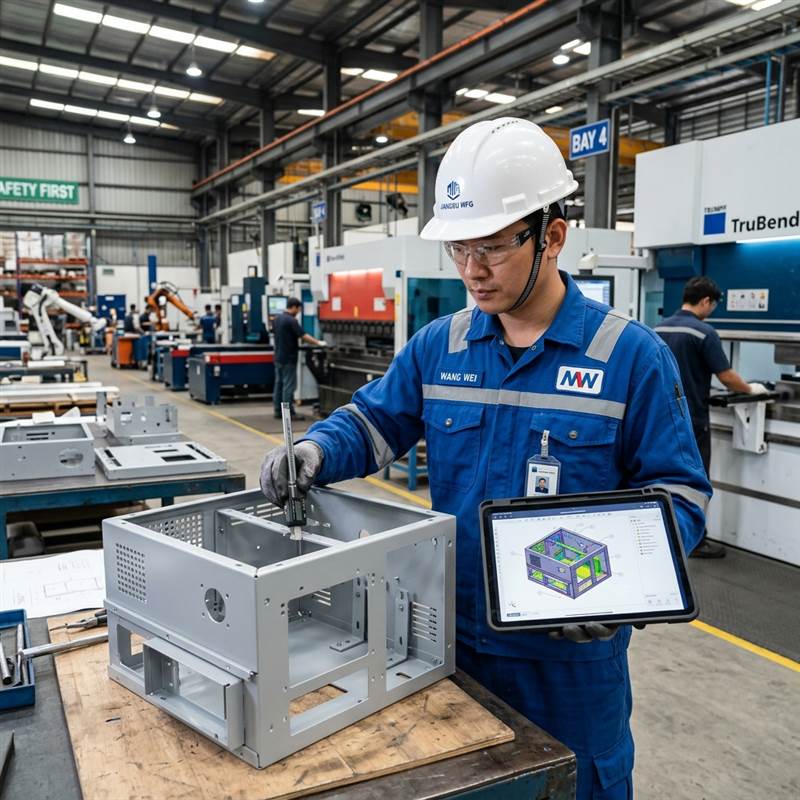
This guide covers drawing-based sheet metal fabrication. For related questions, see the OEM enclosure evaluation guide, bending review guide, welding review guide and powder-coating guide.
1. Separate an Early Estimate from a Production Quote
Photos, sketches and samples can start a useful conversation. They do not automatically define every dimension, material condition, finish or inspection requirement. Ask the supplier to list assumptions and unresolved items, and agree on what must be released before production.
- Identify which dimensions and interfaces are known.
- Record the material, finish and quantity assumed for the estimate.
- List missing files and the person responsible for approving them.
- Confirm whether tooling, samples, inspection, packing and transport are included.
A fast response alone does not prove that a supplier is reliable or unreliable. Compare the stated scope, questions, sample results and agreed records for the actual part.
2. Give Each File a Clear Job
Use the model, drawing and specification together. Check revision consistency and identify which document controls when information conflicts. Confirm the accepted format if native CAD files or unusual annotations are involved.
| Input | Useful information | Still confirm |
|---|---|---|
| Photo, sketch or reference sample | Appearance, intended use and an initial geometry discussion. | Released dimensions, material, finish and acceptance criteria. |
| STEP or STP model | Three-dimensional geometry and mating relationships included in the supplied model. | Units, revision and any information not included in the model. |
| Controlled 2D PDF | Dimensions, datums, tolerances, material and finish notes when specified. | Agreement with the model and the inspection method. |
| DXF or DWG cutting data | Profiles, holes and flat-pattern information when buyer controlled. | Scale, revision, thickness and forming/finish requirements. |
| BOM and project specification | Hardware, quantities, finish, packing and required records. | Availability, substitutions, exclusions and approval ownership. |
3. Release the Drawing Inputs Before Cutting Metal
Use the following checklist for the part being quoted. It is a release checklist, not a claim that a generic model guarantees a specific tolerance, quotation accuracy or test result.
| Input group | What the buyer defines | What to resolve before release |
|---|---|---|
| Revision and units | Identify the controlling drawing/model revision and units. | Resolve conflicting files before quotation. |
| Material grade and condition | Specify grade, temper or condition and permitted alternatives. | No material substitution without buyer approval. |
| Thickness | State nominal thickness and required tolerance. | Review forming, mating and finish implications. |
| Bend geometry | Show bend direction, inside radius and flange dimensions. | Confirm feasibility for the material and available tooling. |
| Reliefs and corners | Define reliefs, returns and corner conditions. | Review access and deformation risks. |
| Holes and cutouts | Locate mounting holes, slots and openings from released datums. | Review features near bends and required finished positions. |
| Critical dimensions | Identify mating datums, tolerance notes and inspection priorities. | Agree on how the finished feature will be measured. |
| Weld requirements | Specify joints, weld locations and post-weld acceptance. | Confirm cosmetic and dimensional requirements together. |
| Finish and masking | Define finish, appearance, contact areas, threads and visible faces. | Approve the finishing scope and acceptance checks. |
| Mechanical hardware | List part numbers, locations and mounting details. | Review hardware availability and assembly interfaces. |
| Access and mating parts | Provide door travel, tool clearance and component envelopes. | Release the relevant interface geometry. |
| Order and records | State quantities, packing, destination and required documentation. | Confirm document availability, exclusions and schedule. |
4. Compare Costs Using Project Records
Compare quotations on the same scope. Record assumptions instead of substituting generic rejection rates, return percentages or cost savings for evidence.
| Cost line | Input to record | Source to use |
|---|---|---|
| Production and samples | Quantity, unit price, sample scope and tooling or programming charges. | Supplier quotation and approved scope. |
| Inspection and documents | Required measurements, reports and customer-specific records. | Agreed inspection and documentation plan. |
| Finish and packing | Finishing route, visible-face protection, labels and packing configuration. | Approved finish and packing requirements. |
| Freight and receiving | Delivery terms, destination, handling and receiving checks. | Logistics quotation and receiving plan. |
| Nonconformance and rework | Actual rejected quantities, disposition and recovery work. | Pilot or receiving records; identify any forecast as an assumption. |
For an evaluated cost per acceptable unit, use the agreed production, sample, inspection, packing and transport costs, plus any evidenced recovery costs, divided by the accepted quantity. Do not treat a hypothetical example as a measured MSTFAB result.
5. Agree on Design, Fabrication and Validation Responsibilities
| Activity | Fabrication scope to confirm | Buyer or responsible-party scope |
|---|---|---|
| Product definition | Review the released mechanical requirements for manufacturability. | Define intended function, equipment layout and performance requirements. |
| Drawing changes | Propose forming, access, hardware or finish changes where useful. | Approve changes and control the drawing revision. |
| Material and finish | Confirm feasible supply and finishing options for the agreed route. | Approve the grade, condition, finish and application suitability. |
| Mechanical inspection | Agree on dimensions, sampling, records and acceptance criteria. | Approve the inspection plan and disposition of deviations. |
| Special documents and approval | Confirm availability and any separately agreed scope before ordering. | Identify requirements and verify supplier eligibility and responsible validation parties. |
| Complete-system validation | Fabricate the drawing-defined metal parts and mounting interfaces. | Own electrical, thermal, functional and regulatory validation of the completed equipment. |
PPAP, IMDS, material certificates, CMM reports, process-capability records or certification status must not be inferred from an article or a generic process illustration. Confirm the exact requirement, availability, responsible issuer and scope before supplier approval.
6. Check Release Readiness Before a Production Order

- Reference stage: describe the intended part and record open questions.
- Geometry stage: reconcile the model, drawing, units and mating interfaces.
- Quotation stage: agree on material, finish, quantities, records, exclusions and schedule.
- Production release: approve the controlled files, sample route and change process.
These are planning stages, not customer rankings or promised return-rate improvements. Use your own sample, receiving and change records to evaluate the program.
7. Build a Mechanical RFQ Package
- Current STEP or STP model and controlled 2D PDF, with units and revision.
- Material grade, condition, thickness and proposed alternatives if permitted.
- Welds, hardware, critical datums, mounting interfaces and service clearances.
- Finish, masking, cosmetic surfaces and acceptance criteria.
- Sample and production quantities, required dates, packing and destination.
- Inspection records and customer-specific documents to confirm before ordering.
If information is incomplete, state what is missing. Confirm the review scope and timing with MSTFAB; this guide does not promise a universal quotation turnaround, price-accuracy percentage or free engineering service.
8. MSTFAB Drawing-Based Metalwork Scope
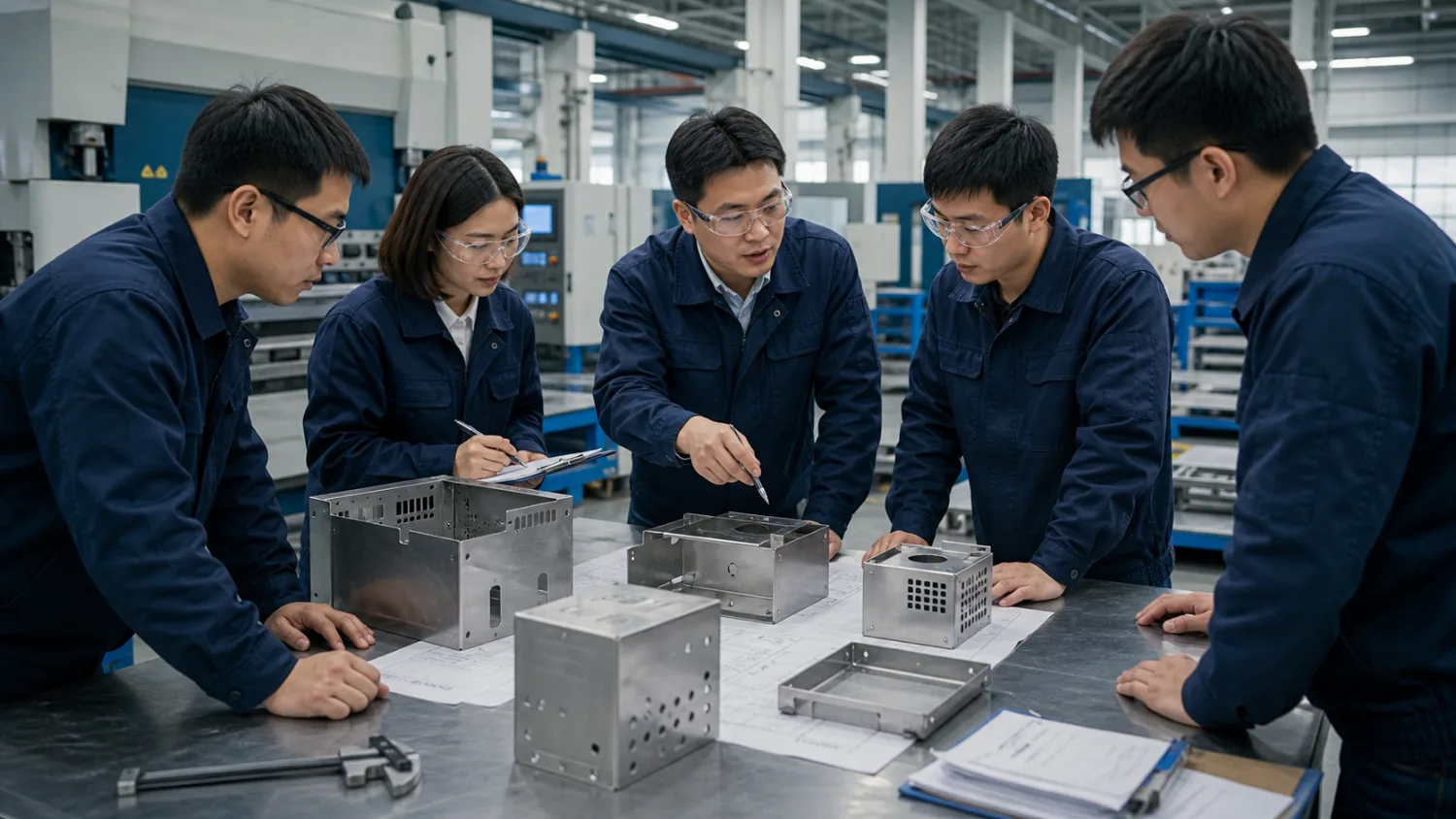
MSTFAB is operated by Guangzhou Maisituo Sheet Metal Manufacturing Co., Ltd. We fabricate drawing-based sheet metal shells, panels, brackets, covers and agreed mechanical features. The quotation defines cutting, bending, welding, hardware, finishing, inspection and packing for the project.
For supplier approval, request current, scope-specific evidence for any required certification, material records, process capability or inspection deliverable. Confirm availability and any separately agreed work in the quotation rather than inferring it from a general article.
Send the Controlled Drawing Package for Review
Share the current mechanical files, material, finish, quantities and required records. Confirm confidentiality requirements and the agreed file-transfer method before sending sensitive information.
Request a Sheet Metal Drawing Review
Send the project requirements through the contact page so missing inputs, feasibility and quotation scope can be discussed.
Related guide: Review how to read sheet metal drawings for drawing interpretation and RFQ preparation.
Buyer Questions Before Ordering
Can MSTFAB review a project before complete drawings are available?
Reference photos, samples or preliminary dimensions can support an initial discussion. Identify missing geometry, material, finish and acceptance requirements before production. The buyer owns the product design and performance requirements; any additional drawing or engineering work must be agreed separately.
What files are needed for a sheet metal fabrication quote?
Provide a STEP or STP model and a controlled 2D PDF where available, with revision, units, material, thickness, finish, quantities, hardware and critical dimensions. Identify missing information. The quotation should state its assumptions and exclusions rather than promise a universal accuracy percentage.
What should be agreed before sharing sensitive CAD files?
Confirm the intended recipient, confidentiality requirements and approved transfer method with MSTFAB before sharing sensitive files. Redacted geometry may support an initial discussion, but omitted interfaces or dimensions must be resolved before a production release. Do not assume confidentiality terms are in place without an agreement.
How should metric and inch dimensions be controlled?
Identify the units on the drawing and model, record the controlling revision and resolve any inconsistency before quotation. Confirm the interpretation of tolerances and interfaces in writing. Any proposed conversion or drawing change requires buyer approval before production.
Should I accept a quote based only on a photograph?
A photo-based estimate may be useful for an early budget discussion, but it is not a released manufacturing specification. Ask which dimensions, material, finish, quantities and inspection requirements the estimate assumes. Agree on the production drawing and sample approval route before ordering.
CNC sheet metal bending services
MSTFAB provides CNC press brake bending services for precision sheet metal parts, enclosures, brackets and OEM assemblies.
 WeChat Contact
 WhatsApp Me Directly