

Manufacturing scope: Guangzhou Maisituo Sheet Metal Manufacturing Co., Ltd., operating as MSTFAB, fabricates drawing-defined empty enclosure shells and mechanical parts. Installed equipment, wiring, software, completed-system validation and final certification remain buyer-controlled unless separately contracted.
Before comparing suppliers, align the team on the sheet metal enclosure design inputs and the costs hidden behind unlike quotations.
1. What Separates a Manufacturing Partner From a Quote Vendor
Evaluate the supplier against the actual part, approved requirements and required evidence. A useful response identifies the controlling drawing revision, open technical questions, proposed process route and what the quotation includes.
- Engineering before pricing: A serious supplier asks about heat, sealing, access, cable routing, mounting load and finish before pretending one number solves the project.
- Process control over promises: Laser, bending, welding, coating and inspection must work as one system. One strong machine cannot compensate for weak production discipline.
- Evidence over slogans: Professional buyers trust real factory photos, DFM comments, inspection records and project examples more than a page full of recycled sales language.
2. OEM Buyer Evaluation Scorecard for Enclosures
Use this example checklist to request comparable information. It is not a record of a completed supplier audit or a universal qualification standard.
| Evaluation Area | What Buyers Really Need | Weak Supplier Signal | Evidence That Builds Trust |
|---|---|---|---|
| Engineering response | Clear DFM feedback on drawings, tolerances, sealing and assembly risk. | Only replies with price and lead time. | Annotated DFM comments, engineering questions and similar project references. |
| Dimensional control | Repeatable fit for doors, panels, brackets, rack rails and mounting holes. | Says tolerance is fine but cannot explain process control. | First-article inspection, fixture use and CNC bending capability. |
| Thermal and access design | Ventilation, fan openings, service access and cable routing that match real use. | Treats airflow and maintenance as decoration. | Thermal opening review, layout feedback and assembly access discussion. |
| Surface finishing | Consistent appearance, corrosion resistance and brand-ready finish. | Only says powder coating available. | Pretreatment route, coating thickness target, edge preparation and finish photos. |
| Production consistency | Prototype learning transferred into stable batch production. | Sample looks good, batch quality drifts. | Controlled workflow, QC checkpoints, packaging standards and export experience. |
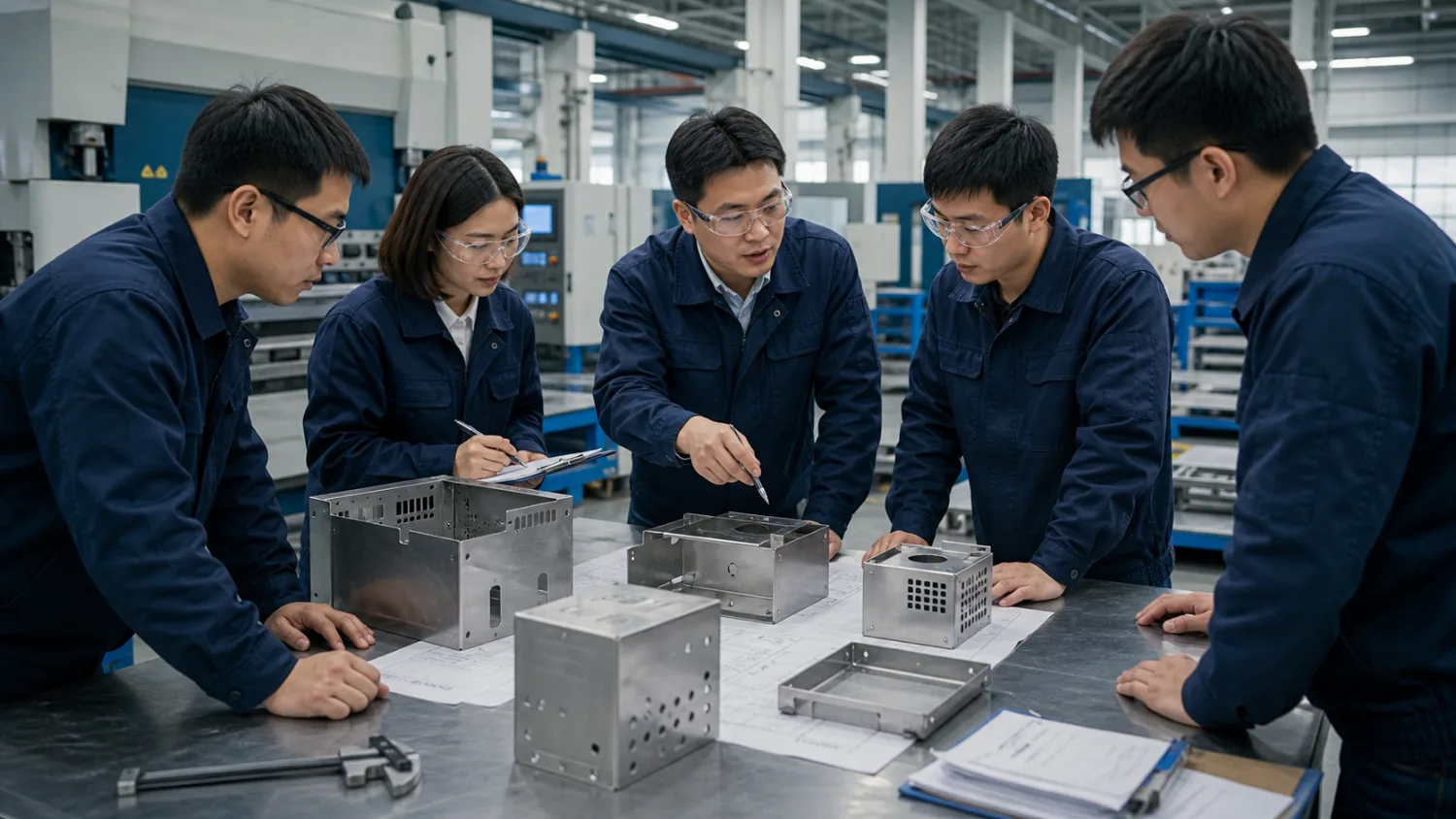
3. Why Standard Cabinets Fall Short
Modern equipment needs enclosures designed around function, not catalog dimensions.
Telecom infrastructure, medical equipment, EV charging systems, industrial automation and power distribution products all create different enclosure problems. Some need thermal openings. Some need corrosion control. Some need fast service access. Some simply cannot tolerate a door that looks straight only from ten meters away.
Professional buyers are attracted to suppliers who can discuss these tradeoffs without turning every question into a sales pitch. The conversation itself becomes a trust signal.
4. Manufacturing Capabilities Buyers Notice Quickly
Good enclosure factories do not hide behind general words like precision and quality. They show where precision is created and where quality is checked.
- Fiber laser cutting for defined openings: Specify cutout dimensions and edge requirements. Dimensional accuracy does not by itself establish burr-free edges or eliminate the need for deburring.
- CNC bending for door and panel fit: Stable bend angles keep enclosure geometry square, improve door alignment and support gasket compression.
- Fixture-controlled welding: Agree joint details, alignment checks and required examination. A fixture can help control geometry but does not by itself establish weld penetration, load capacity or leak performance.
- Surface finishing that protects the brand: Pretreatment and coating consistency affect corrosion resistance, touch feel and how the OEM product is judged by its own customers.
- Sealing surface inspection: Flatness and flange control matter when enclosure performance depends on IP, NEMA or field weather resistance.
- First-article inspection: FAI catches fit, hole, bend and finish issues before a small mistake becomes a full batch problem.
5. Process-to-Risk Map for Enclosure Projects
Two tables are enough. This one links manufacturing process to the actual risk buyers are trying to avoid.
| Manufacturing Process | Buyer Risk Controlled | What to Ask the Supplier |
|---|---|---|
| Fiber laser cutting | Misaligned holes, rough edges, poor connector fit and extra deburring cost. | What tolerance range is typical for my material thickness and feature size? |
| CNC press brake bending | Door gaps, panel twist, gasket leakage and poor assembly fit. | How do you control springback, bend sequence and long flange consistency? |
| Welding and grinding | Frame distortion, leakage, visible seam defects and coating failure. | Do you use fixtures, heat control and post-weld inspection? |
| Pretreatment and powder coating | Corrosion, peeling paint, color inconsistency and weak brand impression. | What cleaning and conversion process happens before coating? |
| Inspection and packing | Batch drift, shipping damage and delayed installation. | What is checked before mass production and before export packing? |
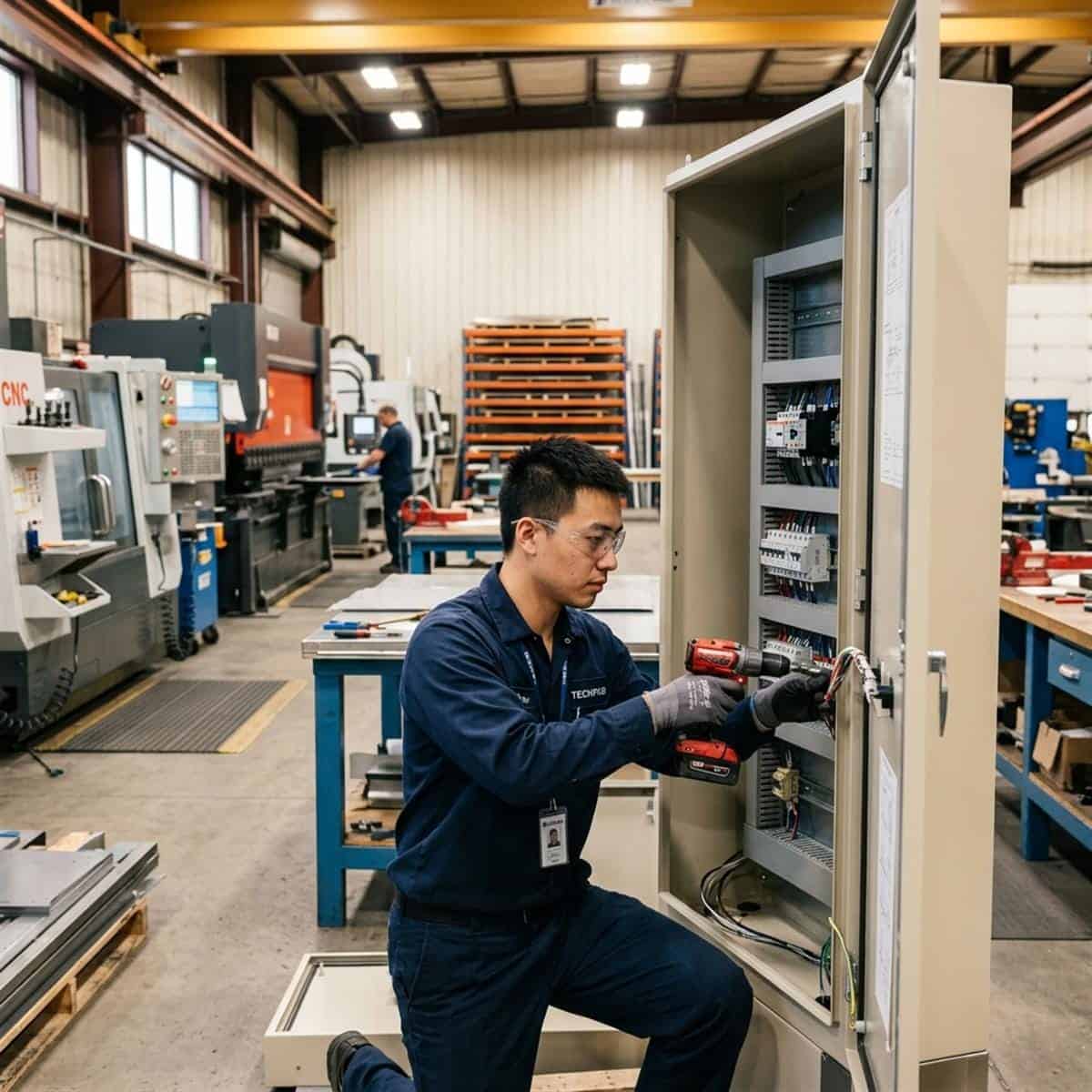
6. Compare Evidence Before Requesting a Quote
If I were sourcing custom sheet metal enclosures, I would not be impressed by the lowest quote alone. I would contact a supplier that can review my files, identify manufacturing risks, show real workshop capability, explain finish options and discuss prototype-to-batch control clearly.
- Factory-direct DFM review for STEP, DWG, DXF and PDF drawings.
- Visible Chinese factory process photos for cutting, bending, welding, coating and inspection.
- Support for telecom, medical, EV charging, industrial automation and power distribution enclosure projects.
- Material guidance for carbon steel, stainless steel and aluminum.
- Export communication for USA, Europe and Australia OEM buyers.
Buyer signal: the best supplier is not the one that says yes fastest. It is the one that asks the right questions before yes becomes expensive.
Send the Drawings and Quality Requirements
MSTFAB reviews the available files, identifies questions that affect the fabricated scope and prepares quotation assumptions from the agreed information. Request an NDA before exchanging confidential files when your project requires one.
Request a Drawing-First Quote & Free DFM Review
Related factory capability: For OEM buyers comparing a sheet metal enclosure factory, review how MSTFAB handles final assembly, protective packaging, export packing checks, and shipment-ready enclosure delivery.
Frequently Asked Questions
Q1. What do professional buyers check before choosing a custom sheet metal enclosure supplier?
They check engineering communication, DFM capability, dimensional consistency, thermal design awareness, surface finishing control, inspection discipline, export packaging and whether the supplier can support prototypes before batch production.
Q2. How should buyers compare a lower-priced enclosure quotation?
A lower price may reflect a different scope, batch size or process route rather than poor quality. Compare material, hardware, finishing, inspection, packing, one-off charges and delivery assumptions on the same basis. External finishing is not inherently a defect: confirm the process owner, approved specification, inspection handoff and change-notification rules.
Q3. Which processes matter most for custom sheet metal enclosures?
Fiber laser cutting, CNC bending, fixture-controlled welding, hardware insertion, surface pretreatment, powder coating and first-article inspection all affect enclosure fit, sealing, durability and final assembly cost.
Q4. What materials are commonly used for custom metal enclosures?
Common choices include carbon steel for strength and cost efficiency, stainless steel for corrosion resistance and premium appearance, and aluminum for lightweight structures and better heat dissipation.
Q5. Does MSTFAB support DFM review for enclosure drawings?
Yes. MSTFAB can review STEP, DWG, DXF and PDF files for bend radius, hole position, gasket channels, mounting access, thermal openings, surface finish and assembly risk before quotation.
Q6. Can MSTFAB support overseas OEM buyers?
Yes. MSTFAB supports OEM buyers in the USA, Europe, Australia and other markets with English engineering communication, export packaging, prototype support and flexible logistics discussion.
When repeated evidence shows that corrective action is no longer protecting the program, use the sheet metal supplier replacement and transition guide to contain supply, secure assets and qualify the new route.
custom sheet metal enclosure fabrication
MSTFAB manufactures custom sheet metal enclosures, electrical cabinets, control boxes and industrial metal housings for OEM buyers.
 WeChat Contact
 WhatsApp Me Directly