
⚡ Direct Answer: What Is Precision Welding in Sheet Metal Fabrication?
Precision welding in sheet metal fabrication is the controlled thermal joining of thin-gauge sheet components (typically 0.8mm to 6.0mm) using TIG (GTAW), pulsed MIG (GMAW), or handheld fiber laser welding with tight heat-input management. The objective is to produce full-penetration, aesthetically seamless joints meeting AWS D1.1/D1.2 structural codes while restricting thermal distortion, angular shrinkage, and weld seam burn-through to within ±0.2 mmmm assembly tolerances.
Sheet Metal Welding Process Comparison: TIG vs. MIG vs. Laser Welding
| Welding Process | Typical Sheet Gauge | Heat Affected Zone (HAZ) | Post-Weld Grinding Required | Best OEM Applications |
|---|---|---|---|---|
| Handheld Fiber Laser Welding | 0.8mm – 3.0mm | Minimal (<1.0mm) | Zero to minimal touch-up | Stainless steel cosmetic housings, medical carts, cleanroom boxes |
| TIG (GTAW) Welding | 1.0mm – 4.0mm | Moderate (2.0mm – 4.0mm) | Medium blending required | IP66 watertight seams, aluminum fuel tanks, food-grade sanitary vessels |
| Pulsed MIG (GMAW) | 2.5mm – 12.0mm+ | Broad (4.0mm – 8.0mm) | Significant spatter cleanup | Heavy structural machine bases, mounting brackets, generator frames |
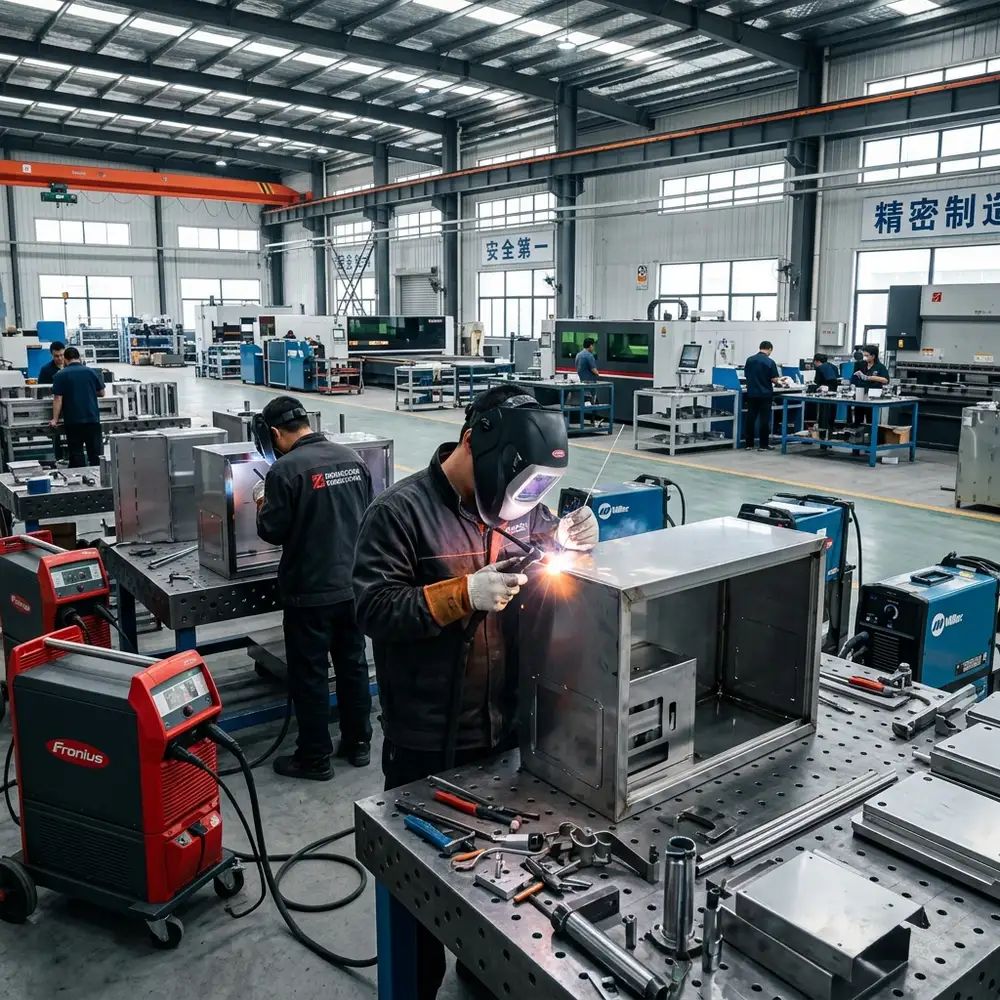
Eliminate Weld Defects with Certified OEM Welding
Send your welding assembly drawings and WPS/PQR specifications to MSTFAB. Our AWS-certified welding engineers review joint geometry and thermal control plans within 24 hours.
Frequently Asked Questions on Precision Sheet Metal Welding
How do you prevent heat warping when welding thin stainless steel enclosures?
We utilize heavy copper chill blocks behind weld seams to rapidly absorb thermal energy, employ sequenced skip-welding patterns, and transition cosmetic seams from TIG to handheld fiber laser welding, reducing heat input by over 70%.
 WeChat Contact
 WhatsApp Me Directly