
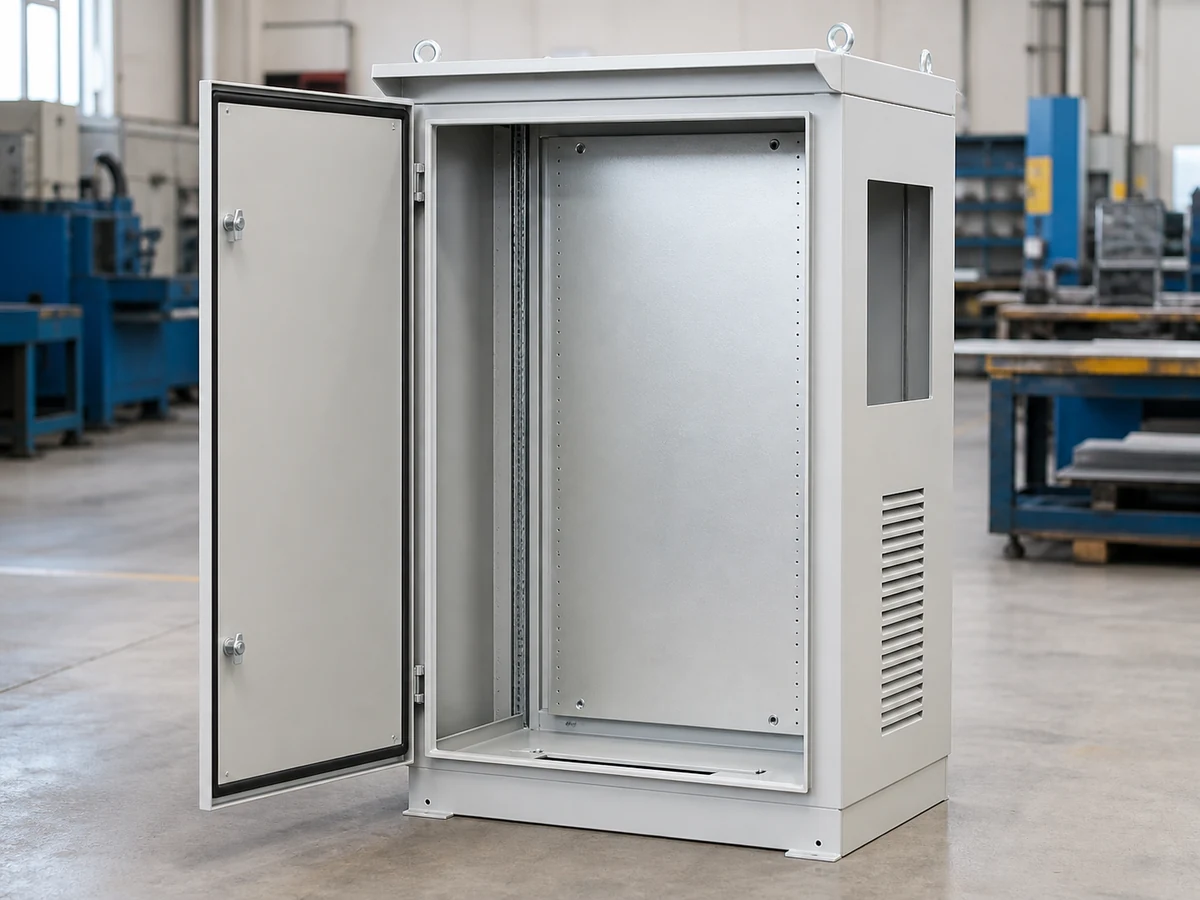
Climate-Controlled Enclosure Shell Fabrication
Empty steel, stainless steel and aluminum cabinet shells prepared for buyer-selected cooling equipment, airflow paths, service access and inspection.
A climate-controlled enclosure shell is the fabricated metal structure around a buyer-defined thermal system. The released drawing package should control the cooling interface, load path, airflow geometry, sealing surfaces, drainage, service state and inspection evidence together.
Supply boundary: MSTFAB is the international brand of Guangzhou Maisituo Sheet Metal Manufacturing Co., Ltd. We supply drawing-based fabricated mechanical parts and empty enclosure shells.
The buyer, OEM or responsible thermal engineer owns the cooling selection and sizing. MSTFAB does not manufacture the fans, heat exchangers, air conditioners or TEC modules.
Release the cabinet as a coordinated assembly of interfaces.
A cooling cutout by itself is not a cooling-ready cabinet. The surrounding panel, support, gasket land, fasteners, cables, drains and service clearance all have to agree with the selected equipment drawing.
Cabinet structure
Bodies, doors, roofs, bases, plinths, removable panels, mounting plates and drawing-defined reinforcement.
Thermal interfaces
Cooling-unit cutouts, fan and filter openings, louvers, hoods, baffles, brackets, fasteners and gasket lands.
Access and routing
Gland plates, cable-entry panels, internal keep-outs, drain routes, removable parts and maintenance clearances.
Release evidence
Agreed material, dimensions, fit, hardware, finished appearance, packing checks and first-article records.
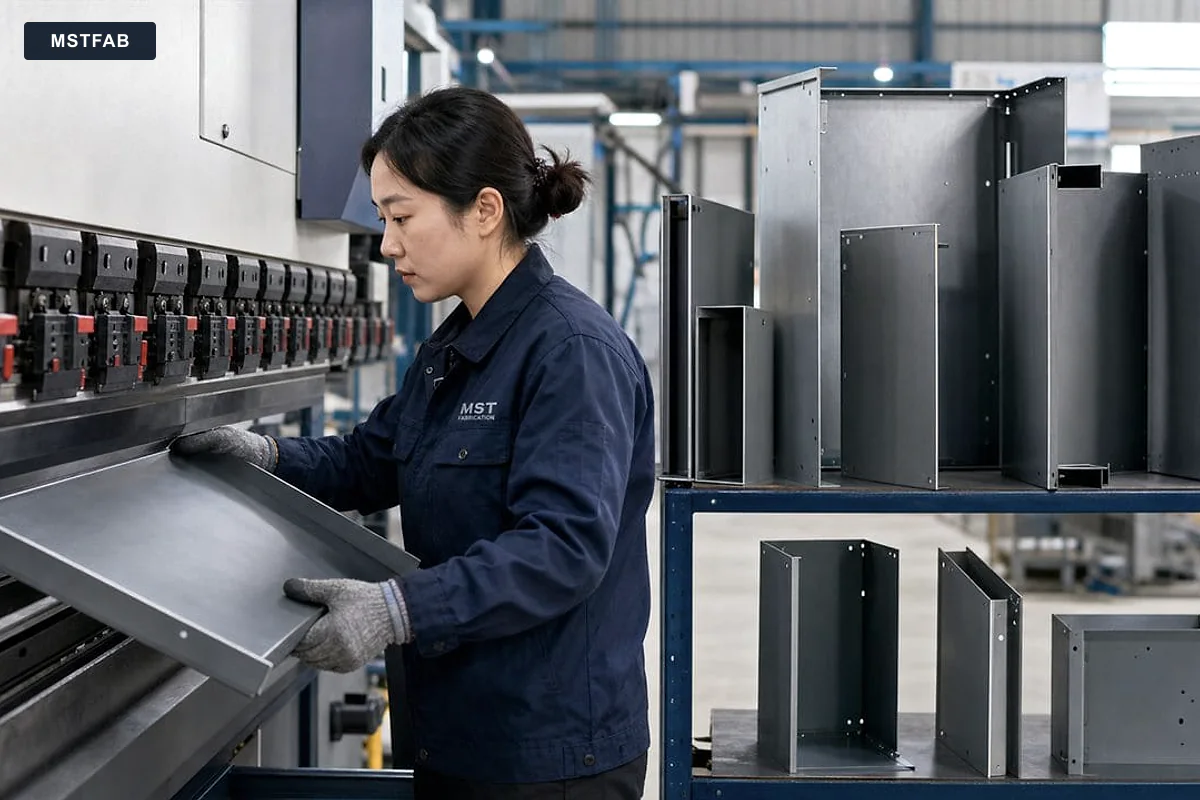
Turn thermal assumptions into drawing-controlled metalwork.
The enclosure fabricator can review manufacturability and inspect released geometry. The responsible thermal team still owns heat-load inputs, equipment capacity, control logic and completed-system acceptance.
| Release gate | Buyer-controlled input | Fabrication evidence |
|---|---|---|
| Thermal architecture | Heat load by operating state, ambient and solar inputs, internal limits, selected cooling method and fault behavior. | Approved equipment interface and shell geometry traceable to the released revision. |
| Air path | Airflow direction, intake and exhaust zones, component envelopes, pressure intent, filters and site clearances. | Air-path, louver, hood, baffle, cutout and internal-clearance inspection. |
| Equipment load | Model, mass, center of gravity, fasteners, orientation, opening states, cables and replacement method. | Cutout, support, reinforcement, hinge, latch and mounting-plane checks. |
| Sealing and drainage | Target standard, installed components, gasket system, penetrations, condensate source and drain termination. | Gasket-land geometry, closure fit, protected openings, channels and drain features in the approved scope. |
| Service state | Door swing, filter change, equipment removal, tool access, lifting and field-maintenance plan. | Operation and access checks using the released equipment envelope or agreed gauge. |
| System validation | Thermal, condensation, ingress, electrical, environmental and compliance acceptance criteria. | Mechanical inspection records; system-level testing remains with the named responsible party. |
Make ownership visible before the first article.
Owns product architecture, installed equipment, electrical design, controls, environmental requirements, installation and final compliance.
Owns the model, heat loads, selected cooling equipment, capacity, airflow or heat-transfer assumptions and acceptance criteria.
Provides the current interface drawing, mass, center of gravity, fasteners, orientation, power, drain and service instructions.
Reviews and fabricates the released mechanical geometry, hardware interfaces, finish scope, inspection evidence and packing.
Control the drawing revision from material to packed cabinet.
The manufacturing route depends on the released design. Finishing, inspection and packing requirements should be confirmed as part of that route, not added as cheerful surprises at the loading dock.
Input review
Confirm files, revision, material, hardware, cooling interface, quantities and evidence.
Cut and form
Control openings, bend access, returns, datums and fit-sensitive panel geometry.
Join and support
Manage weld sequence, distortion, studs, brackets, reinforcement and assembly access.
Finish route
Protect threads, grounding zones, gasket lands and cosmetic surfaces to the approved scope.
First article
Check critical dimensions, hardware, door operation, equipment interfaces and appearance.
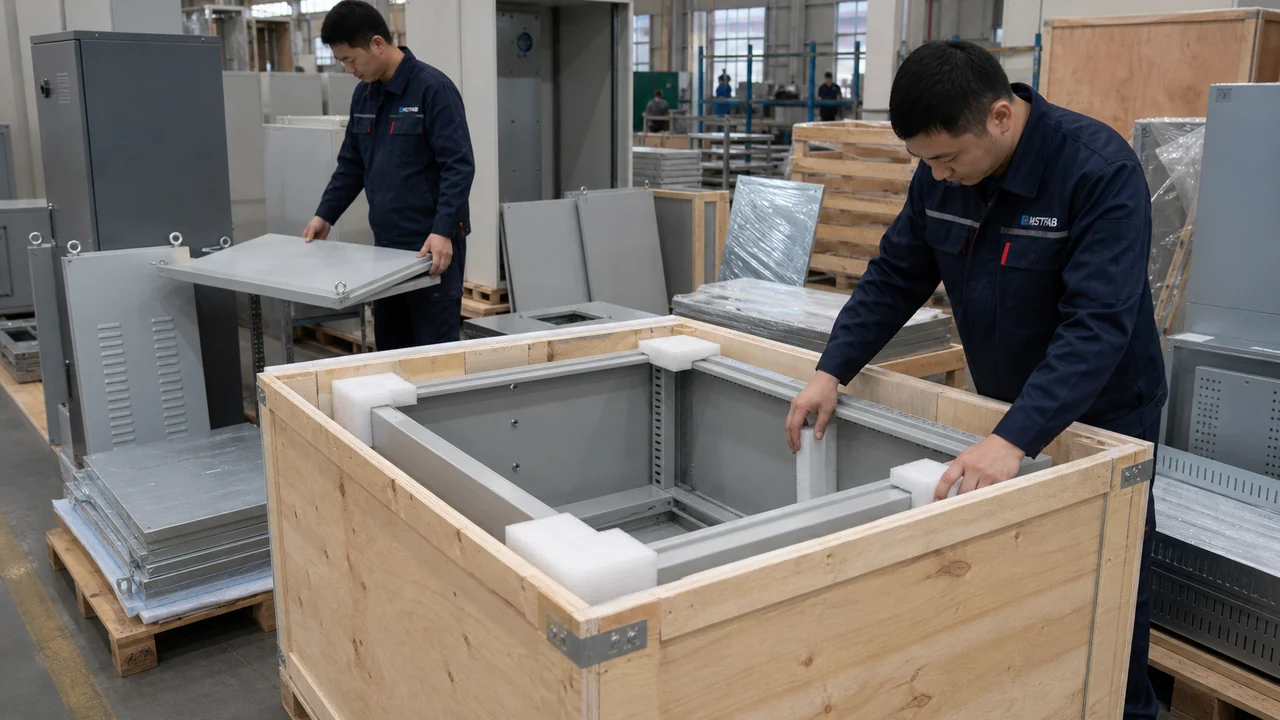
Pack and release
Separate finished surfaces, secure loose parts and retain the agreed shipment evidence.
Selected finishing processes may be completed by qualified long-term partners. The quotation and approved manufacturing route define the applicable scope, controls and acceptance evidence.
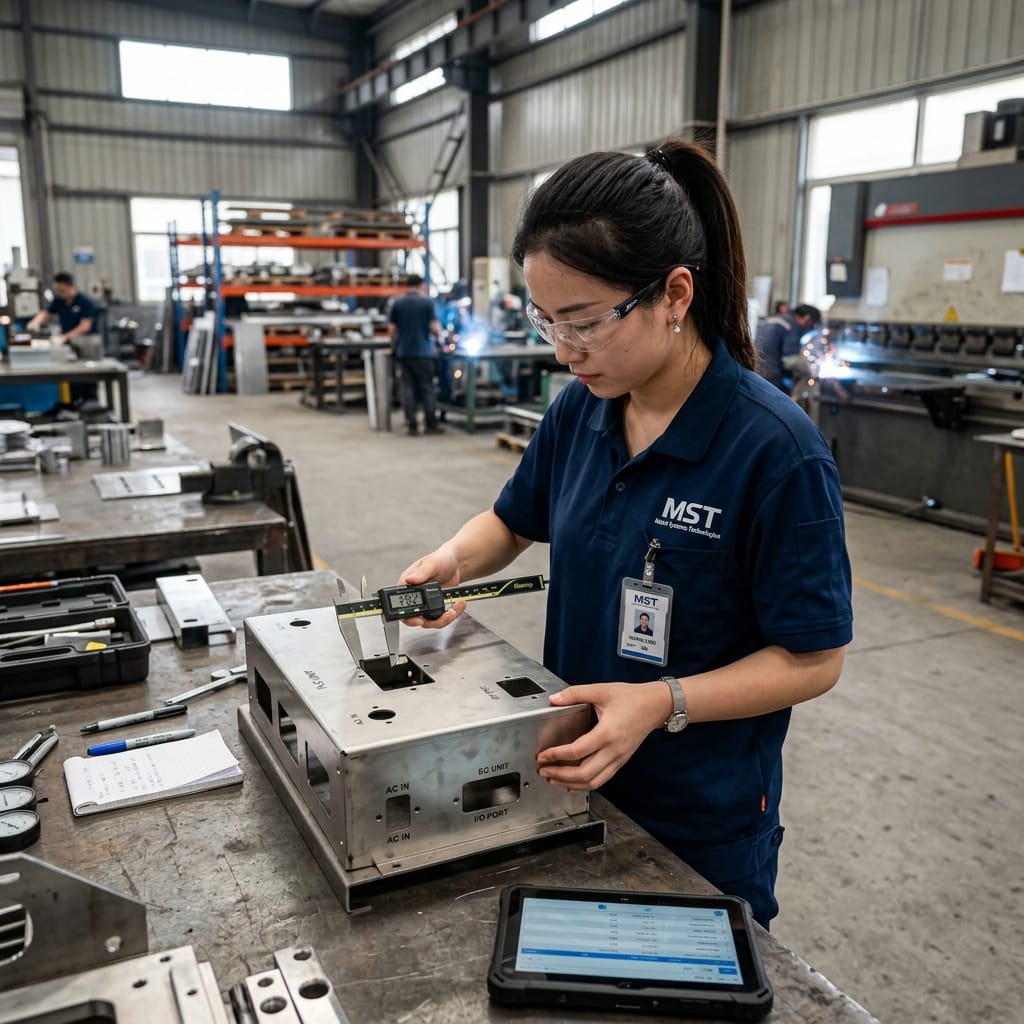
Specify the material from the real environment and load case.
Material names are not shortcuts for corrosion, stiffness, weight or finish decisions. Release the grade, condition, thickness and surface requirement that apply to the project.
Cold-rolled steel
Common for controlled indoor environments when the approved finish and corrosion plan suit the application.
Galvanized steel
Useful where zinc-coated sheet supports the buyer's corrosion strategy and formed edges are addressed in the finish plan.
Stainless steel
Grade, surface condition, weld treatment and cleaning exposure should be named rather than inferred from "stainless."
Aluminum
Alloy, temper, joining method, galvanic interfaces, stiffness and finish remain design inputs, not catalog assumptions.
Send the thermal interfaces with the cabinet drawings.
Provide a STEP or STP assembly with controlled 2D PDF drawings. Include DXF or DWG data when buyer controlled, together with the selected equipment interface drawing and the requirements needed to review the fabrication scope.
- Current file and drawing revision
- Material grade, condition and thickness
- Cooling method and equipment model
- Mass, center of gravity and fasteners
- Airflow zones and component envelopes
- Gaskets, openings and drain routes
- Door, filter and replacement states
- Finish, masks and cosmetic zones
- Inspection and validation ownership
- Quantity, destination and packing
MSTFAB does not publish one MOQ, lead time or tolerance for every enclosure. Feasible terms are confirmed from the released scope and quotation.
Climate-controlled enclosure fabrication questions
What does MSTFAB supply for a climate-controlled enclosure project?
MSTFAB supplies drawing-based fabricated mechanical parts and empty enclosure shells. The approved scope may include cabinet bodies, doors, panels, mounting plates, brackets, cooling-equipment cutouts, louvers, gland plates, passive hardware, gaskets, inspection and export packing.
Does MSTFAB select or manufacture the cooling equipment?
No. Cooling architecture, capacity and equipment remain the responsibility of the buyer, OEM or responsible thermal engineer. MSTFAB fabricates the approved cutouts, supports, sealing surfaces and related mechanical interfaces from the released drawing package.
Does an enclosure shell carry an IP or NEMA rating by itself?
Not automatically. Any claimed rating depends on the applicable standard, completed assembly, installed equipment, openings, seals, hardware, installation and verification plan. The responsible buyer, OEM or test party owns the final claim and completed-system validation.
Which files are needed for an enclosure quotation?
Send a STEP or STP assembly with a controlled 2D PDF drawing. Include buyer-controlled DXF or DWG data when applicable, plus the equipment interface drawing, material, thickness, finish, quantities, critical dimensions, inspection needs and packing destination.
How are powder coating and other finishes handled?
The required finish is confirmed from the approved drawing and quotation. When a qualified long-term partner completes a selected finishing process, the applicable specification, masking, inspection and acceptance evidence remain part of the controlled order scope.
Does MSTFAB publish one MOQ, lead time or tolerance for every cabinet?
No. Cabinet size, material, geometry, cooling interfaces, welding, hardware, finishing route, inspection, quantity and packing affect the project. Feasible quantity, lead time and tolerances are confirmed from the released drawing package and quotation.
Release the cooling interface before releasing the metalwork.
Send the cabinet assembly, controlled drawings, selected cooling-equipment data, service states, finish, inspection scope, quantities and destination. MSTFAB will review the drawing-defined mechanical scope and return project-specific manufacturing questions.
 WeChat Contact
 WhatsApp Me Directly