
Underneath every industrial machine, pump, and gearbox sits an unsung guardian: the drip pan. It catches incidental coolant drips, hydraulic weepage, or condensate before they reach the factory floor. But when procurement teams assume any metal tray will do, they quickly discover that an off-the-shelf catalog tray interferes with frame beams, lacks welded corner seals, or puts the drain boss right where a structural rib lives.
Quick Answer: Custom welded sheet metal drip pans are fabricated metal components designed to collect or direct liquids beneath industrial machinery, pumps, equipment housings, and mechanical assemblies. For machinery OEMs, these pans can be manufactured from carbon steel, stainless steel, or aluminum using laser cutting, CNC bending, and welding according to approved engineering drawings. Unlike standard catalog trays, custom drip pans can incorporate equipment-specific dimensions, mounting flanges, drain openings, welded corners, reinforcement brackets, and removable sections. However, a fabricated metal pan is not automatically leak-tight or suitable for hazardous-liquid containment. Material compatibility, liquid-holding capacity, weld requirements, and any required leak testing must be defined by the equipment manufacturer.
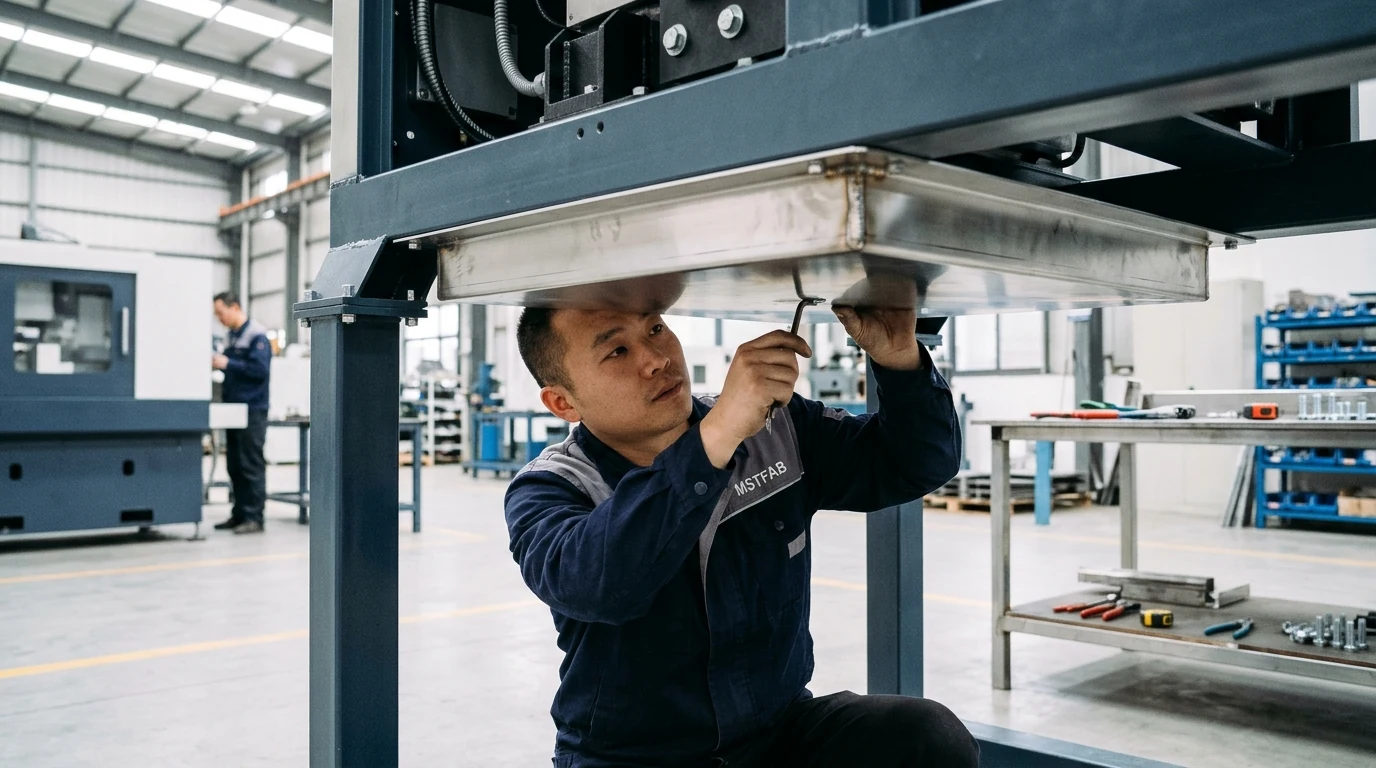
A qualified custom sheet metal fabrication supplier can manufacture these components according to the buyer’s approved specifications and agreed inspection requirements. This guide explains how industrial machinery manufacturers should specify custom metal drip pans, evaluate fabrication methods, and prepare an accurate OEM quotation request.
What Is a Custom Welded Sheet Metal Drip Pan?
A custom sheet metal drip pan is a fabricated metal component positioned beneath or within equipment to collect incidental liquid drips or direct fluid toward an approved drainage point. It may consist of a formed metal base, raised side walls, welded corners, mounting flanges, and an optional drain opening. Depending on the design, it can be installed permanently or manufactured as a removable component for routine maintenance.
Typical Industrial Applications
| Application | Metal Component | Main Function |
|---|---|---|
| CNC machinery | Coolant collection pan | Collect incidental coolant drips beneath cutting chambers |
| Industrial pumps | Pump drip tray | Collect packing or seal weepage beneath equipment |
| Automation equipment | Equipment base pan | Protect surrounding cleanroom or factory areas from incidental oil |
| Hydraulic power units | Oil collection tray | Collect minor oil drips at valve manifolds and defined fittings |
| Industrial compressors | Metal drainage pan | Collect condensate, oily water, or other approved fluids |
| Laboratory machinery | Stainless steel drip pan | Support hygienic liquid collection, washdowns, and sanitary cleaning |
| Equipment electrical cabinets | Internal condensate pan | Direct air-conditioner condensate safely toward an external outlet |
Engineering & Regulatory Boundary: These fabricated metal pans are designed for incidental liquid collection and fluid routing. They should not automatically be treated as certified hazardous spill-containment systems (such as secondary chemical bunding). Where hazardous fluids, large spill volumes, or environmental containment regulations apply, the machinery OEM must determine the applicable standards, holding capacities, and mandatory certification.
Why Do Machinery OEMs Need Custom Drip Pans?
Standard metal trays exist in common catalog dimensions, but industrial equipment rarely offers empty rectangular envelopes. A machine frame typically has support legs, structural I-beams, foundation anchors, motor mounts, hydraulic hoses, or conduit knockouts that restrict available installation clearances. A generic catalog tray either won’t fit or leaves critical drip zones unprotected.
For engineering and procurement teams, these mechanical interface requirements make drawing-based custom manufacturing far more reliable than modifying generic catalog pans. If you are comparing general shallow trays versus machinery collection bases, see our guide on custom sheet metal tray manufacturing.
1. What Materials Are Suitable for Industrial Drip Pans?
Material selection must be based on the actual liquid, operating temperature, corrosion environment, mechanical load, and structural rigidity requirements.
| Material Grade | Potential Application | Main Manufacturing & Service Consideration |
|---|---|---|
| SPCC / Carbon Steel | Indoor equipment frames, oil drip pans | Requires appropriate corrosion protection (primer, powder coat, or plating) |
| 304 Stainless Steel | General industrial coolant & water collection | High corrosion resistance, sanitary cleanability, and excellent weldability |
| 316 Stainless Steel | Aggressive chemical or chloride exposure | Superior pitting resistance; higher raw material cost |
| Aluminum 5052 | Lightweight equipment, mobile machinery pans | Good formability and marine corrosion resistance; requires TIG AC welding |
| Galvanized Steel | HVAC condensate pans, mild outdoor units | Pre-galvanized zinc coating; cut edges and weld heat zones lose zinc protection |
Carbon Steel Drip Pans
Carbon steel (such as cold-rolled SPCC or hot-rolled pickled steel) is widely used for heavy industrial equipment bases. It offers high mechanical stiffness, excellent formability on CNC press brakes, and economical cost. However, unfinished carbon steel corrodes rapidly when exposed to water, synthetic coolants, or humid air.
If powder coating or wet painting is specified, the buyer must verify that the chosen coating system is chemically compatible with the collected fluid. A decorative polyester powder coating may bubble or peel when continuously submerged in aggressive hydraulic oils, solvents, or alkaline cleaners. When specifying powder-coated steel, always indicate the fluid type on your engineering notes.
Stainless Steel Drip Pans
Type 304 stainless steel is the benchmark for industrial liquid collection pans requiring corrosion resistance and cleanable surfaces. For food processing, pharmaceutical packaging, laboratory equipment, or coastal facilities exposed to salt air, 316 stainless steel provides superior pitting resistance. Our detailed stainless steel sheet metal fabrication guide outlines tolerances and passivation practices for both grades.
Aluminum Drip Pans
Aluminum 5052-H32 offers a high strength-to-weight ratio and natural resistance to atmospheric oxidation. It is ideal for weight-sensitive machinery, gantry assemblies, or mobile test units. However, aluminum has a lower modulus of elasticity than steel, meaning larger spans may require folded stiffener ribs or thicker sheet stock. Furthermore, direct contact between aluminum and carbon steel machine frames can cause galvanic corrosion unless insulating isolator washers or coatings are used. For more material comparison tips, review our sheet metal material selection guide.
OEM Purchasing Recommendation: Always specify the exact metallurgical grade and temper (e.g., “Stainless Steel 304 2B finish” or “Aluminum 5052-H32”) on the drawing rather than generic terms like “stainless” or “aluminum.”
2. How Should an Industrial Drip Pan Be Designed?
A custom drip pan should be designed around its physical installation environment and intended fluid-routing function. The sheet metal fabricator manufactures the exact geometry, but the equipment OEM must define its functional performance.
Reinforcement Features for Large Pans
Drip pans spanning more than 1,000 mm in length can experience oil-canning (drumming deflection) when filled with liquid or during handling. Sheet metal designers should consider bottom stiffener ribs, hemmed top flanges, or external welded channel brackets. Learn more about flange stiffness rules in our bend radius and flange checklist.
3. How Is a Custom Welded Drip Pan Manufactured?
Manufacturing custom drip pans involves a series of tightly controlled sheet metal fabrication processes:
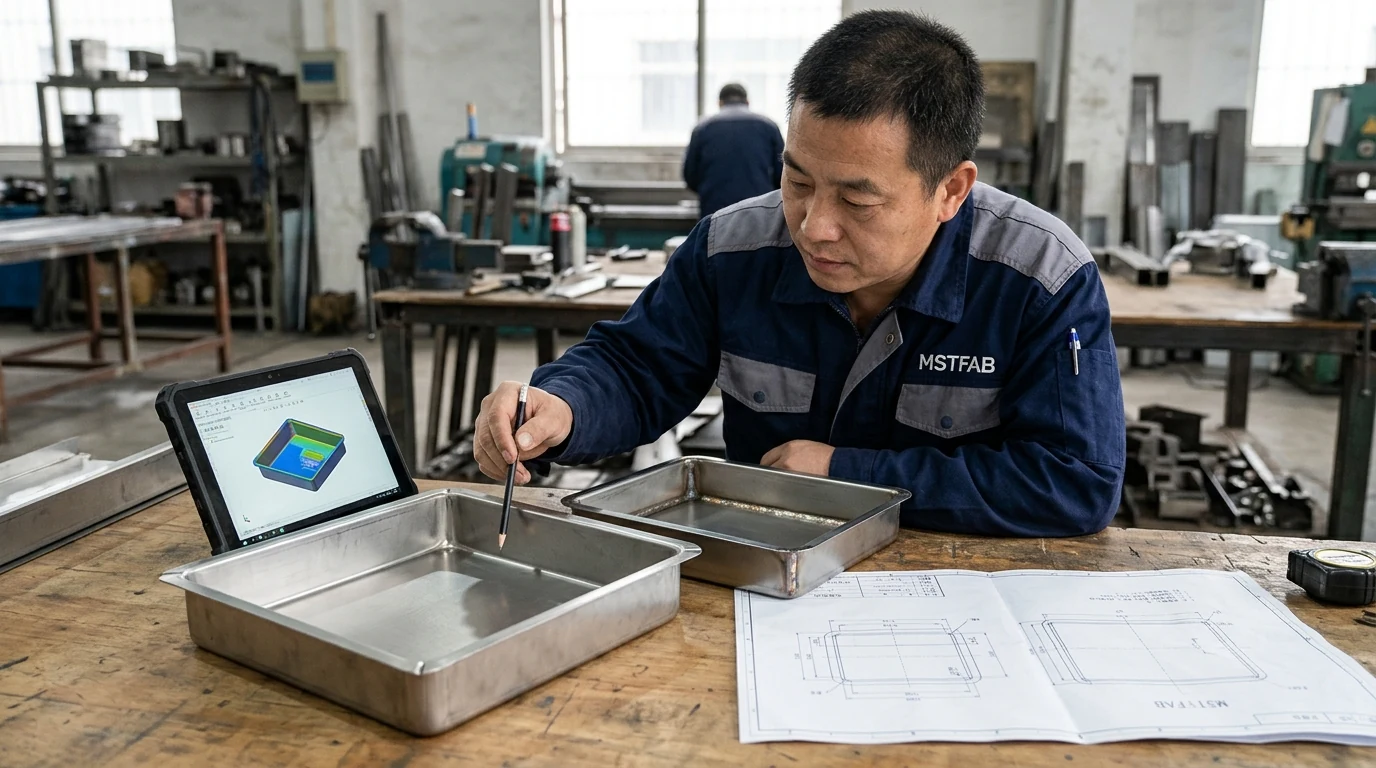
- Engineering Drawing & DFM ReviewThe engineering team reviews 3D CAD models (STEP/STP) and 2D dimensioned PDFs. Technicians check bend radii, bend deduction factors, corner relief clearances, weld accessibility, and material thickness tolerances.
- Precision Fiber Laser CuttingHigh-precision CNC fiber laser cutting produces the flat blank profiles, perimeter contours, mounting slots, notch reliefs, and drain openings with tight ±0.1 mm repeatable tolerances. Read more on our laser cutting services.
- CNC Sheet Metal BendingCNC press brakes form the bottom floor, side walls, and mounting flanges. Multi-axis backgauges ensure precise angle control and consistent flange heights across the entire length of the pan. Explore our CNC sheet metal bending services.
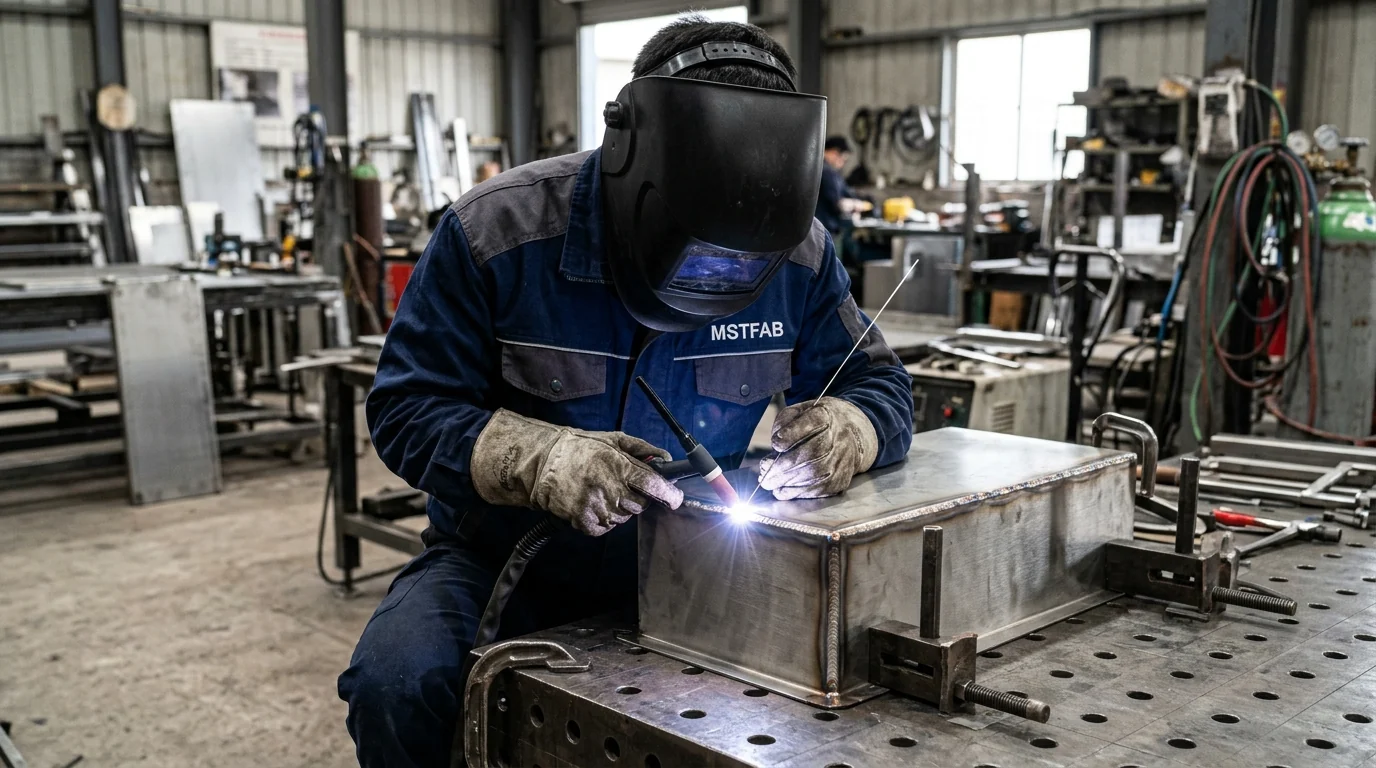
- TIG or MIG Welding & SealingTIG (GTAW) or MIG (GMAW) welding is performed along corner joints, seam intersections, and threaded drain fittings. Skilled welders control heat input to prevent warping and thermal distortion across wide flat sheet metal bottoms.
- Surface Finishing, Deburring & Quality InspectionWelds are ground smooth or left as-welded per drawing callouts. Stainless pans undergo pickling, passivation, or bead blasting. Carbon steel pans are powder coated. Parts undergo dimensional verification and agreed leak testing.
4. Why Are Welded Corners Important?
Corners are the most critical functional feature of a formed sheet metal drip pan. When a flat sheet of metal is bent into a four-sided tray on a press brake, the adjacent vertical walls meet at 90-degree corners. Without specialized relief geometry, the metal would tear or buckle at the corner junction during bending.
Consequently, flat patterns incorporate corner reliefs (circular, rectangular, or tear-drop cutouts). After CNC bending, these relief cutouts leave small open gaps at each corner. If the pan is only meant to act as a dust shield or temporary deflector, these open reliefs may be acceptable. But if the component must hold liquid, those open corners must be fully welded and sealed.
| Pan Feature | Manufacturing Concern | Fabrication Solution |
|---|---|---|
| Corner joint | Gaps left by bend reliefs allow liquid to escape | Full-penetration continuous TIG weld across corner seam |
| Continuous weld seam | High heat input causes floor buckling and oil-canning | Intermittent clamping, copper heat sinks, and pulse TIG |
| Drain fitting interface | Thread distortion or porous fillet welds around coupling | Precision laser hole cutout, machined boss, and back-purged TIG weld |
| Base-to-wall corner | Undercut or weld spatter trapping dirt and liquid | Smooth weld profile, mechanical deburring, and scotch-brite blending |
| Mounting bracket weld | Thermal pull twists mounting flange out of flat plane | Symmetrical tacking and rigid modular fixture tables |
Important Quality Rule: A visually neat weld bead does not automatically guarantee zero fluid leakage. Micro-porosity, pinholes, or cold laps invisible to the naked eye can seep liquid over time. If fluid tightness is critical, specify a formal leak test on your drawing notes.
5. How Should OEM Buyers Specify Leak Testing?
Not every drip pan requires expensive non-destructive testing. An OEM buyer should balance the component’s operational consequence against inspection cost. Leak verification should be clearly defined during the RFQ stage.

Visual Weld Inspection
Visual inspection verifies weld continuity, leg size, absence of surface cracks, and complete fusion. While essential for general structural integrity per AWS D9.1 standards, visual inspection cannot guarantee pressure or liquid tightness on thin-gauge sheet metal.
Static Water-Fill (Hold) Test
For open, non-pressurized drip pans, the static water-fill test is the most practical and cost-effective verification method. The pan is placed on dry test paper or elevated blocks, filled with water up to a specified depth (e.g., 80% of wall he), and held for an agreed duration (commonly 15 to 30 minutes). Inspectors visually inspect all welded corners and drain fittings for moisture or seepage.
Specialized Leak Detection Standards
For critical assemblies, aerospace equipment, or vacuum housings, specialized leak testing standards exist:
- ASTM E515 (Bubble Emission Leak Testing): Applied by creating a slight pressure differential and applying a surfactant solution to detect bubbling at seam defects. Useful for sealed vessels or closed sub-chambers.
- ASTM E1003 (Hydrostatic Leak Testing): Designed for closed piping and pressurized vessels. Because standard open sheet metal drip pans cannot support internal pressure without catastrophic deformation, ASTM E1003 should not be casually specified for open collection trays.
- Liquid Penetrant Testing (PT / Dye Penetrant): Fluorescent or red dye penetrant is applied to welded corners to highlight microscopic surface-breaking cracks and pinholes.
| Test Requirement | Information OEM Buyers Should Specify |
|---|---|
| Test Purpose | Incidental liquid retention vs continuous leak-tight containment |
| Test Method | Visual weld check, static water-hold test, or dye penetrant inspection |
| Test Medium | Clean water, water with fluorescent tracer dye, or test air |
| Fill Level & Duration | Fill to 80% rim height; maintain hold for 15, 30, or 60 minutes |
| Acceptance Criteria | Zero visible moisture, seepage, or dampness on external weld joints |
| Test Sampling Rate | 100% of production units, first-article prototype only, or AQL batch sampling |
| Documentation | Signed Quality Inspection Report (QIR) or test certificate with serial logs |
6. How Can OEM Buyers Determine Drip Pan Collection Capacity?
When sizing a drip pan, equipment engineers must ensure the internal volume is sufficient to capture expected leak volumes before service technicians perform pump maintenance or oil changes.
Theoretical Rectangular Volume Calculation
For a basic flat-bottomed rectangular pan without internal obstructions:
Capacity (Liters) = [ Length (mm) × Width (mm) × Usable Liquid Depth (mm) ] ÷ 1,000,000
Example: Consider a pan measuring 600 mm long × 400 mm wide with a usable fluid height of 40 mm (leaving 20 mm freeboard on 60 mm high walls):
Theoretical Volume = (600 × 400 × 40) ÷ 1,000,000 = 9.6 Liters
However, theoretical geometric volume is rarely equal to practical usable capacity. Several real-world factors reduce effective holding capacity:
- Equipment Displacement: If pump mount blocks, motor feet, or structural beams sit inside the pan, they displace usable liquid volume.
- Pan Incline & Machine Slope: If the machine sits on an unlevel floor or if the pan is sloped toward a drain, fluid pools deeper at one end, reducing overflow margins at the low end.
- Freeboard Margin: Never size capacity to the absolute rim height. Splashing, surface tension, and equipment vibration require at least 15–25 mm of freeboard margin.
- Corner Bend Radii: Internal sheet metal bend radii slightly reduce corner volume compared to sharp theoretical CAD geometry.
7. How Should Drainage Interfaces Be Specified?
Some industrial drip pans operate as closed catch-basins emptied manually during scheduled maintenance. Others connect directly to recovery pumps, recirculating coolant reservoirs, or central wastewater drains. If your drip pan includes an outlet, specify the interface thoroughly:

Drain Outlet Location
Locate the drain opening relative to equipment mounting datum points rather than the raw edge of the pan. A mislocated drain will collide with floor beams or frame cross-members beneath the machine.
Connection Fitting Types
For coolant recovery applications where machining chips also need directing, pair your pan design with insights from our guide on custom CNC chip chutes.
8. Welded Drip Pan vs. One-Piece Bent Pan: Which Costs Less?
OEM buyers frequently ask whether it is cheaper to fabricate a drip pan from a single CNC-bent sheet or to weld separate formed walls onto a flat base plate. The answer depends on pan size, depth, and batch volume.
| Cost & Fabrication Factor | One-Piece Bent Construction | Multi-Part Welded Construction |
|---|---|---|
| Raw Material Utilization | Large developed blank may result in high scrap percentage at corners | Individual strip walls nested efficiently; lower scrap rate |
| Laser Cutting Operations | Single blank cut; fast cycle time; complex relief notches | Multiple blanks cut; more handling between machines |
| CNC Press Brake Bending | Four perimeter bends plus flanges; requires deep-box tooling clearance | Simple 90-degree bends on strip components; straightforward tooling |
| Welding Labor | Only 4 vertical corner seams to weld (short cycle time) | Continuous perimeter base-to-wall welds (substantial welding labor) |
| Welding Distortion Risk | Minimal heat input; floor remains flat and true | High cumulative heat input; significant risk of base plate warping |
| Tooling & Fixtures | Standard press brake tooling; minimal welding jigs needed | Requires rigid clamping fixtures to maintain squareness |
| Leak Verification | Only 4 corner seams to verify for fluid tightness | 100% perimeter seam must be verified for leak-tightness |
| Best Suited For | Pans up to 1,500 mm with depths up to 100 mm | Deep pans (>150 mm), heavy plate (>4 mm), or very large tanks |
For most machinery drip pans with depths under 100 mm, one-piece bent construction with welded corners is significantly more economical because it eliminates feet of labor-intensive perimeter welding and minimizes heat distortion.
9. What Makes a Good Industrial Drip Pan Supplier?
Fabricating a leak-resistant drip pan requires more than standard sheet metal cutting. When auditing potential contract manufacturers, evaluate these key capabilities:
- Press Brake Box Tooling & Clearance: Can the supplier bend four-sided pans with deep return flanges without colliding with the press brake punch holder?
- TIG Welding Mastery on Thin Sheet: Can their welders produce smooth, pinhole-free corner welds on 1.5 mm to 2.5 mm stainless steel without burn-through or warping the base?
- Fixture & Clamping Rigidity: Do they utilize modular 3D welding tables and copper chill blocks to keep mounting flange faces co-planar and flat? Review our welded sheet metal assemblies guide.
- Coordinated Finishing: Can they manage chemical pickling, bead blasting, or chemical-resistant epoxy powder coating under a single manufacturing contract? See surface treatment capabilities.
- In-House Leak Testing Capability: Can they perform documented water-fill hold tests and provide photo-backed inspection reports prior to packaging?
10. Example: Custom Industrial Machinery Drip Pan RFQ
To demonstrate how an OEM buyer should specify a drip pan, consider this representative specification for a CNC machine pump collection tray:
Representative OEM Project Specification
- Component: CNC Machine Pump Base Drip Pan
- Material: Stainless Steel 304, 2B finish, with protective PE laser film
- Material Thickness: 2.0 mm (14 gauge)
- Overall Dimensions: 600 mm (L) × 400 mm (W) × 60 mm (H)
- Construction: 1-piece CNC-bent pan body with 4 fully TIG-welded corner seams
- Mounting Features: 4× folded perimeter mounting flanges with 9×14 mm slotted holes
- Drain Fitting: 1× 3/4″ NPT female half-coupling welded flush to floor per drawing datum
- Weld Quality: AWS D9.1, continuous liquid-resistant corners, deburred, chemically pickled & passivated
- Leak Testing: 100% static water-fill hold test (40 mm water depth, 30-minute duration, 0 leaks allowed)
- Batch Quantities: 10 pcs (prototype evaluation), followed by 50, 100, and 300 pcs production batches
- Submission Files: 3D STEP solid model and 2D dimensioned PDF drawing with GD&T callouts
Supplier Trust Evaluation: What to Ask Your Fabricator
Use these direct technical questions during your quotation review to quickly distinguish experienced sheet metal manufacturers from brokers or unequipped workshops:
| Question to Ask the Supplier | A Reliable Answer Sounds Like | Red Flag Warning Sign |
|---|---|---|
| “Are all your welded pans automatically leak-proof?” | “No fabricated pan is automatically leak-tight unless specified. We qualify joint designs and conduct agreed water-fill or penetrant testing per project specs.” | “Yes, we weld everything so of course it never leaks.” |
| “How do you keep the flat pan floor from warping during welding?” | “We use one-piece CNC bending to minimize seams, clamp corners in modular fixtures, and use pulsed TIG with copper heat sinks.” | “We just hammer or heat-straighten the sheet after welding.” |
| “Can we use standard polyester powder coat for a hydraulic oil tray?” | “Standard polyester can soften under hydraulic oils or aggressive coolants. We recommend an epoxy-based chemical coating or switching to 304 stainless.” | “Powder coat is powder coat; it works for all liquids.” |
| “Can you supply the drain valve and float switch?” | “We weld the threaded boss or mounting spud. Fluid switches, pumps, and valves must be supplied by your assembly team.” | Quotes complete hydraulic sensors without asking for schematics. |
| “What will you inspect before export shipment?” | “Overall envelope dimensions, flange hole locations, thread pitch on drain boss, weld visual quality, and signed water-hold test logs.” | “We do standard factory QC checks.” |
11. How Can MSTFAB Manufacture Custom Sheet Metal Drip Pans?
Guangzhou Maisituo Sheet Metal Manufacturing Co., Ltd. (MSTFAB) is a precision custom sheet metal fabrication manufacturer located in Guangzhou, China, serving international machinery OEMs, automation builders, and equipment designers worldwide. Our manufacturing capabilities include:
- Precision fiber laser cutting up to 20 mm thickness
- Multi-axis CNC press brake sheet metal bending up to 4,000 mm length
- Certified TIG (GTAW) and MIG (GMAW) welding of stainless steel, carbon steel, and aluminum
- Manual and automated robotic seam welding for high-volume enclosures and trays
- PEM hardware insertion (clinch studs, standoff nuts, threaded inserts)
- In-house weld grinding, deburring, graining, and pickling passivation
- Coordinated powder coating, zinc plating, e-coating, and anodizing
- CMM and digital caliper dimensional inspection with full First Article Inspection (FAI) reports
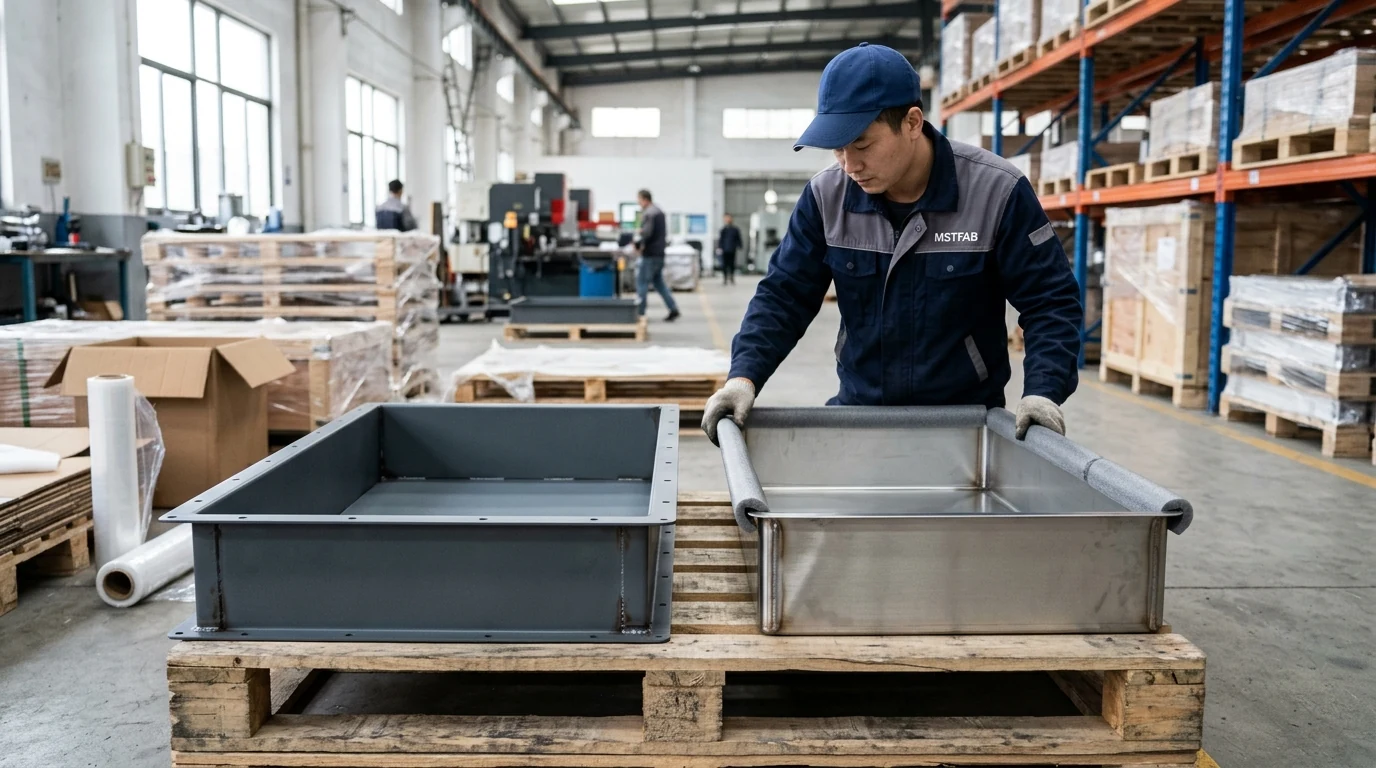
- Custom export wooden crating with foam corner protection and anti-corrosion VCI wrapping
For industrial drip pan projects, MSTFAB engineers can review your CAD models to optimize bend clearances, corner relief cutouts, and drain boss weldability. Explore our full range of custom sheet metal fabrication services and machinery frame and cover manufacturing.
Clear Manufacturing Scope: MSTFAB manufactures customer-designed build-to-print metal parts, welded trays, pans, and structural subassemblies. We do not supply complete fluid circulating systems, hydraulic pumps, drainage valves, electrical float sensors, or certified hazardous spill-containment systems. Project-specific leak testing, hydrostatic procedures, or specialized liquid retention verifications must be reviewed and commercially agreed per project.
12. What Should Buyers Include in a Drip Pan Fabrication RFQ?
An incomplete RFQ leads to delayed quotes or costly rework during assembly. Ensure your quotation package includes the following technical data:
| Required RFQ Information | Why It Matters to the Fabricator |
|---|---|
| 3D CAD Model (STEP / STP) | Defines exact 3D geometry, bend sequences, and hole clearances |
| Dimensioned 2D Drawing (PDF) | Controls critical linear tolerances, hole centerlines, and GD&T datum faces |
| Material Grade & Thickness | Defines raw sheet stock, laser cutting parameters, and bend radii deductions |
| Weld Seam Callouts | Distinguishes continuous liquid-tight corner welds from intermittent structural tacks |
| Drain Boss Details | Specifies thread type (NPT vs BSPP), wall thickness, and fitting protrusion depth |
| Expected Fluid Type | Informs material selection and surface coating compatibility recommendations |
| Leak Testing Specification | Defines test method (water hold vs visual), hold duration, and acceptance threshold |
| Surface Finish & Color | Specifies Ra roughness, passivation, or RAL color code for powder coating |
| Batch & Annual Volumes | Allows optimal production nesting, tooling selection, and volume tier pricing |
| Packaging & Delivery Terms | Defines palletizing, export crating, and commercial terms (EXW, FOB, CIF, DDP) |
For more advice on formatting quote files, review our guide on quoting with STEP, PDF, and DXF files.
Key Takeaways for Sourcing Industrial Drip Pans
- A custom drip pan is a dedicated mechanical interface, not just a folded sheet metal box.
- One-piece CNC bending with welded corners is almost always more cost-effective and dimensionally stable than multi-part welded trays.
- Never assume a continuous weld is automatically leak-tight; define a static water-fill test on your drawing notes if fluid retention is required.
- Ensure the collected fluid is chemically compatible with specified coatings; powder coating can fail when submerged in harsh solvents or hydraulic oils.
- Allow adequate freeboard margin (15–25 mm) above your calculated liquid holding capacity to prevent sloshing during equipment operation.
- Provide complete 3D STEP models and 2D PDFs specifying drain fitting threads, mounting slot datums, and weld finishing requirements.
Frequently Asked Questions
Can sheet metal fabrication be used to manufacture industrial drip pans?
Yes. Custom metal drip pans can be fabricated through CNC fiber laser cutting, precision press brake bending, TIG/MIG welding, and surface treatment according to approved engineering drawings.
What is the best material for a custom machinery drip pan?
There is no single best material. SPCC carbon steel with an appropriate chemical-resistant coating is cost-effective for indoor oil drips; 304 stainless steel is the standard for water, coolants, and washdowns; 316 stainless is required for aggressive chemicals; and 5052 aluminum suits weight-critical mobile equipment.
Can a welded sheet metal drip pan be leak-tight?
Yes, a properly designed and TIG-welded sheet metal pan can achieve complete liquid-tightness for incidental drips. However, leak-tightness must be formally verified using an agreed test procedure (such as a 30-minute water-fill hold test) because visual inspection alone cannot detect microscopic weld pinholes.
Is stainless steel better than powder-coated carbon steel?
Stainless steel provides permanent, non-degrading corrosion resistance without relying on surface coatings that could chip, scratch, or peel when exposed to harsh chemicals. Powder-coated carbon steel is economical, but the OEM must ensure the powder chemistry is chemically compatible with the collected fluid.
Can a custom drip pan include a drain outlet?
Yes. Custom drip pans can incorporate laser-cut drain openings, welded threaded half-couplings (NPT or BSPP), or welded hose spuds according to your plumbing requirements. Complete drainage valves, piping, and return pumps remain the OEM’s responsibility.
Can drip pans be manufactured without welding?
Some shallow drip trays can be stamped or deep-drawn without seams, or CNC-bent with folded corner laps. However, for low-to-medium OEM volumes with custom rectangular dimensions, one-piece CNC bending with four TIG-welded corner seams is the most practical and leak-resistant manufacturing method.
Does every industrial drip pan need leak testing?
No. Pans intended only to catch incidental oil dust or minor machine weepage often rely on standard visual weld inspection. Formal water-hold testing or dye penetrant inspection should be specified when fluid leakage onto the factory floor represents a critical safety or regulatory issue.
Can MSTFAB manufacture small prototype batches of custom metal drip pans?
Yes. MSTFAB supports OEM clients with prototype runs (e.g., 5 to 10 pieces) for physical fit-up and machine assembly trials before scaling into repeat production batches of hundreds or thousands of units.
Can MSTFAB supply complete machinery fluid-collection systems?
MSTFAB specializes in custom sheet metal components, welded pans, brackets, and equipment enclosures. Complete fluid-handling systems, including pumps, level sensors, float switches, circulation valves, and certified hazardous-material containment certifications, are outside our standard build-to-print metal manufacturing scope.
Final Thoughts: Source the Metal Pan According to Its Real Function
A custom sheet metal drip pan may appear to be a simple component, but it performs a vital role in keeping industrial machinery operational, clean, and safe. Sourcing the right pan requires balancing mechanical clearances, liquid volume capacity, drain plumbing, and corrosion resistance.
By partnering with an experienced sheet metal fabricator like MSTFAB, equipment OEMs receive precision-manufactured drip pans that fit their machine frames right out of the crate, with full drawing compliance and agreed inspection documentation.
Request a Custom Sheet Metal Drip Pan Quote
Need custom welded metal drip pans, oil collection trays, equipment base pans, or mounting brackets for your industrial machinery project? Send your STEP models and dimensioned drawings to the MSTFAB engineering team. We will review your manufacturability, verify corner weld designs, and provide a competitive quotation within 24 to 48 hours.
Request a Custom Fabrication Quote
Explore Custom Sheet Metal Fabrication
View CNC Bending Services
 WeChat Contact
 WhatsApp Me Directly