
The Short Answer
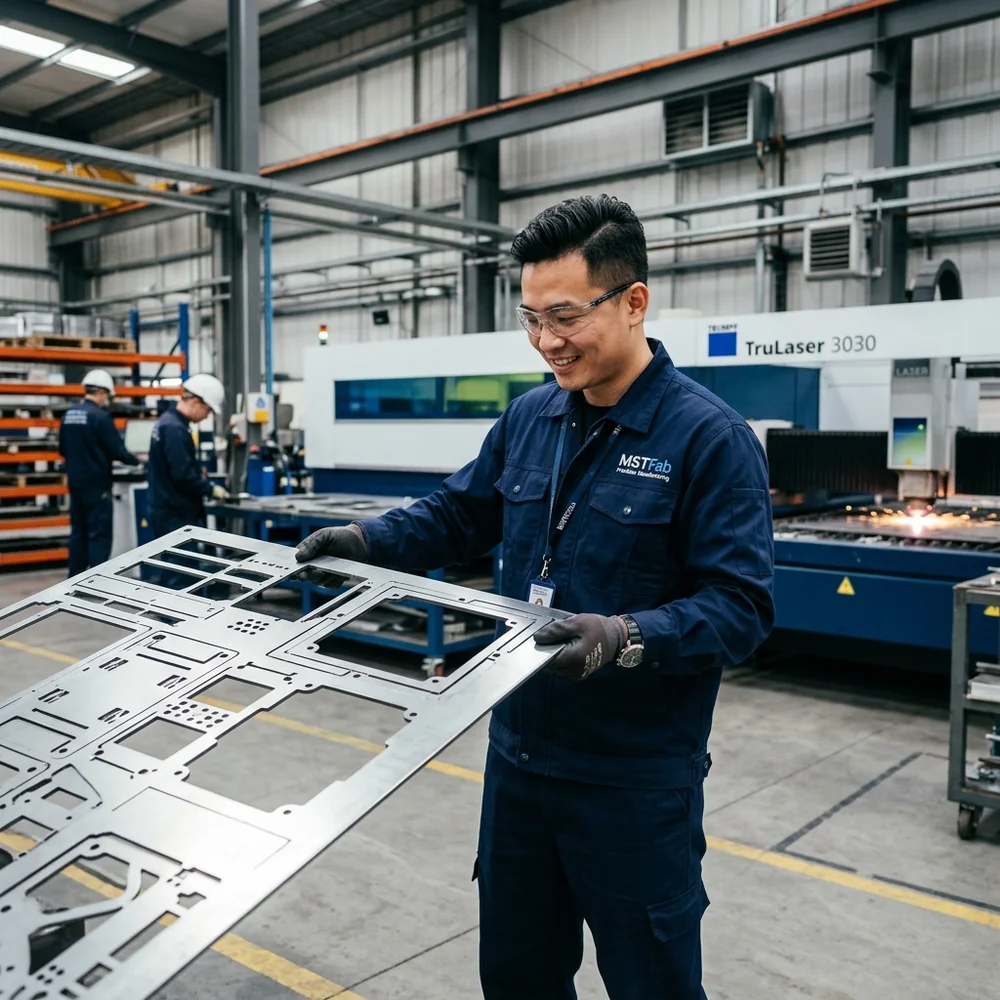
Successful sheet steel laser cutting depends on matching the steel grade, surface condition and assist-gas regime to every downstream fabrication step. While high-power fiber laser cutting slices carbon steel, mild steel, galvanized sheet and stainless steel with ±0.10 mm repeatability, choosing oxygen versus high-pressure nitrogen assist gas directly governs cut-edge oxide scale, weld porosity and powder-coat edge adhesion. Reviewing flat-pattern bend deductions, minimum hole-to-thickness ratios and edge deburring requirements through laser cutting services from CAD drawings prevents costly fit-up and coating failures.
Explore this guide
01 / Material Metallurgy & Grade Selection
Matching Sheet Steel Grades to Laser Cutting and Downstream Forming
Not all sheet steel behaves identically under a fiber laser beam or in a press brake V-die. Selecting between cold-rolled mild steel (SPCC/DC01), hot-rolled pickled and oiled structural steel (SPHC/Q235B/A36), galvanized steel (SGCC/DX51D) and austenitic stainless steel (304/316L) determines both the laser parameter window and the part’s structural performance.
Cold-rolled steel up to 3.0 mm offers superior thickness uniformity and a smooth surface ideal for cosmetic powder-coated enclosures. Hot-rolled pickled and oiled (HRPO) plate from 3.0 mm to 20 mm provides economical strength for heavy brackets and agricultural machinery mounts without the heavy mill scale that destabilizes laser piercing.
Cold-Rolled & Mild Steel (SPCC / Q235)
Tight thickness tolerance, clean surface finish and predictable bend deduction make cold-rolled steel the baseline choice for indoor cabinets, brackets and painted chassis.
Galvanized Steel (SGCC / SECC)
Pre-coated zinc layers deliver immediate corrosion protection for HVAC plenums, internal sub-panels and electrical backplates without post-fabrication wet painting.
Stainless Steel (304 / 316L)
Cut with high-pressure nitrogen to maintain bright, oxide-free edges for washdown food equipment, outdoor kiosks, chemical guards and marine brackets.
Material sourcing check: For hot-rolled steel above 4 mm that will be CNC bent or powder coated, specifying HRPO (Pickled & Oiled) prevents loose mill scale from flaking off in press brake dies or under paint.

02 / Thermal Kerf & Edge Control
How Assist Gas Selection Impacts Burr Control, Welding and Paint Adhesion
During laser cutting, the assist gas coaxial with the laser beam ejects molten metal from the kerf. Choosing between oxygen (O₂), nitrogen (N₂) and high-pressure shop air fundamentally changes the metallurgy of the cut edge.
- Oxygen Cutting on Thick Carbon Steel: Exothermic reaction assists cutting speed on 6 mm to 25 mm carbon steel, but leaves a dark iron-oxide (FeO/Fe₃O₄) crust on the cut face that must be ground or blasted before painting or welding.
- High-Pressure Nitrogen Cutting: Inert nitrogen physically blows molten steel out of the kerf without oxidation, producing bright, weld-ready and paint-ready edges on stainless, galvanized and thin-to-medium mild steel.
- Pierce & Lead-In Strategy: Placing pierce points inside scrap cutouts and routing lead-ins away from tight bearing bores or mating tabs prevents blow-out craters on functional surfaces.
- Mechanical Deburring & Edge Rounding: Wide-belt brushing and rotary edge-rounding machines remove micro-burrs and break sharp 90° laser edges so powder coatings wrap uniformly around corners.
Parts shipped with sharp, oxidized laser edges frequently fail salt-spray testing along the perimeter first because liquid and powder coatings pull back from sharp corners (edge pull-back) and delaminate from loose oxide scale.

03 / From Flat Blank to Finished Subassembly
Coordinating Sheet Steel Laser Cutting with CNC Bending and Welding
Ordering flat laser-cut steel blanks from one vendor and sending them to another shop for forming and welding often results in misfitting parts. When bend deductions in the CAD flat pattern do not match the actual V-die tooling on the press brake, every flange and mounting hole shifts.
- Integrated CNC bending uses tooling-verified K-factors so flat laser blanks fold to exact outside/inside envelope dimensions on the first try.
- Grain direction is controlled during laser nesting so structural bends on higher-carbon or thicker steel plates run perpendicular to the rolling grain, preventing outer-radius micro-cracking.
- Countersinking, thread tapping, reaming and PEM fastener clinching are executed immediately after cutting and deburring while hole datums are flat and accessible.
- Precision tab-and-slot laser features allow multi-part steel weldments to self-locate on modular welding tables, cutting fixture costs and controlling heat distortion.
Running laser cutting, press brake forming, hardware insertion and MIG/TIG/laser welding under one roof ensures that flat-pattern revisions happen in minutes on the shop floor rather than across multiple purchase orders.
See how our build-to-print laser cutting services work from CAD drawings →

04 / Corrosion Protection & Surface Treatment
Surface Finishing Options and Pre-Treatment Checks for Sheet Steel Parts
Carbon and mild steel oxidize rapidly when exposed to ambient shop humidity, while stainless and galvanized steels require specialized cleaning and passivation or priming when coated.
- Thermoset Powder Coating: Preceded by alkaline degreasing, de-rusting and iron or zinc phosphate conversion coating to achieve strong cross-hatch adhesion and uniform 60–100 μm film build.
- Electro-Galvanizing (Zinc Plating): Blue-white, yellow or black trivalent chromate zinc plating (8–15 μm) protects precision brackets, linkages and threaded steel hardware where thick paint would jam assembly tolerances.
- Hot-Dip Galvanizing & E-Coating: Selected for heavy structural outdoor brackets and automotive-style underbody or agricultural machinery components requiring complete interior/exterior coverage.
- Stainless Brushing, Bead Blasting & Passivation: Restores uniform surface appearance on 304/316L parts and removes free iron contamination after laser cutting and welding.
Every coated steel batch undergoes visual finish inspection, dry film thickness measurement and masking verification on threads and grounding pads before packing.
05 / Process & Quality Decision Matrix
Sheet Steel Laser Cutting Engineering Matrix
Reference this decision matrix when preparing engineering drawings and evaluating supplier capabilities for laser-cut and formed sheet steel parts.
06 / CAD Verification & DFM Review
What Our Engineers Check Before Releasing Sheet Steel Files to the Laser
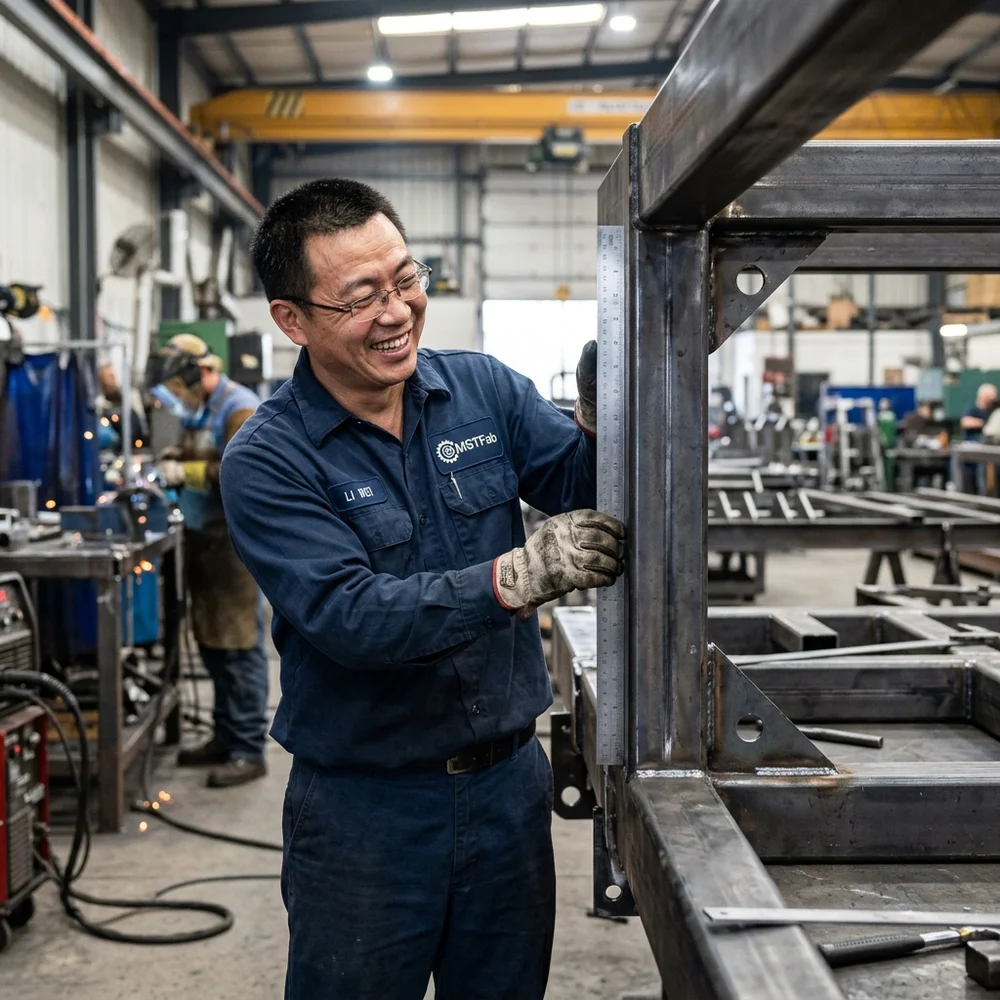
Submitting a clean DXF or STEP file is only the starting point. Before nesting any sheet steel job, our manufacturing engineers audit the CAD geometry against real-world thermal cutting and forming rules.
We check for duplicate overlapping spline vectors, unclosed contours, text callouts accidentally left on the cutting layer, and non-0.9999999999999999 scale views. When a part includes bends, we never rely solely on an unverified customer flat pattern; instead, we unfold the 3D STEP model using our press brake tooling table and cross-check every critical flange dimension against the 2D PDF drawing.
If we spot narrow bridges smaller than material thickness, holes encroaching on bend tangents, or tight slot tolerances that need kerf offset adjustments, we issue a clear DFM report with annotated screenshots before cutting steel.
Learn more about our custom laser cutting services and capabilities →
07 / Rust-Free Transit & Manufacturing Scope
Preventing Transit Corrosion and Edge Damage on Sheet Steel Orders
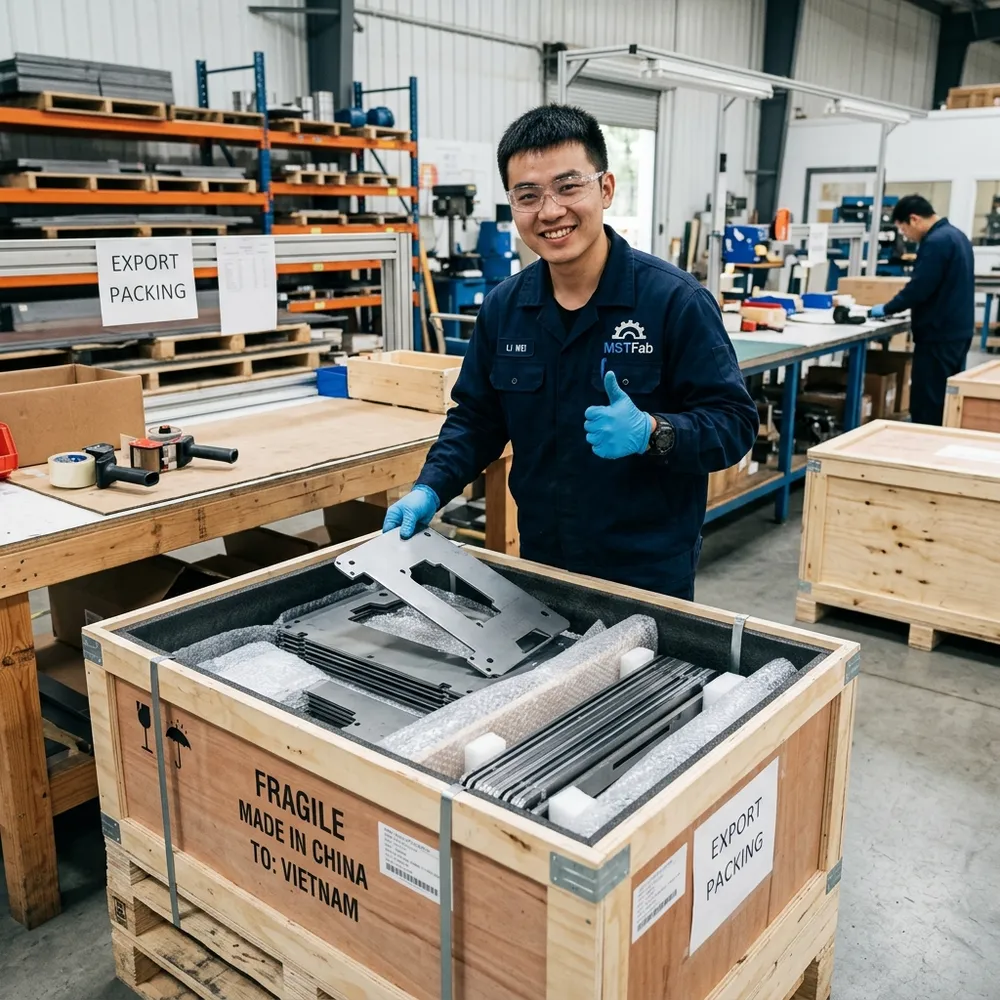
Sheet steel components are dense and susceptible to both mechanical edge denting and condensation rust (“white rust” on galvanized or red rust on bare mild steel) inside sea-freight containers. Engineered Export packaging safeguards part quality from factory floor to your receiving dock.
Heavy flat blanks are strapped flat on reinforced fumigation-free pallets with edge boards and VCI film wraps, while formed and powder-coated sheet steel assemblies are separated with custom foam dividers inside enclosed plywood crates.
Manufacturing scope: MSTFAB manufactures custom build-to-print sheet steel blanks, formed brackets, welded frames and enclosure shells under ISO 9001 quality controls. Final electrical assembly, powered machinery testing and end-product certification remain with the OEM.
08 / Pre-Quote Engineering Checklist
What Buyers Should Include When Quoting Sheet Steel Laser Cutting
- CAD File Package (DXF/DWG + STEP + PDF):Send 1:1 clean DXF files for flat blanks, or 3D STEP + 2D PDF drawings for bent, tapped or welded steel parts.
- Steel Standard & Grade Equivalent:Specify exact material standard (e.g., SPCC, Q235B/A36, HRPO, SGCC, SUS304/316L) and nominal sheet thickness in millimeters.
- Assist Gas & Edge Condition:Note if oxide-free nitrogen cutting, mechanical edge rounding, or slag/burr removal is required for downstream welding or painting.
- Secondary Machining & Forming:Indicate all CNC bends, countersinks, tapped threads, reamed dowel holes and self-clinching fasteners.
- Surface Treatment & Corrosion Spec:Call out bare oiled, zinc plating color/thickness, powder coat RAL code/texture, or stainless brushing/passivation.
- Grain Direction & Cosmetic Faces:Identify brushed grain orientation or critical structural bend axes that must cross the coil rolling direction.
- Dimensional Inspection & Certs:Request mill test reports (MTR 3.1), first article dimensional logs or coating thickness reports as needed.
- Order Quantities & Delivery Terms:Provide prototype sample count, batch production volume, target lead time and preferred Incoterms (EXW, FOB, DDP).
Sharing complete material, edge-quality and secondary fabrication details allows our engineering team to quote the right laser gas regime and downstream routing on the first revision.
Frequently Asked Questions About Sheet Steel Laser Cutting
What is the maximum thickness of sheet and plate steel you can laser cut?
Our high-power fiber laser systems cut cold-rolled and mild/carbon steel from 0.5 mm up to 25 mm, stainless steel from 0.5 mm up to 20 mm, and galvanized steel sheet from 0.5 mm up to 4.0 mm with consistent edge perpendicularity.
Why does powder coating sometimes peel off the edges of laser-cut carbon steel?
When carbon steel is laser cut using oxygen assist gas, a brittle iron-oxide scale forms along the cut face. Because that oxide layer is weakly bonded to the base steel, powder coating applied directly over it will flake off under impact or thermal cycling. Switching to nitrogen cutting or mechanically descaling/edge-rounding the cut face solves the issue.
Can you laser cut holes smaller than the steel sheet thickness?
As a general DFM rule for fiber laser cutting, hole diameters should be at least 1.0× material thickness (down to 0.8× with pulsed piercing on thinner sheets). Smaller holes accumulate pierce spatter and taper; for smaller or H7-tolerance holes, we laser-etch a pilot mark or pre-cut undersize and drill/ream on a CNC machine.
Do you supply flat laser-cut steel blanks only, or complete fabricated parts?
We supply both. While we produce high-volume flat laser-cut steel profiles, most OEM buyers rely on MSTFAB for complete fabrication—including deburring, CNC press brake bending, hardware insertion, MIG/TIG/laser welding, powder coating/plating and export-ready assembly.
How do you prevent bare mild steel parts from rusting during ocean freight?
For parts ordered in bare steel (such as weld-ready blanks or parts to be painted at your facility), we apply a light, easily removable rust-preventative oil, seal the parts in VCI (Vapor Corrosion Inhibitor) poly bags with desiccant packs, and pack them in moisture-barrier lined plywood crates.
Is a DXF file enough for a bent sheet steel bracket quote?
A flat DXF alone does not show bend angles, bend directions, inside radii, thread callouts or critical tolerances. For any formed or machined steel part, please send a 3D STEP file plus a 2D PDF drawing so we can calculate the exact bend deduction for our press brake tooling.
Technical references
Thermal cutting edge quality, cold-rolled/hot-rolled steel tolerances and corrosion protection practices reference the following industry standards:
- ISO 9013 — Thermal cutting: Classification of thermal cuts, geometrical product specification and quality tolerances
- ISO 2768-1 — General tolerances for linear and angular dimensions in fabricated metal components
- ASTM B117 — Standard Practice for Operating Salt Spray (Fog) Apparatus for Coated Steel Evaluation
Need a Reliable Sheet Steel Laser Cutting & Fabrication Partner?
Send your DXF, STEP and PDF drawings to MSTFAB for a fast engineering DFM review, assist-gas and finishing recommendation, and competitive OEM quotation.
Request a Sheet Steel Cutting Quote →
Have a question first? caroline@mstfab.com
 WeChat Contact
 WhatsApp Me Directly