
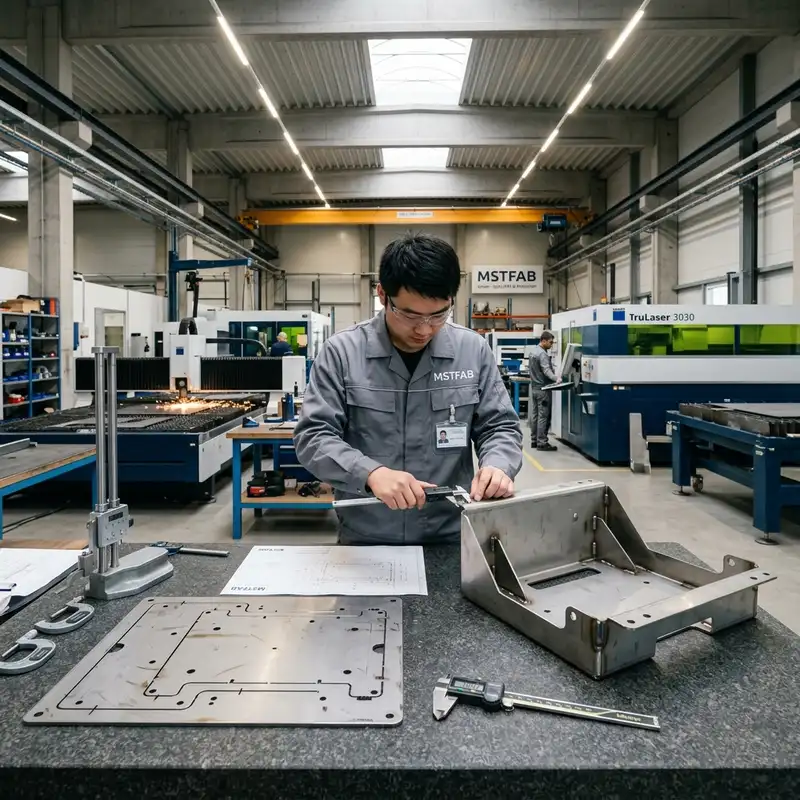
CNC Laser Cutting for OEM Metal Parts: Buyer Checks for Tolerance and Edge Quality
CNC laser cutting is where almost every custom metal part begins. It slices through flat steel and aluminum to create the raw geometry for your brackets, panels, equipment housings, and electrical cabinets.
But here is the painful truth for OEM procurement buyers: A flat laser-cut blank is completely useless to your assembly line.
A supplier might have the fastest, newest 20,000-watt fiber laser in the world, but if they bend the part with the wrong tooling radius, install the PEM nuts off-center, or paint over your critical grounding holes, that “perfect” laser-cut blank still ends up in the scrap bin.
That is why you should not just look for a factory with a laser. You need a custom metal parts manufacturer with CNC laser cutting capabilities who actually controls the entire downstream fabrication route.
The golden rule of CNC Laser Cutting Manufacturing Services:
The laser cut must be planned around the final formed dimensions, the hardware insertion, the coating thickness, and the final assembly fit.
Need production capability? This article focuses on cnc laser cutting for oem metal parts. For manufacturing scope, process capability and drawing-based quotation support, review MSTFAB’s laser cutting services.
The MSTFAB Continuous Fabrication Process
At MSTFAB, laser cutting is simply step one. We engineer the complete manufacturing route so that your flat blank actually transforms into a usable, repeatable component ready for your production line.
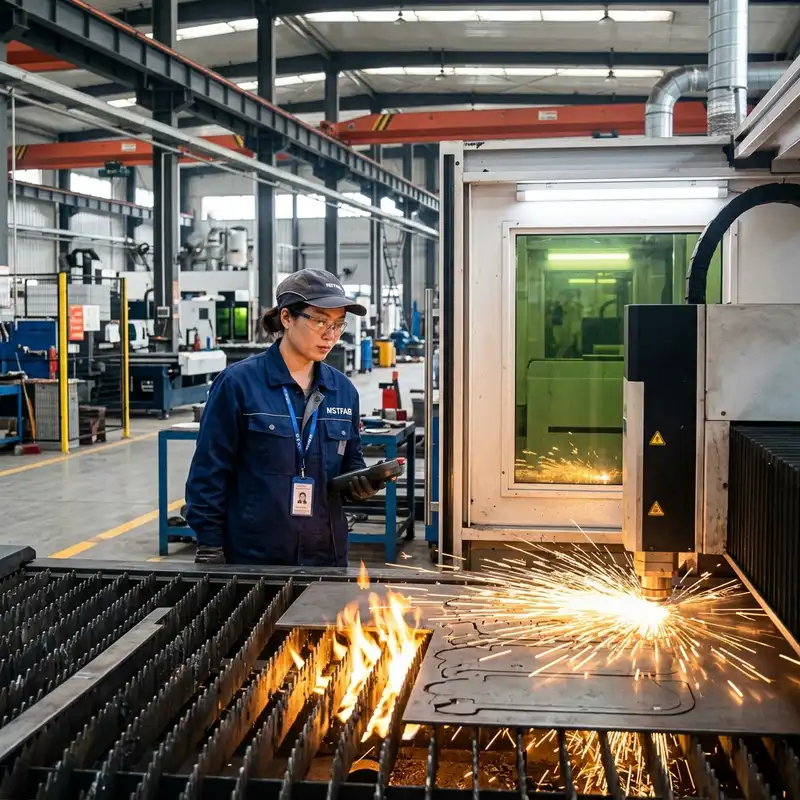
1. CNC Laser Cutting (The Flat Blank)
Using advanced fiber lasers, we cut outer profiles, ventilation slots, HMI cutouts, and precise mounting holes with minimal thermal distortion and zero edge burrs. This provides the clean foundation for the rest of the fabrication process.
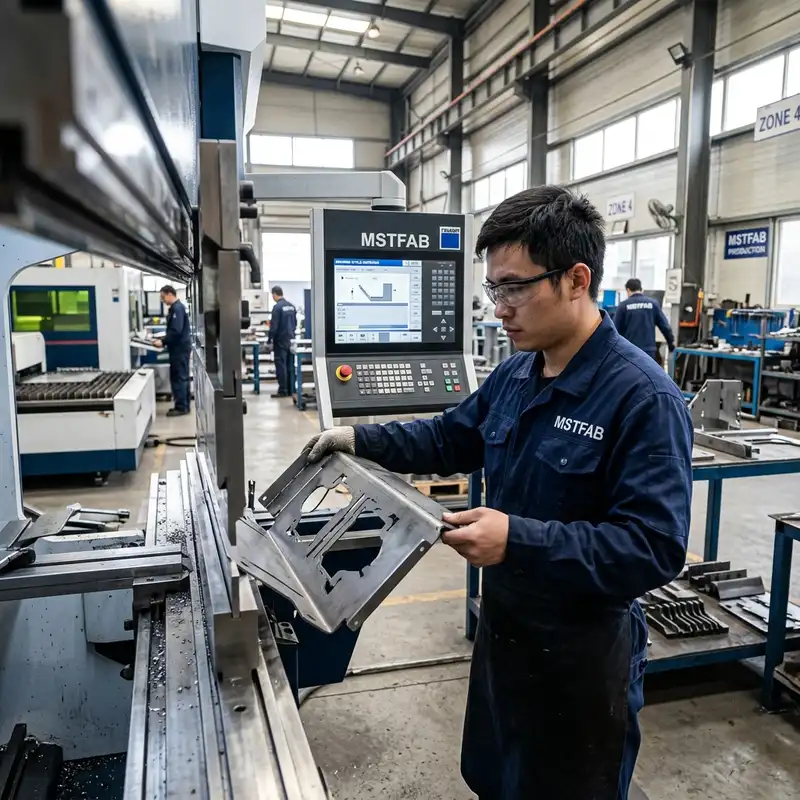
2. CNC Bending (Forming the Geometry)
A flat 2D file is easy; bending it into 3D is where tolerances fail. We calculate material springback and hole-to-bend clearances during DFM, ensuring that after the press brake forms the bracket or door, the final dimensions actually match your assembly needs.
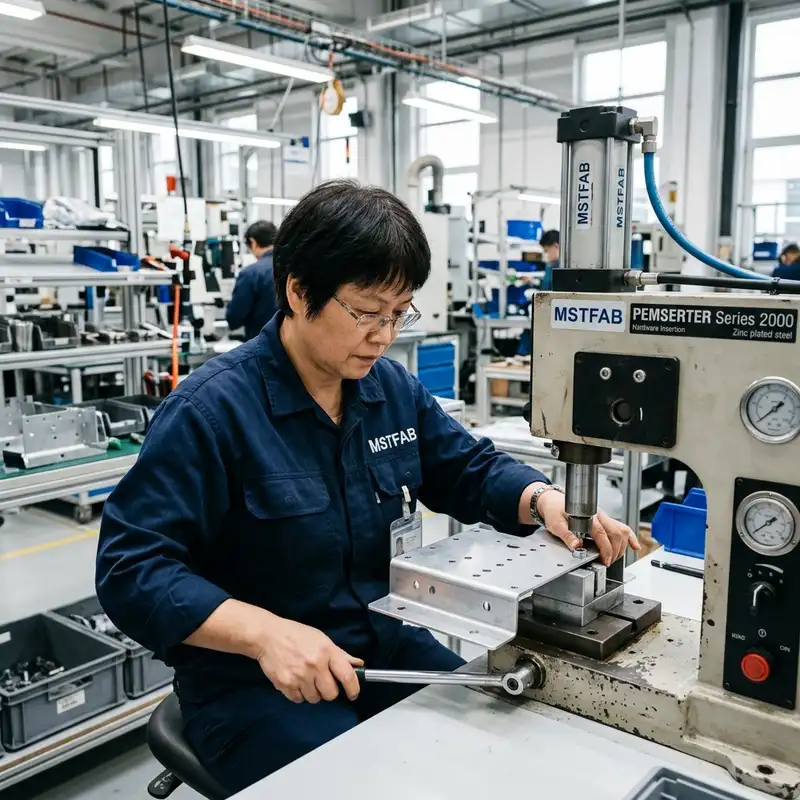
3. Welding & PEM Hardware Insertion
A laser-cut hole is designed for a specific fastener. We use hydraulic insertion presses to seat PEM nuts, standoffs, and studs perfectly straight. For enclosures, we use heavy-duty fixtures during welding to prevent the laser-cut panels from warping out of square.
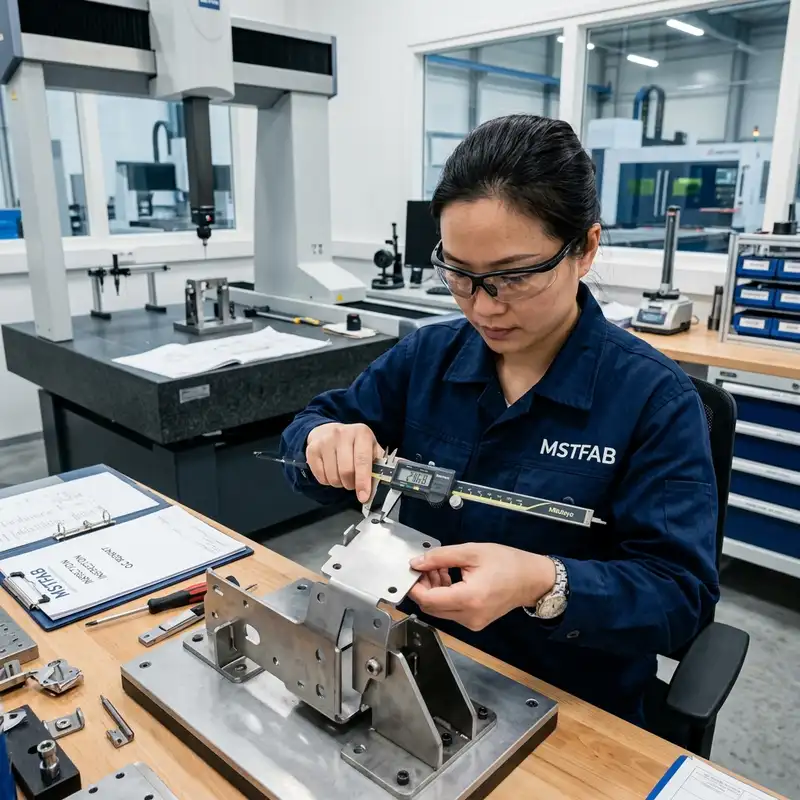
4. Surface Finish & Dimensional Inspection
After powder coating or anodizing, we do not just look at the color. We use digital calipers to verify critical post-bend dimensions and hole locations to guarantee the coating thickness has not ruined your tight assembly tolerances.
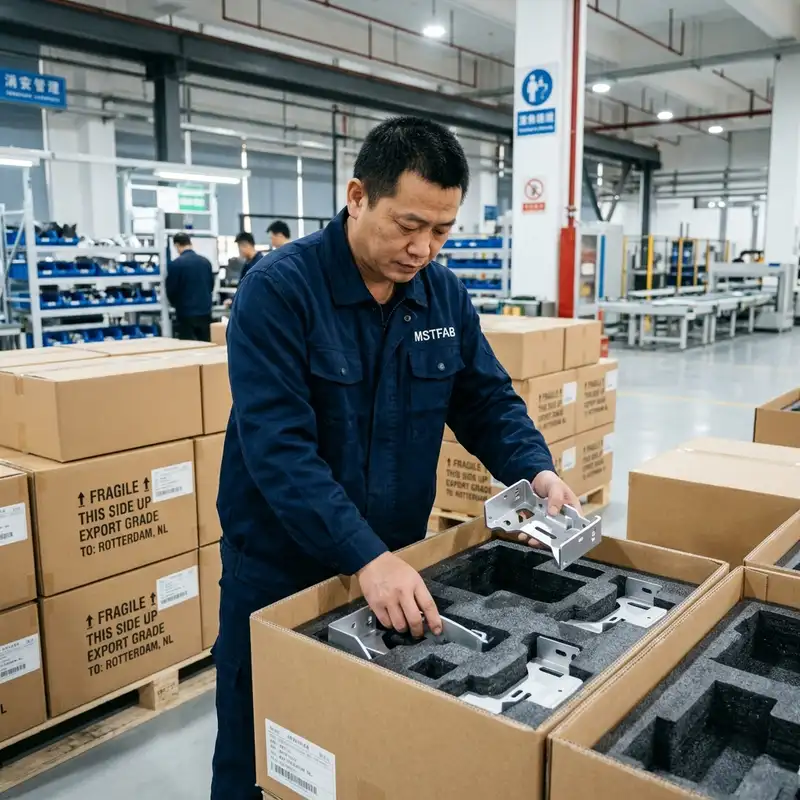
5. Export Packing (Securing the Finished Part)
The journey from a flat laser-cut sheet to a finished product ends in a box. We use foam separation, edge guards, and custom cartons to ensure your beautifully finished metal parts survive the rough sea freight journey to your assembly line.
Why DFM (Design for Manufacturing) Matters Before the Laser Fires
A DXF file only shows the flat profile. If we just blindly feed your DXF into the laser, you are guaranteed to have assembly problems later. Before we cut, our engineering team performs a strict DFM review:
- Hole-to-Bend Clearance: Is a laser-cut hole too close to the bend line? If so, it will stretch and deform into an oval during the press brake stage.
- Hardware Allowances: Are the laser-cut holes the exact correct diameter for the specific PEM standoff you requested before the powder coating goes on?
- Material Grain: For brushed stainless steel or aluminum, are we nesting the laser cuts so the material grain runs in the correct, uniform direction for your cosmetic panels?
How to Compare Custom Metal Parts Manufacturers With CNC Laser Cutting
Do not compare suppliers based solely on their “cutting rate per meter.” The cheapest laser cutting shop will almost certainly ruin your parts in the bending or finishing stage because they treat it as an afterthought.
| What to Compare | What OEM Buyers Should Confirm |
|---|---|
| Engineering Review | Do they check hole-to-bend clearances and springback before cutting the blank? |
| Process Integration | Do they handle the bending, hardware insertion, and welding in-house, or do they outsource it? |
| Inspection Focus | Do they inspect the final post-bend dimensions, or just measure the flat laser-cut profile? |
| Masking & Finish Control | Will they protect the laser-cut threaded holes from paint buildup? |
| Final Packaging | Do they pack the finished parts securely, or just dump them in a bulk box? |
Frequently Asked Questions
Why is a DXF file not enough for a finished metal part quote?
A DXF file only defines the flat 2D cutting geometry. To quote a finished part, we need a 3D STEP file and a PDF drawing to understand the bends, tolerances, PEM hardware, and surface finish requirements.
Can CNC laser-cut parts also be bent, welded, and finished?
Yes. We specialize in taking the flat CNC laser-cut blank through CNC bending, welding, hardware insertion, powder coating/anodizing, and final assembly.
Is CNC laser cutting suitable for low volume production?
Absolutely. CNC laser cutting requires zero dedicated stamping dies, making it highly cost-effective for OEM prototypes, product revisions, and low-to-mid volume repeat orders.
Request Custom CNC Laser Cut Metal Parts
A CNC laser cutting supplier should do far more than just produce a flat steel blank.
They must guarantee that the part can be bent accurately, welded squarely, finished flawlessly, and packed securely so it is instantly usable when it arrives at your factory.
Send your 3D STEP files, PDF drawings, flat DXFs, material requirements, hardware lists, and finish details through the MSTFAB quotation system.
Because the laser cut is only the beginning. It is the controlled process afterward that actually builds your product.
 WeChat Contact
 WhatsApp Me Directly