
Use this page for sealing failure prevention
This article focuses on why control station enclosure shells fail sealing or assembly, while the drawing checklist focuses on preparing the file. Different jobs, less keyword wrestling.
This page has been separated from the control station drawing checklist so Google and buyers can see the job of this article clearly. The useful question here is not “can someone make metal parts?” It is: what should a buyer check before sending drawings, approving a quote or moving into production?
- Review gasket compression and flange flatness.
- Check cutout location after bending and coating.
- Mask threads and grounding areas before powder coating.
- Inspect hinge, lock and door gap after assembly.
- Request photos of sealing areas before shipment.
| 1 | Review gasket compression and flange flatness. |
| 2 | Check cutout location after bending and coating. |
| 3 | Mask threads and grounding areas before powder coating. |
| 4 | Inspect hinge, lock and door gap after assembly. |
| 5 | Request photos of sealing areas before shipment. |
OEM FABRICATION SERVICES
A control station is the physical interface between humans and heavy machinery. If the HMI screen cutouts are jagged, the sloped console is bent at the wrong ergonomic angle, or the pendant box leaks oil, the entire machine fails. MSTFAB provides tier-1 OEMs with precision-fabricated, bare metal control enclosures designed for flawless integration.
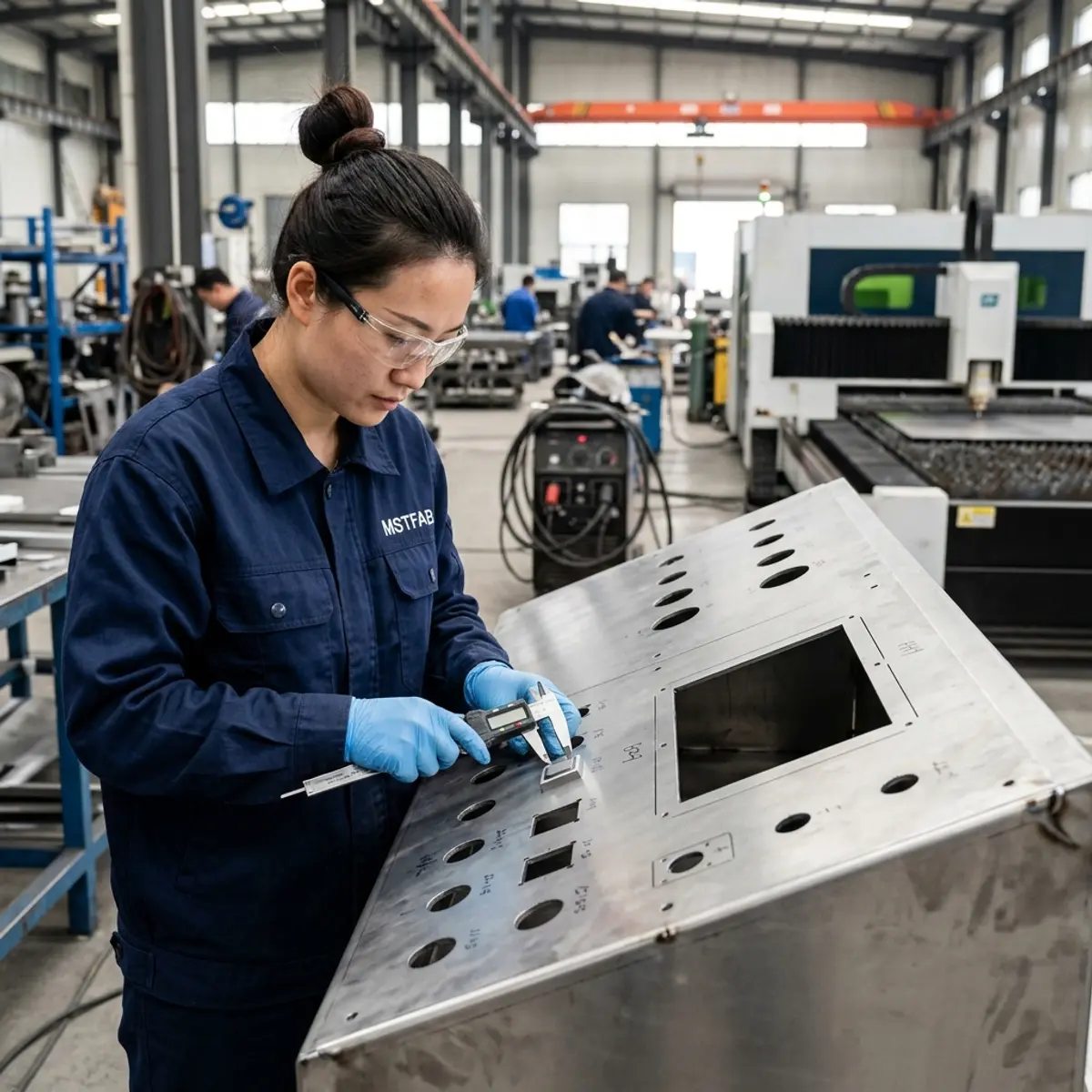
Engineered for Human-Machine Interfaces (HMI)
Control enclosures demand a much higher level of cosmetic and dimensional perfection than standard electrical cabinets because operators interact with them constantly. The sheet metal must be ergonomic, smooth, and precisely cut to mount sensitive instruments.
Touch screens require exact cutout dimensions (often ±0.2mm tolerance) to ensure the bezel gasket seals properly against the metal. A sloppy cutout means a loose screen and water ingress.
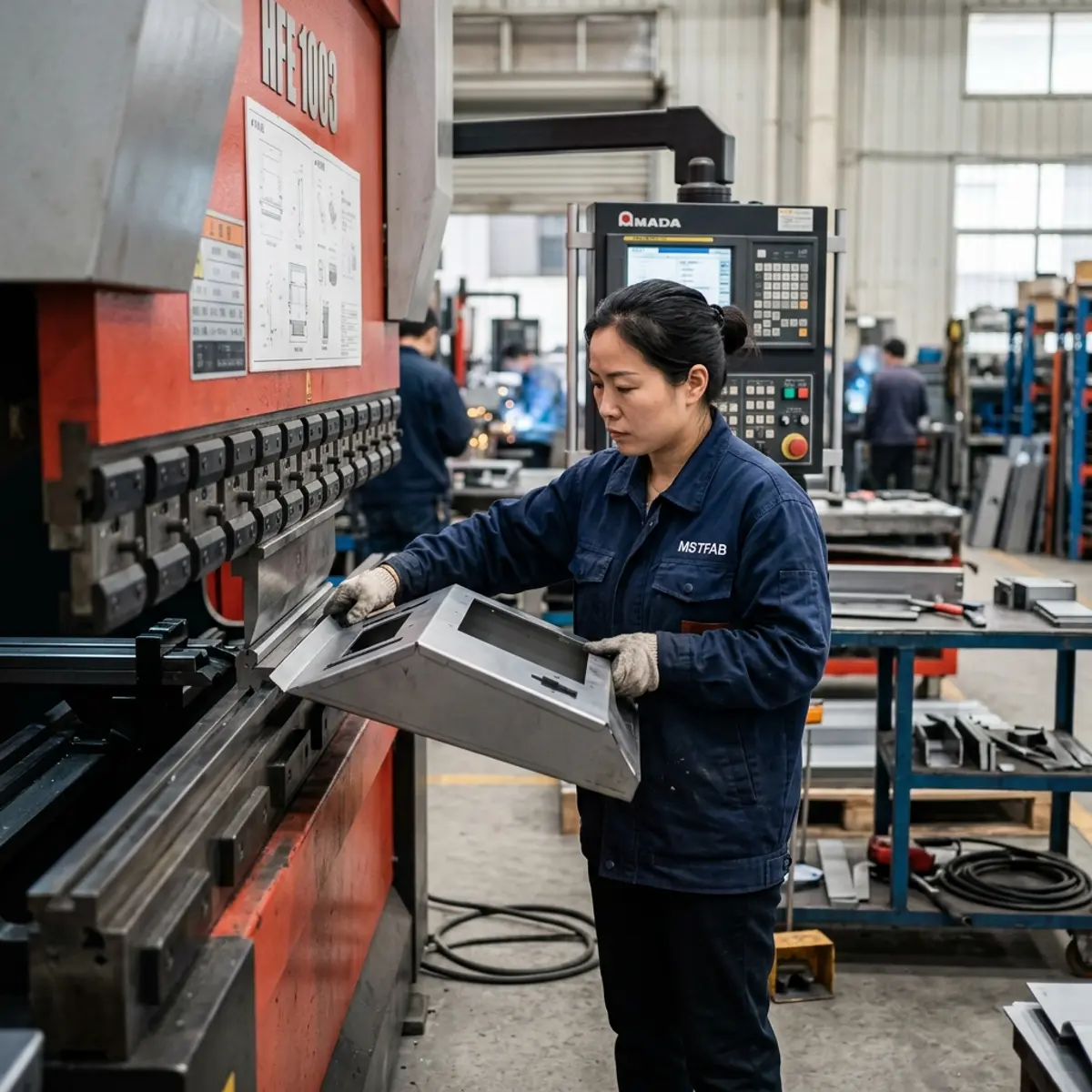
Control desks must be bent at exact angles (e.g., 15° or 30°) for operator comfort. This requires highly accurate multi-axis CNC press brakes to maintain the angle across a long span of metal.
For food/beverage or medical control stations, we fully TIG weld and polish the corners flush. This eliminates crevices where bacteria can grow and allows for high-pressure washdowns.
Freestanding control stations require thick, rigid pedestal bases (often 3mm – 5mm steel) that won’t vibrate or tip over when operators lean on the console.
How We Manufacture Control Station Shells
We eliminate the “retrofit penalty.” When your bare metal shells arrive, your assembly technicians will not have to file down jagged edges or force buttons into misaligned holes.
Critical Quality Control for Control Enclosures
A control station on a factory floor is subjected to oil, dust, and heavy physical use. Our QA process ensures the mechanical shell can survive the environment.
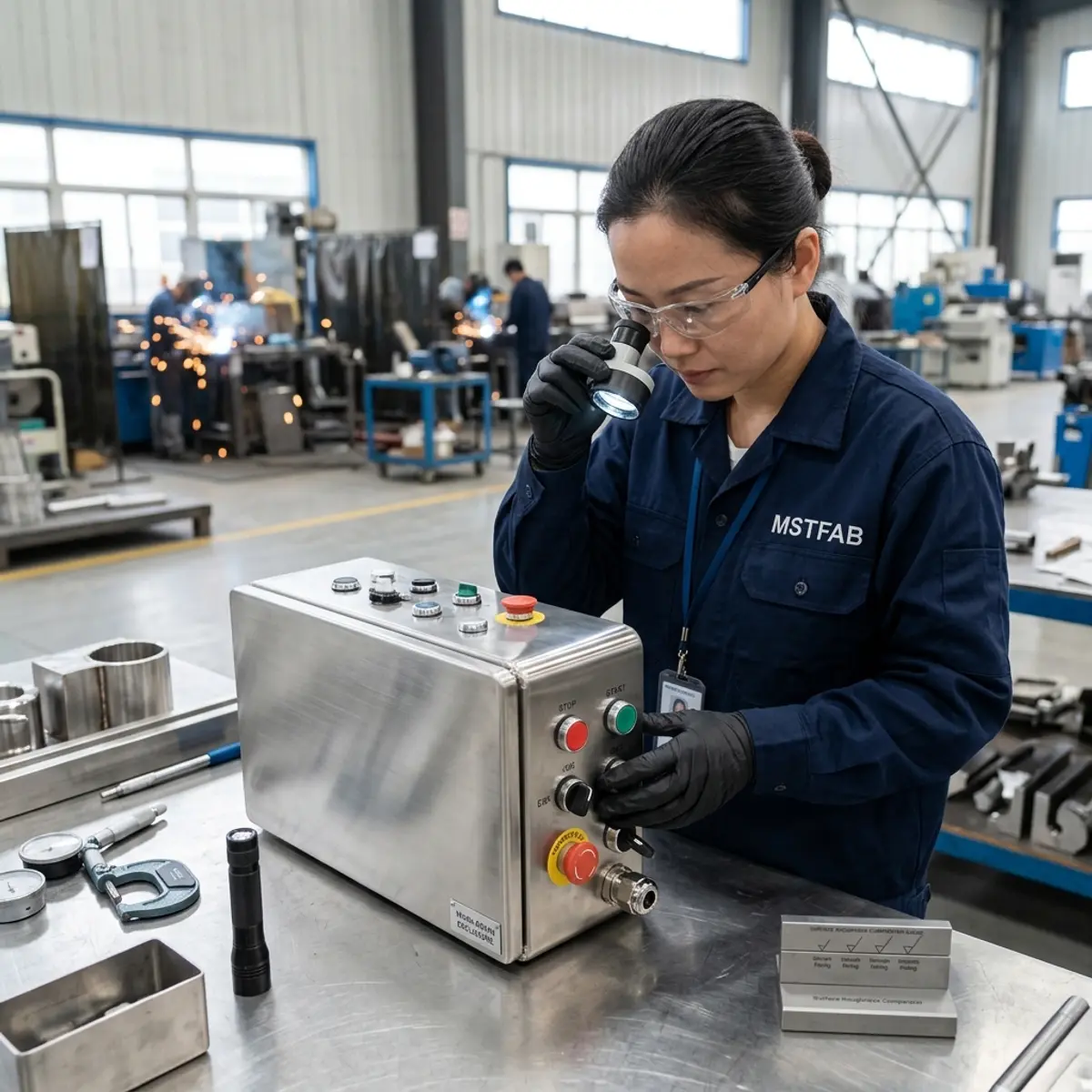
During the First Article Inspection (FAI), we use go/no-go gauges to verify that standard 22mm push buttons and standard HMI bezels fit perfectly into our laser-cut holes.
To achieve NEMA 4 or IP66 ratings, we inspect the continuous poured-in-place Polyurethane (PU) foam gasket around the rear access doors for any gaps.
Because operators look closely at control stations, we enforce strict cosmetic standards, rejecting panels with any powder coat orange-peel, dust inclusions, or uneven texture.
We meticulously mask all internal threaded grounding studs with silicone caps before painting, ensuring perfect electrical continuity for your PLC and button wiring.
Choosing the Right Material for the Environment
Control stations are deployed in vastly different environments. We fabricate shells using the exact alloy required by your industry.
| Material Grade | Typical HMI Application | OEM Procurement Note |
|---|---|---|
| Cold-Rolled Steel (SPCC) | Indoor factory automation desks, CNC machine control panels, and warehouse pendants. | The most cost-effective solution. Requires a high-quality textured powder coat for durability against operator wear. |
| Stainless Steel (304 / 316L) | Food processing control boxes, pharmaceutical cleanrooms, and outdoor marine controls. | We provide a brushed No. 4 finish and chemically passivate all TIG welds to prevent localized oxidation. |
| Aluminum (5052-H32) | Handheld remote pendants, mobile robot controllers, and aerospace interfaces. | Extremely lightweight. Often finished with an anodized coating or a specialized industrial powder coat. |
Frequently Asked Questions
Do you supply the push buttons or HMI screens?
No. We are a specialized sheet metal fabrication factory. We manufacture the precise metal consoles, pendant boxes, and pedestals. Your team procures and installs the active electrical components.
Why do you use laser cutting instead of punching for button holes?
While punching is fast, it can slightly warp the metal around the hole and leave micro-burrs. Fiber laser cutting produces a perfectly clean, undistorted edge, ensuring the rubber seal on your push button sits completely flat against the metal.
Can you create custom hinged access panels for wiring?
Yes. We routinely design and fabricate hidden hinged panels on the rear or bottom of the control desk, allowing your technicians easy access for wiring without disrupting the cosmetic front face.
Do you install the continuous foam gasket?
Yes. We use an automated CNC dispensing machine to apply a continuous Polyurethane (PU) foam gasket to the access doors, ensuring strict IP54 to IP66 sealing depending on your design.
Need Flawless Control Station Shells?
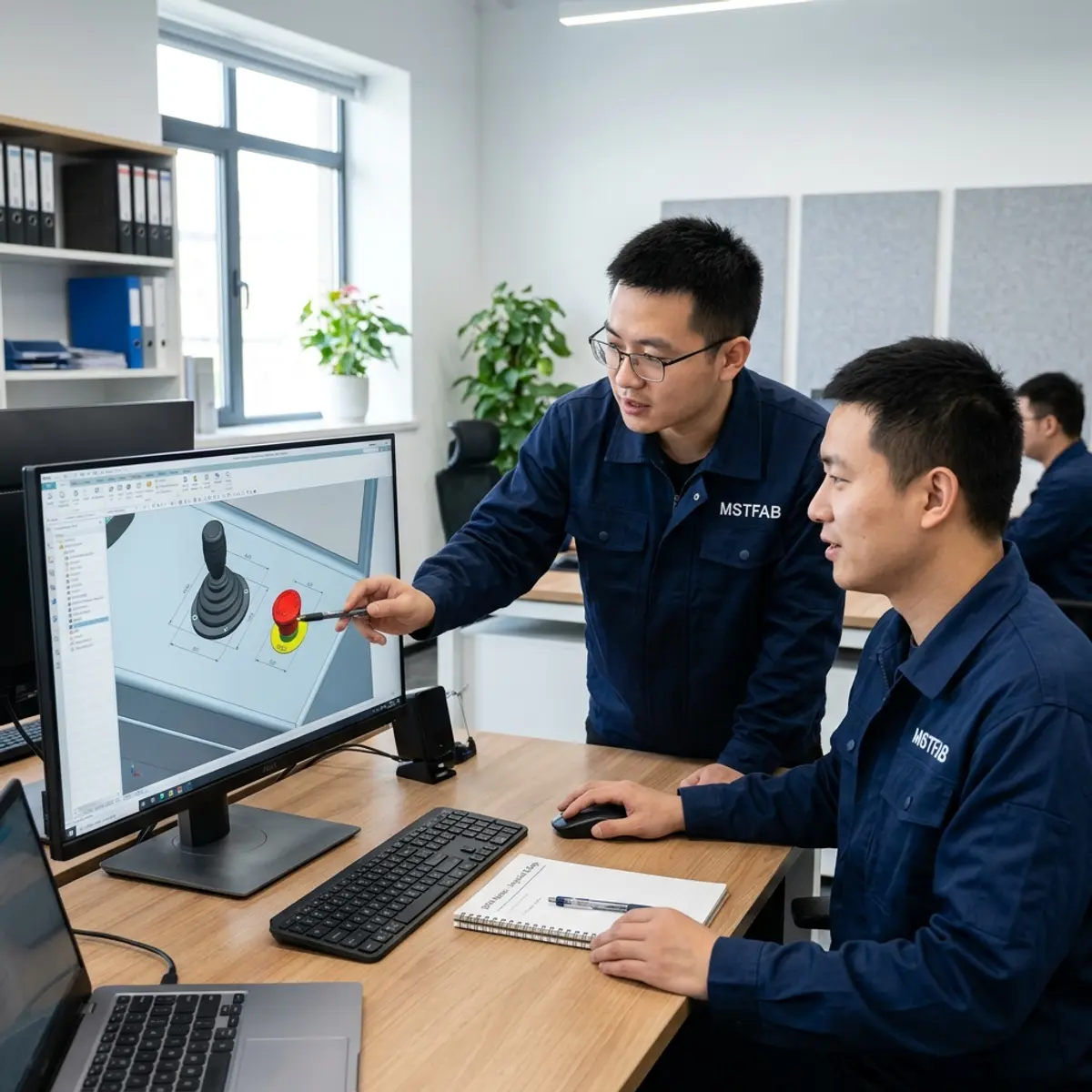
Stop forcing your assembly team to deal with misaligned cutouts and warped consoles. Send your 3D CAD models to MSTFAB. Our engineering team will review the DFM for your HMI layout and provide a factory-direct quote for precision-fabricated metal shells.
 WeChat Contact
 WhatsApp Me Directly