
Sheet Metal Enclosure Assembly Problems: Fit and Rework Checklist
When a sheet metal enclosure does not fit its mating parts, preserve the evidence before modifying it. Enlarging a hole, forcing a door or replacing an insert may hide the original condition without resolving the requirement that failed. OEM buyers need a clear comparison between the released design, the delivered shell and the actual mating component.
Quick answer: identify the affected part and revision, record the fit problem, confirm the measurement reference and delivered condition, then compare results with the agreed requirement. Have the responsible parties approve the disposition and affected re-inspection before releasing the parts. “It fits after adjustment” is not a complete acceptance record.
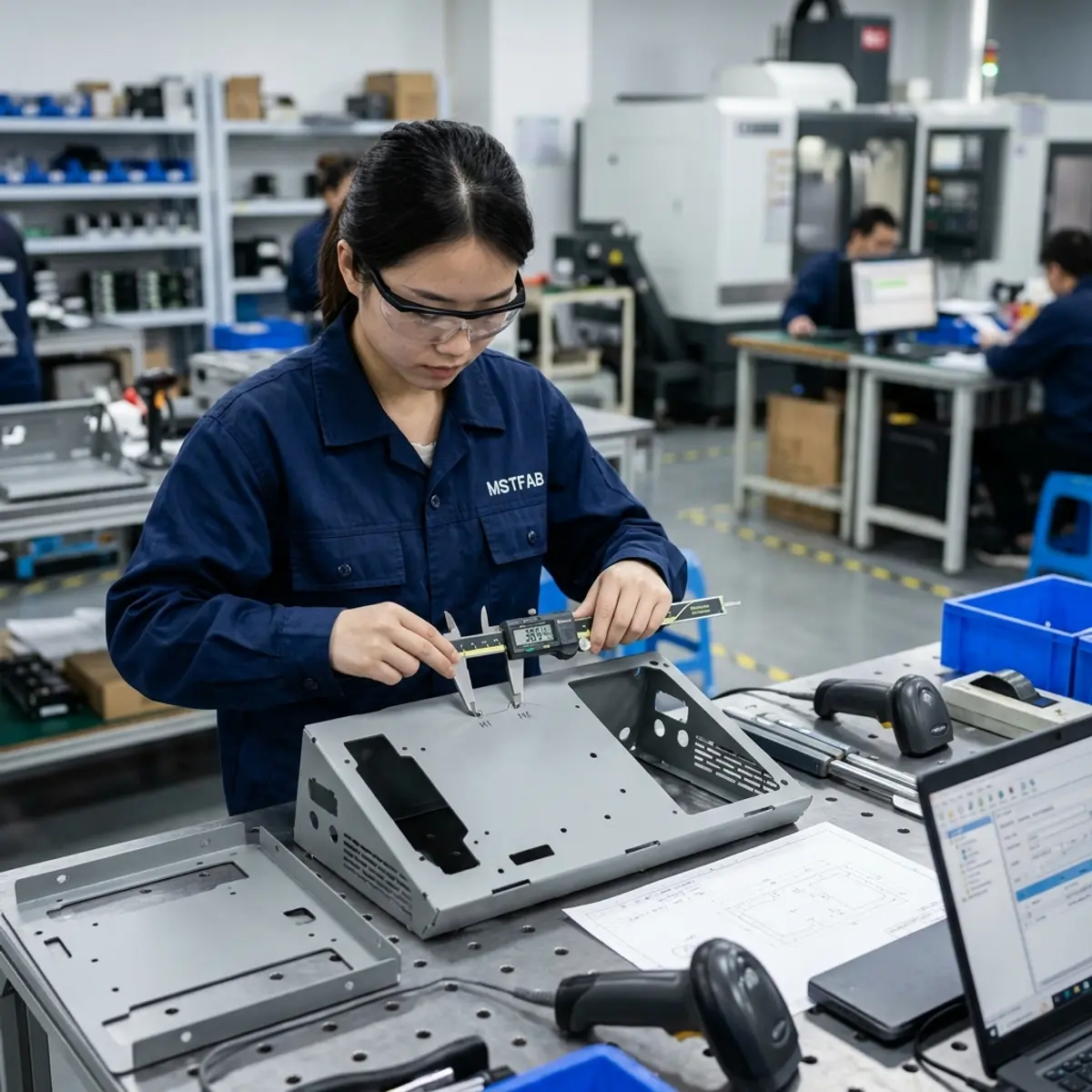
Identify the Failed Interface Before Assigning a Cause
Record exactly what does not fit: the mounting plate, a door, a hardware interface or a specified bought-in component. Identify its part number, revision and the stage at which the problem appears. Keep a dimensional failure separate from a cosmetic rejection or a missing component.
Check the released drawing and assembly references on both sides of the interface. A correct enclosure made to one revision may not match a component changed under another revision. Conversely, matching document labels do not prove the delivered geometry is correct. Verify the parts rather than choosing a cause from the symptom alone.
Enclosure Fit Troubleshooting Table
| Observed problem | Evidence to collect first | Decision before rework |
|---|---|---|
| Mounting holes do not line up | Both part revisions, specified references, measured hole locations and the defined assembled condition. | Determine which requirement is not met; do not assume that enlarging the enclosure hole is acceptable. |
| A plate does not seat on its supports | Support identities and heights, mating-part geometry, contact locations and relevant clearances. | Confirm the affected components and required interface before changing a support or the plate. |
| The door rubs or will not close as specified | Door/frame dimensions, hinge and latch configuration, support condition and any visible interference. | Review the mechanical cause and affected requirements; do not treat a forced closure as acceptance. |
| An installed insert turns or is loose | Actual fastener model, sheet specification, installation records and location of affected units. | Use the applicable fastener data and approved repair disposition; do not substitute a generic insert or welding operation without review. |
| Fit changes after finishing or shipment | Comparable before/after measurements, finish requirements, handling condition and any damage record. | Investigate the measured change and agreed delivery condition before changing the cutting file or removing finish. |
These are investigation prompts, not diagnoses. A similar symptom can have different causes, and more than one component may contribute to an assembly mismatch.
Make the Measurements Comparable
Agree the reference features, measurement method and part condition before comparing supplier and buyer results. State whether the enclosure is free-standing, supported as specified or held in a defined fixture. Record whether the measurement applies to a cut blank, a formed part, a welded assembly or the finished shell.
A single caliper reading or overall enclosure dimension may not answer a positional or multi-part fit question. Select a suitable inspection method for the feature with the responsible quality personnel. Do not prescribe a CMM for every part or interpret a photograph as a dimensional report.
Do not add every panel tolerance as if all variations act in the same direction along the same assembly relationship. The relevant dimensional chain and acceptance condition belong in the engineering review. For weld-related geometry, see the sheet metal welding distortion guide.
Investigate Fastener Problems Using the Actual Part Data
PennEngineering’s self-clinching technology overview explains the role of installation and the different material and sheet-thickness considerations. A press brand alone does not establish that a selected fastener has been correctly specified and installed.
For the affected insert or standoff, obtain its exact product reference and applicable installation information. Review the specified sheet, hole requirements and process records with the supplier. Define any retention or other verification required for the application using the appropriate part data; this guide does not set a universal installation force or test value.
Document the location and quantity affected. A replacement that appears secure is not automatically an approved disposition, particularly if the surrounding panel, finish or interface has also changed.
Approve the Disposition Before Changing the Shell
- Contain and identify: distinguish affected units and retain the original measurements and photographs.
- Compare with requirements: identify the failed feature, relevant specification and any unresolved interpretation.
- Review the proposed action: describe what would change and its effect on dimensions, hardware, finish and other applicable requirements.
- Authorize and verify: record the required approvals, checks after the action and the release decision for the identified units.
Use the agreed quality process to distinguish restoring compliance from accepting a documented deviation. If the original requirement cannot be met, obtain the appropriate disposition rather than silently changing the acceptance criterion. This guide addresses mechanical acceptance of empty shells, not modifications to installed or energized equipment.
For a separate appearance-only issue, use the cosmetic rework versus remake guide. A surface touch-up cannot establish that a dimensional fit problem has been resolved.
Example: a Finished Mounting Plate Does Not Fit
Illustrative example, not a customer case: an enclosure mounting plate cannot be assembled onto the delivered supports. Before modifying it, compare the plate and support revisions, measured locations and finished-part requirements. Record the contact or interference condition without forcing the parts together.
The responsible team then determines whether the problem is in the plate, supports, assembly definition or another requirement. Any approved corrective action includes the affected fit check and finish review. The fact that a screw can finally be installed does not, on its own, close the investigation.
Enclosure Assembly and Rework Questions
Should I enlarge a mounting hole when an enclosure does not fit?
Not without the required review and approval. First record the condition, compare both sides of the interface with the released requirements and evaluate the effect of the proposed change.
Does a loose self-clinching nut prove the wrong press was used?
No. Identify the actual fastener, sheet and installation requirements and inspect the affected condition. The symptom alone does not establish one process cause.
Does passing dimensional inspection prove the enclosure is waterproof?
No. Dimensional acceptance and an environmental-performance requirement are separate evidence questions. Define and verify the relevant assembled configuration and applicable test requirements.
Send the Failed Interface, Not Only a General Complaint
Send MSTFAB the enclosure and mating-part references, drawings and revisions, affected quantities, measurements, photographs and required acceptance condition. Identify any proposed change so the scope can be reviewed before manufacturing or rework is agreed.
Discuss an Enclosure Fit Review WeChat Contact
 WhatsApp Me Directly