
Tabs and slots are sheet metal’s version of flat-pack furniture: the parts tell you where they go. That is genuinely useful on the shop floor. It is also where the comparison ends, because unlike a bookshelf, your equipment frame still needs welds, clearances that survive real material tolerances, and a supplier who checks the finished assembly, not just the fit-up.
Quick answer: Custom tab-and-slot sheet metal assemblies use laser-cut tabs and matching slots to position components before welding, riveting or mechanical fastening. Done well, they simplify assembly, reduce manual alignment and help place multiple parts consistently. But tab-and-slot construction does not automatically eliminate welding fixtures, guarantee dimensional accuracy or provide structural strength. OEM buyers should specify material, thickness, tab geometry, slot clearance, joining method, critical mounting dimensions and final assembly requirements before ordering.
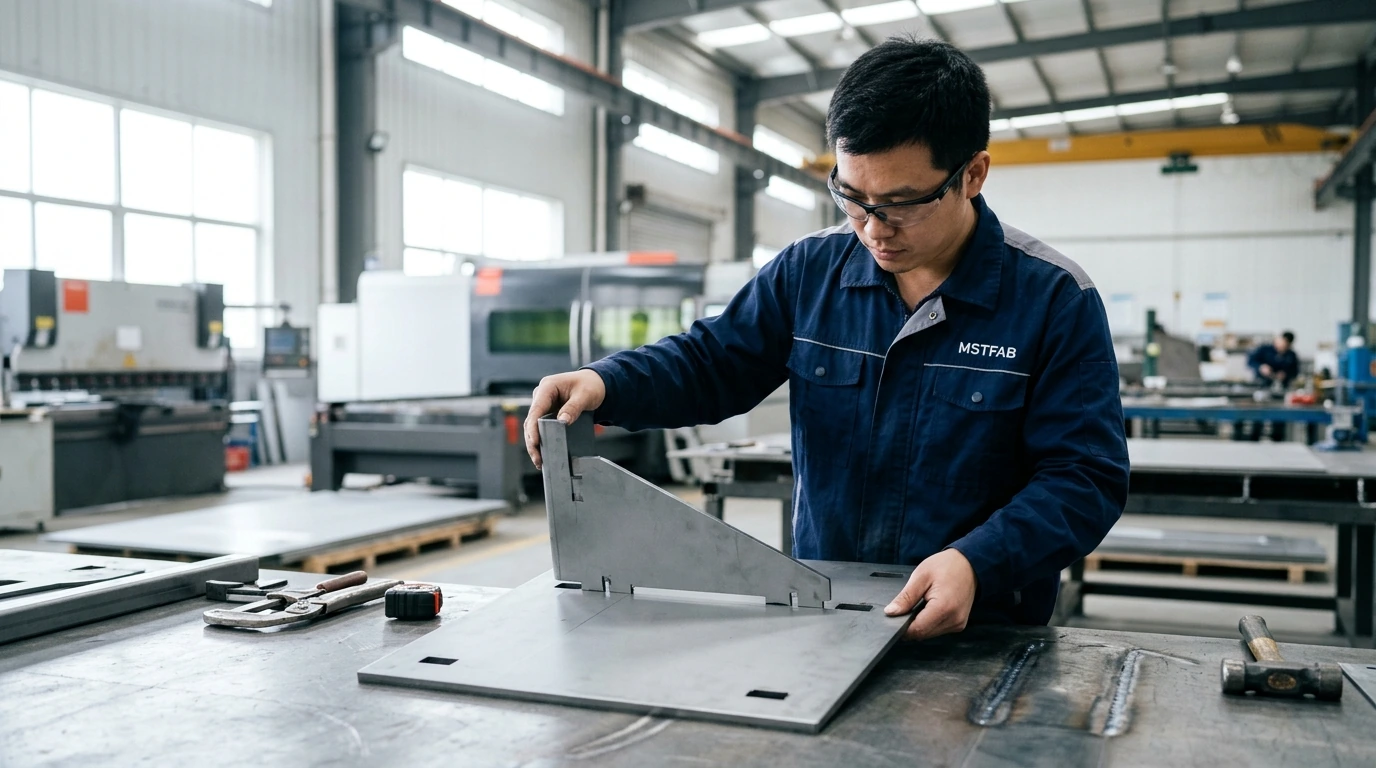
Picture an industrial enclosure base with several internal support brackets. Conventionally, someone measures, marks and clamps each bracket before welding. With an approved tab-and-slot design, the brackets carry locating tabs that engage slots in the base, so the starting position is built into the parts. This guide explains how to source custom tab-and-slot sheet metal parts, what to specify, and what to compare between quotations.
What Is Tab-and-Slot Sheet Metal Fabrication?
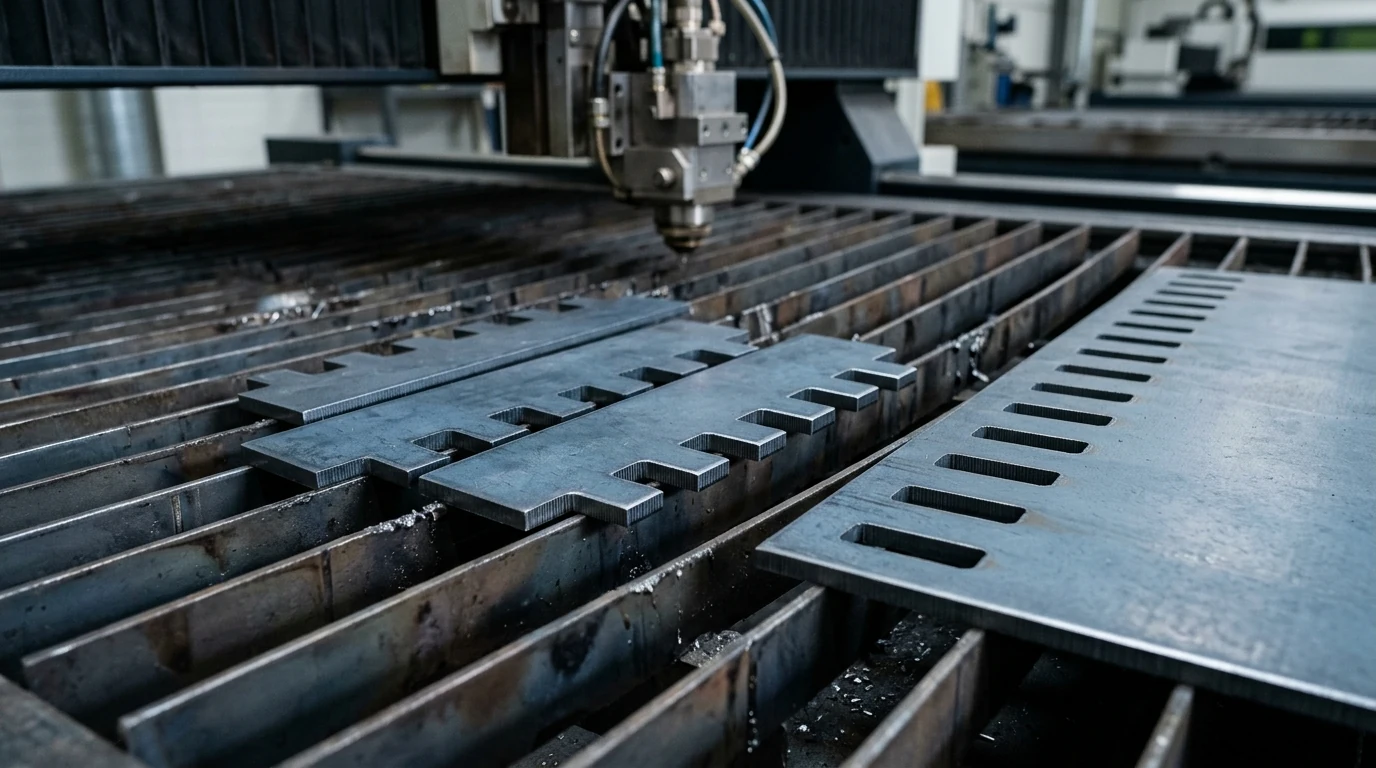
One component has projecting tabs; its mating component has matching slots. Insert the tabs into the slots and the parts are located relative to each other. Depending on the design, the assembly is then welded, riveted, bolted or joined by another approved method. The features are usually cut on a laser cutting machine before the parts go to CNC bending or further fabrication.
Typical OEM applications
- Industrial equipment enclosure frames
- Custom steel mounting structures
- Electrical cabinet internal supports
- Machine guards and protective covers
- Industrial electronics chassis
- Laboratory equipment housings
- Mechanical mounting brackets
- Welded equipment base assemblies
In all of them the goal is the same: make the relative location of the parts easier to establish during fabrication.
Tab-and-Slot vs. Conventional Fabrication
Both routes can produce good OEM structures. The difference is how parts are positioned before the final joint is made.
| Manufacturing Factor | Conventional Assembly | Tab-and-Slot Assembly |
|---|---|---|
| Initial positioning | Measurements, fixtures or alignment tools | Interlocking locating features |
| Laser cutting | Standard part profiles | Additional tabs and matching slots |
| Welding | Required where specified | Still required where specified |
| Assembly orientation | May depend on fixtures or markings | Can be guided by locating features |
| Fixture requirements | Project-dependent | May be simplified |
| Dimensional accuracy | Depends on process controls | Depends on locating geometry and process controls |
| Manufacturing cost | Based on the complete route | Based on the complete route |
| Design flexibility | Conventional joints and supports | Requires suitable tab-and-slot geometry |
Important: Tab-and-slot features are mainly for location and assembly assistance. Don’t assume they replace structural welds, approved fasteners or load-bearing connections. A tab sitting in a slot is a good start, not a joint. If you’re still deciding whether the product should be welded at all, see welded vs. bolt-together sheet metal enclosures.
Why OEM Manufacturers Use Tab-and-Slot Construction
1. Less manual alignment
When several parts have to be joined, measuring and marking each position takes time. An approved interlocking design gives a repeatable starting point. A steel equipment base with four internal brackets, for instance, may no longer need each bracket position marked by hand before welding. How much time that saves depends on part complexity, fit requirements and the manufacturing method.
2. Correct orientation, by design
Some parts look nearly identical but install in different directions. An asymmetric tab pattern can make a bracket fit only the right way round, which is useful in assemblies with many similar brackets and plates. (It’s the same mistake-proofing idea we discuss for left- and right-hand sheet metal parts.) Verify that the design really prevents wrong assembly; a determined operator and a rubber mallet can defeat a weak one.
3. Potentially simpler welding fixtures
Fixtures matter for location and distortion control. Tab-and-slot positioning can reduce how complex the initial-assembly fixture needs to be. But welding adds heat, and heat moves metal. Tabs alone can’t control every welding effect, especially on large or thin structures, so clamps, supports and dimensional checks may still be needed. Our article on welding fixture control covers this in more depth.
4. Consistent repeat production
Once an assembly design is validated, the same locating features are cut into every later batch, which helps production teams position parts the same way each time. The supplier still has to control material variation, cutting accuracy, forming geometry, welding conditions and final inspection. Tabs make consistency easier; they don’t make it automatic.
How Tab-and-Slot Assemblies Are Manufactured
- Review the engineering drawings.The manufacturer reviews the STEP/STP assembly model and dimensioned PDFs. The package should show which tabs and slots are for location and which other features control the finished assembly, plus the joining method and required finished dimensions.
- Laser cutting.Tabs and slots are cut with allowance for material thickness, feature size, edge condition and process capability. Narrow slots and small tabs may need extra manufacturability review. Cut features should be checked against the agreed requirements before forming or joining.
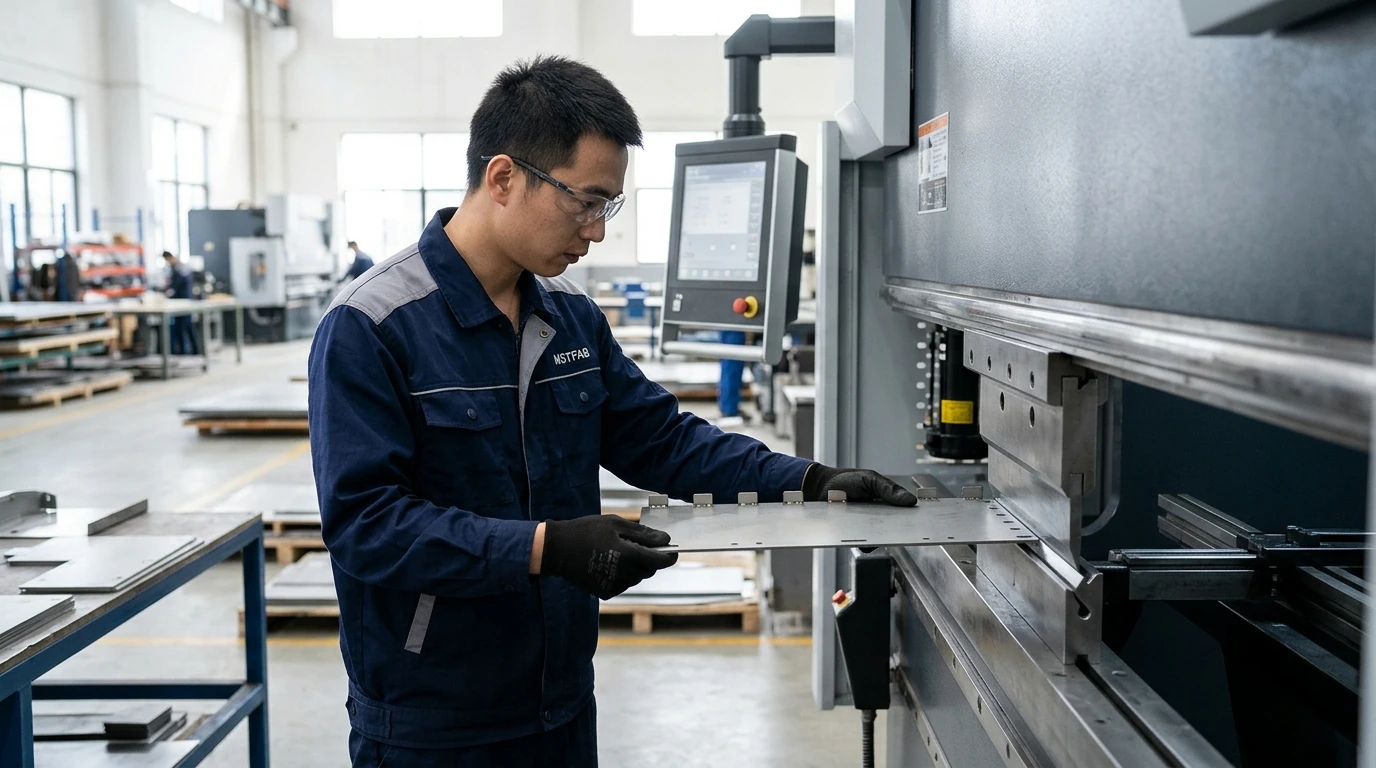
- CNC bending.Formed flanges are bent to the approved geometry. Bend sequence and tooling must account for where the tabs and slots sit; features too close to a bend may distort or clash with the tooling.
- Mechanical fit-up.Parts are assembled using the locating features. This is where excessive tightness, unwanted movement, incomplete insertion or interference show up. Parts should not need unapproved grinding or forcing to fit.
- Welding or mechanical fastening.The assembly is joined by the specified process: TIG, MIG, riveting or other methods, chosen by material, thickness, joint geometry and required performance.
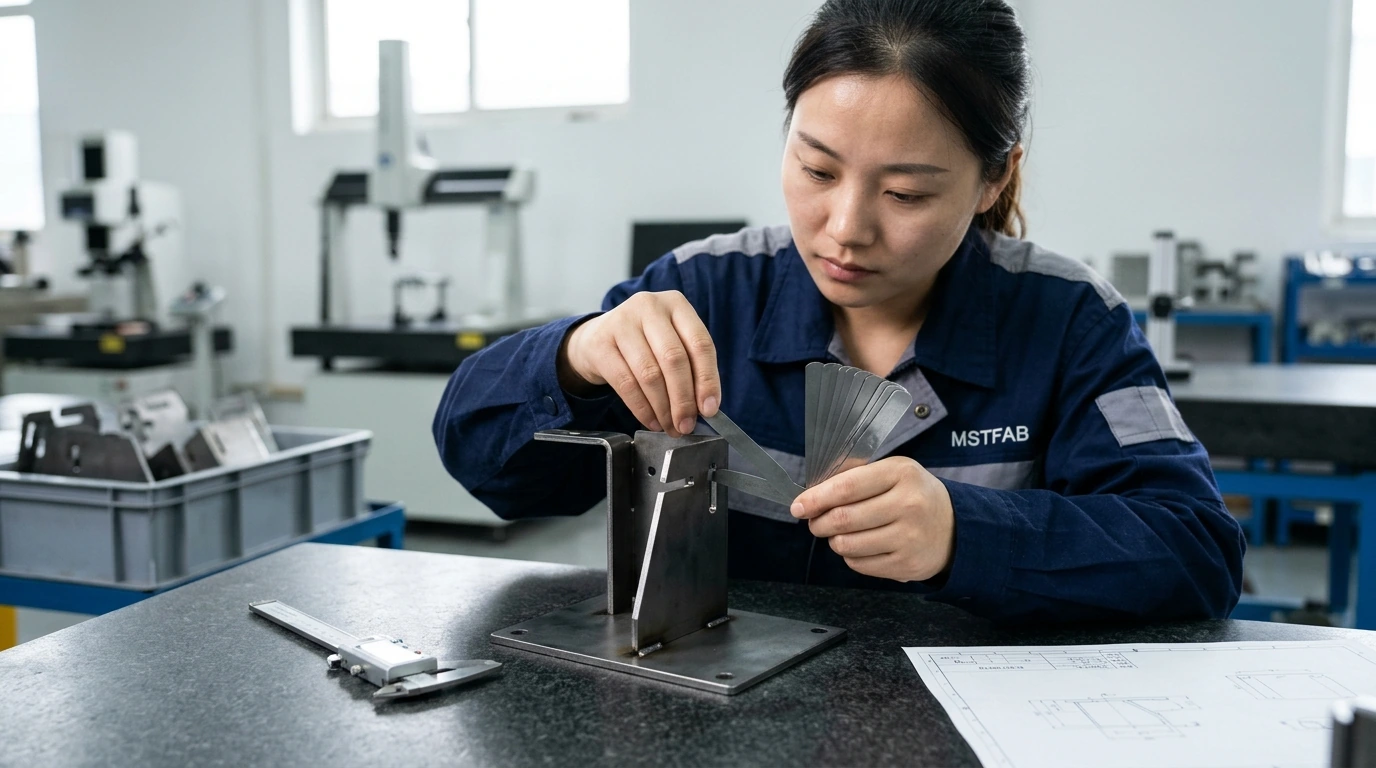
- Inspection and finishing.The finished structure is inspected to the drawing, then finished where specified. For OEM parts, the most important checks are usually mounting locations, assembly fit, overall geometry and functional interfaces.

How Should OEM Buyers Specify Tab-and-Slot Clearance?
Clearance between tab and slot is the make-or-break detail. Too tight and the parts won’t assemble without force. Too loose and the “locating” feature doesn’t locate anything. There is no universal clearance that works for every material and thickness. The design should account for:
- Material thickness and its variation
- Laser cutting capability and edge condition
- Burrs and other cut-edge features
- Bend variation
- Assembly direction
- Required fit type
- Welding or fastening sequence
- Surface coating, where relevant
It helps to name the intended fit explicitly, because each one implies a different clearance and a different inspection:
Example: a nominal 2.0 mm steel bracket
An OEM design has a 2.0 mm steel bracket with a tab that fits into a slot in a steel base plate. The tempting move is to draw the slot at exactly 2.0 mm. Don’t. Real sheet is rarely exactly nominal, cut edges aren’t perfectly square, and a slot that equals the nominal thickness will fight every part that comes in slightly thick. The supplier should review the proposed clearance against actual material tolerance, cut quality and the intended fit type, and confirm it with a test piece.
OEM purchasing recommendation: Define the intended fit and have the manufacturer confirm the tab-and-slot dimensions through a sample or controlled fit-up test before batch production.
Can Tab-and-Slot Features Be Used on Bent Parts?
Yes, when the geometry suits the bending process. But the final formed shape matters more than the flat laser profile. A tab on a bracket flange ends up wherever bend radius, bend angle, material behaviour and forming method put it. If that tab has to engage a slot on another formed part, both parts must be evaluated in their final assembled condition. Our bend radius and flange design checklist is a useful companion here.
| Design Feature | Possible Manufacturing Issue |
|---|---|
| Tab close to bend line | Deformation during bending |
| Slot near a formed edge | Distortion or insufficient support |
| Multiple locating tabs | Interference from accumulated variation |
| Deep interlocking geometry | Difficult insertion or tooling access |
| Small corner radii | Cutting and stress-concentration concerns |
| Closely spaced slots | Reduced local material strength |
| Coated mating features | Reduced clearance after finishing |
A good manufacturing review looks at the complete assembly, not just whether each flat pattern can be cut.
Do Tab-and-Slot Features Reduce Welding Costs?
They can cut positioning and setup work, but savings aren’t guaranteed. Less time aligning parts is real; so are the extra cut paths and the fit-up checks the features introduce. Evaluate the whole route.
| Cost Factor | What Buyers Should Evaluate |
|---|---|
| Material consumption | Whether tabs and slots affect nesting efficiency |
| Laser cutting | Additional cut paths and feature complexity |
| CNC bending | Whether features affect the forming process |
| Welding setup | Potential reduction in manual positioning |
| Welding time | Actual joint length and approved welding requirements |
| Fixtures | Whether fixture complexity can be reduced |
| Inspection | Fit-up checks and completed assembly verification |
| Rework | Risk of poor-fitting or wrongly positioned parts |
For a simple two-part assembly, the benefit may be small. For a complex assembly with many brackets and repeated joining, there’s more alignment work to save. Either way, be wary of anyone quoting a fixed percentage saving. The meaningful comparison is:
When Should Tab-and-Slot Construction Be Avoided?
- Highly stressed structural areas: slots remove material and can create stress concentrations. In heavily loaded regions, the responsible engineer should evaluate the design before approval.
- Tight sealing requirements: a slot through an enclosure wall is, technically, a hole. Sealed enclosures need appropriate seam geometry and joining. Tab-and-slot alone doesn’t make anything waterproof or dustproof.
- Extremely tight functional fits: ordinary laser-cut tabs may not locate critical interfaces accurately enough on their own. Machining, controlled fixtures or proper datums may be needed.
- Over-constrained multi-part designs: with too many tabs, parts may not engage in the intended sequence without force or deformation. If assembly needs a hammer, the design needs another look.
- Cosmetic surfaces: visible tabs, slots or weld areas may not be acceptable on customer-facing panels. Keep locating features off the faces people look at. Our enclosure design guidelines cover visible-surface planning.
What Should Go in a Tab-and-Slot BOM?
For multi-part OEM projects, list each component separately. A welded equipment support assembly, for example:
| Part Number | Description | Material | Thickness | Qty/Set |
|---|---|---|---|---|
| TS-001 | Main base plate with locating slots | SPCC steel | 2.0 mm | 1 |
| TS-002 | Left support panel with tabs | SPCC steel | 2.0 mm | 1 |
| TS-003 | Right support panel with tabs | SPCC steel | 2.0 mm | 1 |
| TS-004 | Internal reinforcement bracket | SPCC steel | 3.0 mm | 1 |
| Components per set | 4 | |||
Illustrative manufacturing example only.
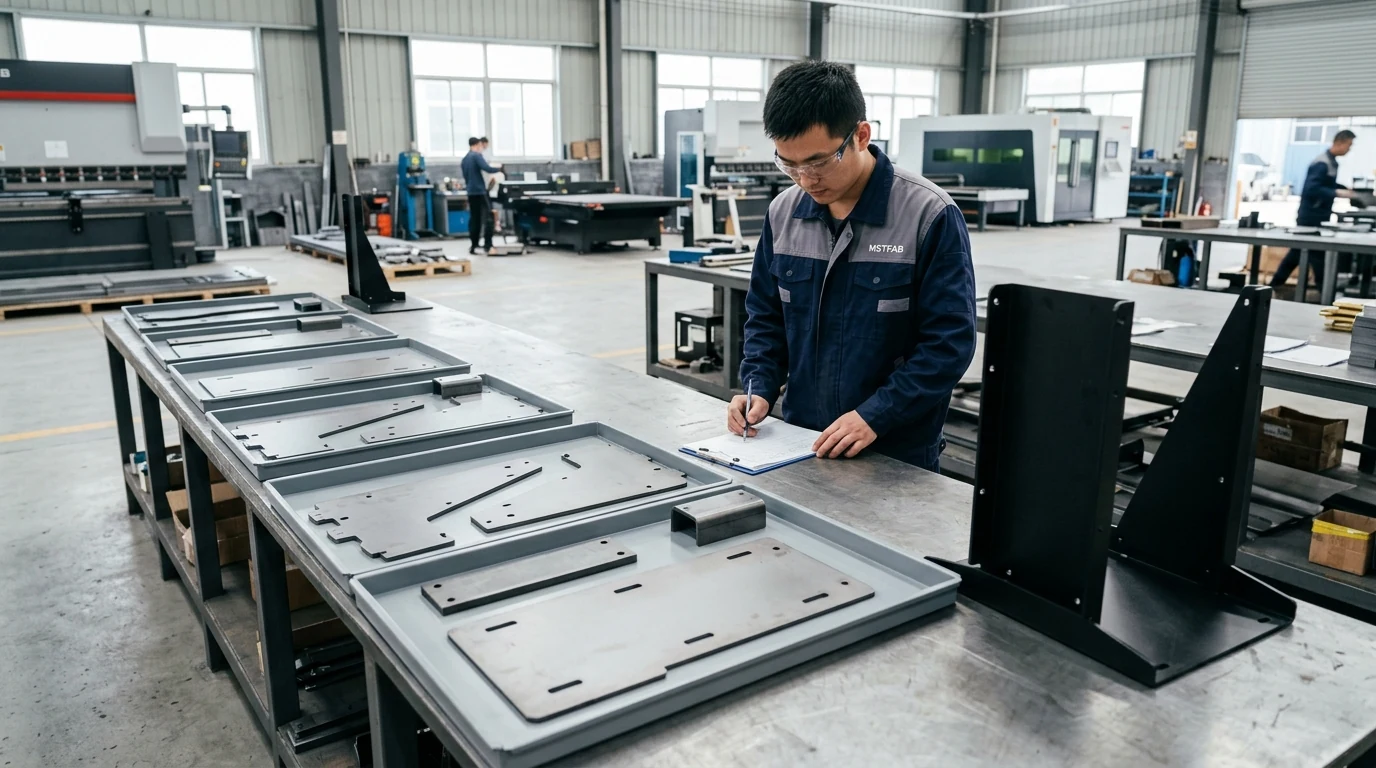
Order 100 complete sets and the project needs 400 individual components before spares or production allowance. The quotation must say clearly whether the supplier delivers loose components or complete welded assemblies. Two quotes that look far apart are often just quoting different things.
What Quality Checks Should Buyers Request?
A practical plan checks two things: do the locating features work as intended, and does the finished assembly meet the drawing?
| Inspection Item | Purpose |
|---|---|
| Material grade and thickness | Verify approved raw material |
| Tab dimensions | Confirm locating-feature geometry |
| Slot dimensions | Confirm matching-feature geometry |
| Cut-edge condition | Identify burrs and interference risks |
| Bend geometry | Verify final formed features |
| Trial assembly | Confirm intended insertion and fit |
| Welded assembly dimensions | Verify final geometry after joining |
| Mounting holes | Confirm equipment installation interfaces |
| Surface finish | Verify specified finished condition |
For prototypes, ask for a fit-up test before welding. For repeat production, agree the inspection scope around the critical features and real manufacturing risks.
Keep in mind: A successful fit-up shows the parts engage as intended under the tested conditions. It does not establish structural strength or long-term durability. Those need their own verification.
Tab-and-Slot Supplier Trust Table
A few questions that separate a supplier who designs for assembly from one who just cuts what’s drawn.
| Question to Ask | A Reliable Answer Sounds Like | Red Flag |
|---|---|---|
| What slot clearance do you recommend? | “Depends on thickness tolerance, cut edge and fit type; we’ll confirm with a test piece.” | One number for every job. |
| Do tabs mean we don’t need welding fixtures? | “Maybe simpler fixtures; we’ll still control clamping and distortion.” | “No fixtures needed at all.” |
| Are the tabs strong enough to carry load? | “Tabs locate; welds or fasteners carry load. Your engineer should confirm.” | “Tabs make it stronger.” |
| Any problems near bends? | Points out tabs or slots too close to bend lines before cutting. | Finds out at the press brake. |
| What if parts don’t fit at fit-up? | Stops, reports and proposes a geometry change for approval. | Grinds or hammers until they go in. |
| Are you quoting parts or assemblies? | States clearly: loose components or welded, finished assemblies. | Vague unit price with no scope. |
How to Request a Tab-and-Slot Fabrication Quote
The most accurate RFQ includes both the assembly geometry and the individual part specifications.
Example RFQ: custom tab-and-slot equipment frame
Project: Custom welded sheet metal equipment support assembly
Material: SPCC cold-rolled steel
Thickness: 2.0 mm and 3.0 mm per BOM
Construction: Laser-cut locating tabs and slots with specified welded connections
Finish: Black powder coating, RAL 9005
Quantities: 10, 50, 100 and 500 complete assemblies
Technical package:
- STEP assembly model
- Dimensioned PDF component drawings
- Bill of materials
- Approved tab-and-slot geometry
- Defined welding locations
- Critical mounting-hole positions
- Fit-up verification requirements
- Finished assembly inspection
Request: Please evaluate the manufacturability of the tab-and-slot features and confirm the proposed fabrication process. Provide unit pricing for the quantities above, including laser cutting, CNC bending, welding, finishing, inspection and agreed packaging, and identify any recommended geometry changes before production approval.
That gives suppliers the same picture of the assembly and makes the quotes actually comparable.
How MSTFAB Manufactures Custom Tab-and-Slot Assemblies
Guangzhou Maisituo Sheet Metal Manufacturing Co., Ltd. (MSTFAB) is a China-based custom sheet metal fabricator serving international OEM equipment companies. Our core processes are laser cutting, CNC bending, TIG and MIG welding, grinding and deburring, custom enclosure fabrication, mounting brackets, welded frames and mechanical components, project-specific dimensional inspection and mechanical assembly within the approved scope. We work with carbon steel, galvanized steel, 304/316 stainless and 5052/6061 aluminum.
For tab-and-slot projects, our engineers review customer CAD and evaluate cutting, forming, joining and assembly feasibility. Send us an equipment frame or enclosure with locating tabs and slots, and we’ll flag fit-up or forming concerns and discuss the fabrication arrangement before quoting. Powder coating and anodizing, where applicable, are coordinated through established finishing partners. More on our custom sheet metal fabrication services.
Scope, plainly: MSTFAB makes drawing-based sheet metal parts and empty mechanical enclosure structures. We don’t provide electronic circuitry, wiring, software or complete electronic equipment assembly under our standard fabrication services.
Key Takeaways
- Tabs and slots locate parts; welds and fasteners hold them. Don’t confuse the two.
- Clearance is the critical spec: define the fit type and confirm it with a test piece.
- Never size a slot to nominal sheet thickness.
- Keep tabs and slots away from bend lines, high-stress areas, seals and cosmetic faces.
- Fixtures may get simpler; distortion control still applies.
- Compare quotes on cost per accepted assembly, and on parts vs. assemblies scope.
- Fit-up success is not proof of strength; verify that separately.
Frequently Asked Questions
What is the purpose of tabs and slots in sheet metal fabrication?
They locate and orient components during assembly, simplifying positioning before welding or mechanical fastening when the design is suitable.
Can tabs and slots eliminate welding fixtures?
They may simplify some alignment, but they don’t automatically eliminate fixtures. Clamping, dimensional control and welding distortion still need to be managed.
Can laser cutting produce tab-and-slot components?
Yes, to approved drawings, subject to material, thickness, feature size and cutting capability.
Are tab-and-slot assemblies stronger than conventional welded assemblies?
Not necessarily. Strength depends on the complete joint design, material, loading, welding or fastening process and structural validation.
Can stainless steel and aluminum use tab-and-slot construction?
Yes. Material properties, cut quality, fit, joining process and required performance must be reviewed for each design.
Do tab-and-slot assemblies always cost less?
No. They can reduce positioning and fixture work, but extra cutting complexity and inspection can add cost elsewhere. The complete manufacturing route sets the price.
Can MSTFAB supply complete welded tab-and-slot assemblies?
Yes. MSTFAB evaluates custom tab-and-slot components and welded assemblies to customer drawings; feasibility, inspection, finishing and assembly scope are confirmed during project review.
Use Tab-and-Slot Features Where They Earn Their Place
Tab-and-slot construction can make custom sheet metal products easier to build: parts locate themselves, alignment work drops and assembly becomes more consistent. But tabs shouldn’t be added to every joint by reflex. The best designs consider cutting, bending, joining, structural requirements, finishing and inspection together.
The most effective tab-and-slot assembly is the one that helps the fabricator build the right structure every time, without quietly compromising its mechanical requirements.
Request a Custom Tab-and-Slot Fabrication Quote
Looking for a manufacturer for interlocking sheet metal components, welded equipment frames or enclosure assemblies? Send your STEP/STP models, dimensioned PDF drawings, material specifications, BOM, welding requirements and planned quantities. Our engineers will review manufacturing feasibility and prepare a project-specific quotation.
Request a Custom Fabrication Quote
Explore Fabrication Services
CNC Bending Services
 WeChat Contact
 WhatsApp Me Directly